Most Web3 games ask too much before the player plays.
Create a wallet. Fund it. Sign a transaction. Download a client. Install something else.
By the time the game loads, the player is gone.
YOM runs token mechanics under the hood. Click a link. Game streams. The chain stays the friction leaves.
Airdrop Registration Update 🔥
The airdrop registration update for Xeffy Miniapp has been completed.
https://t.co/hmAJIkcSfD
Please complete your registration by following the registration tasks inside the Xeffy Mini app.
Cost concentrated in one place → unsustainable at scale.
Cost distributed across the network → it gets cheaper as it grows.
That's the difference between renting a building and renting compute.
learn more - https://t.co/fGVltFTX1p
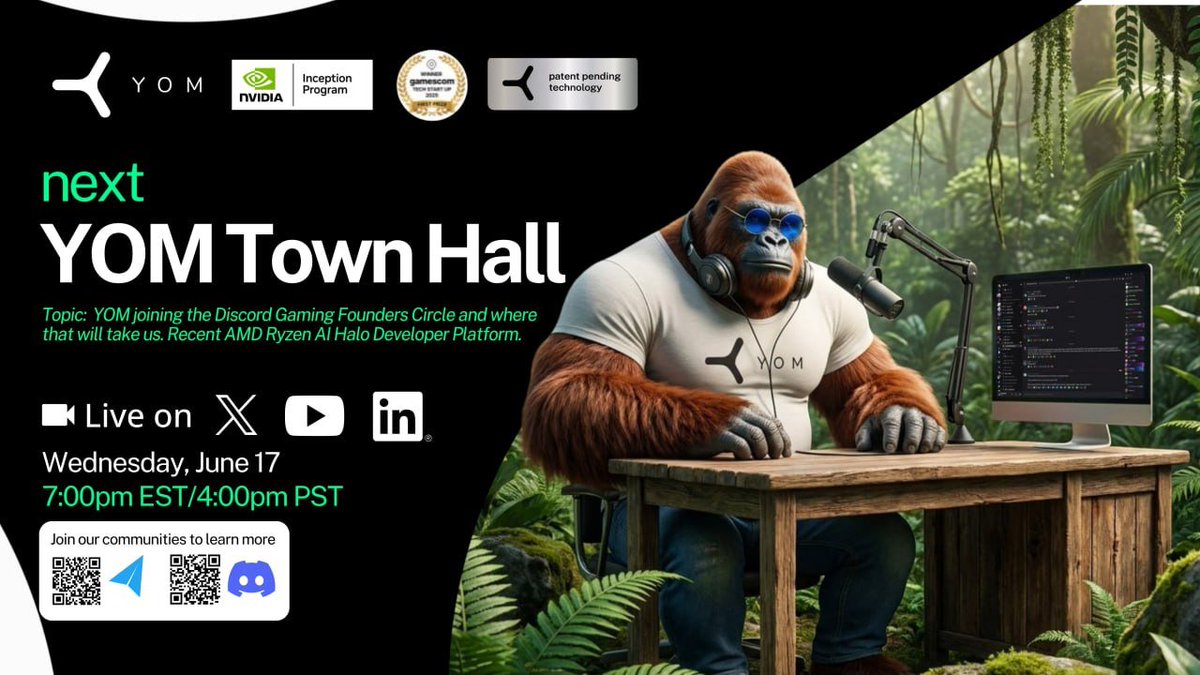
📢 YOM Town Hall | Episode 74 Tomorrow!
We're back after a week off and coming in strong.
Covering:
• YOM joining the Discord Gaming Founders Circle
• Where that partnership takes us next
• AMD Ryzen AI Halo Developer Platform
⏰ 7:00PM EST / 4:00PM PST
📺 X | YouTube | LinkedIn
📅 Wednesday, June 17
See you there! 🤝
The hidden problem with cloud gaming:
The bigger your audience, the heavier your bandwidth bill.
Centralized infrastructure punishes scale. Indie studios get hit first.
YOM's edge mesh flips the math. Compute moves closer to the player. Cost gets distributed instead of concentrated.
That's the structural alternative.
→ Learn more at https://t.co/EvAydwgc0G
Quick one for the community.
If you could stream any game instantly, in your browser, no downloads what would you pick first?
Drop the title below.
We're building the network for that exact moment.
Most cloud gaming setups look like this:
A massive data center in one region. Players everywhere else. Every session has to travel the full distance both ways.
Now imagine flipping that.
Thousands of consumer GPUs, distributed across cities. A player presses play. The nearest available node responds. The session never leaves the region.
That's the YOM edge mesh.
Same game. Same fidelity. Different physics.