A recipient publishes one meta-address (a spend public key and a view public key), and the issuer admits it into a depth-24 Poseidon Merkle tree that holds up to 16,777,216 entries.
Every payer derives a fresh one-time stealth address from that meta-address. The whitelist root lives on chain, and every admit or removal updates it where anyone can check.
Liora implements zkBSA ("Auditable and Compliant Stealth Addresses for Blockchains", Siyuan Zheng and Zhe Han, Ant International, March 2026) on Solana.
The paper proves three properties: the public can't link a payment to a recipient, a payment to a non-whitelisted recipient can't pass, and the auditor's decryption matches the paid leaf. Liora verifies that proof in Groth16 on BN254 over Solana Privacy Rings.
https://t.co/gm4xpJgaUK
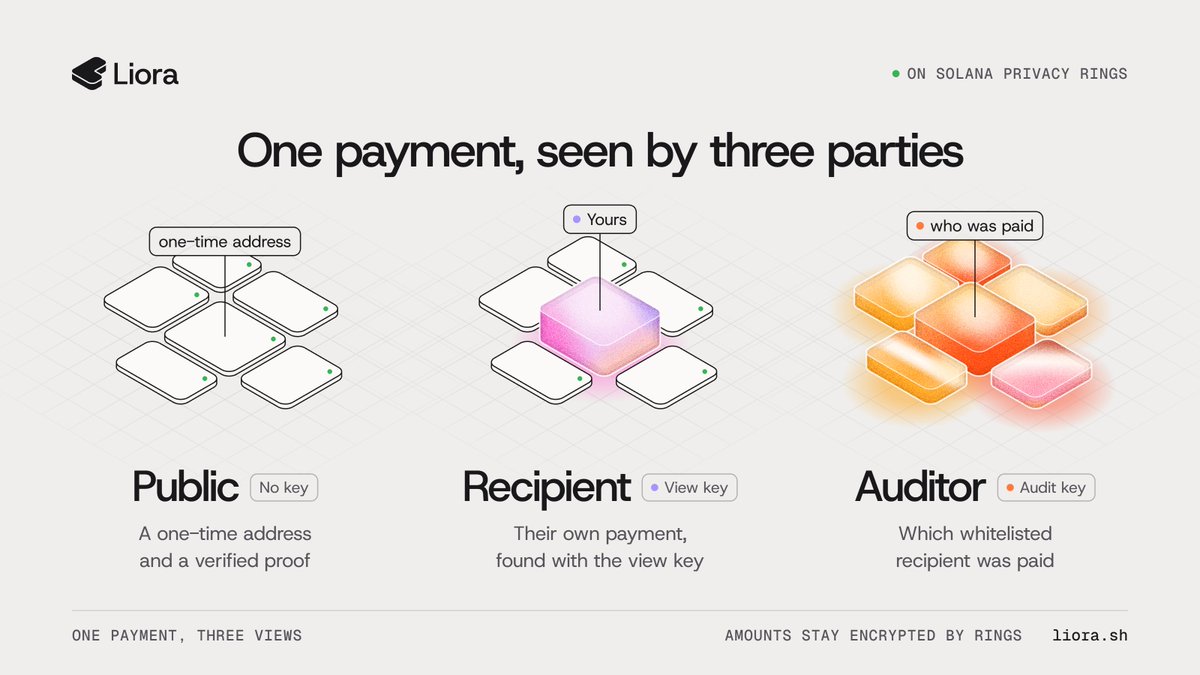
Every Liora payment sits on the public ledger as a one-time address and a verified proof. Nothing on chain points at who received it.
The recipient scans announcements locally with their view key, and only the payment meant for them lights up. The auditor uses the audit key to read which whitelisted recipient was paid, while amounts stay encrypted by Rings.
https://t.co/u5sVddZO0q
People hear "issuer" and "auditor" and assume one of them can freeze or pull back a payment. Neither holds a spend key.
The issuer updates the whitelist root. The auditor decrypts who a payment went to, with amounts still encrypted by Rings. Once a payment settles, moving those funds requires the one-time spend key, which only the recipient's own spend key and the payment's announcement can derive. Nobody else can move it, including us.
A recipient who isn't on the whitelist can't be paid on Liora.
Without a valid leaf in the on-chain whitelist root, the browser can't build a proof for that meta-address, and the program rejects any forged proof before a Rings note ever moves.
"Why not just use an anonymous Custom Ring?"
Custom Rings are set up through Helius for businesses and aren't self-serve. A three-person studio paying contractors, or a freelancer sending invoices, lands on the Default Ring where recipient addresses are public.
Liora holds balances in the Default Ring through its own program authority so anyone can use recipient privacy without waiting on a custom deployment.
How a payment moves through Liora from meta-address to audit, in 88 seconds.
Watch the proof step: it checks that the hidden recipient is in the depth-24 whitelist without naming which leaf.
https://t.co/AjU0y7BF44
Where we're taking Liora: businesses paying contractors and teams in dollars, each under a whitelist it runs itself, with its own issuer key and its own auditor key.
Liora holds neither key. The test is simple: open /ledger and count how many payments settled under whitelists that aren't ours.
The zkBSA paper proves its statement inside a RISC Zero zkVM on EVM, taking under 5.3 s at depth 24.
Liora proves the same statement in Groth16 on BN254 so Solana can verify it via alt_bn128 syscalls in one transaction: 0.6 s in a browser, 128-byte proof, 286,814 compute units.
https://t.co/cMVTl3l8Df
Saw someone pitch a private payment protocol with a 1% protocol fee written in plaintext on every transaction.
There's a reason Liora's fee is flat in SOL.
Here is what the public ledger actually holds for a mainnet payment on Liora: a one-time stealth address, an ephemeral key, an audit ciphertext, the whitelist root, and a verified Groth16 proof.
No recipient, no amount. Anyone can check the row directly: https://t.co/zK4Mv1PHKh
People hear "auditor" and picture a backdoor into balances and amounts.
On Liora the audit key decrypts one field: which whitelisted recipient a payment went to. The public key sits in the program config where anyone can check it, the amount stays encrypted by Rings, and the auditor can't move funds or read anything else.
Next up in Payouts: saving a run on your own device so a page reload doesn't drop where you were.
Each payout is encrypted under your key, resumes from the first unsent row, and shows up as one grouped entry in /app/activity while staying separate stealth addresses on /ledger.
The buyback crank just ran its first mainnet burn: 21,425,613 LIO (~2.14% of supply), funded strictly from claimed fees.
On-chain supply is now 978,574,386 LIO. Both protocol fees and creator fees route through the same automated burn.
https://t.co/ReB8JEOwCl
Every privacy product should answer one question before anything else: private from whom?
If nobody at all can verify who was paid, a compliance officer can't sign off on it, so payroll and contractor invoices never move on chain. Make the recipient invisible to the public and readable by one auditor, and real payments can actually use it.
Payroll and contractor invoices come in runs, so /app/pay now takes multiple whitelisted recipients in one sitting, proves each row in turn, and shows the combined total and flat fee upfront.
Watch the three rows land as three unrelated stealth addresses on /ledger.
https://t.co/y7sXDPejQo
Payroll and contractor invoices come in runs, so /app/pay now takes multiple whitelisted recipients in one sitting, proves each row in turn, and shows the combined total and flat fee upfront.
Watch the three rows land as three unrelated stealth addresses on /ledger.
https://t.co/y7sXDPejQo
@Pinqxz The first mainnet payment is already on the ledger. You can inspect the stealth address and verified proof here, or try it yourself at https://t.co/R9z7NT4oVp: https://t.co/zK4Mv1PHKh
Developer allocation is locked on Streamflow: 3% of LIO supply (30M before Streamflow's fee), non-cancellable and non-transferable, unlocking 2027-11-26 11:42 UTC.
https://t.co/W8qbVHSKrr
Rings encrypts the asset and the amount. On the Default Ring, the recipient is still public.
Liora sends to one-time stealth addresses, proves the hidden recipient is whitelisted, and lets one auditor read who was paid.
https://t.co/7QVm7DggYc