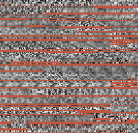
Introducing tile, a trade-inscribed liquidity engine built around the idea that a market can produce its own irreversible visual history without ever being instructed what to draw.
ca: EcYVFGDFNBcZUbvZc4iNoi2Ngx5UPp19sJ3ihtj6pump
there is a second structure forming beneath the price of every traded asset. an ordered sequence of signatures, ownership transitions, liquidity movements, and irreversible decisions that conventional market interfaces reduce to candles and volume.
tile extracts that structure and gives it a physical representation.
the system begins with an empty field of 128,000 characters, partitioned into 1,000 independent 16×8 inscriptions. each corresponds to exactly one million units of the underlying token supply.
a Solana transaction signature contains 512 bits. tile decomposes those bits into 128 four-bit values, establishing a direct correspondence between cryptographic transaction identity and the cellular geometry of an individual tile.
the signature is not used to generate an image. it is the image's initial state.
every subsequent swap introduces a localized perturbation. transaction-derived coordinates determine where pressure is applied, trade magnitude determines its intensity, and direction determines whether the surrounding cellular field undergoes growth or erosion.
these perturbations propagate through an eight-neighbour cellular automaton, producing spatial structures that depend on the complete ordering of preceding transactions.
but the system has a more unusual property: ownership is not erased when it ends.
when a holder falls below the threshold required to retain a tile, a fragment of their wallet address is permanently inscribed across its surface. the tile enters a last-in-first-out inheritance structure, where future owners receive the accumulated damage alongside the remaining information.
new signatures are superimposed through bitwise XOR. previous ownership marks remain immutable.
after eight distinct address inscriptions, the tile reaches a terminal state and is removed from circulation permanently.
this creates a finite visual substrate undergoing continuous inscription, erosion, inheritance, and eventual exhaustion.
the resulting field is path-dependent. two markets with identical final prices, volumes, and holder distributions can produce entirely different structures because the sequence of transactions is itself part of the computation.
every transition is folded into a cryptographic replay chain beginning from a fixed genesis state. the complete structure can be independently reconstructed from the same ordered transaction history.
there is no artist controlling the composition, no generative model interpreting market conditions, and no hidden process advancing the field between trades.
what appears on the surface is the residue of everything that has happened underneath it.
tile is an attempt to observe what happens when liquidity becomes a writing mechanism, ownership becomes an inheritable memory, and a market is allowed to inscribe a structure that none of its participants can fully anticipate.
https://t.co/NBgWpfDbIy
tile is an attempt at the first trade-native, cryptographically reproducible artwork where the market itself acts as the execution environment.
not an nft representing a finished image, and not an algorithm generating visuals from price movements.
the artwork is constructed directly from transaction signatures, modified by deterministic cellular rules, and permanently altered by the transfer of ownership through buying and selling.
every one of its 128,000 cells belongs to a finite computational surface whose history cannot be reset by its participants.
the result is something fundamentally different from conventional onchain art: a visual artifact that cannot exist independently of the economic activity producing it.
the market isn't interacting with the artwork. the market is the process that writes it.