Welcme to #LiquidityLogic™
Cheat Code Levels for any HTF Candle
1. High
2. Low
3. Open
4. Close
5. EQ (Low - High)
6. Body EQ (Open -Close)
7. Bearish Liquidity Pool EQ (O/C - High)
8. Bullish Liquidity Pool EQ (O/C - Low)
Instant clarity
Get yourself some
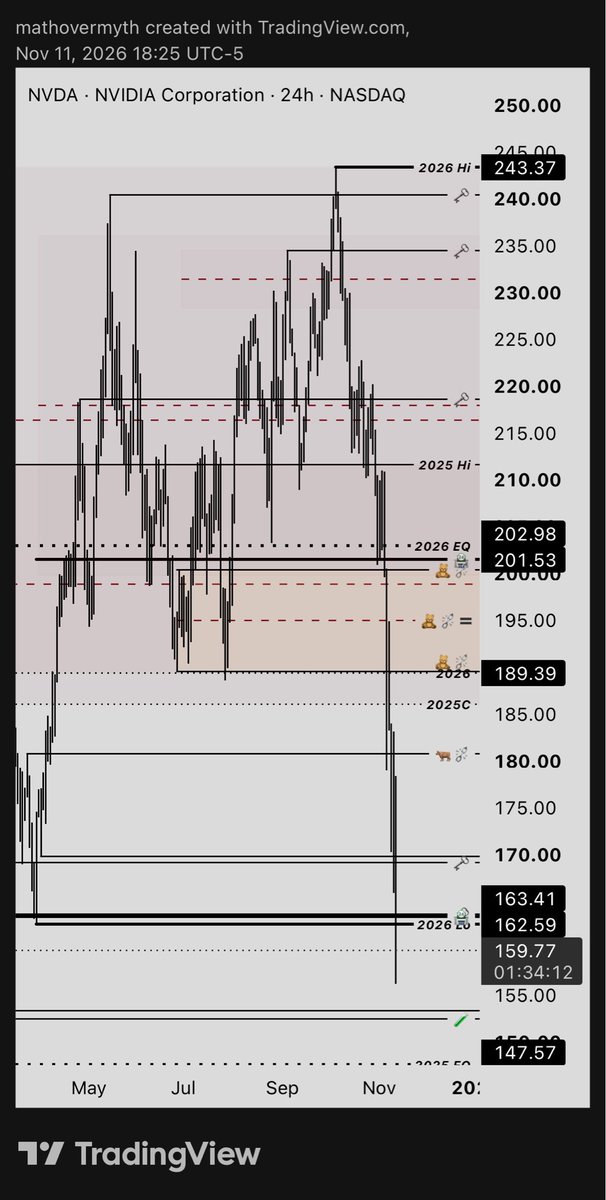
$NVDA #NVDA “This is the bottom!” 🥴
We’re still near the top of #TechWreck2
Key Levels:
YTD Low 162.59
2025 EQ 147.57
Discount 127.07
2025 Bullish Pool EQ 109.55
2025 Low 83.45
It’s not a Lagging Indicator
It’s #LiquidityLogic™
$QQQ $SPY
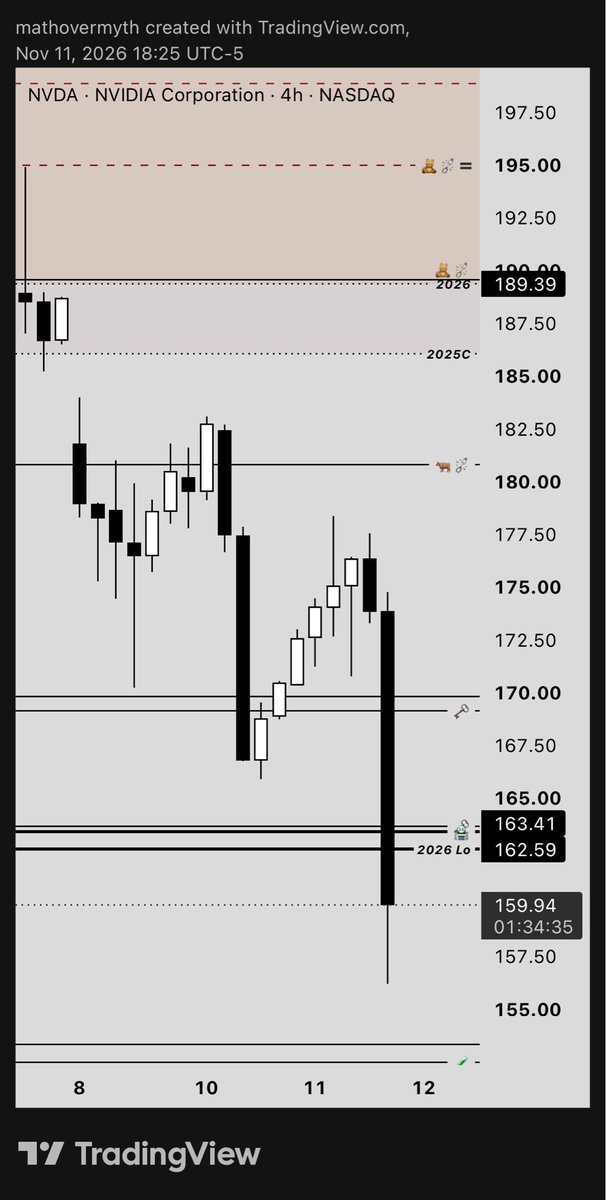
$NVDA #NVDA “This is the bottom!” 🥴
We’re still near the top of #TechWreck2
Key Levels:
YTD Low 162.59
2025 EQ 147.57
Discount 127.07
2025 Bullish Pool EQ 109.55
2025 Low 83.45
It’s not a Lagging Indicator
It’s #LiquidityLogic™
$QQQ $SPY
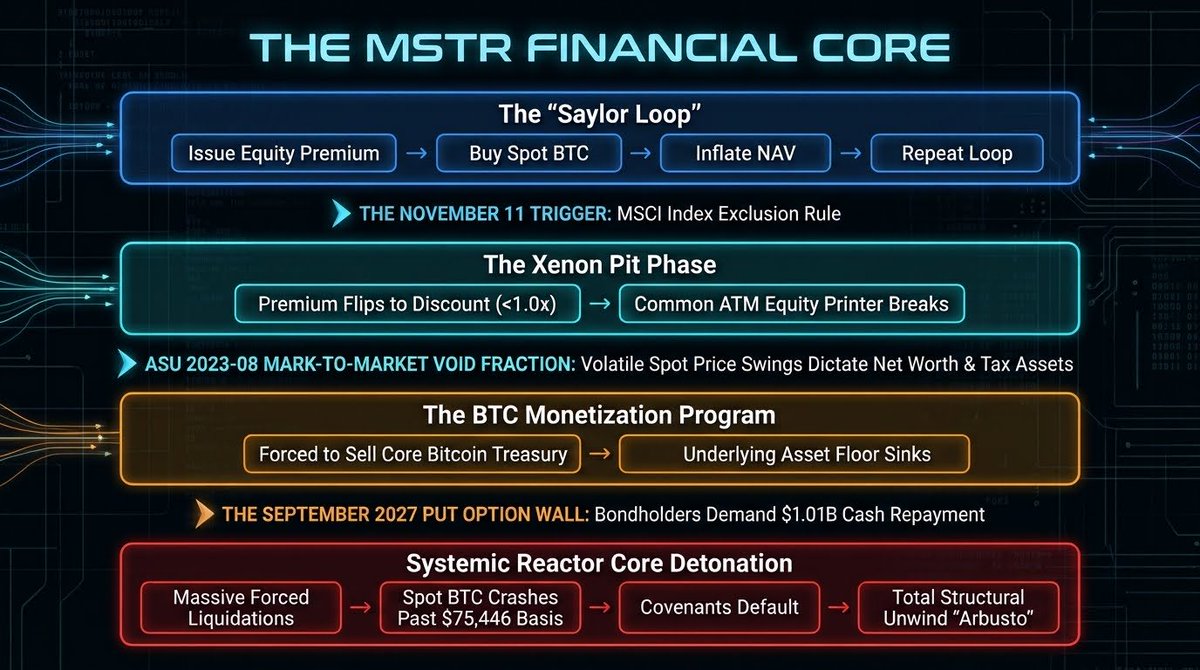
Based on the Strategic Analysis of $MSTR published by @mathovermyth under the #LiquidityLogic framework, a breakdown where #Bitcoin ($BTC) falls below $75,000 while #MSTR drops below $120 marks the complete inversion of @Saylor’s recursive capital flywheel.
In this specific threshold regime, the corporate structure transitions from an exponential value creator into an unstable, low-power state. The white paper outlines three critical systemic failure modes triggered by these price points:
1. Inversion of the "Saylor Loop" (Premium Compression)
The Premium Death Spiral: The primary mechanism driving MSTR's multi-billion dollar premium over its Net Asset Value (mNAV) is the market's expectation of infinite, accretive token purchases per share.
The Break-Even Threshold: As #BTC dips under $75K—sliding right against MSTR's aggregate historical cost baseline—and the equity drops below $120, the market rapidly begins stripping away this premium.
Asset Parity Repricing: Without the premium, MSTR loses its unique dual-engine capability to issue expensive stock to buy cheap Bitcoin, forcing the enterprise value to contract to match only its raw digital holdings.
2. Fiat Revenue Deficit vs. Debt Service
The Legacy Engine Math: The white paper highlights that MicroStrategy's legacy enterprise software utility generates roughly $500 million in total annual revenue.
The Unfunded Capital Stack: This native cash flow is mathematically incapable of covering the massive debt service required by the company's aggressive, low-coupon convertible notes and capital stack engineering.
Valuation Dependency: Below these key technical levels, the firm cannot rely on At-The-Market (ATM) equity issuance without punishing dilution, creating a structural cash-flow deficit that relies purely on expanding credit markets to roll over liabilities.
3. The Collapse of "Project Paddy's Dollars"
The Reflexive Illusion: The white paper mockingly categorizes the architecture as Project "Paddy's Dollars"—referencing a self-sustaining currency loop that only works as long as external participants keep injecting value into the ecosystem.
Systemic Failure Regime: Once both thresholds breach, reflexivity works in reverse. Lower stock prices stop the accretive buying machine; lack of buying pressure stalls Bitcoin; and a stalling Bitcoin further compresses the stock multiple. The financial reactor effectively running out of kinetic energy, locking shareholders into a vehicle holding highly volatile digital commodities encumbered by heavy senior claims.
From a critical perspective, $MSTR is playing a high-stakes shell game with its own capital structure:
1. Shifting the Burden: They printed 2.05 million new common shares (diluting current investors) just to buy back 1,88 million $STRC preferred shares. They didn't actually create new value; they just moved the liability from a contractual, high-yield obligation (the preferred dividend) onto the backs of common equity holders.
2. The "Accretive" Illusion: Management defends this by arguing that because the stock trades at a premium, the math works out in the shareholders' favor on paper.
3. The Valuation Trap: This entire house of cards depends on the market continuing to value MSTR at a massive premium.
Definitive #LiquidityLogic White Paper:
https://t.co/j2QevpAaJ0
#Bitcoin #BTC $BTC $QQQ
Strategic Analysis of ($MSTR) Strategy’s Financial Reactor
Project "Paddy’s Dollars" — A Comprehensive Synthesis of Capital Stack Engineering, Accounting Reflexivity, and Systemic Failure Modes
1. Executive Summary
Originally an asset-light enterprise software utility, Strategy, Inc. (formerly MicroStrategy) engineered a dual-engine corporate architecture that acts as a hybrid leveraged #Bitcoin holding company and a digital asset central bank.
By exploiting a persistent market-to-net-asset-value (mNAV) premium via continuous At-The-Market (ATM) common equity issuance and low-coupon convertible notes, management built a reflexive wealth-creation engine known as the "Saylor Loop".
However, recent shifts in their capital structure—specifically an aggressive pivot into $13.5B of high-yielding Perpetual Preferred Stock ($STRC)—have stripped the vehicle of its traditional safety cushions. The company now carries an annualized fixed-income and dividend burden of $1.712B, vastly eclipsing its stagnating software revenue (~$500M annually).
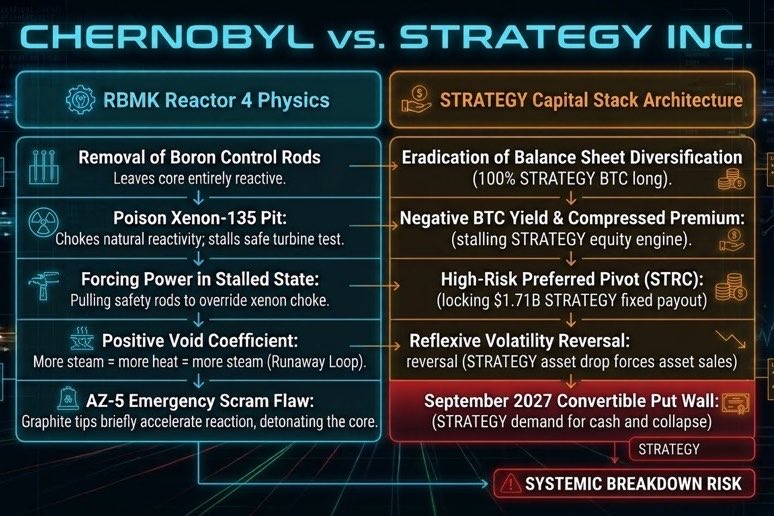
With its market premium compressed to a razor-thin 1.14x, the vehicle has entered a phase of severe structural vulnerability analogous to nuclear "xenon poisoning." The adoption of ASU 2023-08 fair-value accounting amplifies this instability by tying the company's GAAP income statement and balance sheet tax shields directly to the volatile spot price of Bitcoin.
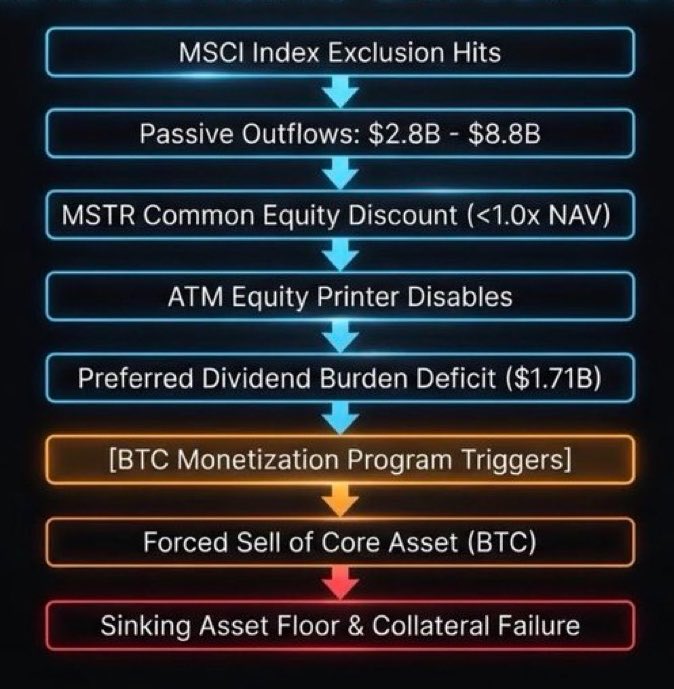
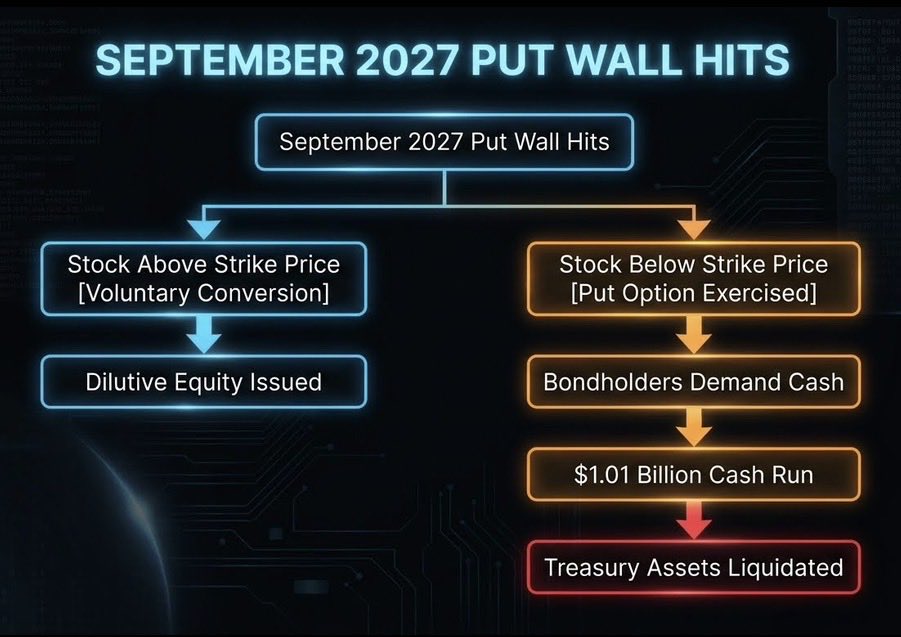
The system is now mathematically primed for a catastrophic, reflexive unwind. The primary trigger is a non-speculative, regulatory catalyst: the finalized MSCI "Non-Operating Company" index exclusion framework scheduled for November 11, 2026. This event threatens to trigger up to $8.8B in forced institutional divestment, breaking the equity printer and setting off a deterministic countdown to a catastrophic solvency event at the September 2027 convertible debt put option wall.
———
🧵1/12 $BTC #BTC $BTCUSD #BTCUSD
From a critical perspective, $MSTR is playing a high-stakes shell game with its own capital structure:
1. Shifting the Burden: They printed 2.05 million new common shares (diluting current investors) just to buy back 1,88 million $STRC preferred shares. They didn't actually create new value; they just moved the liability from a contractual, high-yield obligation (the preferred dividend) onto the backs of common equity holders.
2. The "Accretive" Illusion: Management defends this by arguing that because the stock trades at a premium, the math works out in the shareholders' favor on paper.
3. The Valuation Trap: This entire house of cards depends on the market continuing to value MSTR at a massive premium.
Definitive #LiquidityLogic White Paper:
https://t.co/j2QevpAaJ0
#Bitcoin #BTC $BTC $QQQ
Based on the Strategic Analysis of $MSTR published by @mathovermyth under the #LiquidityLogic framework, a breakdown where #Bitcoin ($BTC) falls below $75,000 while #MSTR drops below $120 marks the complete inversion of @Saylor’s recursive capital flywheel.
In this specific threshold regime, the corporate structure transitions from an exponential value creator into an unstable, low-power state. The white paper outlines three critical systemic failure modes triggered by these price points:
1. Inversion of the "Saylor Loop" (Premium Compression)
The Premium Death Spiral: The primary mechanism driving MSTR's multi-billion dollar premium over its Net Asset Value (mNAV) is the market's expectation of infinite, accretive token purchases per share.
The Break-Even Threshold: As #BTC dips under $75K—sliding right against MSTR's aggregate historical cost baseline—and the equity drops below $120, the market rapidly begins stripping away this premium.
Asset Parity Repricing: Without the premium, MSTR loses its unique dual-engine capability to issue expensive stock to buy cheap Bitcoin, forcing the enterprise value to contract to match only its raw digital holdings.
2. Fiat Revenue Deficit vs. Debt Service
The Legacy Engine Math: The white paper highlights that MicroStrategy's legacy enterprise software utility generates roughly $500 million in total annual revenue.
The Unfunded Capital Stack: This native cash flow is mathematically incapable of covering the massive debt service required by the company's aggressive, low-coupon convertible notes and capital stack engineering.
Valuation Dependency: Below these key technical levels, the firm cannot rely on At-The-Market (ATM) equity issuance without punishing dilution, creating a structural cash-flow deficit that relies purely on expanding credit markets to roll over liabilities.
3. The Collapse of "Project Paddy's Dollars"
The Reflexive Illusion: The white paper mockingly categorizes the architecture as Project "Paddy's Dollars"—referencing a self-sustaining currency loop that only works as long as external participants keep injecting value into the ecosystem.
Systemic Failure Regime: Once both thresholds breach, reflexivity works in reverse. Lower stock prices stop the accretive buying machine; lack of buying pressure stalls Bitcoin; and a stalling Bitcoin further compresses the stock multiple. The financial reactor effectively running out of kinetic energy, locking shareholders into a vehicle holding highly volatile digital commodities encumbered by heavy senior claims.
Strategic Analysis of ($MSTR) Strategy’s Financial Reactor
Project "Paddy’s Dollars" — A Comprehensive Synthesis of Capital Stack Engineering, Accounting Reflexivity, and Systemic Failure Modes
1. Executive Summary
Originally an asset-light enterprise software utility, Strategy, Inc. (formerly MicroStrategy) engineered a dual-engine corporate architecture that acts as a hybrid leveraged #Bitcoin holding company and a digital asset central bank.
By exploiting a persistent market-to-net-asset-value (mNAV) premium via continuous At-The-Market (ATM) common equity issuance and low-coupon convertible notes, management built a reflexive wealth-creation engine known as the "Saylor Loop".
However, recent shifts in their capital structure—specifically an aggressive pivot into $13.5B of high-yielding Perpetual Preferred Stock ($STRC)—have stripped the vehicle of its traditional safety cushions. The company now carries an annualized fixed-income and dividend burden of $1.712B, vastly eclipsing its stagnating software revenue (~$500M annually).
With its market premium compressed to a razor-thin 1.14x, the vehicle has entered a phase of severe structural vulnerability analogous to nuclear "xenon poisoning." The adoption of ASU 2023-08 fair-value accounting amplifies this instability by tying the company's GAAP income statement and balance sheet tax shields directly to the volatile spot price of Bitcoin.
The system is now mathematically primed for a catastrophic, reflexive unwind. The primary trigger is a non-speculative, regulatory catalyst: the finalized MSCI "Non-Operating Company" index exclusion framework scheduled for November 11, 2026. This event threatens to trigger up to $8.8B in forced institutional divestment, breaking the equity printer and setting off a deterministic countdown to a catastrophic solvency event at the September 2027 convertible debt put option wall.
———
🧵1/12 $BTC #BTC $BTCUSD #BTCUSD
Strategic Analysis of ($MSTR) Strategy’s Financial Reactor
Project "Paddy’s Dollars" — A Comprehensive Synthesis of Capital Stack Engineering, Accounting Reflexivity, and Systemic Failure Modes
1. Executive Summary
Originally an asset-light enterprise software utility, Strategy, Inc. (formerly MicroStrategy) engineered a dual-engine corporate architecture that acts as a hybrid leveraged #Bitcoin holding company and a digital asset central bank.
By exploiting a persistent market-to-net-asset-value (mNAV) premium via continuous At-The-Market (ATM) common equity issuance and low-coupon convertible notes, management built a reflexive wealth-creation engine known as the "Saylor Loop".
However, recent shifts in their capital structure—specifically an aggressive pivot into $13.5B of high-yielding Perpetual Preferred Stock ($STRC)—have stripped the vehicle of its traditional safety cushions. The company now carries an annualized fixed-income and dividend burden of $1.712B, vastly eclipsing its stagnating software revenue (~$500M annually).
With its market premium compressed to a razor-thin 1.14x, the vehicle has entered a phase of severe structural vulnerability analogous to nuclear "xenon poisoning." The adoption of ASU 2023-08 fair-value accounting amplifies this instability by tying the company's GAAP income statement and balance sheet tax shields directly to the volatile spot price of Bitcoin.
The system is now mathematically primed for a catastrophic, reflexive unwind. The primary trigger is a non-speculative, regulatory catalyst: the finalized MSCI "Non-Operating Company" index exclusion framework scheduled for November 11, 2026. This event threatens to trigger up to $8.8B in forced institutional divestment, breaking the equity printer and setting off a deterministic countdown to a catastrophic solvency event at the September 2027 convertible debt put option wall.
———
🧵1/12 $BTC #BTC $BTCUSD #BTCUSD
Based on the Strategic Analysis of $MSTR published by @mathovermyth under the #LiquidityLogic framework, a breakdown where #Bitcoin ($BTC) falls below $75,000 while #MSTR drops below $120 marks the complete inversion of @Saylor’s recursive capital flywheel.
In this specific threshold regime, the corporate structure transitions from an exponential value creator into an unstable, low-power state. The white paper outlines three critical systemic failure modes triggered by these price points:
1. Inversion of the "Saylor Loop" (Premium Compression)
The Premium Death Spiral: The primary mechanism driving MSTR's multi-billion dollar premium over its Net Asset Value (mNAV) is the market's expectation of infinite, accretive token purchases per share.
The Break-Even Threshold: As #BTC dips under $75K—sliding right against MSTR's aggregate historical cost baseline—and the equity drops below $120, the market rapidly begins stripping away this premium.
Asset Parity Repricing: Without the premium, MSTR loses its unique dual-engine capability to issue expensive stock to buy cheap Bitcoin, forcing the enterprise value to contract to match only its raw digital holdings.
2. Fiat Revenue Deficit vs. Debt Service
The Legacy Engine Math: The white paper highlights that MicroStrategy's legacy enterprise software utility generates roughly $500 million in total annual revenue.
The Unfunded Capital Stack: This native cash flow is mathematically incapable of covering the massive debt service required by the company's aggressive, low-coupon convertible notes and capital stack engineering.
Valuation Dependency: Below these key technical levels, the firm cannot rely on At-The-Market (ATM) equity issuance without punishing dilution, creating a structural cash-flow deficit that relies purely on expanding credit markets to roll over liabilities.
3. The Collapse of "Project Paddy's Dollars"
The Reflexive Illusion: The white paper mockingly categorizes the architecture as Project "Paddy's Dollars"—referencing a self-sustaining currency loop that only works as long as external participants keep injecting value into the ecosystem.
Systemic Failure Regime: Once both thresholds breach, reflexivity works in reverse. Lower stock prices stop the accretive buying machine; lack of buying pressure stalls Bitcoin; and a stalling Bitcoin further compresses the stock multiple. The financial reactor effectively running out of kinetic energy, locking shareholders into a vehicle holding highly volatile digital commodities encumbered by heavy senior claims.
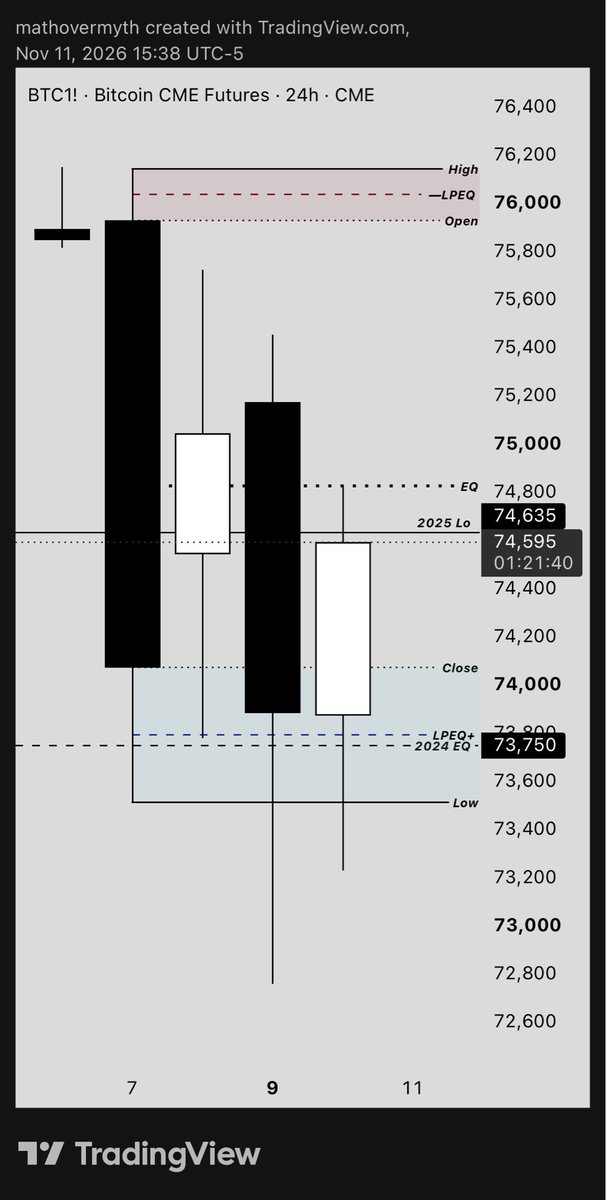
#BTC_F Great example on #Bitcoin Futures
Price came down, swept 2025 Low, 2024 EQ, two Daily Lows, and we know there’s going to be a reaction.
Our trading range is from three days prior. Sweep the low, get above the LPEQ+ and Close, and make a run for the EQ. That’s the sequence.
EQ also closely coincides with 2025 Low, so you understand why price may react strongly there as well.
Eight #LiquidityLogic levels per candle. That’s all you need.
$BTC $ETH $MSTR
#BTC_F Great example on #Bitcoin Futures
Price came down, swept 2025 Low, 2024 EQ, two Daily Lows, and we know there’s going to be a reaction.
Our trading range is from three days prior. Sweep the low, get above the LPEQ+ and Close, and make a run for the EQ. That’s the sequence.
EQ also closely coincides with 2025 Low, so you understand why price may react strongly there as well.
Eight #LiquidityLogic levels per candle. That’s all you need.
HTF Levels pretty much stay. Watch the Four Hour Rotation intraday for sweeps which provide LTF Directional Bias. The same #LiquidityLogic sequence works on any candle, but 8H and 4H are the most reliable for LTF execution, IMHO. I always start with Annual, then Quarterly, Monthly, Weekly, and 24H. This way I’m creating an HTF Liquidity Thesis first and using the HTF —> LTF Liquidity Stack to confirm any and all sweeps/pivots.
#NQ_F Target Acquired: Prior Year High ☑️
“New Weekly Bearish Imbalance should send price down into Discount and bounce off the 2025 High.”
—LiLo (10/23/26)
The sequence is the sequence 🌀
It’s not Rocket Science 🚀🧬
It’s #LiquidityLogic™ 💧🧠
—————
#NQ $NQ #QQQ $QQQ
"They just don't understand our business model" is the final-stage warning sign of every over-leveraged corporate structure in history.
Skilling said it in 2001.
Fastow said it.
SBF said it in 2022.
Whenever an executive claims debt "never comes due" and there's "no liquidation risk," it simply means management doesn't face automated margin calls—because they plan to dilute common shareholders into oblivion to service the stack.