Wall Street can't break Bitcoin's 21 million hard cap on-chain, so they built a massive "Paper Bitcoin" casino off-chain to suppress the price.
Here are the 4 categories of Bitcoin derivatives and exactly how much they let institutions cheat. 👇
1️⃣ CATEGORY 1: "Pure Paper"
Level of Cheating: INFINITE ♾️
Products: Perpetual Swaps (Perps), CME Cash-Settled Futures, Cash Options.
The Cheat: 100% paper. Neither side owns actual $BTC. They just bet fiat on the price. This creates infinite synthetic supply and allows billions in leverage to dictate price discovery instead of real scarcity.
2️⃣ CATEGORY 2: "Rehypothecation"
Level of Cheating: HIGH / SYSTEMIC RISK ⚠️
Products: Prime Brokerage, OTC Swaps, Institutional Lending.
The Cheat: You deposit 1 physical BTC. They lend it to a hedge fund to short, who sells it to a new buyer. Now multiple people think they own the exact same coin. This "shadow finance" multiplies the paper float and causes FTX/Celsius style collapses.
3️⃣ CATEGORY 3: "Operational Shorting"
Level of Cheating: TEMPORARY BUT HEAVY ⏱️
Products: Spot Bitcoin ETFs (like IBIT, FBTC).
The Cheat: The SEC "Cash Create" model + Reg SHO exemptions. Authorized Participants (APs) can legally sell you ETF shares they haven't created yet. Thanks to T+6 settlement delays, they absorb your spot buying pressure with synthetic shares, delaying the pump.
4️⃣ CATEGORY 4: "Fully Backed"
Level of Cheating: ZERO 🛡️
Products: Physically-Settled Futures, transparent On-Chain Wrapped $BTC.
The Reality: These require 1:1 real Bitcoin locked up before trading. They don't artificially expand the supply. Sadly, they make up a tiny fraction of total trading volume.
The takeaway? Wall Street uses paper derivatives to dilute your purchasing power and turn a scarce asset into a fractional reserve game.
There is only one way to break their casino and force true price discovery:
Buy real spot. Withdraw to cold storage.
#Bitcoin #CryptoNews #WallStreet
In a classic Ponzi, old obligations are paid with new investors' cash in secret.
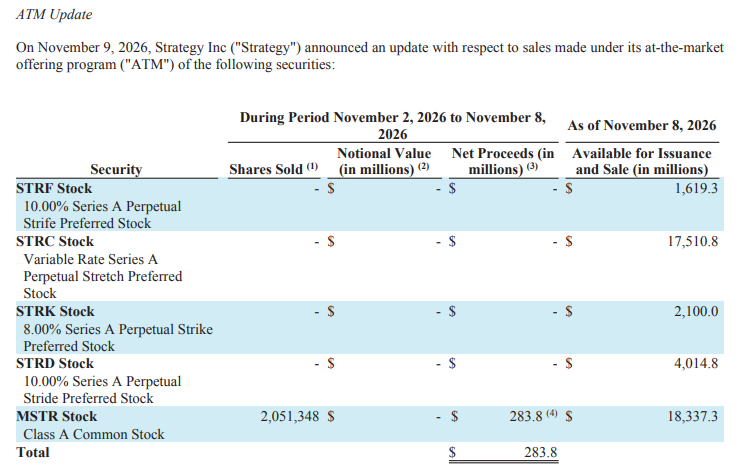
In corporate America, you dump 2M common shares via the ATM to bail out your own double-digit preferred debt ($STRC) in broad daylight, and call it "accretive digital credit."
The only difference is that they disclose it on page 40 of an SEC filing so regulators call it "speculative risk" instead of fraud. The mathematical destination for late retail buyers is identical.
MSCI isn’t "attacking Bitcoin" by excluding Strategy. They are enforcing century-old index standards:
If a company’s primary business is:
1. Printing equity to buy an asset
2. Issuing junk preferreds to leverage that asset
3. Printing more equity to buy back those preferreds when the multiple compresses
...that’s not a public operating company. That’s an unhedged, leveraged holding vehicle.
MSCI benchmarks are built for operating companies with real commercial cash flows. When passive index funds represent trillions in retirement savings, index providers cannot let a synthetic, double-leveraged debt wrapper slip in as a "software stock."
If institutions want Bitcoin, they buy spot ETFs or cold storage. They don't need an encumbered proxy diluting sats-per-share to service a Wall Street capital stack.
The passive index subsidy is officially coming to an end.
For years, Strategy relied on blind index-fund inflows from 401(k) savers to absorb relentless ATM dilution and prop up an inflated NAV multiple.
MSCI finally drew the line:
• A non-operating asset holding shell
• Breakneck share printing running 24/7
• BPS actively diluted (-617 sats/share) to clean up double-digit preferred debt
When index providers stop funneling passive capital into the wrapper, the multiple compresses toward fair value.
Saylor just thinks he can print shares at breakneck speed to pocket the money and nobody will notice. That game has ended. Hold spot Bitcoin directly.
THE BLOCK: MSCI will remove Strategy $MSTR from its USA Index at the close of Nov. 30, its November review confirms.
The bitcoin treasury giant previously pushed back against MSCI's new rules against non-operating companies, calling them "discriminatory" against digital asset treasuries.
Not even close.
Insurance companies collect billions in upfront customer premiums (operating cash flow) and invest the float.
Strategy doesn't generate cash premiums. Its legacy software revenue is flat (~$125M/qtr), so it relies almost entirely on At-The-Market (ATM) share printing and debt to buy assets.
Insurers don't dump 2M newly printed common shares onto the market just to buy back double-digit yield preferreds ($STRC) to keep their balance sheet afloat.
Real customer cash flow ≠ printing equity to service leverage.
"They just don't understand our business model" is the final-stage warning sign of every over-leveraged corporate structure in history.
Skilling said it in 2001.
Fastow said it.
SBF said it in 2022.
Whenever an executive claims debt "never comes due" and there's "no liquidation risk," it simply means management doesn't face automated margin calls—because they plan to dilute common shareholders into oblivion to service the stack.
Saying "we borrowed money that we never have to pay back" on camera is precisely why MSCI is barring the door.
That isn’t an operating business model; it’s the rhetoric of a debt-fueled financial experiment.
And the filings prove it isn't "free money":
• You can't just "suspend dividends" without your credit freezing and preferred stock crashing.
• Last week alone, Strategy had to dump $284M of common stock just to spend $188M buying back $STRC.
If you "never have to pay it back," why are you furiously diluting common shareholders to buy it back?
Spot on. They loved traditional passive index flows when 401(k) money was blindly pumping their NAV multiple.
The second benchmark providers look at the balance sheet and enforce basic operating screens, it’s suddenly a "coordinated attack."
You can't demand institutional index legitimacy while running a leveraged debt wrapper that prints shares to bail out its own preferreds.
Index rules exist to protect retirement savers from non-operating, double-leveraged holding vehicles.
The speed of the dilution was the death blow.
Real operating companies fund growth through earnings and cash flow. Strategy went into overdrive running a hyper-dilutive printing press: issuing millions of shares at breakneck speed, burning the cash on $STRC buybacks, and diluting sats-per-share (-617 sats in a single week).
That hyper-inflationary share velocity made MSCI’s decision effortless. The printer was running too fast to hide the truth.
The entire marketing pitch of $MSTR was "BTC Yield" and permanent accretion.
Now the SEC filings show the opposite: negative 617 sats per share.
Strategy dumped 2.05M new common shares on the market, but instead of aggressively stacking Bitcoin, $188M went toward bailing out their own high-yield $STRC preferred stock.
Common shareholders are taking direct equity dilution not to buy coins, but to de-risk senior corporate debt.
In cold storage, 1 BTC remains 100,000,000 sats forever. In an encumbered proxy, your sats get diluted to patch the balance sheet.
Zero. Zero is the number of #Bitcoin that $STRC purchased last week.
$188M. $188M is how much $MSTR was diluted for $STRC buybacks.
-617. Negative 617 sats per share is the effect that these treasury operations had on shareholders.
Because dilution doesn’t "go both ways."
Those -617 sats per share don't magically reappear when Bitcoin hits $200k. That equity was permanently printed and sold to de-risk senior Wall Street paper ($STRC).
And when price does pump? Billions in convertible notes convert into common stock, diluting the share count a second time.
If you believe Bitcoin is going to $120k–$200k, buy spot Bitcoin. You get 100% of the upside with zero counterparty risk, zero debt walls, and zero corporate bailouts.
Why will anyone buy a stock that prints like no tomorrow?
@TheGovtHatesU Saylor has been fucking his shareholders by selling MSTR as fast as possible to pocket the money. We should short his stock along with Saylor.
The ultimate irony of the "Bitcoin Central Bank":
Satoshi embedded the 2009 bank bailout headline into the Genesis block to escape debt-based fractional banking.
Now, Strategy has recreated the exact same fiat apparatus on top of Bitcoin:
1. Fractional "Digital Credit": Layering billions in convertible debt and high-yield preferred shares ($STRC) over a single corporate vault.
2. Corporate Quantitative Easing: Printing corporate paper out of thin air to bid up the collateral backing that same paper.
3. Cantillon Hierarchy: Insiders cash out via 10b5-1 plans; bondholders get senior cash put rights; retail absorbs -617 sats/share in dilution to bail out the capital stack.
Saylor used maximalist sound-money rhetoric to absorb Bitcoiner retail capital, only to build an encumbered, centralized corporate bank at a state-regulated custodian.
Bitcoin was built to kill central banking, not become the collateral for a new one.
Hold your own keys.
By scaling $MSTR Strategy, Inc. into a self-styled "Bitcoin Central Bank," Saylor has managed to invert the core philosophy of the asset class, introducing three direct structural ironies:
—Fractional-Reserve Crypto-Banking: Central banks inflate economic bubbles by issuing un-backed credit against thin collateral. Under its "Digital Credit" framework, Strategy issues billions of dollars in preferred stock ($STRC) and convertible notes, effectively printing synthetic dollar-denominated liabilities layered on top of its Bitcoin base. The company has re-introduced fractional, leveraged architecture to an asset designed strictly for absolute, transparent scarcity.
—The Quantitative Easing Loop: Saylor aggressively critiques the Federal Reserve for printing fiat currency to purchase government bonds and manipulate bond yields. Yet, the "Saylor Loop" is an identical mechanism. Strategy systematically uses its own printed equity and corporate paper to purchase spot #Bitcoin, artificially bidding up the price of its underlying collateral to inflate its own net worth. It is corporate Quantitative Easing in its purest form.
—Re-Introducing Systemic Counterparty Risk: Bitcoin's foundational promise is "not your keys, not your coins"—the complete elimination of counterparty risk. By aggregating nearly 1% of the total circulating Bitcoin supply inside a single corporate balance sheet wired to Wall Street credit covenants, Strategy has created a multi-billion-dollar point of failure. If the September 2027 put option wall triggers forced liquidations, traditional fiat debt rules will legally compel the company to dump its treasury, dragging the entire decentralized crypto ecosystem down with it.
Phase 6: The Philosophical Irony — The Hard Money Mirage
Beyond the systemic ironies of banking mechanics lies a glaring philosophical contradiction in Saylor’s foundational rhetoric.
In public keynote addresses and financial media appearances, Saylor routinely shits on “fiat” currency, describing the U.S. dollar as a melting ice cube, a dying economic system, and an inherently toxic web of unbacked government decrees. In its place, he champions Bitcoin as "sound money" and "digital energy"—a pristine, un-corruptible reality rooted in absolute cryptographic proof.
Yet, the actual execution of his corporate strategy reveals a hypocritical reliance on the very system he demeans:
—The Monopoly of an Imaginary Internet Algorithm: Saylor’s core objective is to use a legacy corporate wrapper to systematically monopolize an abstract ledger—an internet consensus algorithm. He attempts to reframe this concentration of digital lines of code as the ultimate expression of immutable property. However, the corporate vehicle he uses to corner this market does not run on Bitcoin. It is completely plugged into, and dependent on, the traditional fiat plumbing.
—The Fiat Lifeline: While praising Bitcoin as the only true store of value, Strategy, Inc. cannot survive on a digital-token standard. The company's massive $1.712B annual overhead and preferred dividend obligation must be settled exclusively in traditional, fiat U.S. Dollars. Bitcoin cannot be used to pay off Wall Street fixed-income creditors or satisfy Delaware corporate tax liabilities.
—The Synthetic Yield Illusion: Saylor boasts of generating an abstract, non-GAAP mathematical "Bitcoin Yield" to prove his company is building wealth. But this metric is an ideological mirage. By financing his operations through high-yield dollar preferred shares (STRC) and billions in dollar-denominated convertible notes, Saylor hasn't escaped the fiat matrix—he has hyper-financialized it. He is printing unbacked corporate paper to hoover up a decentralized token, guaranteeing that if the fiat liquidity taps ever dry up, his "sound money" fortress will be dismantled by the exact legacy legal codes and margin calculations he claims to have outsmarted.
———
🧵5/12 $BTC #BTC $BTCUSD #BTCUSDT
It’s even worse than not raising capital—Strategy is now actively diluting common shareholders just to bail out the preferreds.
Last week, $MSTR dumped $284M of common stock on the market.
Did it all go to Bitcoin? No.
$188M was spent repurchasing their own expensive $STRC preferred shares, leaving barely $82M for BTC.
"Digital credit" was sold as perpetual, non-dilutive leverage. In reality, it’s a high-cost capital trap that broke the moment the NAV multiple compressed.
The flywheel isn't just stalled—it's cannibalizing common equity to service the debt stack.
If you were surprised by the fact that @Strategy did not issue any new $STRC via ATM last week, then you don't understand how fragile this whole "digital credit" really is.
179 days since $STRC contributed anything positive for $MSTR shareholders.
@0z_Dustin136 Saylor is just repeating what he did from 2000 to 2002, destroying 99.86% of MSTR shareholders capital when he benefited by his own scheme.
Strategic Analysis of ($MSTR) Strategy’s Financial Reactor
Project "Paddy’s Dollars" — A Comprehensive Synthesis of Capital Stack Engineering, Accounting Reflexivity, and Systemic Failure Modes
1. Executive Summary
Originally an asset-light enterprise software utility, Strategy, Inc. (formerly MicroStrategy) engineered a dual-engine corporate architecture that acts as a hybrid leveraged #Bitcoin holding company and a digital asset central bank.
By exploiting a persistent market-to-net-asset-value (mNAV) premium via continuous At-The-Market (ATM) common equity issuance and low-coupon convertible notes, management built a reflexive wealth-creation engine known as the "Saylor Loop".
However, recent shifts in their capital structure—specifically an aggressive pivot into $13.5B of high-yielding Perpetual Preferred Stock ($STRC)—have stripped the vehicle of its traditional safety cushions. The company now carries an annualized fixed-income and dividend burden of $1.712B, vastly eclipsing its stagnating software revenue (~$500M annually).
With its market premium compressed to a razor-thin 1.14x, the vehicle has entered a phase of severe structural vulnerability analogous to nuclear "xenon poisoning." The adoption of ASU 2023-08 fair-value accounting amplifies this instability by tying the company's GAAP income statement and balance sheet tax shields directly to the volatile spot price of Bitcoin.
The system is now mathematically primed for a catastrophic, reflexive unwind. The primary trigger is a non-speculative, regulatory catalyst: the finalized MSCI "Non-Operating Company" index exclusion framework scheduled for November 11, 2026. This event threatens to trigger up to $8.8B in forced institutional divestment, breaking the equity printer and setting off a deterministic countdown to a catastrophic solvency event at the September 2027 convertible debt put option wall.
———
🧵1/12 $BTC #BTC $BTCUSD #BTCUSD