Yona Research: Ways to Connect to Liquidity in Bitcoin
PT 1/4: Introduction, Types of bridges
🟠 Introduction 🟠
One of the fundamental things for BTC L2 is to create a link to Bitcoin in order to be able to use the economic power embedded in BTC. In the case of L2, it is for Bitcoin that bridges occupy an important place in the architecture, as Bitcoin does not have the functionality of an L1 like Ethereum and cannot be used as an execution layer.
So it is the bridges that are the core piece that ensures that the massive liquidity of Bitcoin is recycled. And building this road from the two-dimensional world of Bitcoin to the three-dimensional world of Bitcoin-based DeFi is a non-trivial task. All BTC L2s, including Yona Network, are building it in different ways, creating many paths from Bitcoin to the DeFi ecosystem on top of it. So now let's take a look at how these paths are being built, some of which could become huge highways in the future.
🟠 The main types of bridges 🟠
Bridges can be compared to a real bridge, where assets and information can be moved as cargo from one side to the other. In the case of platforms operating without smart contracts, it is only a matter of moving liquidity as cargo.
However, in the case of platforms operating with smart contracts on L1, the bridge enables not only the movement of goods, but also the exchange of different cultures with the connection of different protocols - because in this case it becomes possible to transfer various information, for example, the results of DAO votes, logs of smart contracts, etc.
Accordingly, bridges can be classified into different types based on different criteria:
1⃣ Unidirectional and bidirectional bridges:
🔸 A unidirectional bridge allows funds to be sent only to the target blockchain, but not back to its own blockchain.
🔸 A bidirectional blockchain bridge allows assets to be freely traded between two blockchains.
2⃣ Operation according to the principle of liquidity operation or mint/burning:
🔸 In the case of a liquidity-only operation, the bridge must have liquidity on both sides. This technique involves allocating an equivalent amount of the desired asset from the bridge's liquidity pools on the target blockchain instead of blocking and releasing assets for each transaction.
🔸 Mint/burning technology involves locking a cryptocurrency on its own blockchain and simultaneously issuing a representative token on another blockchain, often referred to as the wrapped asset method. In the reverse process, the wrapped asset is burned and the bridge unlocks the appropriate amount of liquidity on the native blockchain.
3⃣ Centralization Spectrum Bridges:
🔸 Centralized Bridges: These bridges are like crossing a bridge controlled by a central authority. They aim for ease of use and speed, making them great for beginners or quick transfers, but it strongly resembles a traditional banking system.
🔸 Decentralized non-custodial Bridges: Think of these bridges as community-built networks, eliminating the need for a central authority. They have more complex architectures and can be slower than centralized solutions. This is currently the most common bridge design principle. Trustless Smart Contract Bridge, Proof-of-Stake (PoS) Bridge.
🔸 Federated bridges: are managed by a group of trustees or a committee balancing centralisation and decentralization.
🔸 This can also include bridges that work with TSS, where there are multiple nodes and actions are confirmed when a minimum threshold of agreeing nodes is reached. For example, this could be 4/7 or 6/11 - when consensus agreement is reached. Federated bridges can also work according to this principle, especially in the case of cluster of nodes implementations with Intel SGX.
4⃣ Verification Mechanism Bridges:
🔸 Natively Verified Bridges: Merkle Proof Bridge, Smart Contract Verification Bridge
🔸 Externally Verified Bridges: External Oracle Bridge, External Validator Bridge
5⃣ Optimistic Bridges: When using optimistic bridging, the system assumes the accuracy of the transaction data provided and the correct amount. Within 7 days, nodes have an opportunity to challenge the accuracy of the data. If an issue is raised and fraud is proven, the bridged transaction will fail. However, if the issue is not claimed, the funds will be carried forward after the 7 day period.
🔸 Optimistic Rollup Bridge: Assumptions are made regarding transaction validity, with the possibility of subsequent challenges.
🔸 Optimistic PoS Bridge: Implements an optimistic approach combined with a PoS consensus mechanism for transaction assurance.
🔸 Zero-Confirmation Bridge: Allows immediate transfers without transaction confirmation, assuming low-risk scenario
One example of Optimistic Bridges can be considered BitVM2. Similar to @Truebitprotocol and @arbitrum, BitVM2 makes use of optimistic computation where the computing party (operator) is assumed to be honest until proven guilty using so-called fraud proofs.
6⃣ Atomic swaps: This type of bridging is different in that it facilitates direct peer-to-peer exchanges by eliminating the need for intermediaries. That is, unlike the bridge types listed above, atomic swaps operate on the basis of a direct exchange of assets between users.
7⃣ State Bridge: Besides bridging assets, bridging only the Bitcoin network state to an L2 is also being explored. By synchronizing the Bitcoin state to another blockchain system, applications can read all Bitcoin transactions and UTXO state to enable certain applications in a "non-bridge" approach. E.g. Babylon is enabling PoS security with Bitcoin remote staking; Rooch is enabling non-custodial gaming apps with state binding.
In the case of BTC, the difficulty is that it is not a platform for smart contracts and does not allow verification of data at its level. Therefore, most types of bridges are not suitable to work in the BTC ecosystem. In addition, the UTXO model also introduces significant differences in the fundamental organization of bridges compared to the more familiar Account model. Then how can you bridge BTC and L2 on top of it? Let's further look at current main implementations so that the key differences between the various technologies can be understood.
📰 Read the full research at the link in our blog: https://t.co/730g4bZ7tC
Yona Research: Ways to Connect to Liquidity in Bitcoin
PT 2/4: UTXO vs Account Model, Taproot, BitVM, BitVM2
🟠 BitVM and Taproot 🟠
A unique attempt to extend the functionality of Bitcoin L1 is BitVM . The concept is based on the update of Taproot for Bitcoin (this technology incidentally has a reported number of fans thanks to @TaprootWizards). The concept behind BitVM is to extend the functionality of Bitcoin by executing programmes off-chain with the guarantee that the execution can be challenged on-chain with evidence of fraud.
BitVM uses a model that combines fraud evidence with a query response protocol to process and verify transactions between two parties: a verifier and a checker. The verifier initiates a computational task and sends it through a channel established between itself and the verifier, who then validates the computation. After verification, the transaction is added to the overall package, which is stored in the underlying Bitcoin blockchain.
BitVM itself is operated by Taproot. Taproot Assets is a protocol for operating tokens on the Bitcoin network that uses Taproot's UTXO and related solutions Tapscript and taptweak to store information about the supply and balance of an asset in bitcoin transaction data. Taproot Assets records the information in the Taproot output of a transaction in the form of a so-called "sparse Merkle tree". In effect, Taproot Assets embeds a Merkle tree into the bitcoin transaction, proving the balance of a particular user and the total token supply. This tree in turn displays data from Universe, a repository that stores the entire history of the asset and is maintained by the token issuer.
And BitVM (which is also supported by the @Bitvmclub community of enthusiasts) uses Merkle's tree to proving on the Bitcoin network, which is basically incapable of performing calculations to prove fraud. Using Taproot, it creates a NAND logic schema written to the Taproot transaction.
That is, the Merkle tree in the transaction data becomes a NAND schema where each "branch" contains one of two possible values - 1 or 0. The on-chain computation is performed literally bit by bit, and the output of the previous "branch" becomes the input for the next. Transactions are constantly exchanged between the parties to the smart contract to reconcile the values.
While it may seem possible that BitVM can be used to implement arbitrary logic off-chain, in practice the cost of performing a fraud proof in L1 grows rapidly with the size of the off-chain programme. This problem limits the applicability of BitVM to certain problems, such as BTC bridging with minimum trust.
Another problem with BitVM-based bridges is that they must rely on pre-signed transactions. Since there are no covenants, the only options in a BitVM setup are 2 options:
1⃣ Pay the blocked UTXO to the proving party
2⃣ Burn the UTXO
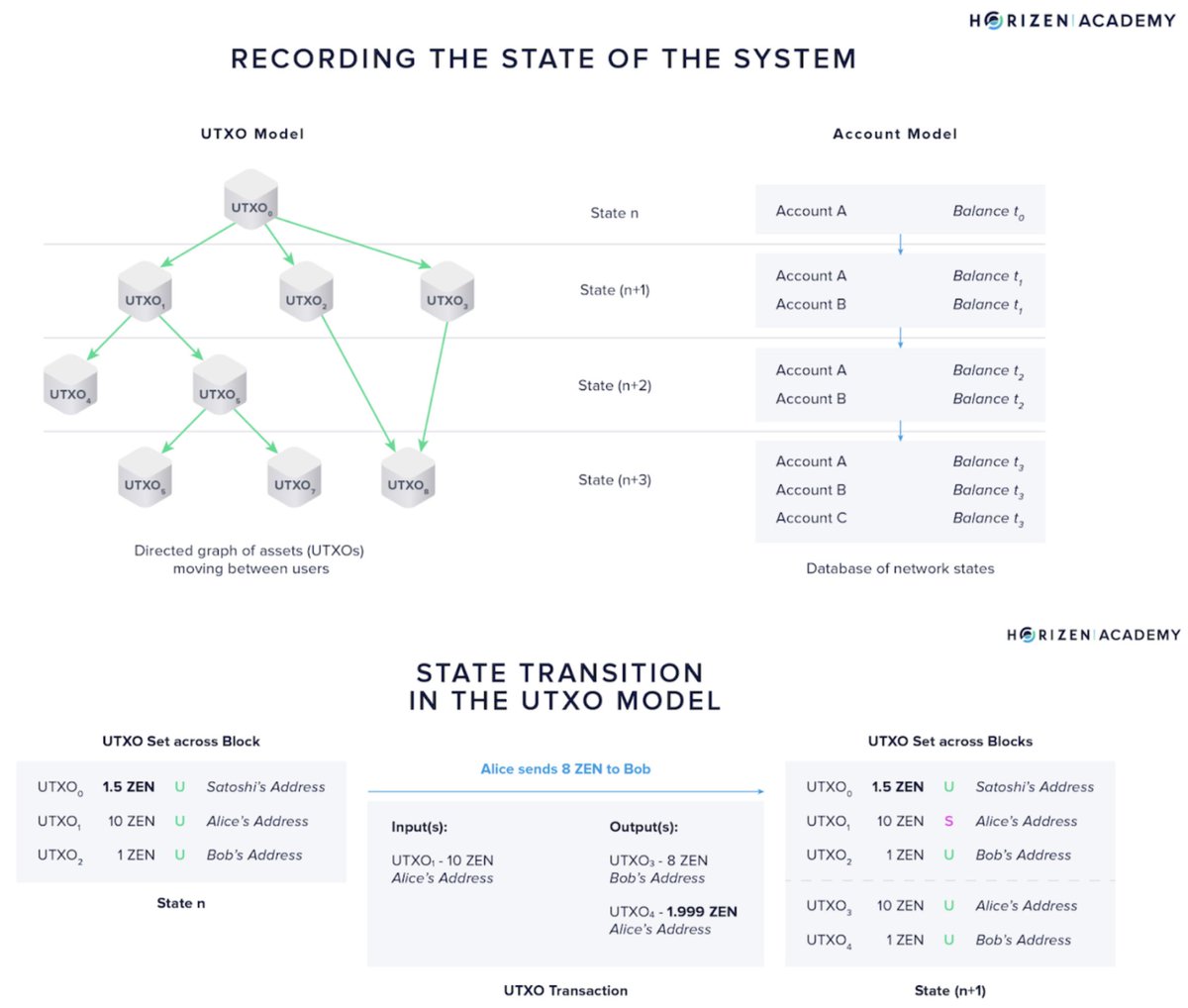
Transactions with UTXO are a consequence of the peculiarity of the accounting logic in the Bitcoin network as opposed to the account model in EVM for example. If in the account model it is the change of funds on the balances that is tracked: after the execution of a transaction there is less on one account and more on another, then with UTXO one of the cardinal differences is that it is virtually irreplaceable (reminds you of NFT, doesn't it?).
Each transaction spends one or more previous UTXOs and creates one or more new UTXOs. The total value of the new UTXOs must equal the total value of the spent UTXOs, and the difference between the two is the transaction fee paid to the miners. Thus, in a blockchain based on UTXO logic, each UTXO has a separate owner and can only be spent by the owner.
And whereas in an EVM network a user says "I have some coins and I can spend them", in a Bitcoin network a user actually says "I have some UTXOs that allow me to spend some BTC". That is, the conceptual difference is that the account model updates user balances globally. The UTXO model only records transactional receipts.
Accordingly, a bridge based on BitVM logic works as follows:
🔸 Users deposit UTXO, not BTC itself, into the BitVM-based bridge contract
🔸 L2 "listens" to the bridge contract, and when it sees UTXO credited to its contract, it credits the corresponding amount of BTC in L2 to these users.
🔸 The users on L2 have received their tokens and everyone is happy.
What about the reverse process? @Dr_DAO_ & @rot13maxi highlight this problem in their research "BitVM Bridges Considered Unsafe": the logic of the BitVM bridge is currently such that L2 users cannot claim funds locked in the bridge. There are only two paths of expenditure:
1⃣ Redirecting to the bridge operator
2⃣ Burn
This means that if the bridge operator fails, L2 participants can only hope that validators will burn the bridge. Therefore, it is critical to consider that the ratio of funds at the bridge from deposited BTC on L1 to mine BTC on L2 should always be 1:1.
This point seems very simple and logical, but there are 2 problems: the slowness of BTC itself and the fact that BitVM relies on bridge operators that have a settlement period of weeks to months. And at some point, there could be an outflow that exceeds the collateral held by the bridge operator. Accordingly, this is really similar to optimistic rollups, BitVM being an optimistic-based protocol.
Another potentially dangerous point was highlighted by @BobBodily of Bioniq, who noted that BitVM in combination with other similar solutions risks overloading slow and expensive BTC. And accordingly, one could speculate that the economic model could break down due to ultra-expensive transactions.
Part of what may solve this problem is the addition to BitVM technology that Taproot is based on, which is DLC.
DLC allows two parties to make conditional payments based on predefined conditions. The parties define possible outcomes, pre-sign them, and use those pre-signatures to make payments when Oracle signs off on the outcome. In such a scenario, Taproot's MAST provides sophisticated transaction logic in Bitcoin, while DLCs optimise transaction processes by moving most transactions off-chain, providing both security and privacy.
With these technologies, transaction contracts are stored similarly to Ordinals, facilitating direct storage on-chain and execution by nodes off-chain. This approach allows contracts to be executed in a manner similar to Ordinals, combining efficiency with blockchain integrity.
🟠 BitVM2 🟠
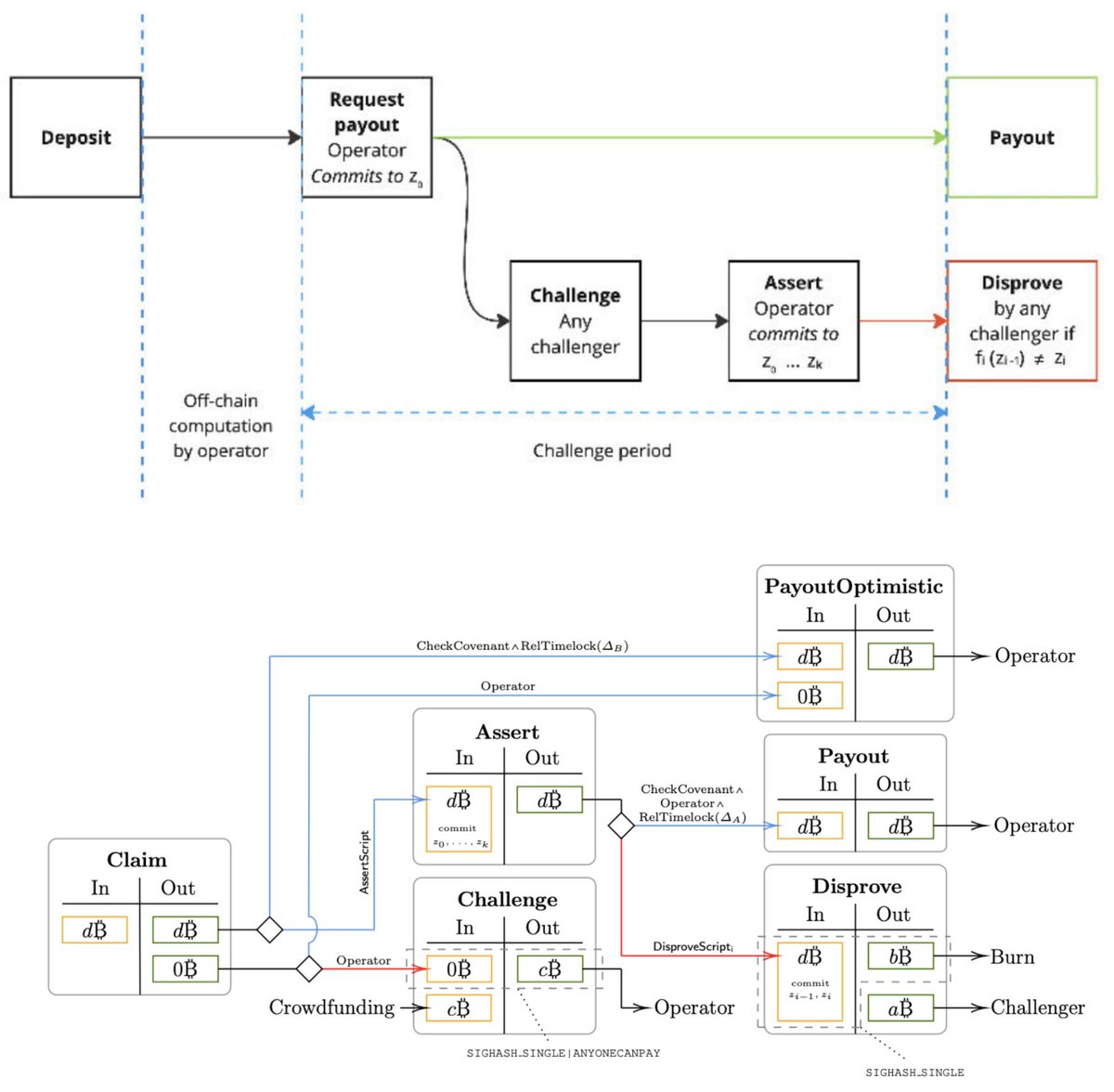
BitVM2 is inspired by the BitVM paradigm proposed and makes significant improvements in terms of computational and communication complexity, as well as security. While in BitVM and similar designs, only a fixed set of operators can perform challenges, BitVM2 supports for the first time permissionless challenging, i.e., any user with a Bitcoin full node can challenge faulty operators.
The main difference is that the original BitVM design required up to 70 on-chain transactions (over a period of multiple weeks or even months in practice) to disprove a faulty operator, whereas BitVM2 requires only 3 on-chain transactions that can be executed within 1-2 weeks, achieving similar practical properties as Ethereum L2S.
At the same time, things are not as simple as in the case of Optimistic solutions on Ethereum. The fact is that BitVM2 implements the Succinct Non-interactive Argument of Knowledge (SNARK) verifier in the Bitcoin script. This allows complex computations to be efficiently verified within the constraints of Bitcoin, allowing for a wide range of potential applications.
This is to reduce the size of the data: the SNARK verifier is divided into subroutines, each of which is small enough to be executed within a single Bitcoin transaction. This allows bypassing Bitcoin script size limitations and verifying complex calculations piecemeal.
Besides the roles of depositor (Alice) and beneficiary (Bob), in BitVM2 bridge protocol we additionally have the following participant roles:
🔸 Operators (01,..., Om): The operators are responsible for executing a pre-agreed program f; in the case of our bridge, this is the peg-out process. The operators are assumed to be rational, i.e., they are profit-maximizing agents.
🔸 Challengers: The challengers ensure the safety of the peg-out process by challenging an operator in case of misbehavior. Anyone can act as a challenger, including the operators. We assume that challengers are rational
🔸 Signers (S1, .., Sn): A committee of n signers that is responsible for the correct setup of a BitVM2 instance for a pre-agreed program f. One of the n signers is assumed to be honest (existential honesty).
How BitVM2 works:
1⃣ The operator commits to the correct execution of the programme by placing a transaction on the Bitcoin blockchain.
2⃣ The execution of the programme takes place outside the blockchain, with the operator providing the result and the necessary proof.
3⃣ If anyone suspects foul play, they can challenge the operator's claim within a predetermined period of time.
4⃣ If there is a problem, the operator must disclose the intermediate states of computation on the blockchain.
5⃣ The challengers can then refute the erroneous computation by executing the corresponding subroutine in the chain, demonstrating the discrepancy between the operator's claim and the actual computation.
Don't switch! There will be further parts to come!
📰 Read the full research at the link in our blog: https://t.co/730g4bZ7tC
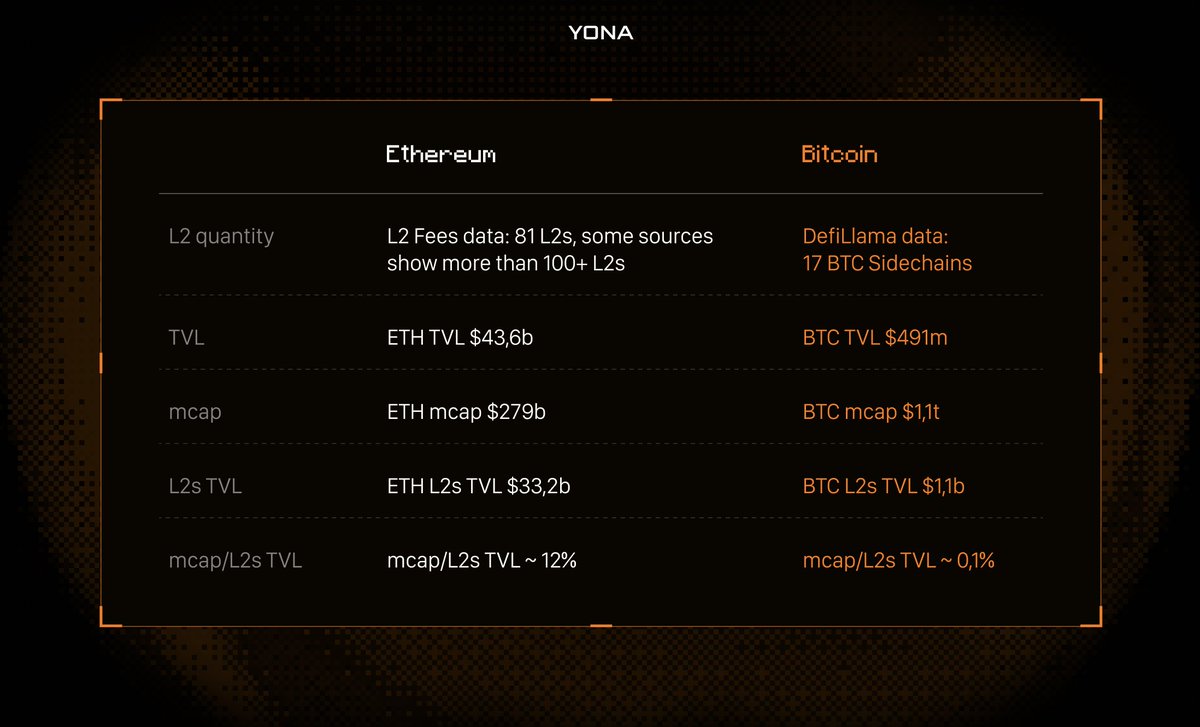
BTC's capitalization is 4x higher than ETH, but Bitcoin L2s have a 120x lower capitalisation, which could indicate a huge growth potential.
What is the growth potential of BTC L2s when pure digital gold flows there?
1/2 Yona Network is pleased to announce the launch of the first version of Yona Canonical Bridge on Devnet!
Fully trustless bridge based on on-chain Bitcoin Light Client - the new era of interop for the worlds of BTC and SVM!
https://t.co/ie5ONSjxIf
🚀 Are you ready for the mainnet? The countdown is on!
Fasten your seat belts and join the ANS @aleonames and Arcane Finance Galxe campaign.
Grab your OAT and take a chance to win free ANS names. Don’t miss out! 🌟
Claim now: https://t.co/2khyjRv2gS
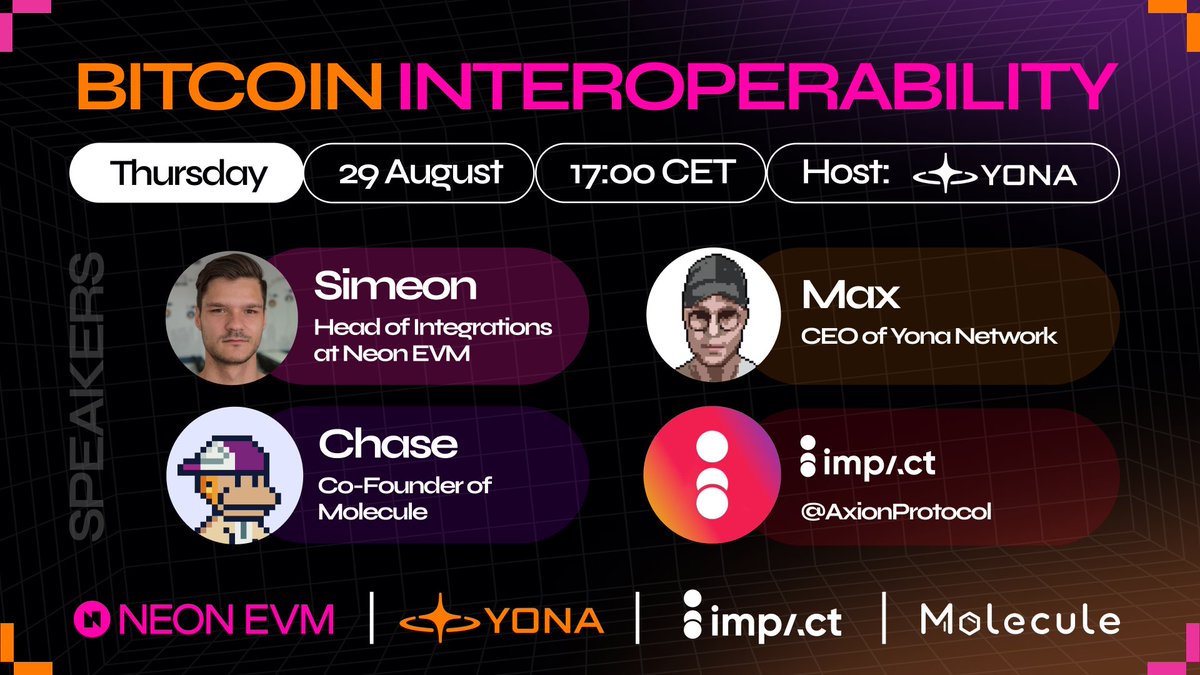
🚨 AMA Announcement 🚨
Yona's CEO @0xMaxSoul will be hosting an AMA with @0xlucianx0 from @neon_evm, @chasegm_ from @moleculebtc and @AxionProtocol!
Join tomorrow to learn about BTC Interoperability and SVM!
📆 29th August, 15:00 UTC
📍 Twitter space: https://t.co/IadYlh7BLX
🚀 We’re excited to see @AleoHQ reaching the final stage before the mainnet launch!
Arcane Finance is also fully prepared for mainnet and eager to welcome new users.
Don’t miss your chance to participate in our quests and earn exclusive roles on Discord! Let’s build a decentralized future together! 🌐
Our testnet is active again, and Arcane is fully ready for the mainnet!
From now on, Arcane supports the MTSP standard, taking @AleoHQ DeFi to an entirely new level.
It's been a long journey, and we remember everyone who has been with us 🤝
Test now: https://t.co/EQtRm3OdsC
1/7
Introducing the first-ever Clicker game powered by Blinks!
We are proud to pay homage by launching the game's first season on @solana! ❤️
Smash, score, and dodge 👇
https://t.co/la6CHECecY
🚀 Excited to announce Arcane Token Creator 101 on Galxe! Whether you’re planning to launch a memecoin or just trade them, this is your chance to create tokens— for free!
Complete simple tasks, earn a unique NFT, and create your own token with Arcane.
https://t.co/lV0Tv58ZKO
1/4 Yona team is cooking up something funny for you!
In order for this to work - you need to figure out how to activate Solana's new technology - @solana Blinks and Actions.
This feature is disabled by default, so you need to activate it in your wallets 👇🧵
1/ Yona Announces Partnership with @nubit_org for Data Availability Layer Integration!
Yona Network, the fastest Bitcoin-based L2 network running on the Solana Virtual Machine (SVM), integrates with Nubit to extend the capabilities and scalability of the Yona ecosystem.
1/ We’re thrilled to announce our integration with Yona Network (@yona_network), the fastest modular Bitcoin L2 using Solana VM!
Our integration brings together speed, scalability, and security, creating a strong infrastructure for unlimited applications on Bitcoin.
1/4 Yona Network Announces Integration with Neon Stack by @Neon_evm! The implementation of such a solution may allow connecting the worlds of Bitcoin, SVM-based Yona L2 and EVM. This allows to explore the prospects of launching EVM-based apps in the Yona ecosystem.
📢 Yona Network integrates Neon Stack!
With the adoption of Neon Stack, @yona_network can unlock EVM compatibility on its Bitcoin L2.
The Neon Stack toolkit allows SVM-powered blockchain networks to integrate compatibility for EVM dApps.
Ethereum 🤝 Solana 🤝 Bitcoin
Learn more: https://t.co/S1zCm5TiDi
1/4 Yona Network announces integration with @babylon_chain to connect the worlds of Bitcoin and @Solana VM with complementary synergies. It brings the security, speed, scalability, and user experience of Solana into the Bitcoin ecosystem with integration of BTC economic security