Tweeting about faith, health, cooking, writing, the great outdoors and tacos. My retweets, interactions and follows do not equal endorsements. Phillipians 4:8
Four musket balls tore through George Washington's coat at the Battle of Monongahela. Two horses were shot dead beneath him. He rode back and forth across the worst of the fighting rallying broken men, and when the smoke cleared he did not have a single scratch on him. An Indian chief later said he ordered his men to fire at Washington again and again, then stopped, certain the Great Spirit was shielding him.
He was 23 years old. He wrote to his brother a few days later, almost puzzled by it, and said he had been protected beyond all human expectation by the miraculous care of Providence.
And here is the part people forget. That was not the one time. That was the pattern.
At Princeton he rode his horse to within thirty yards of the British line and told his men to hold as the muskets opened up. An officer who was there covered his eyes because he was sure he was about to watch the general die. When he looked again Washington was still sitting tall in the saddle, waving his hat, completely unharmed. For eight years of war he stood where the fighting was heaviest and the bullets simply refused to find him. His enemies started to talk about it. His own soldiers started to believe it.
He was not being reckless. He just never seemed to believe it was his time.
This is the thread that runs through nearly every great man in history. They lived like the date had already been written and no enemy on earth could move it up by a single hour.
Caesar stood on the bank of the Rubicon, looked at everything he was about to risk, and said the die is already cast. Then he walked into it.
Cromwell rode into battle after battle convinced the outcome had been settled long before either army woke up that morning, and he fought like a man who had nothing left to fear because the ending was not his to decide.
Andrew Jackson stood on the Capitol steps while a man walked up and pulled a pistol on him at point blank range. It misfired. The man drew a second pistol. That one misfired too. The odds of both failing were so small that people argued about it for years. Jackson just raised his cane and went after the man himself.
Stonewall Jackson would ride calmly through a storm of gunfire while everyone around him flinched, and when someone finally asked how he stayed so steady he said it plainly. My religious belief teaches me to feel as safe in battle as in bed. God has already fixed the time of my death, so I do not trouble myself about it. I am always ready, no matter when it comes.
That was the whole secret. Not that they loved danger. Not that they did not feel fear. They simply believed their steps were already numbered by a hand higher than any king, and a man who truly believes that walks through fire like it is a hallway.
You cannot kill a man before his work is done.
And when you line their lives up side by side, the escapes, the misfires, the bullets that passed through the coat but never the man, it gets very hard to call all of it luck.
For the United States Bicentennial in 1976, the government funded one of the wildest short films ever made.
Created by animator Vincent Collins & produced by the United States Information Agency, the film goes on a kaleidoscopic journey through iconic
American symbols.
On this day in 1780, the British made their last serious push into New Jersey, and a furious chaplain handing out hymn books may have been the reason they failed. This is one of the best Revolutionary War stories almost nobody knows.
Two weeks earlier, the British had burned through Connecticut Farms, and during that raid a soldier shot and killed Hannah Caldwell, the wife of local Presbyterian minister James Caldwell, inside her own home with her children nearby. The killing of a pastor's wife enraged the whole region. The British were trying to break American morale. They lit a fire under it instead.
On June 23 about 5,000 British and Hessian troops marched on Springfield, aiming to punch through to Washington's supply base at Morristown. Standing in the way were maybe 1,500 Continentals under Nathanael Greene and a few hundred local New Jersey militia. Badly outnumbered, defending their own homes.
Then came the moment that made the legend. American troops at the bridge started running low on paper wadding for their muskets, the stuff that held the powder and ball in place. Reverend Caldwell, the same man who'd just buried his wife, ran into a nearby church, grabbed armfuls of hymn books by the famous hymn writer Isaac Watts, and threw them to the soldiers shouting "Give 'em Watts, boys! Give 'em Watts!" They literally fired the pages of hymns at the enemy.
The outnumbered Americans held. The British took the village, burned most of it, then turned around and retreated all the way back to Staten Island that same night. They never seriously invaded New Jersey again. Historians call Springfield "the forgotten victory" because the war's spotlight moved south right after.
A grieving preacher turned a hymnal into ammunition and helped end an invasion. Sometimes the most dangerous person on the field is the one with nothing left to lose.
“The very worst sin that’s ever been committed was the murder of the Son of God. The very best thing that’s ever happened on this planet was the death of the Son of God. And if God can make the worst thing the best thing, He can make your disappointment, even your sin, even your foolishness, work together for good.”
– Stuart Olyott
They threw boots at him in the barracks.
They called him a coward.
His commanding officer tried to have him removed from the Army.
Everyone was waiting for him to break.
He never did.
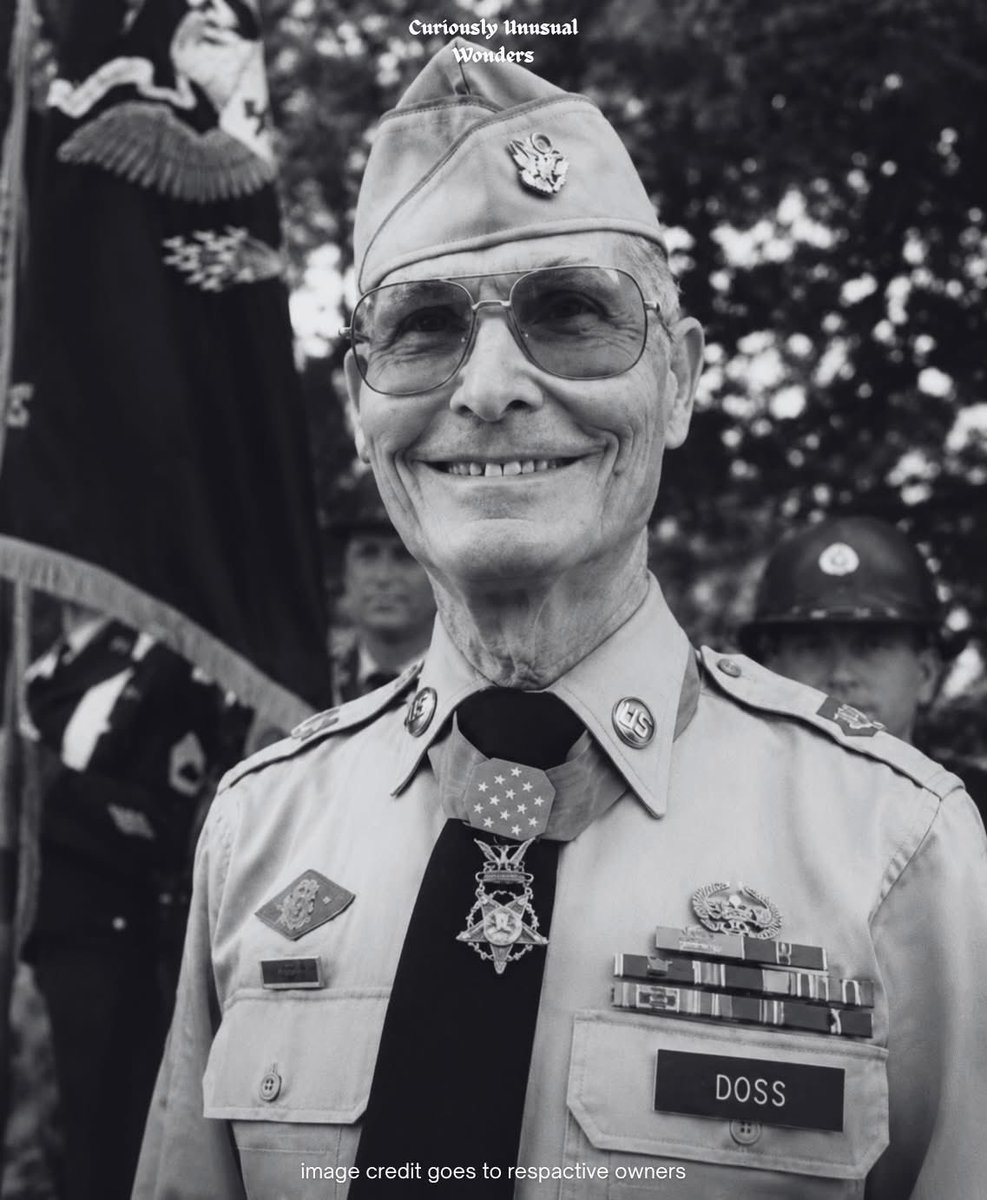
His name was Desmond Doss.
And he became one of the bravest soldiers in American history without ever carrying a weapon.
Doss was a devout Seventh-day Adventist who believed the commandment "Thou shalt not kill" was absolute.
When World War II began, he volunteered to serve.
But he refused to carry a rifle.
He refused to take a life.
His fellow soldiers couldn't understand it.
Many hated him for it.
They saw him as a burden.
A liability.
A man asking others to fight while he stood aside.
But Doss wasn't trying to avoid danger.
He volunteered as a combat medic.
He intended to run directly into it.
By 1944, he was serving in the Pacific.
Under fire in Guam and the Philippines, he repeatedly risked his life to rescue wounded soldiers.
The insults started fading.
The men who doubted him had seen what happened when bullets started flying.
Doss always ran toward the wounded.
Then came Okinawa.
The Maeda Escarpment.
A place soldiers called Hacksaw Ridge.
A 400-foot cliff defended by heavily fortified Japanese positions.
On May 5, 1945, a massive counterattack forced American troops to retreat.
Most made it down.
Roughly 75 wounded men did not.
They were stranded on top of the ridge.
Abandoned under enemy fire.
Desmond Doss stayed.
Alone.
Unarmed.
He found one wounded soldier and dragged him to the cliff edge.
Using a rope, he lowered him to safety.
Then he went back.
And found another.
And another.
And another.
Each time he prayed the same prayer:
"Lord, help me get one more."
For hours he moved through gunfire, artillery, and chaos.
One man at a time.
By the end of the night, he had rescued approximately 75 soldiers.
Single-handedly.
Without firing a shot.
Days later, a grenade exploded beside him.
Shrapnel tore through his body.
While waiting for evacuation, he saw another wounded soldier whose injuries were worse than his own.
So he gave up his stretcher.
Then a sniper's bullet shattered his arm.
Using the stock of a broken rifle as a splint, he crawled hundreds of yards to safety.
On October 12, 1945, President Harry S. Truman placed the Medal of Honor around his neck.
Doss became the first conscientious objector in American history to receive the nation's highest military award.
One of the men he saved on Hacksaw Ridge was Captain Jack Glover.
The same officer who had once tried to force him out of the Army.
Years later, Glover called Doss one of the bravest men he had ever known.
Desmond Doss died in 2006 at the age of 87.
He never carried a weapon.
He never fired a shot.
He never compromised what he believed.
And when everyone else was running down the ridge, he kept going back.
Just one more.
Then one more.
Then one more.
I just voted for Boise State for School of the Year - Group II in the 2026 NIL Store Awards! Cast your vote: https://t.co/ftSvej5qB8
Let’s goooooo Bronco Nation!! Takes a TEAM! #BleedBlue 🔵🔵🔵🔵🔵🔵🔵
On June 13, 1777, a 19-year-old French teenager landed on a beach in South Carolina, uninvited, to fight in someone else's war. He would become one of the most important men in American history.
The Marquis de Lafayette was one of the richest young aristocrats in France. He had a beautiful wife, a fortune, and zero reason to risk any of it. But he believed in the American cause so fiercely that when the French king forbade him from going, Lafayette bought his own ship and sailed anyway. He literally went AWOL from a life of luxury to bleed for a country that didn't exist yet.
Congress was annoyed at first. Another foreign officer looking for a paycheck? Then Lafayette offered to serve for free and pay his own way. That got their attention.
He met Washington and the two formed one of the great father-son bonds in American history. Washington had no biological children. Lafayette named his only son George Washington Lafayette.
He took a bullet in the leg at Brandywine and kept rallying the retreat. He was instrumental at Yorktown, the battle that won the war. He went home a hero on two continents.
A foreign teenager believed in America before America did. 249 years ago today.
🍠 “My 87-year-old neighbor just dropped potato wisdom that saved me $200 this year…”
She pulled out a plain cardboard box, sprinkled a handful of baking soda like it was gold dust, and whispered, “This is how we kept potatoes through the whole winter back home — no fridge, no chemicals, no sprouting.”
I thought she was joking… until I tried it.
Old-world potato preservation hack:
1. Place your potatoes in a cardboard box (breathable = key)
2. Generously dust them with baking soda
3. Tuck the box away in a cool, dark place (closet, pantry, under the bed)
4. Watch them stay firm and sprout-free for months
No more mushy potatoes. No more throwing away half the bag. Just simple, forgotten knowledge from a generation that didn’t waste a single thing.
Who else is bringing back grandma’s tricks in 2026? Drop a 🥔 if you’re trying this!
Save this before your next grocery run. Your wallet (and your potatoes) will thank you. ❤️
The Committee of Five—John Adams, Benjamin Franklin, Thomas Jefferson, Robert Livingston, and Roger Sherman—was appointed to draft the Declaration of Independence 250 years ago today.
Jefferson's draft of the document is here at the Library, and will be featured in a new exhibition opening July 3.
USA. A potluck. Everyone brings one dish. I have never been so out of my depth in my life.
I was invited to a gathering. "Just bring a dish to share," they said. Simple words. I did not sleep for three days.
Because I understood instantly what this was. A summit. Every guest, a lord of their own house, arriving bearing tribute. And tribute is judged. Tribute is ranked. To bring the wrong dish to the wrong table is to fall in standing before your peers, possibly forever.
So I prepared. I made my finest dish. I carried it to the door with two hands and a straight back, braced for the weighing of my worth.
The first lord arrived with a bowl of orange powder noodles. Macaroni and cheese. The crowd roared. He set it down at the center of the table. The CENTER. I noted this. The center is the seat of power.
The second lord brought a tower of small brown meat orbs in red sauce. "Meatballs," he announced, like a man laying down a sword. They were placed beside the macaroni. A strong showing. An alliance, perhaps.
I studied the table like a battlefield map. Potato salad: defensive, reliable, old money. A vegetable tray, untouched, clearly a hostage offering no one expected to win. And then a woman walked in, raised a flat box overhead, and the entire room turned and CHEERED.
Pizza. She had brought pizza. Store-bought. Still in the box.
I was stunned. She had not even cooked it. And yet the people rejoiced as if a king had entered. I revised my entire understanding of the hierarchy on the spot. Effort means nothing here. Only the roar of the crowd decides rank.
I placed my dish down, humbly, near the napkins. A peasant's position. I accepted it.
And then a man tapped my shoulder, pointed at my dish, and said the words that changed everything.
"Whoa, did you make this? This is amazing. Everybody, you GOTTA try this guy's thing."
The room turned. The room came. The room ATE. My dish vanished in ninety seconds. The pizza woman herself took a second helping and looked at me with respect.
I had won the summit. By accident. With a dish I placed by the napkins.
I understand nothing about this country. I have never been happier. I am hosting the next one.
So tell me, America.
Is there a system to the potluck? A secret rank? A hidden law?
I have decided there is not.
You just bring the thing you love, and everyone eats it, and somehow everybody wins.
It is the most insane way to hold a war.
I will fight in every single one.
In 1943, the Gestapo finally caught Raymond Aubrac — one of France's most wanted Resistance leaders. He was sentenced to death. His execution was days away.
His wife Lucie was six months pregnant.
Most people would have hidden. Would have grieved quietly and prayed for a miracle. Lucie Aubrac did something else entirely. She obtained forged identity papers, constructed a cover story, and walked straight into the office of Klaus Barbie — the man history would remember as the Butcher of Lyon — and convinced him to grant her a visit with the condemned man.
She wasn't there to say goodbye.
She was memorizing guard positions. Counting minutes. Mapping the route the prison truck would take.
On October 21, 1943, that truck rolled through the streets of Lyon carrying Raymond and other prisoners toward what should have been the end. Lucie had spent weeks quietly assembling a team of Resistance fighters, planning an ambush with the precision of a military operation. When the truck reached the ambush point, the team struck — fast, coordinated, and without hesitation.
In the chaos of gunfire and confusion, Raymond Aubrac was pulled free.
Lucie — visibly, unmistakably pregnant — had organized every detail of his liberation.
They went into hiding. Weeks later, Lucie gave birth to their daughter in a safe house while German forces searched for them across France. When liberation finally came, the Aubracs didn't merely survive — they rebuilt.
Raymond became a celebrated engineer and entered public life. Lucie became a historian, pouring decades into ensuring that the women of the French Resistance — so often unnamed, so easily forgotten — were written permanently into the record. They raised three children. They traveled the world. They argued and laughed and grew old together.
When journalists asked Lucie, years later, what had compelled her to risk everything that October day, she didn't hesitate.
"He was my husband. What else would I do?"
Lucie Aubrac passed away in 2007 at the age of 94. Raymond — who had once needed a commando team to be freed from a German prison — lived on until 2012, reaching 97 years old. In his final years, he continued speaking publicly about the Resistance, about memory, about the obligation to tell the truth.
They had been married for 64 years.
Not a love story built on grand gestures or perfect circumstances. A love story built in occupied France, in safe houses and forged documents and a prison truck ambush on a Lyon street — forged in fire, and never broken.
True love doesn't wait for rescue. Sometimes, it does the rescuing