There are some hard truths about homelessness:
- Homelessness is inextricably linked to drug use and mental illness, and to the behaviors associated with them
- Failure to remove encampments entrenches homelessness in a community
- Even when homeless people with addictions are housed, a significant share still die
- Homelessness hurts small and large businesses alike
- Homelessness drives away tourism
Two California cities seem to have admitted these things. When will others do the same?
https://t.co/GpEKr2dTD4
Political difference is not abuse.
I wrote a whole book about loving your enemies years ago, and I meant the people whose politics turn your stomach. Watching families come apart over politics has only convinced me of that even more.
To be clear, I'm not talking about abuse. There are relationships you have to leave because your safety comes before anyone else's feelings. If you're in one of those relationships, leave it.
But over time, the line has crept. More and more, we're told that political disagreement itself is a reason to cut off a parent, a sibling, or a child.
I think that's a terrible mistake.
The people selling estrangement know exactly what they're doing. They take your real pain, attach it to their politics, and leave you alone with the consequences. They get the attention and the moral certainty. You get an empty chair at Thanksgiving. And if you can no longer imagine loving someone because they voted differently than you did, you've lost something much more important than a political argument.
So before you cut off someone you love over politics, ask yourself who benefits from the distance. Sometimes the answer is you. But more often than we care to admit, the people who benefit most are the ones you've never met.
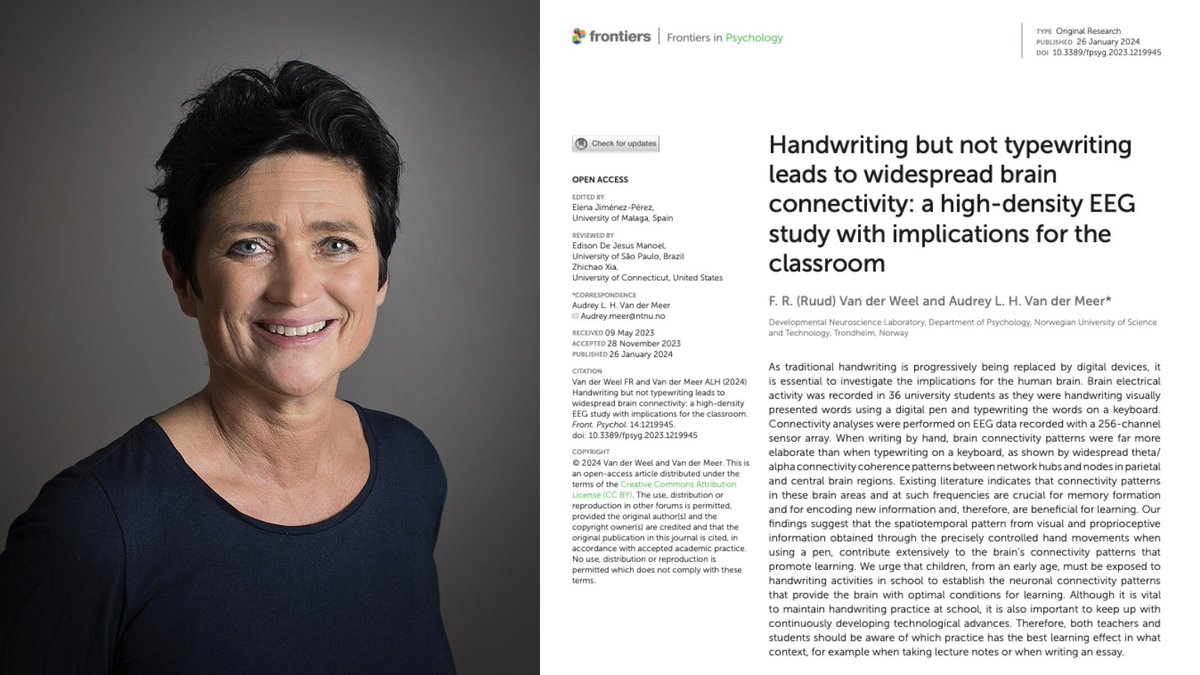
A Norwegian neuroscientist spent 20 years proving that the act of writing by hand changes the human brain in ways typing physically cannot, and almost nobody outside her field has read the paper.
Her name is Audrey van der Meer.
She runs a brain research lab in Trondheim, and the paper that closed the argument was published in 2024 in a journal called Frontiers in Psychology. The finding is brutal enough that it should have changed every classroom on Earth.
The experiment was simple. She recruited 36 university students and put each one in a cap with 256 sensors pressed against their scalp to record brain activity. Words flashed on a screen one at a time.
Sometimes the students wrote the word by hand on a touchscreen using a digital pen, and sometimes they typed the same word on a keyboard. Every neural response was recorded for the full five seconds the word stayed on screen.
Then her team looked at the part of the data most researchers had ignored for years, which is how different parts of the brain were communicating with each other during the task.
When the students wrote by hand, the brain lit up everywhere at once.
The regions responsible for memory, sensory integration, and the encoding of new information were all firing together in a coordinated pattern that spread across the entire cortex. The whole network was awake and connected.
When the same students typed the same word, that pattern collapsed almost completely.
Most of the brain went quiet, and the connections between regions that had been alive seconds earlier were nowhere to be found on the EEG.
Same word, same brain, same person, and two completely different neurological events.
The reason turned out to be something nobody had really paid attention to before her work. Writing by hand is not one motion but a sequence of thousands of tiny micro-movements coordinated with your eyes in real time, where each letter is a different shape that requires the brain to solve a slightly different spatial problem.
Your fingers, wrist, vision, and the parts of your brain that track position in space are all working together to produce one letter, then the next, then the next.
Typing throws all of that away. Every key on a keyboard requires the exact same finger motion regardless of which letter you are pressing, which means the brain has almost nothing to integrate and almost no problem to solve.
Van der Meer said it plainly in her interviews.
Pressing the same key with the same finger over and over does not stimulate the brain in any meaningful way, and she pointed out something that should scare every parent who handed their kid an iPad.
Children who learn to read and write on tablets often cannot tell letters like b and d apart, because they have never physically felt with their bodies what it takes to actually produce those letters on a page.
A decade before her, two researchers at Princeton ran the same fight using a completely different method and ended up at the same answer. Pam Mueller and Daniel Oppenheimer tested 327 students across three experiments, where half took notes on laptops with the internet disabled and half took notes by hand, before testing everyone on what they actually understood from the lectures they had watched.
The handwriting group won by a wide margin on every question that required real understanding rather than surface recall.
The reason was hiding in the transcripts of what the two groups had actually written down.
The laptop students typed almost word for word, capturing more total content but processing almost none of it as they went, while the handwriting students physically could not write fast enough to transcribe a lecture in real time, which forced them to listen carefully, decide what actually mattered, and put it in their own words on the page.
That single act of choosing what to keep was the learning itself, and the keyboard had quietly skipped the choosing and skipped the learning along with it.
Two studies. Two countries. Same answer.
Handwriting makes the brain work. Typing lets it coast.
Every note you have ever typed instead of written went into your brain through a thinner pipe. Every meeting, every book highlight, every idea you captured on your phone instead of on paper was processed at half depth.
You did not forget those things because your memory is bad. You forgot them because typing never woke the part of the brain that would have made them stick.
The fix is the thing your grandmother already knew.
Pick up a pen. Write the thing down. The slower road is the faster one.
For 38 years, the US paid farmers NOT to grow too much corn. In 1971, one guy killed that rule. Within 13 years your Coke had corn syrup instead of sugar, food was the cheapest it had ever been, and Americans were getting heavier every year.
Since the Great Depression, US farm policy ran on simple supply and demand. If everyone planted everything, prices would crash and farmers would go broke. So the government paid farmers to leave a chunk of their land empty, and held big stockpiles of grain like an emergency fund.
Then Nixon picked Earl Butz to run the Department of Agriculture. Butz was a farm-economy professor from Indiana who also sat on the boards of giant food companies. He told farmers to "get big or get out" and to plant every inch of land they owned. In 1972, when the Soviet Union had a bad harvest and came shopping, Butz quietly sold them 30 million tons of grain in one deal. The US emergency stockpile was gone overnight. By 1976 he had killed the entire 38-year-old system.
By the late 1970s, the country was drowning in corn, and Washington kept guaranteeing the prices anyway. Corn became the cheapest ingredient in the American grocery store. The government still hands corn farmers about 3.2 billion dollars a year, more than any other crop.
That cheap corn went two places. The first was your soda. Scientists had recently figured out how to turn corn starch into a syrup that tasted almost like sugar. With corn this cheap, that syrup (high-fructose corn syrup, or HFCS) was way cheaper than cane sugar. Coca-Cola started swapping it in by 1980. By 1984, Coke and Pepsi had ditched cane sugar entirely in the US. The average American went from eating zero corn syrup in 1970 to almost 38 pounds of it a year by 1999.
The second place was everything else. That same cheap corn fed the cows, pigs, and chickens packed into industrial farms. It also became the base ingredient or sweetener in most processed food on the shelf. Americans went from spending 17 percent of their take-home pay on food in 1960 to under 10 percent by 2000, one of the lowest rates in the world. Daily calories per person climbed from about 2,054 in 1970 to over 2,500 by 2010. The extra 500 came mostly from added fats, refined grains, and corn syrup. When Butz took office in 1971, about 15 percent of American adults were obese; today the CDC says it's 40.3 percent. Severely obese, defined as way past overweight, used to be under 1 percent. Now it's nearly 1 in 10.
Butz's policy did exactly what it promised. Productivity, exports, and grocery prices all moved the way he said they would, year after year for three decades. The right photo is just what happens to the average American body after fifty years of policy designed to make calories as cheap as possible.
now take this information and flip it. constantly pointing out the things you are grateful for can train your brain to notice more things to be grateful for. constantly noticing abundance will train your brain to notice even more abundance. flip the script & stay in control.
I had a male teacher for grades 5 and 6 who was highly eccentric (and not gay - he was a family man without a whiff of scandal). He had old printing presses in the classroom and we learned about how books and newspapers were printed - by printing our own pages with movable type we set ourselves. He showed us violent war movies. He had WW2 and Vietnam veterans come in and give graphic talks. One guy talked about his baptism of fire in Japan - he said something like ‘I jumped into the foxhole and killed two Japs with my pistol - I’m glad I bought that pistol off a guy before the fight because I might not be here if I hadn’t.’ The teacher would tells us the casualty figures of WW1 and 2 and sometimes start crying. He also taught us chess, and he spotted kids who were good in math. He gave me math problems well in advance of 6th grade, and ensured I was pushed up a level in middle school. He was tolerant of wild boy behavior - including boys throwing things at each other across the classroom.
Only a few years later I heard he had to stop showing the war movies, the veterans weren’t allowed to give talks. He retired shortly thereafter - he was getting old anyway.
But this kind of man used to teach elementary school. I don’t know why he wanted to do it - but he was good at it. And I don’t think there are many like him in public schools now - and that isn’t good for boys.
Make critical thinking a foundational subject in education. Teach students how to think critically, analyze information, and discern fact from fiction using scientific methods, creating a more discerning and informed society.