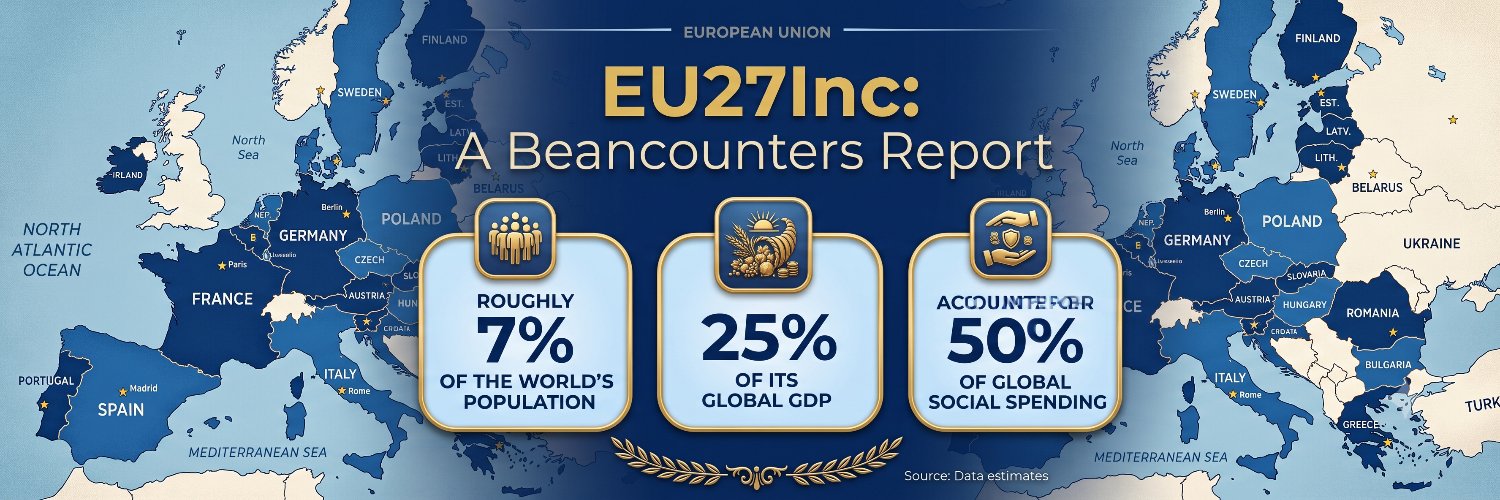
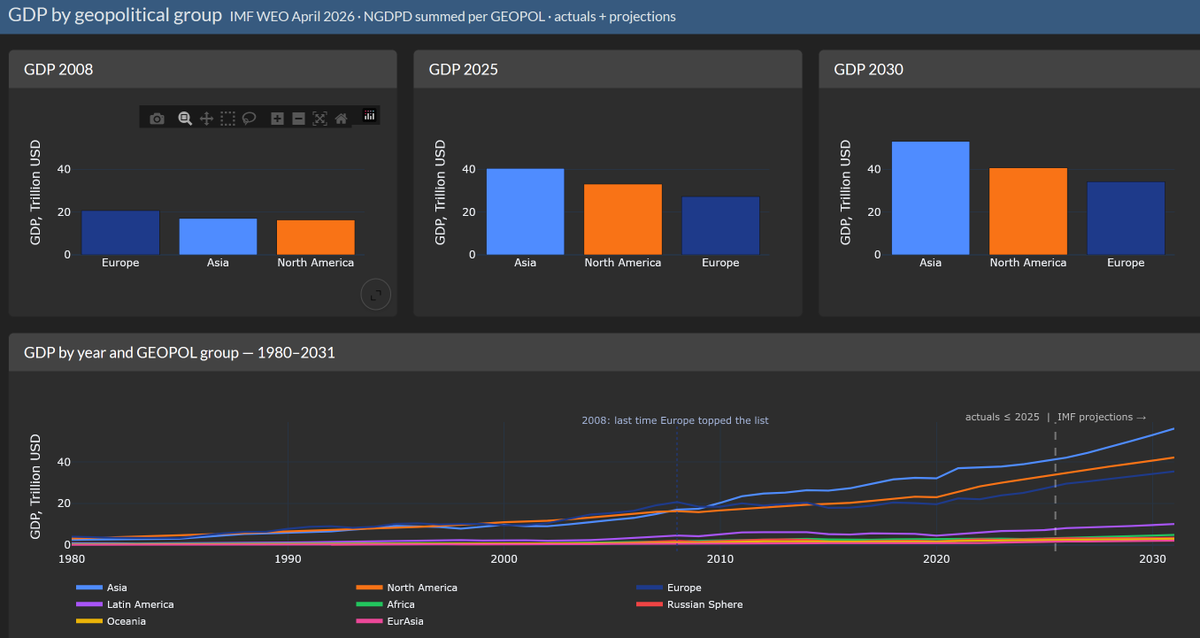
Looking at the numbers behind the state of EU27Inc and its standing in the world. A European bean counter's perspective on how to contribute to a better world.
Hay un informe que no me canso de citar. Lo publica todos los años @McKinsey y repasa el "balance global": la riqueza, la deuda y los activos reales y financieros de los principales países del mundo.
Acaba de salir la edición de este año y es demoledor:
https://t.co/M1Hv0MO18v
A small article on how the west won the first cold war, took a long victory nap and woke (partially) up in a cold war 2.0 with diminished power cards and questioning the system which built its strenghts.
https://t.co/z2ijl7iJ5Y
For years while economists both inside and outside China have called on Beijing to fight off delation and raise the consumption share of GDP by lowering interest rates and expanding credit, I have argued that this is the wrong solution, based on mistakenly assuming that China's financial system works like that of the US.
In fact it works in a very different way. Chinese banks mostly borrow from households to lend to businesses and government. Households are overwhelmingly net creditors to the banks while businesses and government net borrowers.
Lowering interest rates, in other words, rather mechanically reduces the household income share of GDP and expand the business and government shares, which means it tends to expand production faster than consumption.
We saw this most obviously in the 2000s, when Beijing engineered highly negative real interest rates to help clean up bad debt, and saw a near-collapse of the household share of GDP (and with it, the consumption share).
That's why, I argued, credit expansion and lower interest rates in China actually reduce consumption and are likely to be deflationary. This, by the way, was a similar story in Japan in the 1980s and 1990s.
Jinfan Zhang and Wei Xiong have just published an NBER paper that makes a very similar point. They write: "This paper investigates why China’s recurrent credit expansions have coincided with persistently weak inflation. We argue that this pattern reflects the country’s production-oriented monetary regime."
"Credit expansion in China," they continue, "tends to sustain production and balance sheets rather than stimulate final demand. As a result, monetary policy operates less as a conventional tool for demand management and durable reflation, and more as a mechanism for preserving production capacity and supporting growth."
If they are right (and I think they clearly are right), this has the seemingly counter-intuitive implication that rebalancing the economy towards a greater reliance on domestic consumption requires higher, not lower interest rates.
Of course given how heavily indebted government and businesses are, raising interest rates will be extremely painful for the production side of the economy, but this simply reinforces what we already know from the historical precedents – that it is necessary, but extremely painful, to rebalance an economy with very low consumption.
That's because the income transfers needed to rebalance an economy towards consumption must come from a production side that had previously benefitted from the reverse transfers. This almost always results in a growth contraction on the production side. That is probably why rebalancing is always put off for so long.
https://t.co/X7NY4Pfeo8
1/2
The New Yorker has a very good article by Evan Osnos on the potential emergence of China's technological leadership. Osnos wonders if the future of technology might be Chinese, but he also notes that this future is very opaque.
https://t.co/dZS1Ovr4XF
@LauRademakers1 Evolutie bevolking: 2016: 46.4mio - 2026: 49.7 mio (waarvan 7,3 mio extranjeros). El aumento reciente se debe casi en su totalidad a la llegada de personas extranjeras. Nu 1.3Mio aanvragen voor regularisatie -> 3 mio via hereniging. Waar gaan ze slapen?
@LauRademakers1 Causas principales 1. Vivienda y altos costes 2. Precariedad laboral: La temporalidad, la jornada parcial involuntaria y los salarios bajos de los progenitores. 3. Grupos más vulnerables: familias monoparentales (50,8%), de origen extranjero (67,5%) o familias con +3 hijos (68%).
@LauRademakers1 El riesgo de pobreza infantil en España es alarmantemente alto, afectando a 1 de cada 3 menores (un 33,2% de la infancia y adolescencia), lo que sitúa al país entre los peores de la Unión Europea. Casi 2,7 millones de niños y niñas viven en esta situación de vulnerabilidad.
@LauRademakers1 Als je een slimme regularisatie van migranten doet zonder meer huizen te bouwen (want de-growth is beter?), dan wordt behuizing onbetaalbaar voor wie geen woonst heeft en creëer je een verarming van de bevolking: de jongeren kunnen zich geen kinderen veroorloven. Slim? 1/2