Starting a literature review?
Try this 5-step approach in Litmaps:
🔎 Add one paper
📖 Explore its map
🌱 Grow your network
🏷️ Tag sub-topics
🤳 Visualize & share
Full 5-min tutorial 👉 https://t.co/QEyHTqApJf
Struggling with your literature review?
Learn how to:
• find papers faster
• map your research
• stay up to date automatically
All in one workflow 👇
https://t.co/QEyHTqAXyN
A good literature review answers three questions
- what's been done
- what's missing
- what's next
Visualizing the field helps with all three.
https://t.co/UQBuJRZ01m
New papers are published in your field every week.
Monitor in Litmaps tells you when they appear, so you can spend less time searching and more time reading.
https://t.co/UQBuJRYsbO
Most research problems start with a weak question.
If you get the question right, everything else becomes easier: finding papers, staying focused, actually finishing the work.
We put together a simple, practical guide on how to write a research question that actually works:
https://t.co/j7NmxU4dq1
What's harder: Getting your paper done, or getting your advisor to read it?
Let's face it, miscommunication with supervisors is painful (and common).
👉 The [surprising] fix? Literature sharing. 📚
A shared library =
✅ Alignment on what matters
✅ Easy paper sharing (no lost PDFs)
✅ Less back-and-forth when writing
✅ Quick agreement on peer reviewers
Better communication isn’t more meetings.
It’s a shared foundation.
How do you stay on the same page with your advisor?
👋 Follow @LitmapsApp | 🧪 litmaps . com
#PhDLife #ResearchTips #LiteratureReview
That’s it. You’re no longer buried under millions of results! You’ve built a focused, credible, research foundation.
✨ You’ll never read 2,629,995 papers. But with the right system, you don’t need to. You only need to read the right papers that shape your field.
Try it for yourself with Litmaps.
How many papers did you read for your literature review? Share with us below!
You open Google Scholar, type in your research topic, and…
💥 2.63 million results. (literally)
The top five look useful, but what about the other 2,629,995?
🤔 Are you missing something important?
😥 Could skipping a key paper undermine your credibility?
😰 How could you ever know when you’ll never read even a small fraction?
But, there's a better way.
5 steps to finding the most important papers first:
👇
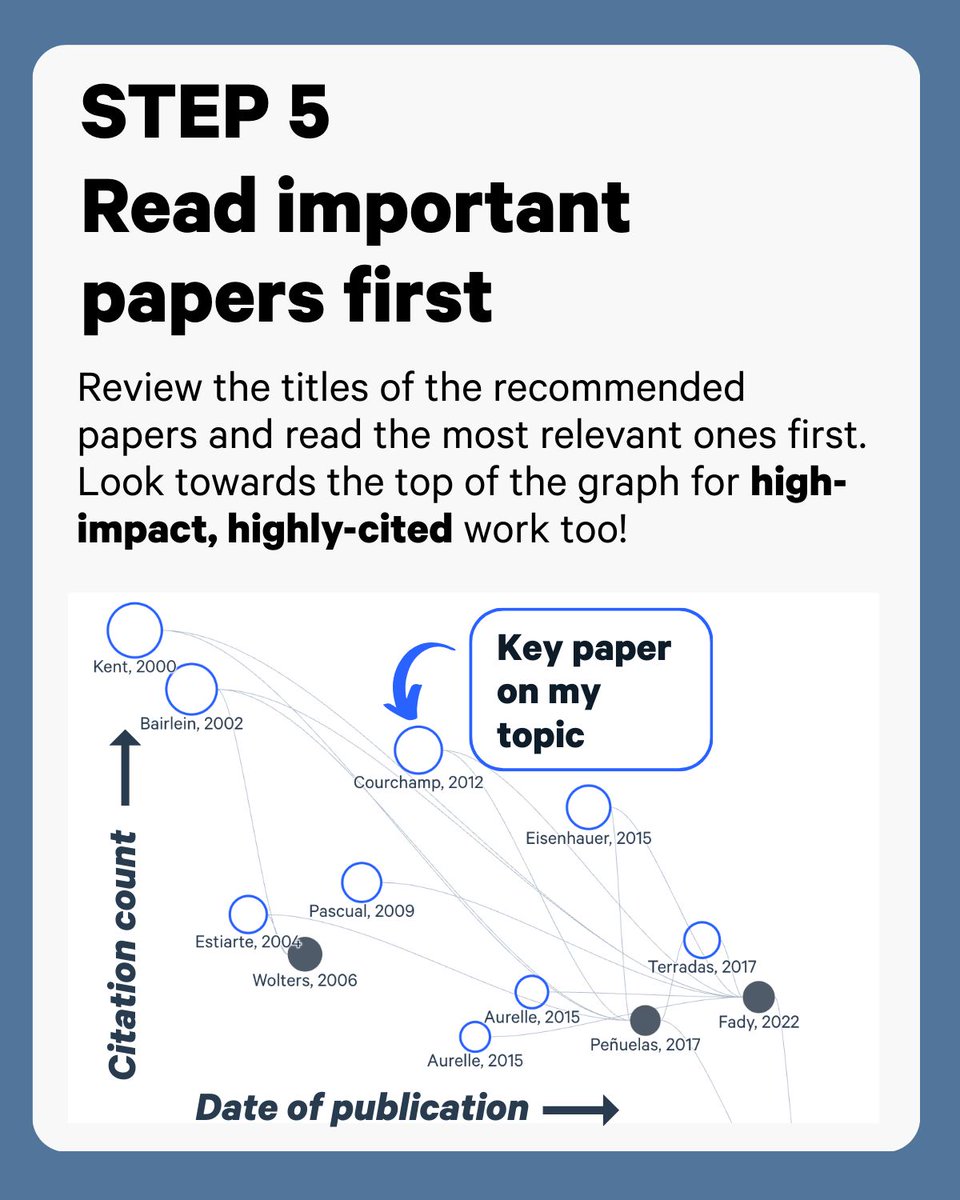
5️⃣ Step 5: Review recommendations smartly 👀
Skim titles. If relevant, scan the abstract. Still relevant? Open the PDF, read, and save.
Always check:
✅ Journal quality,
✅ Author reputation,
✅ How it links back to your seed papers.
HINT: Look at papers towards the top. Those have the most citations (sorted on the y-axis). It's a quick way to find high-impact work in your field.




![LitmapsApp's tweet photo. What's harder: Getting your paper done, or getting your advisor to read it?
Let's face it, miscommunication with supervisors is painful (and common).
👉 The [surprising] fix? Literature sharing. 📚
A shared library =
✅ Alignment on what matters
✅ Easy paper sharing (no lost PDFs)
✅ Less back-and-forth when writing
✅ Quick agreement on peer reviewers
Better communication isn’t more meetings.
It’s a shared foundation.
How do you stay on the same page with your advisor?
👋 Follow @LitmapsApp | 🧪 litmaps . com
#PhDLife #ResearchTips #LiteratureReview](https://pbs.twimg.com/media/G1H_NYUXAAA5V64.jpg)