We developed a two-step ML + Bayesian optimization framework to rapidly optimize eco-friendly, scalable #PerovskiteSolarCell fabrication in ambient air — no anti-solvent, low-toxicity TEP solvent, and 24.26% PCE achieved! Newly online in JEC @jenergychem: https://t.co/zlgedBqr4P
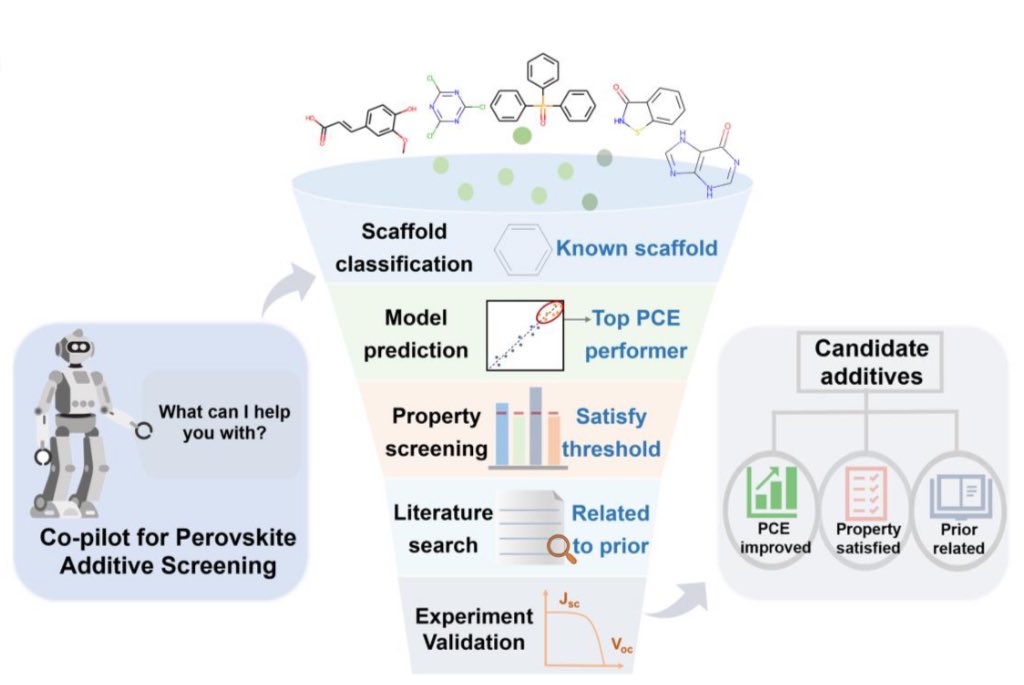
Introducing you to the Co-PAS (Co-Plot for Additive Screening), an ML-driven framework designed to accelerate additive screening for perovskite solar cells. https://t.co/hRYHyM20ZW; https://t.co/JaOZcaQtZx .
Hello, world! Are you looking for an AI copilot while searching the vast chemical space of organic additives for perovskite solar cells? Preprint at: https://t.co/tnBfzIFMvF; Open-source Code: https://t.co/RXGKhmFney
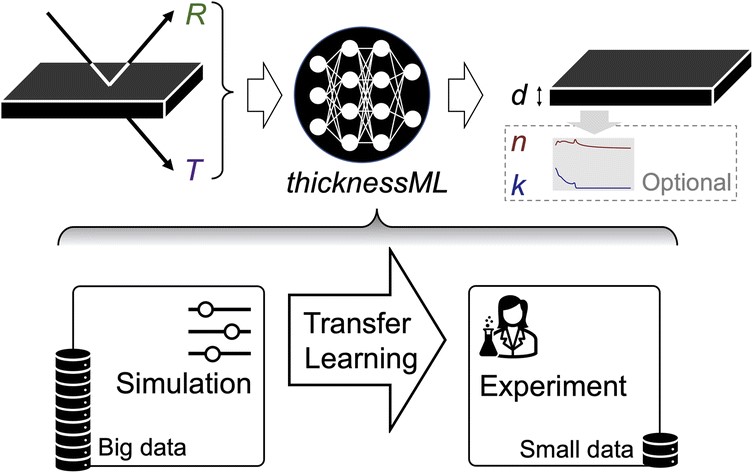
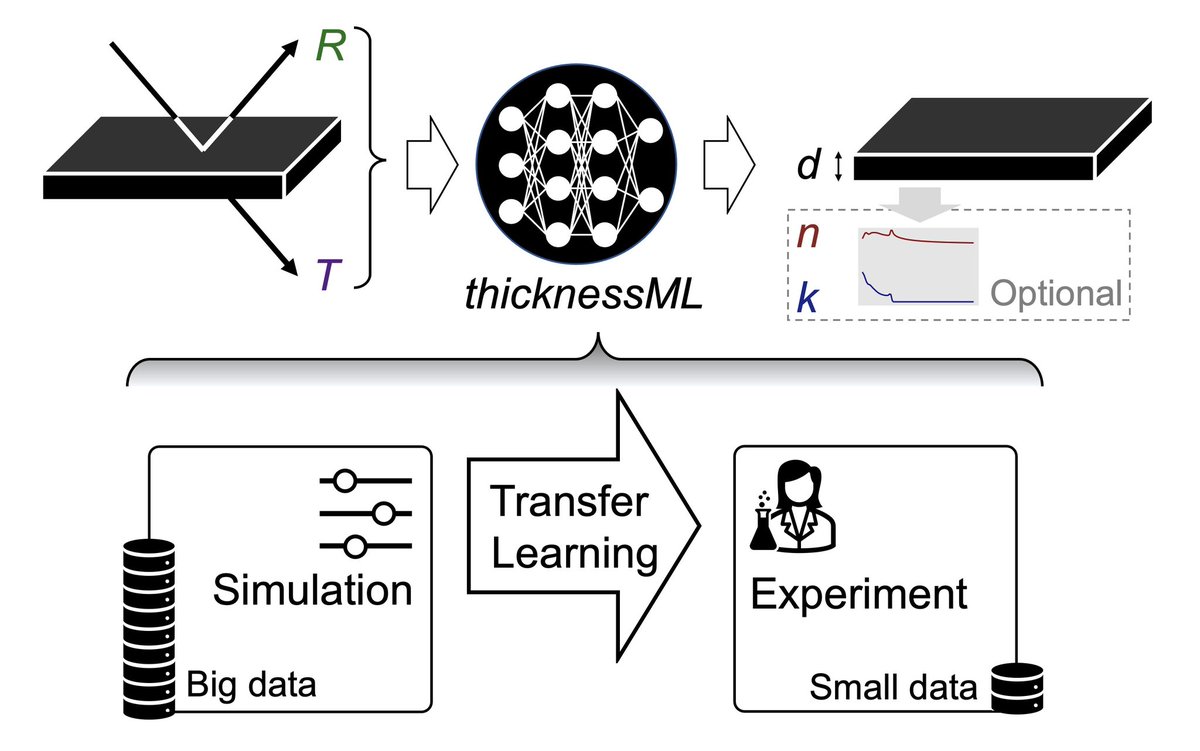
Buonassisi et al. use transfer learning to overcome data scarcity in high-throughput, automated experimental work in thickness characterisation of optoelectronic thin films. Read more in today's featured article: https://t.co/O5vIxskKBt #openaccess
Finally, we got this thicknessML published in Digital Discovery @digital_rsc. We used transfer learning for thin film thickness analysis. Please see an early preview: https://t.co/vrlNqFW3ga. Great collaboration with many awesome researchers.
On ML side, inspired by a talk from @prashungorai on avoiding data bias, we supplemented the previous research-intuition-driven dataset with five Latin-Hypercube-sampled ammonium salts. The data diversity gets increased, and the model prediction becomes more robust.
Following up our ML-assisted previous screening research led by @SunShijing@noortitan @toniobuonassisi, a new study found an ML-suggested molecule (2-phenylpropane-1- aminium iodide) experimentally achieves PCEs of 22.36% for FAMACs-based and 24.47% FAMA-based solar cells.
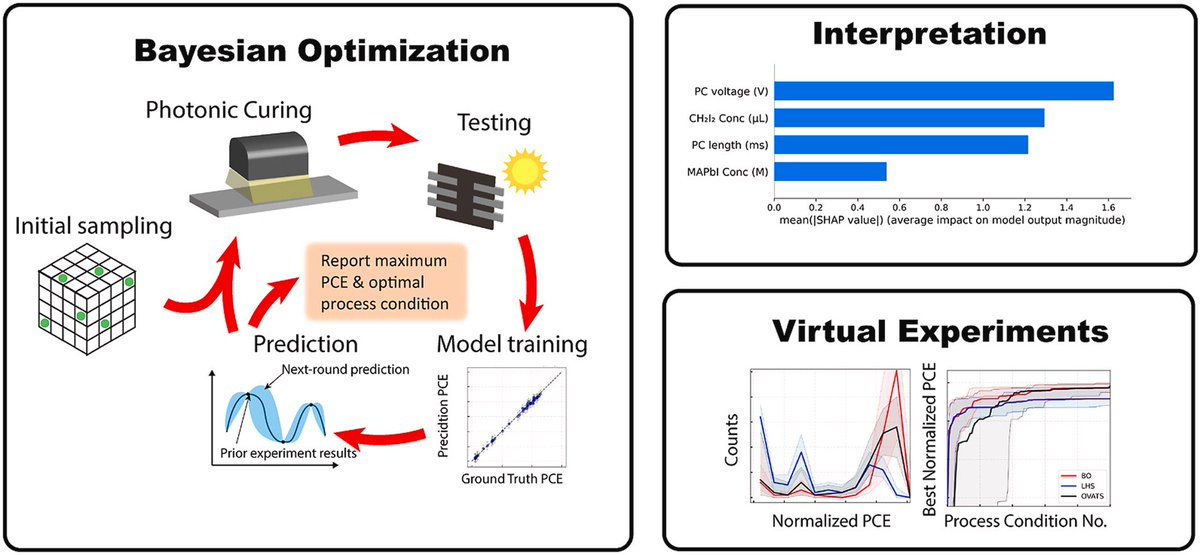
Another demo of a quick and informed optimization with BO and SHAP analysis. This time we tackle the challenge of making flexible perovskite solar cells. Here is a link: https://t.co/jsoCSIRc1E. A great collaboration with Prof. @JuliaHsu_UTD 's team @UT_Dallas.
@Sergei_Imaging @toniobuonassisi @SterlingBaird1@JuliaHsu_UTD@UT_Dallas I've read these papers. I guess the idea is to use physical laws to accelerate BO, correct? I will be cool to try these concepts in solar cells.
@SterlingBaird1@JuliaHsu_UTD@UT_Dallas Cool idea! Lengthscale values are fitted independently for each input dimension. I will check how they are ranked. But, by definition, it should show the covariance on X values at different locations. Not the impact on the output y though. It would be a different perspective.
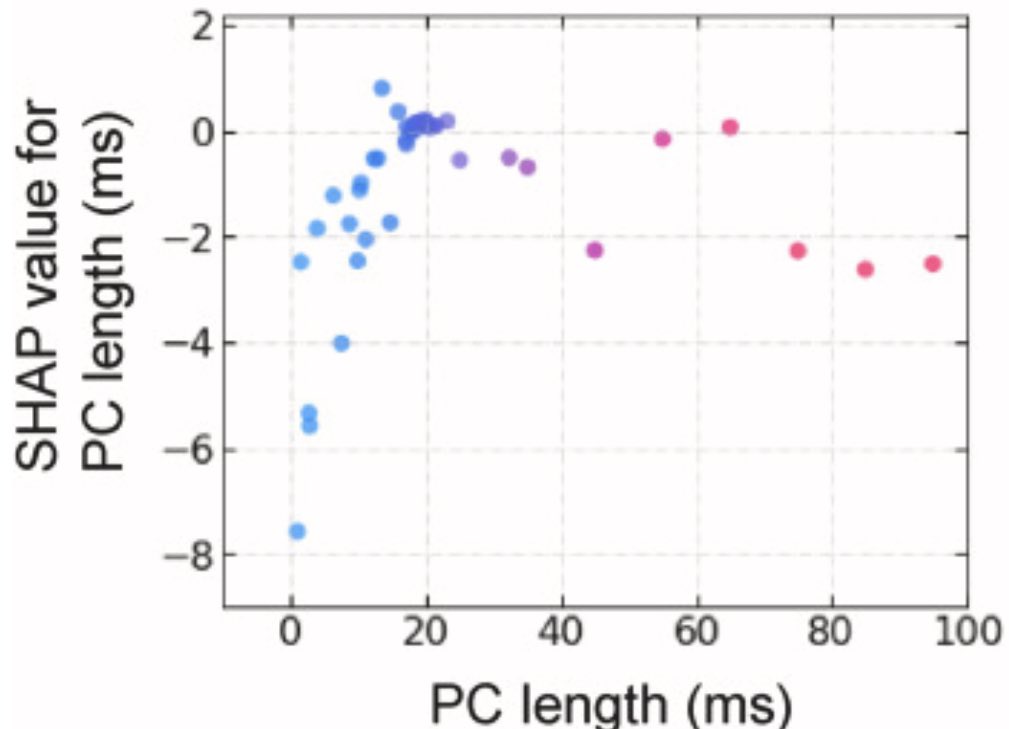
Speaking of human-ML interaction, we expanded the search boundaries after the first round for the “PC length” variable. (Semi-)surprised to find out the PC tool have a limitation. So, the take-away: check your BO surrogate at every iteration with contour plot and SHAP analysis.
I am happy to share with you our first trial using BO and SHAP in optimizing Photonically Cured flexible perovskite solar cells. Big shout-out to my collaborator
@LiuZhe_MIT and my advisor @JuliaHsu_UTD This demo shows a Good Human-Machine Partnership.
https://t.co/ZjQFoYdmYL