The voice of #FattyLiver, #MASLD & #MASH. The only patient organization aimed at improving screening, education & outreach dedicated to fatty liver patients.
Our annual State of Steatotic (Fatty) Liver Care in America Survey is now open.
This year marks the 5th year of collecting voices from people living with MASLD, MASH, MetALD, ALD, and other forms of SLD. What patients share helps shape real programs from peer storytelling to tools that connect people with support like mental health services and transportation to medical appointments.
If you are living with steatotic liver disease, we invite you to share your experience: https://t.co/MvxISnHnnN
"The struggle gets mistaken for not caring." Dr. Wei Zhang on why the assumptions we make about alcohol use disorder get in the way of effective care. Watch in full: https://t.co/b49lDeU53A
A shift in how Medicare reimburses certain cancer therapies is raising questions about whether payment policy can keep pace with medical innovation. As newer formulations dramatically reduce the time required to administer some treatments, the way Medicare values and reimburses those advances could influence whether patients can benefit from them.
Patients Rising examines the CMS proposal and what it could mean for the future of cancer care.
Read more: https://t.co/p7hSYfA3FC
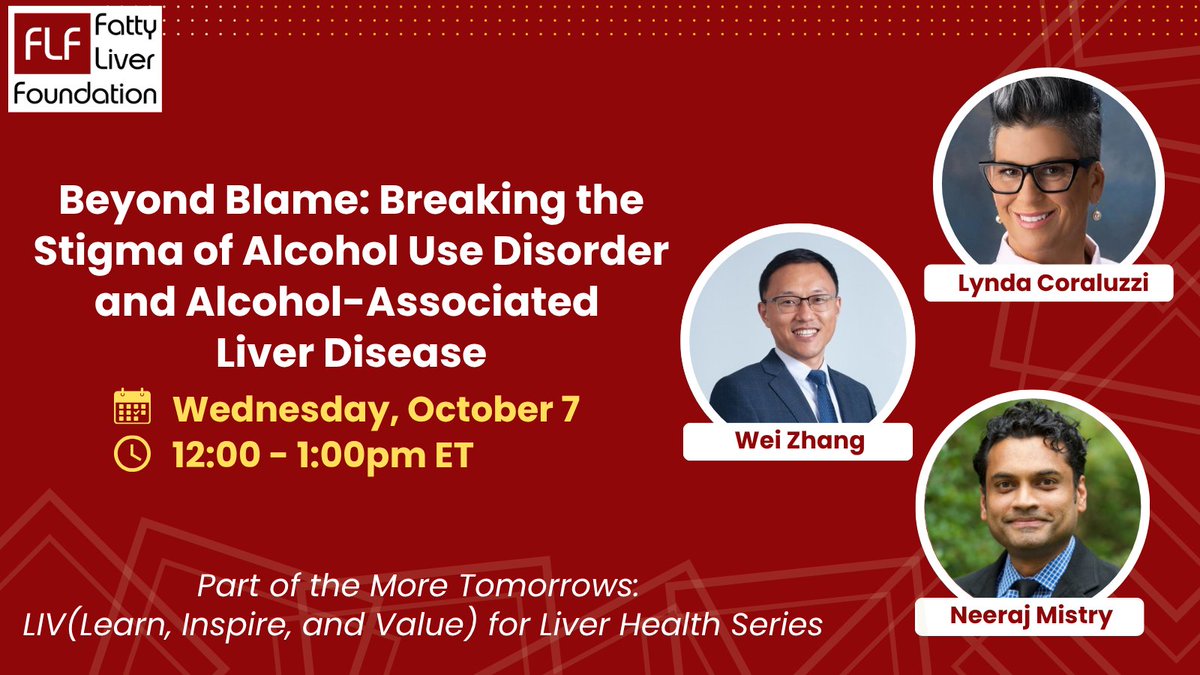
What happens when stigma becomes a barrier to liver care? That's the question at the center of our October 7 webinar, Beyond Blame featuring Dr. Wei Zhang and Dr. Lynda Coraluzzi.
One week away. Register now: https://t.co/lrmGXR5VxR
Stigma shapes whether people with alcohol-associated liver disease disclose, seek help, or feel worthy of care. That's not a small thing; it's a barrier to treatment.
We're hosting a webinar on October 7 to talk about it honestly, with Dr. Wei Zhang and Dr. Lynda Coraluzzi. Join our conversation: https://t.co/s33FfCeiqV
We are deeply grateful to our community members who courageously share their stories to raise awareness of steatotic liver disease. Thank you @livrdiseasenews for the feature!
What does life with steatotic liver disease really look like? 📷
Tiffany shares what patient voices have taught her and why truly listening to those experiences matters! https://t.co/JBT8W6l4aU
#SteatoticLiverDisease#LiverDisease#FattyLiverDisease
We often celebrate the big, dramatic medical interventions. But Dr. Jessica Mellinger reminds us that building trust and achieving incremental change with patients is where the real progress happens: https://t.co/r1T3pk1PVJ
Telling someone to go home and be abstinent for 6 months... that's not providing care, it's providing advice at best." Dr. Juan Pablo Arab on why we must actively treat Alcohol Use Disorder in liver patients. The full talk: https://t.co/r1T3pk1i6b
Stigma is a moral judgment. Feeling uncomfortable talking to your doctor about difficult topics is not. Dr. Jessica Mellinger breaks down the difference and why it matters for patient care. Our full conversation: https://t.co/r1T3pk1PVJ
"If you get rid of alcohol and obesity, you get rid of 85% of liver disease." Dr. Juan Pablo Arab on why we can no longer treat metabolic factors and alcohol use in silos: https://t.co/NMLM86Ho6V
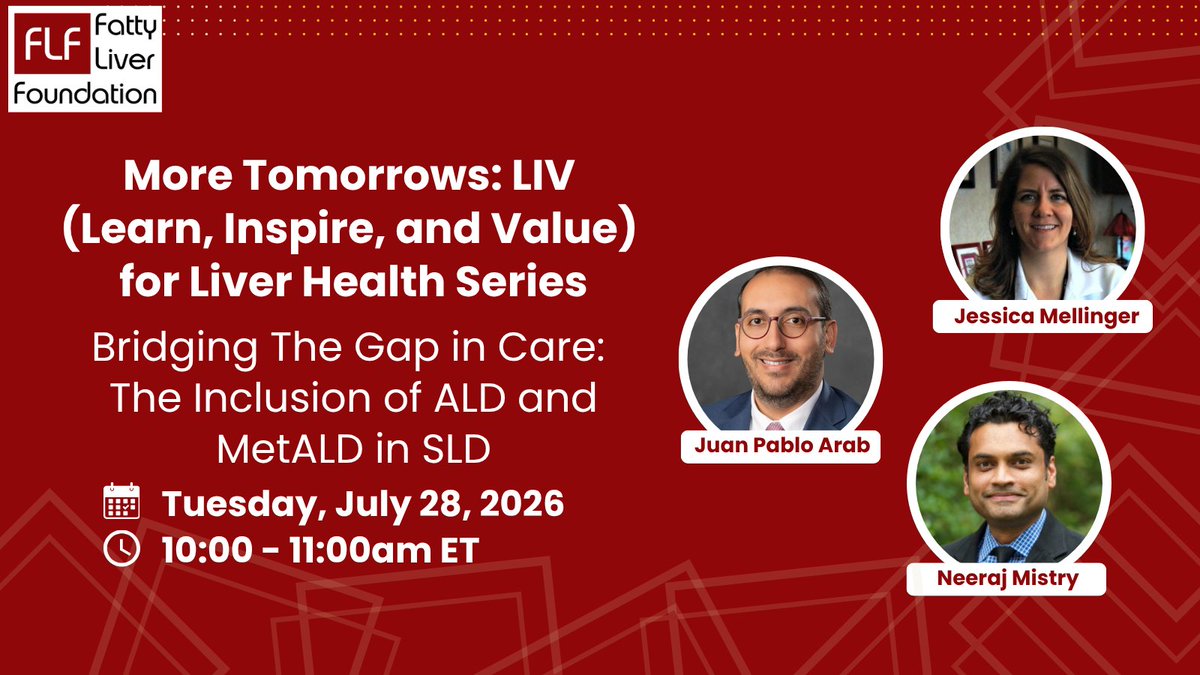
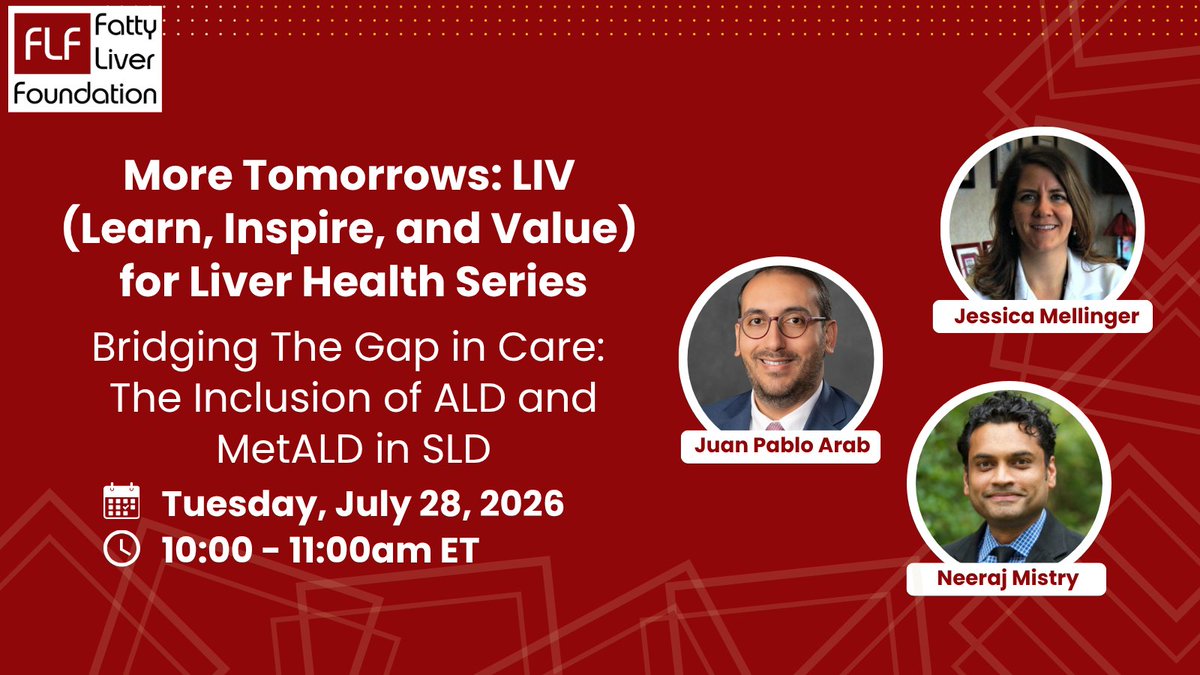
Our webinar is tomorrow. Bridging the Gap in Care: The Inclusion of ALD and MetALD in SLD 📅 Tuesday, July 28 | Zoom
Still time to register: https://t.co/TOj1j7AIIw
Marc Andreessen says the best engineers alive stopped sleeping on purpose, and every one of them calls it the happiest they’ve ever been.
Andreessen: “You’re up all night doing AI coding because you’re getting so much done that you can’t turn off. The opportunity cost of going to sleep is too high.”
The body has one price it never negotiates. An hour of this just cleared it.
They call them AI vampires now. Twenty agents working the night shift, and one human who refuses to be the bottleneck in his own life.
Andreessen: “They’re sleep deprived, they’ve got bags under their eyes, they’re clearly not taking care of themselves. And they’re absolutely ecstatic.”
Burnout is exhaustion in the absence of meaning. This is the reverse. Exhaustion from an oversupply.
It was supposed to make us obsolete. It made us insatiable.
We have only ever met desire in a cage. Uncaged, we call it sickness.
Wanting more than you could reach was a wound with no treatment, so we made a virtue of not wanting.
Moderation. Contentment. Being realistic. Knowing your limits. Handed down as wisdom. All of it anesthesia for a species that could not afford its own ideas.
Underneath the vampires sits a quieter story that does far more damage.
A friend on Wall Street. MIT computer science degree, thirty five years ago. Then the market bid higher for his hours, and he put it down for three decades.
Andreessen: “He’s picked up coding with AI. He’s completely re-automated his entire house.”
Nothing was resurrected. Nothing had ever died.
Andreessen: “…in his spare time has generated 500,000 lines of code, just by working with AI.”
He never lacked the vision. He lacked the hours.
Three decades of wanting with nowhere to put it. Desire doesn’t die when you starve it. It goes quiet, and you start describing it in the past tense.
Andreessen: “The coders that are using AI, the estimate is right now that they’re 20 times more productive than they were before they started using AI.”
Not twenty percent. Twenty times.
He draws the pessimistic case from it himself.
Andreessen: “If there’s only a limited amount of software that people want in the world, then yeah, you’re going to get mass unemployment.”
One clause in that sentence holds up the entire automation debate. A limited amount that people want.
Every number we have on human demand was taken inside a rationing regime. We measured the ideas that could clear a payroll. Everything beneath that line never existed long enough to be counted.
The house that works the way you pictured it. The fix nobody else needs. The idea too small to fund and too personal to sell.
We spent a century measuring the supply curve and filed the result under human nature.
Nobody alive has ever seen what a person wants. Only what they could afford to want.
You were never a person with limits. You were a person with prices.
Scarcity was never only a constraint. It was an alibi. It let everyone believe the life they never lived was taken from them.
I would have, but.
There is no but anymore.
The vampires aren’t up all night because the machine demands it.
They’re up because the thing they always meant to make finally stopped being impossible.
You have one too. You’ve just been describing it in the past tense.
That was never a verdict on you. It was a price.
The price went to zero.
Elon Musk just put an expiration date on the human hand.
Four years.
The one tool that was never replaced. Everything else we ever made was something for it to hold.
Musk: “You have a recursive, multiplicable, triple exponential. Put a little margin on it, better than any human in four years.”
Not a narrow task. Not one industry. Any human.
Most progress rides a single exponential. One curve, steep enough to outrun intuition.
One curve is why the phone in your pocket humiliates the computer that flew Apollo. Sixty years, running alone.
He is describing three, stacked and multiplying.
Musk: “You have an exponential increase in the AI software capability, exponential increase in the AI chip capability, and an exponential increase in the electromechanical dexterity.”
Better chips shorten the training cycle.
Better software sharpens the hands.
Better hands generate the physical data that trains the software.
Each one pays the other two back.
Say each curve only doubles once a year. Four years in, one of them is sixteen times better.
Three of them multiplied is four thousand times better.
Same four years. One number your instincts can hold. The other they cannot.
Then the whole loop goes into a machine that builds itself. Every unit shortens the time to the next.
Nobody has ever noticed an exponential from the inside. You do not feel it coming. You feel late.
Maybe four years is six. The date is arguable. The direction is not.
But the machines are the smaller story.
Human skill has always been perishable.
Knowledge compounds because we write it down. Every generation starts higher than the last.
Skill does not. It lives in one body, in one city, for thirty good years, then goes in the ground.
We can copy what a master knew. We have never once copied what a master could do.
The best hands that ever lived belonged to someone whose name we will never know.
Every civilization ever built has been rebuilding the same hands from scratch.
So we did what people do with a limit they cannot beat. We gave it a nicer name.
We called it craft. We called it bedside manner. We called it the human touch.
Then it came apart, in the least dramatic way possible.
Musk: “I wouldn’t want the best ophthalmologist, even the steadiest hand out there, with a hand laser on my eyeball.”
Millions of people handed a machine their eyesight.
Because the machine does not sneeze, does not tire, does not have a bad morning.
Nobody agonized. There was no debate about the soul of ophthalmology.
The objection never changes. People will still want a human in the loop.
Five words.
Musk: “For a less assured outcome.”
We only defend the human in the loop while the stakes stay abstract.
With a laser pointed at your optic nerve, you do not want a soul. You want a guarantee.
The human in the loop was never a standard. It was a shortage.
Soon, insisting on one stops being a principle and becomes negligence.
For ten thousand years, a human life was priced by what it could do that nobody else could.
That price is going to zero.
It only reads like a loss because we have never had to tell being needed apart from being worth something.
Necessity did that math for everyone before us. Hunger. Distance. The limits of two hands.
Everyone who ever lived was handed their answer before they arrived.
A field to work. A wound to close. A child to feed.
You were whatever the moment was short of.
Even love came with work attached. Someone to carry. Someone to sit up with through a fever. Someone to bury.
We have never seen what is left of it once the work is gone.
Nobody has ever had to say out loud what a person is for.
Not what you are needed for.
What you are for.
Nothing is pointing at us anymore.
We are the first who get to step out of the loop and answer it ourselves.
Alcohol use disorder is a chronic medical condition, not a moral failure. To support liver transplant recipients, we must replace stigma with a strong therapeutic relationship. Hear Dr. Channa Jayasekera share why engaging with patients is the key to long-term success. Listen to the full episode: https://t.co/MtaN0THCV4
Jensen Huang doesn’t use AI to think less. He uses it to think past his own limits.
Huang: “90% of my instructions are actually conflated with questions.”
The man running a five trillion dollar company doesn’t give AI commands. He interrogates it.
Huang: “I take the answer from one AI, give it to the other AI, ask them to critique itself.”
Same question. Multiple models. Pit them against each other. Keep only what survives.
Not because the machine can’t be trusted.
Because challenging it is where the sharpest thinking happens.
Huang: “The process of critiquing, criticizing the answers, applying your critical thinking, enhances cognitive skills.”
AI doesn’t replace your thinking. It demands more of it than you’ve ever given.
Every question takes reasoning. Every answer takes scrutiny. The machine isn’t thinking for you.
It’s pulling thinking out of you that didn’t exist before you sat down.
Huang: “In order to formulate good questions, you have to be thinking, you have to be analytical, you have to be reasoning yourself.”
AI is not the shortcut everyone thinks it is.
It is the most powerful cognitive amplifier ever built. It sharpens the engaged. It leaves the passive exactly where they started.
Same tool. Same access. The only variable is what you bring to it.
The world is debating whether AI will replace human thinking.
Wrong conversation.
The real question is what happens when a tool built to think for you becomes the thing that forces you to think beyond yourself.
That’s not a threat to humanity.
That’s the entire point.
This is a profound truth, when people become comfortable it is easy to stop striving and decay is the consequence. When the many depend on the work of the few a society is doomed
The most elegant medical solutions are often the simplest. The PACT protocol from the Mayo Clinic uses generic, accessible medications and standard monitoring to support transplant recipients. Dr. Channa Jayasekera explains why this model is easy for any center to adopt. Hear the full talk: https://t.co/MtaN0TIaKC
New medical terms don't automatically mean better care. That's the conversation we're having on July 28. Join us for our next webinar on ALD, MetALD, and what the evolving SLD classification means for patients: https://t.co/TOj1j7Bgy4
Why do we wait for a transplant recipient to struggle before offering support? Dr. Channa Jayasekera from the Mayo Clinic explains why post-transplant care must shift from reactive monitoring to proactive prevention starting on day one. Watch the full LIV Breakthroughs episode: https://t.co/MtaN0THCV4