Most trading algos are one brain trying to beat the market.
We built a swarm.
🧠🧠🧠🧠🧠 → one signal.
https://t.co/2MC5OigLqB is now live. Agentic AI for institutional finance.
The hive mind just entered the chat.
The AI Bubble Isn’t a Valuation Bubble. It’s an Earnings Bubble.
Most investors are looking at AI through the wrong lens.
Traditional bubbles are driven by valuation expansion. Price-to-earnings multiples detach from reality, speculation takes over, and eventually the music stops.
This cycle looks different.
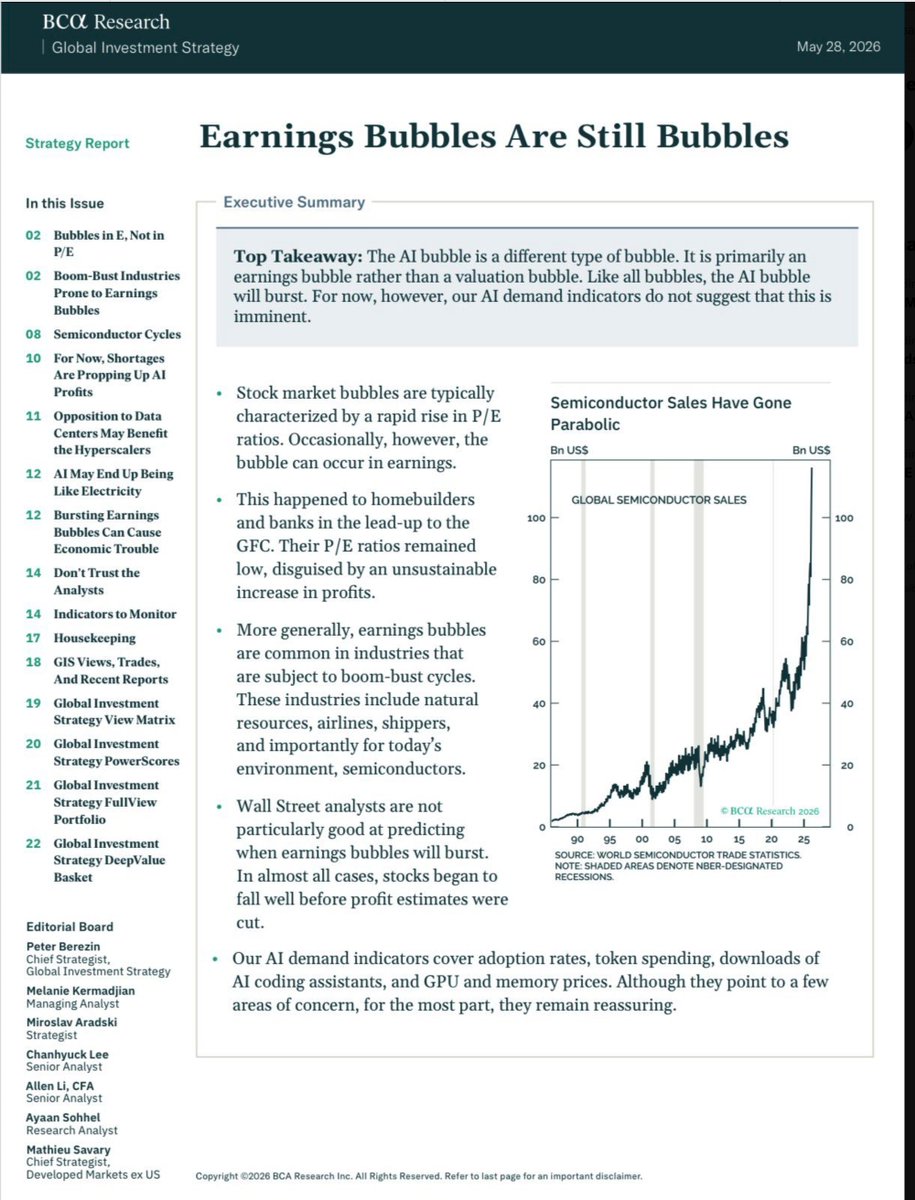
According to BCA Research’s latest report, what we’re witnessing is primarily an earnings bubble, not a valuation bubble.
Semiconductor revenues have gone nearly vertical. AI infrastructure spending continues to accelerate. GPU demand remains extraordinary. Data center capex is breaking records.
The result?
Many AI-related companies appear “reasonably valued” on traditional metrics because earnings are exploding just as fast as stock prices.
That doesn’t mean there isn’t a bubble.
History shows that homebuilders before the Global Financial Crisis and banks before 2008 looked deceptively cheap because unsustainable profits masked underlying risks.
The same pattern may be emerging across AI infrastructure today.
A few observations:
• Global semiconductor sales have entered a parabolic phase.
• AI capex is increasingly concentrated among a handful of hyperscalers.
• Nvidia has become the most important company in the global technology stack.
• Entire ecosystems are now being built around assumptions of continued exponential AI demand.
The key question isn’t whether AI changes the world.
It almost certainly will.
The question is whether current earnings can justify today’s investment cycle once the industry moves from infrastructure buildout to utilization and monetization.
Interestingly, BCA’s conclusion is not bearish.
Their demand indicators — adoption rates, AI software spending, coding assistant usage, GPU pricing, and memory markets — do not yet suggest an imminent collapse.
In other words:
The bubble may be real. The bursting may not be imminent.
For investors, that’s a critical distinction.
The biggest winners of the next decade may still be AI infrastructure, compute, robotics, and autonomous systems.
But history suggests that even transformational technologies rarely move in a straight line.
The internet changed the world.
So did railroads.
So did electricity.
All three experienced bubbles along the way.
AI may be no different.
What matters now is separating temporary earnings acceleration from durable long-term value creation.
Because when the next phase begins, the winners won’t necessarily be the companies selling the most GPUs.
They’ll be the companies creating the most economic value from them.
#AI #NVIDIA #OpenAI #Anthropic #Semiconductors #Investing #PrivateMarkets #Technology #VentureCapital #SingularGlobal #ArtificialIntelligence
@nvidia sold $5.4B of GPUs.
Apollo financed them.
xAI uses them.
Athene owns the debt.
Retirees ultimately carry the risk.
Modern finance isn’t about who owns the asset.
It’s about who ends up holding the risk.
The memory cycle is starting to turn hard
Morgan Stanley says legacy memory is tightening faster than expected, with DDR4 prices potentially rising another 20% in Q3
They now expect a 19% to 20% supply-demand gap in the second half of 2026
And the shortage may not be a short-term issue
It could extend through 2027 and 2028
If that plays out, suppliers like $MU, Samsung and SK Hynix could see a much stronger pricing cycle than the market expected
$IREN is moving deeper into AI cloud infrastructure
The company signed a $1.6B agreement with $DELL for air-cooled Blackwell systems across its Texas data centers
Those systems are tied to IREN’s 5-year, $3.4B AI cloud contract and could help take annualized run-rate revenue to $4.4B
This is no longer just a data center story
It is becoming an AI infrastructure scale-up
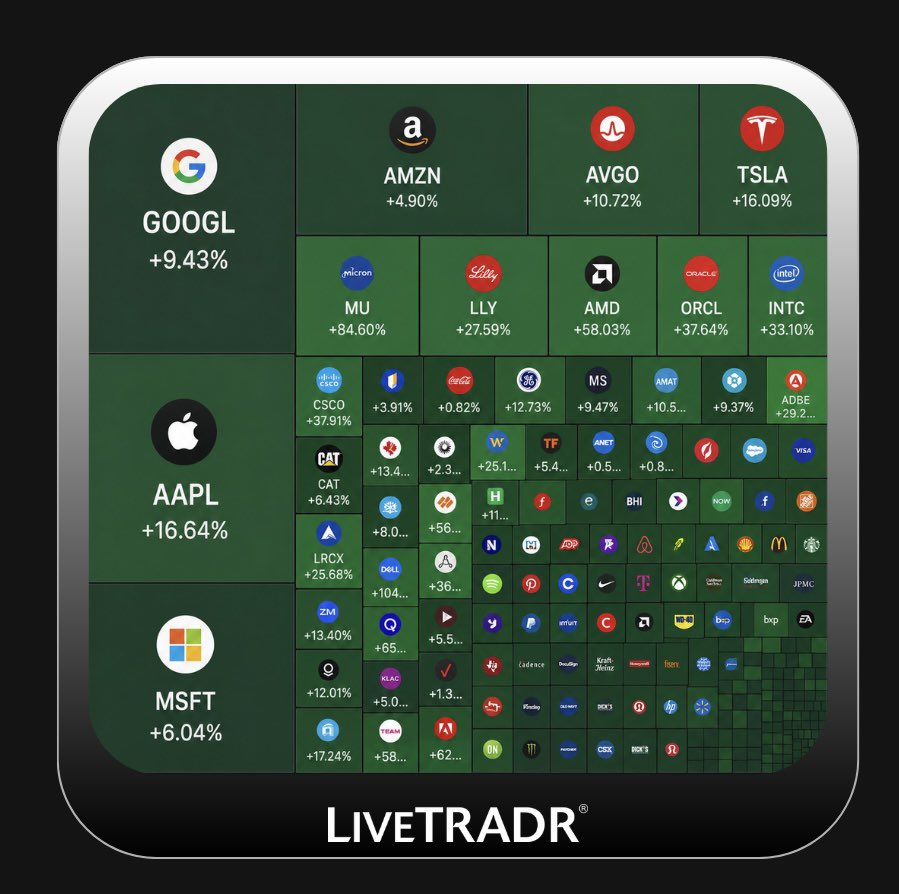
2026 is turning into an AI hardware rally
Top S&P 500 performers:
$SNDK +609%
$MU +238%
$DELL +224%
$INTC +221%
The physical layer of AI is getting repriced
The U.S. Space Force awarded SpaceX a $4.2B contract for its Space-Based Airborne Moving Target Indicator program
Another major win for SpaceX as defense and space infrastructure keep becoming more connected
$META is creating a new Enterprise Solutions unit designed to work directly with corporate customers
The team will embed engineers and product managers inside client relationships to help companies build and deploy Meta’s technology faster
Leopold Aschenbrenner’s long book is still almost entirely an AI infrastructure trade
His largest disclosed positions today:
$NBIS — 35%
$SNDK — 15%
$BE — 13%
$CRWV — 9%
$MU — 6%
$IREN — 5%
$CORZ — 5%
$TSM — 5%
$APLD — 4%
$INTC — 2%
The message is clear:
Memory, compute, data centers and power are still where he sees the AI upside
Rumors are pointing to the first agentic laptop being unveiled Monday in Taiwan
https://t.co/2MC5OigLqB is ready for the next move !
See you Monday !
$MSFT $NVDA
Rumors are pointing to the first agentic laptop being unveiled Monday in Taiwan
https://t.co/2MC5OigLqB is ready for the next move !
See you Monday !
$MSFT $NVDA
Rumors are pointing to the first agentic laptop being unveiled Monday in Taiwan
https://t.co/2MC5OigLqB is ready for the next move !
See you Monday !
$MSFT $NVDA
Rumors are pointing to the first agentic laptop being unveiled Monday in Taiwan
https://t.co/2MC5OigLqB is ready for the next move !
See you Monday !
$MSFT $NVDA
Rumors are pointing to the first agentic laptop being unveiled Monday in Taiwan
https://t.co/2MC5OigLqB is ready for the next move !
See you Monday !
$MSFT $NVDA
Rumors are pointing to the first agentic laptop being unveiled Monday in Taiwan
https://t.co/2MC5OigLqB is ready for the next move !
See you Monday !
$MSFT $NVDA
Rumors are pointing to the first agentic laptop being unveiled Monday in Taiwan
https://t.co/2MC5OigLqB is ready for the next move !
See you Monday !
$MSFT $NVDA