The subgiant star ⭐️TOI-5882 contains high levels of lithium, potentially caused by the engulfment of a smaller planet
📄https://t.co/EdXhCLRmOH
#space#science#astronomy#spacenews
Radial velocity reveals for the first time planetary mass object around a brown dwarf. It was found in the system ⭐️CD-35 2722 consisting of a low-mass star and even lighter brown dwarf
📄 https://t.co/Afhyc24Xu5
#space#science#astronomy#spacenews
🪐TOI-2195 A b is an inflated hot Neptune found orbiting an orange dwarf. Its extreme orbit and physical size suggest it was once a much larger gas giant that lost nearly 90 percent of its mass through gravitational interactions and intense tidal forces
📄 https://t.co/5utDNsMbSS
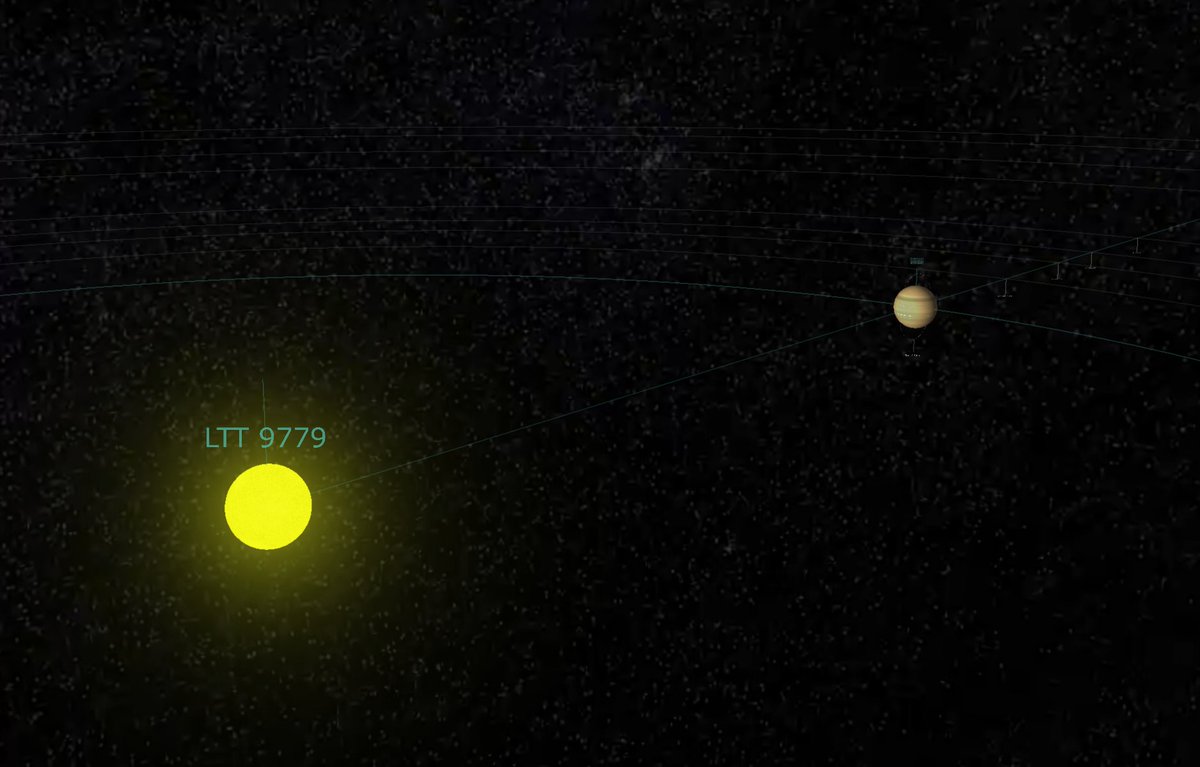
Reflected light from the ultra-hot Neptune 🪐LTT 9779 b has been measured using high-resolution spectroscopy. The planet shows a high geometric albedo of 0.88, suggesting a highly reflective atmosphere likely dominated by clouds or scattering processes
📄 https://t.co/QSKzv5odlE
New observations of the young star ⭐️PDS 70 reveal two elongated dust clumps and a potential third 🪐planet candidate
📄https://t.co/6o7EjkUrp8
#space#science#astronomy#exoplanets#spacenews
A flyby of the star ⭐️HD 7977 may have triggered a comet shower in our solar system 2.5 million years ago. Simulations suggest this encounter explains current comet patterns and indicates the Oort cloud population may be smaller than previously thought
📄 https://t.co/TEmTJJU3kK
James Webb finds ammonia in the atmosphere of giant planet 🪐TOI-6894 b. Observations also show methane, carbon disulfide and signs of water. The chemical makeup is surprisingly similar to the gas giants in our solar system
📄 https://t.co/XAWy9R9l5c
#space#science#jwst
Sub-Neptunes 🪐TOI-421 b and 🪐Gliese 3470 b show evidence of forming in water-poor regions. Modeling indicates that initial building blocks—rock, water, and soot—are the primary drivers of atmospheric diversity in these distant worlds
📄 https://t.co/B4qXjx3J8z
#space#science
Three new hot Jupiters have been discovered orbiting stars nearing the end of their main sequence (⭐️TOI-3664,⭐️TOI-4034, ⭐️TOI-6564). All three planets have radii larger than Jupiter but lower masses
📄 https://t.co/P47gFOByEj
⭐️HD 81809 B shows a strange chemical composition compared to its primary star. A new study suggests this could be due to the star engulfing 25–75 Earth masses of planetary material
https://t.co/luJ6W6u2yJ
#stars#space#science#spacenews#sciencenews
JWST has detected water vapor in the atmosphere of super-Earth progenitor 🪐V1298 Tauri c. The study reveals that the planet's atmospheric metallicity is lower than that of mature planets, suggesting this relationship evolves with planetary age
📄 https://t.co/ikuaTzwA6f
Massive brown dwarf discovered closely orbiting old star ⭐️TOI 7154. The brown dwarf is more than 70 times heavier than Jupiter and seems to be on a limit between very massive planets and low-mass stars
📄 https://t.co/aNAsspueCq
#space#science#spacenews#browndwarfs
The ⭐️14 Herculis system’s two eccentric 🪐super-Jupiters likely owe their chaotic orbits to the early ejection of another massive planet
📄 https://t.co/ut8MUoV5ve
#space#science#astronomy#exoplanets#stars#spacenews
⭐️Proxima Centauri’s two planets show magnetic interactions with their star. Flares are phase-locked to the inner planet’s orbit, and both planets influence stellar activity
📄 https://t.co/6hZE6QZysi
#space#spacenews#science#astronomy#exoplanets
Dayside of extremely hot Jupiter 🪐CoRoT-2 b shows water vapor and carbon monoxide, revealing a complex atmosphere
📄 https://t.co/bGYzlSrIZh
#space#science#spacenews#astronomy
A cold Saturn-mass 🪐planet was found orbiting a Sun-like star ⭐️HD 38973 every 7.5 years. Precision measurements confirm its mass and highlight the power of combining radial velocity and astrometry
📄 https://t.co/61Du5dr6Xc
#space#science#spacenews#sciencenews
Super-Earth 🪐Gliese 3378 b, orbiting a nearby red dwarf, is lighter and closer to its star than previously thought. It sits in the habitable zone, near the the limit where atmospheres may be lost
📄 https://t.co/MT3J5BuTRs
#space#science#spacenews#sciencenews#astronomy
🪐super-Earth found orbiting nearby red dwarf ⭐️Ross 318 (Gliese 48) in its habitable zone. The planet is more than 6 times heavier than Earth and orbits the star in 40 days. Only 27 light years away
📄 https://t.co/AoMHMxwi9I
#space#science#astronomy#spacenews#sciencenews
🪐super-Earth found orbiting nearby red dwarf ⭐️Ross 318 (Gliese 48) in its habitable zone. The planet is more than 6 times heavier than Earth and orbits the star in 40 days. Only 27 light years away
📄 https://t.co/AoMHMxwi9I
#space#science#astronomy#spacenews#sciencenews
Orange dwarf star ⭐️TOI-4311 hosts a dense super-Earth with a one-day orbit and a sub-Neptune with a fifteen-day orbit. A third planet may exist, but needs to be confirmed
📄 https://t.co/RJ5kjlUpBW
#space#science#astronomy#spacenews#sciencenews