Google can't stop.
@GoogleDeepMind Gemini 4 Hydrogen outperforms @AnthropicAI Opus 5.5 across most of our rare-disease benchmarks for a fraction of the price, lower latency, and faster throughput.
Hydrogen vs. Opus 5.5
RareBench: 49.2% vs. 51.6%
LabBench: 46.0% vs. 40.2%
LabRobotBench: 31.7% vs. 23.0%
ScreenBench: 70.2% vs. 47.2%
And latency and throughput don't get talked about enough. The combination of Gemini 4 Hydrogen's speed and intelligence lets it operate as a real-time agent in the loop with our laboratory robotics.
The video shows our workcell autonomously running an experiment with nothing more than a natural language prompt to Hydrogen. This performance is reflected in its very strong score on LabRobotBench as well.
More information on all of these benchmarks is available at https://t.co/HbNAgoKecq
Congrats on another great launch, Big G!
Robotics RL is very hard, particularly because of how expensive robotics can be to operate. In high-consequence environments like a wet lab, performing many rollouts to find out what works is impossible. Because of this, we simulate.
How do we prove realism in simulation? How can we ensure that the learning that occurs in simulation translates to real-world hardware?
These are some of the most important questions to ask in robotics RL. We focus on this in our latest LabRobotBench update. As we iterate, we bring our simulations closer to reality, allowing us to
1. Learn faster, because we can rollout in simulation
2. Be more robust in production, because we've caught failures in simulation.
Our latest blog post goes through our approach in detail.
Can frontier AI agents run a robotic wet lab?
We built LabRobotBench to test how they operate equipment, manage timing, and recover interrupted experiments. LabRobotBench allows models to steer a simulation based on our real wet-lab setup in Boulder, CO!
The best model tested, GPT 6.1 Sol, scores a 46% on our benchmark.
Improving on LabRobotBench implies better robotic control and spatial awareness, as well as biological reasoning.
read more in our latest blog post: https://t.co/ZVLKV23Ns0
@GoogleDeepMind gave us early access to Gemini 4. which achieved first place on our clinical genetics benchmark RareBench and scientific experiment design LabBench.
Thank you to Google for the early access and congrats on the launch!
Big G is back! 🙇
@GoogleDeepMind Gemini 4 takes the 👑 on @GamowLabs RareBench and LabBench by a healthy margin over previous champ Opus 5.5.
A tip of the hat to @melvinjohnsonp, @taotu831, @divy93t, and the rest of the science team for this very strong release.
We've moved essentially all of our biology and genomics research work to Gemini 4 in agy with science skills since joining the EAP program and look forward to seeing if this model can help diagnose some new kids!
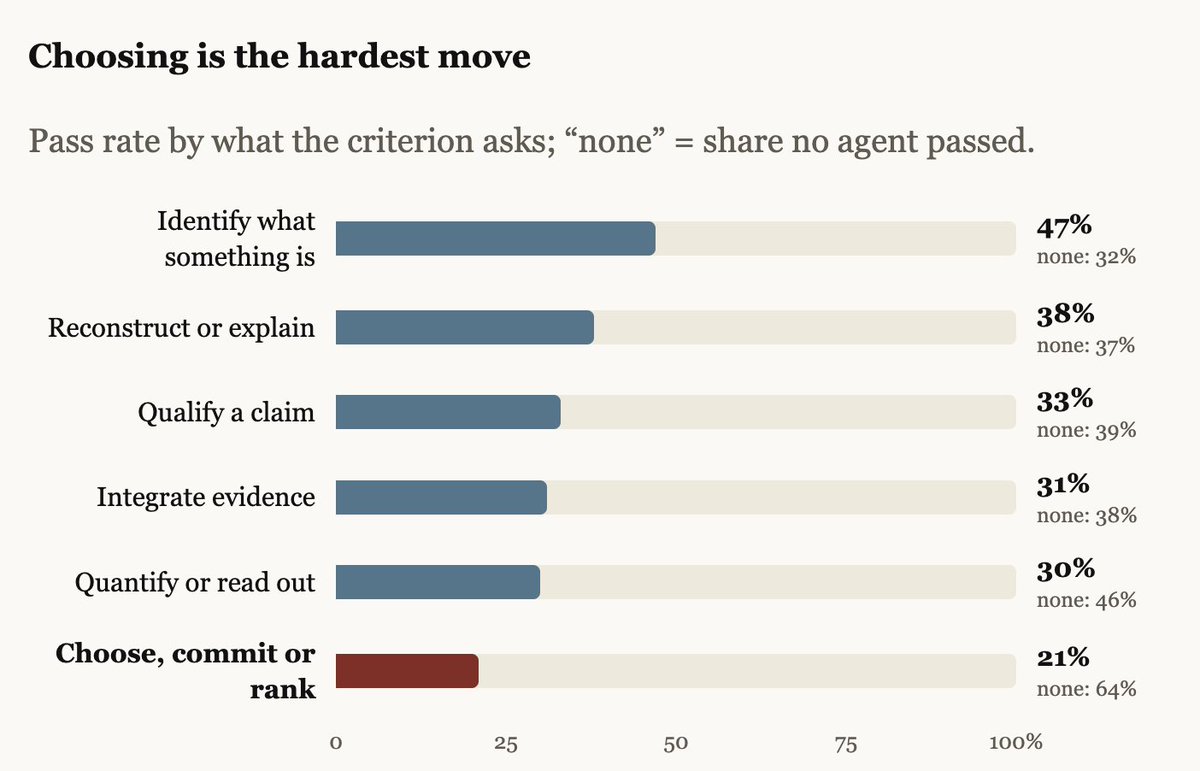
Can AI agents decide what experiment to run next?
We present LabBench, a benchmark built to challenge agents to choose and design experiments for wet-lab biology.
Our core finding: agents struggle to commit to the next most-important experiment, despite considerable domain knowledge and expertise demonstrated in other parts of the eval.