Advanced Physio Practitioner GP Practice NHSLothian and McNaughton Physiogrange Edinburgh, honorary lecturer UoE, PhD on injury prevention. Views my own.
I've been a shoulder surgeon for close to 30 years... It's pretty clear now that most rotator cuff tears do not require surgery. Some do. Most don't.
Why is that? Why can a shoulder with a cuff tear function normally?
Well... check the first reply and find out.
This recent paper, “Neuroimmune interactions in musculoskeletal conditions: an introduction for clinicians”, has me thinking about how we package information about pain for patients.
https://t.co/APSqRj8o2r
Here are five educational Pain Science lenses 🔎 that may help structure conversations & help patient understand their pain and, importantly, take action from a persistent pain perspective.
These are covered in depth on our residential BACK to Health Programme, but can also be used selectively in one-to-one settings. They offer different ways of understanding pain, depending on which lens and how deeply a patient wishes to engage.
🔎 1. Risk factors
Why me, maybe?
Examples include menopause, concurrent health conditions, smoking, obesity, and high or monotonous occupational activity.
🔎 2. Initial triggers
How did this start?
Sometimes historical, sometimes related to a traumatic event. These can help people connect the dots and make sense of what kicked things off, although they are not always relevant to the current situation and are often not modifiable.
🔎 3. Sustaining stuff
What is happening now that may be stifling recovery, quality of life, function, distress: Over-protection, reduced activity, stress, crappy sleep, beliefs, lack of social support, framing, and tissues with issues.
🔎 4. Underlying physiology
e.g Blood flow, acute inflammation, chronic inflammation, pressure, neuroimmune interplay, central processes.
Neuroimmune mechanisms are explored in this paper. In clinic these should be broken down into simple, relatable ideas that can be integrated or lightly alluded to.
🔎 5. Pain philosophy
The meaning of pain to the individual and to humans more broadly.
Hurt versus harm, over-protection, discordance between structure and pain, concordance between structure and pain, management philosophies, prognosis, how pain changes over time, the multifaceted nature of pain, and general health as a pain barometer.
A few clinical pointers:
✅️Avoid painsplaining. Allude to concepts and ask what level of understanding the patient wants.
✅️ Link explanations to the patient’s life and story.
✅️Use underlying physiology judiciously and only where it meaningfully relates to one or more of the five lenses.
My latest blog is about Achilles tendon tears and how to spot them. They are real! Without a good history, you're unlikely to pick them up.
Read the full blog here: https://t.co/ma3xdiodtO
PS my new course is coming to the Gold Coast & UK!
Details here: https://t.co/TruF1z24z5
195 studies have assessed associations between potential risk factors and 🦵 injuries across 1,525,662 athletes. Only 2.4% were females/women/girls & only 115 reported female/woman/girl specific data. Lots of room for improvement #FAIRdreamteam
PEAQ is a free web based app for #athletes all disciplines and #dancers Male and female versions. Personal report immediately generated on completion with score and breakdown scores for #physical#physiological and #psychological#health PEAQ based on published research
'The NHS wouldn’t tell a surgeon to stop an operation halfway through.
'A pharmacist wouldn’t hand out 40% of a course of antibiotics.
'So why is it OK for patients to be denied a full course of rehabilitation?'
@SHazzard#RightToRehab
https://t.co/gNy3zr7mVz
Sunday Express Better Bones campaign week 71:
Diagnosed with osteoporosis at 55, Sara feared she'd have to stop walking. With the right support, she’s back on the fells.
Thanks to the Sunday Express for another inspiring #BetterBones story.
Free access to our latest editorial on pain vs function until 5 June! Perfect for journal clubs, team discussions, or sparking debate - please read, share, and join the conversation! @neiljlangridge https://t.co/iNGhJUyBxf
Open-access online osteoarthritis training for community-based clinicians.
We conducted a mixed methods evaluation of the e-learning modules that we developed for the KneeCAPS clinical trial. The paper is available open access:
https://t.co/t53C8Bj4ag
1/4
📋Acute ankle sprain in athletes: Clinical aspects and an algorithmic approach 🦶
Here is a comprehensive review article covering a wide range of topics on acute ankle sprains 👇
https://t.co/8Lpc5NkKbV
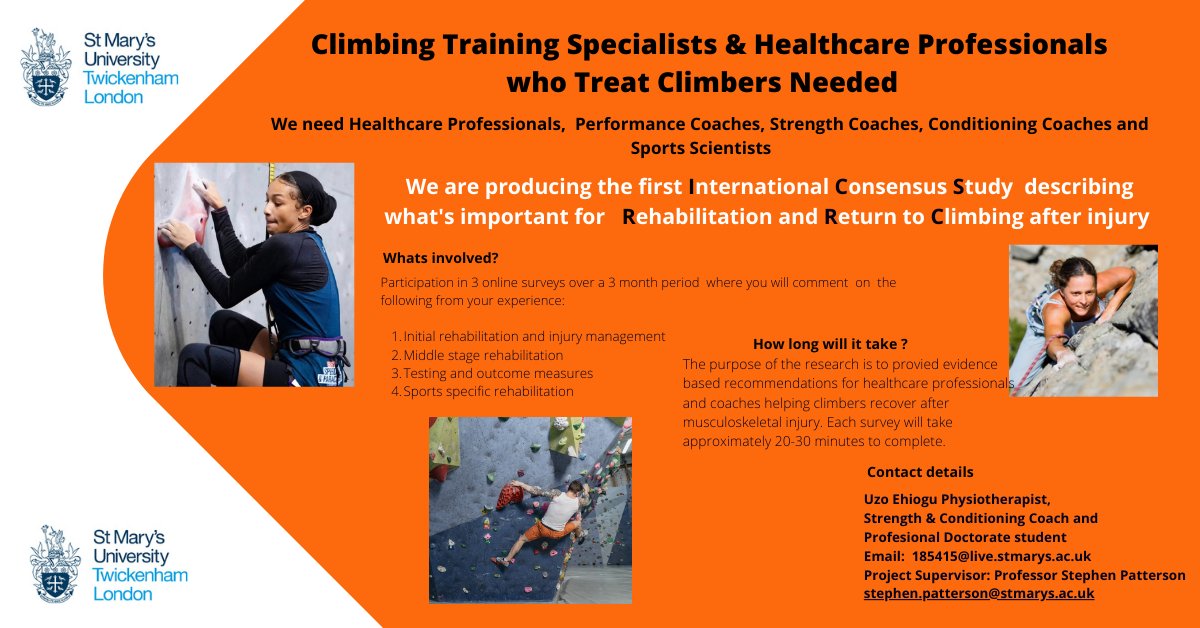
🚨 Developing the 1st International Consensus study describing "What is important for rehabilitation and return to climbing 🧗♀️ after injury" 🚨 Looking for
HCPs and Performance coaches who work with climbers to participate... *(Please DM me ) Retweets very much appreciated