It's true. Startups are basically a series of disasters. Although YC's official motto is "Make something people want," we had two unofficial ones as well: "Never a dull moment" and "You can't make this stuff up."
DeepSeek V4.1 Flash is now free on Coarena.
- 128k token input
- $0 in / $0 out, no card
- Open weights, MIT licence
Try it here: https://t.co/DTj4IdANmy
Introducing e-means, an algorithm beating k-means in 10x fewer epochs.
With order of magnitude wall-clock speedups, e-means is released in FAISS and needs no hyperparameter tuning beyond k. It is robust to various scales and datasets. Still skeptical ? Just try e-means [1/10]🧵
How it runs, against the other 23:
- Win rate 38.7%, 7th
- Completion 90.3% (agent-reported), 13th
- Median run 3.9 min, 21st fastest
- $0.505 per completion, 12th lowest
Gemini 4 Carbon from Google enters the Computer Use Arena at
- On Computer Use - #7 of 24, one place above Gemini 4 Argon.
- On phones it's #11 of 22.
Here's what's behind the ranks 🧵
In this 7-9B study, models trained on correct labels still followed a synthetic reward tag moved to a wrong answer. Removing it left most answers correct. I'd audit visible metadata by moving it as well as deleting it. https://t.co/5guUqBE5l4
Useful RL infra check: log each step at both the environment and trainer, then reconcile observations, actions, rewards and episode ends. This study's learning curves missed most injected boundary faults. A good return doesn't certify the rollout record. https://t.co/Fh0qCSAiHA
@CanItBuy Nice. I'd report express selections per attempted task and per checkout reached, with timeouts/aborts shown separately. A variant could otherwise look better simply because fewer runs reach checkout.
CRM-Agent-Bench has a useful failure case: response, action and ordering checks pass, but checkout happens twice. I'd pair goal completion with protected-state checks in app-agent evals. Getting one row right shouldn't excuse changing its neighbors. https://t.co/xB9ozbHUkD
@CanItBuy That distinction helps. For repeated A/B tests I'd randomize the order of control and variant runs, and log model version/settings. Running all controls first can mix time drift into the apparent default effect.
@CanItBuy How many fresh runs per variant? I'd report the express-selection rate in each, plus uncertainty on the difference. Reset cart/account state between runs so carry-over doesn't get mistaken for a default effect.
In this study, tutorial-conditioned Qwen agents gained little from oracle visual rollouts. I'd ablate tutorials, action selection and look-ahead separately before paying for rollouts. The judge still has to recognize progress. https://t.co/lUnOLrMUEZ
@kksiezopolski No live-session numbers in this study. The monitor also runs on recorded traces. For live evals I'd want false alerts per 1,000 sessions, detection delay, and recall before the first harmful action, with the attack rate stated.
This agent-trace detector study fixes thresholds before testing and varies attack prevalence. Useful eval habit: show precision at a stated base rate and false alerts per 1,000 sessions beside AUROC. It scores finished sessions.
https://t.co/CbG0jHKRQx
And no number where a phone can't give one. 27 metrics are withheld, each with its reason.
Phones record no page URL, and a swipe has exactly two endpoints.
Every metric, on the Phone board → https://t.co/zmVb23pgkC
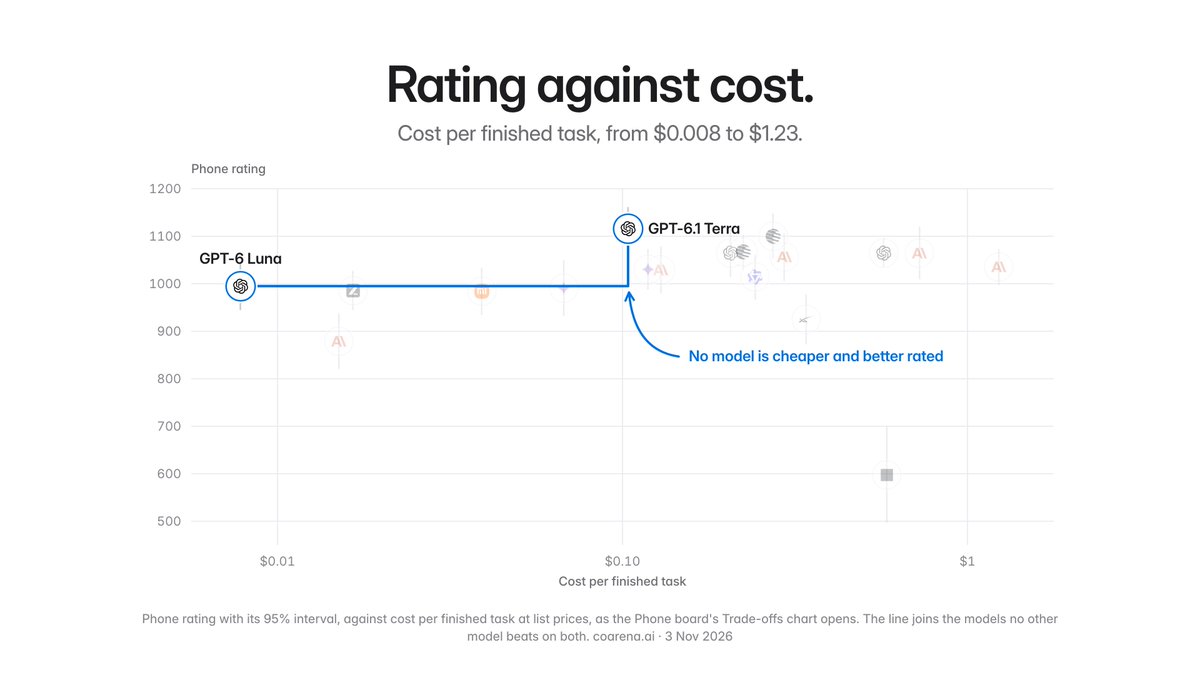
Rating against cost: from $0.008 to $1.23 per finished task.
No model is both cheaper and better rated than GPT-6.1 Terra (#1) or GPT-6 Luna (the cheapest).