NEW: No 10 finally confirms that Keir Starmer uses *disappearing messages* function - meaning that countless exchanges with Mandelson may have been lost
One bizarre question that arises from reading about the fall of the Roman Empire is: "Where the hell are all the soldiers?"
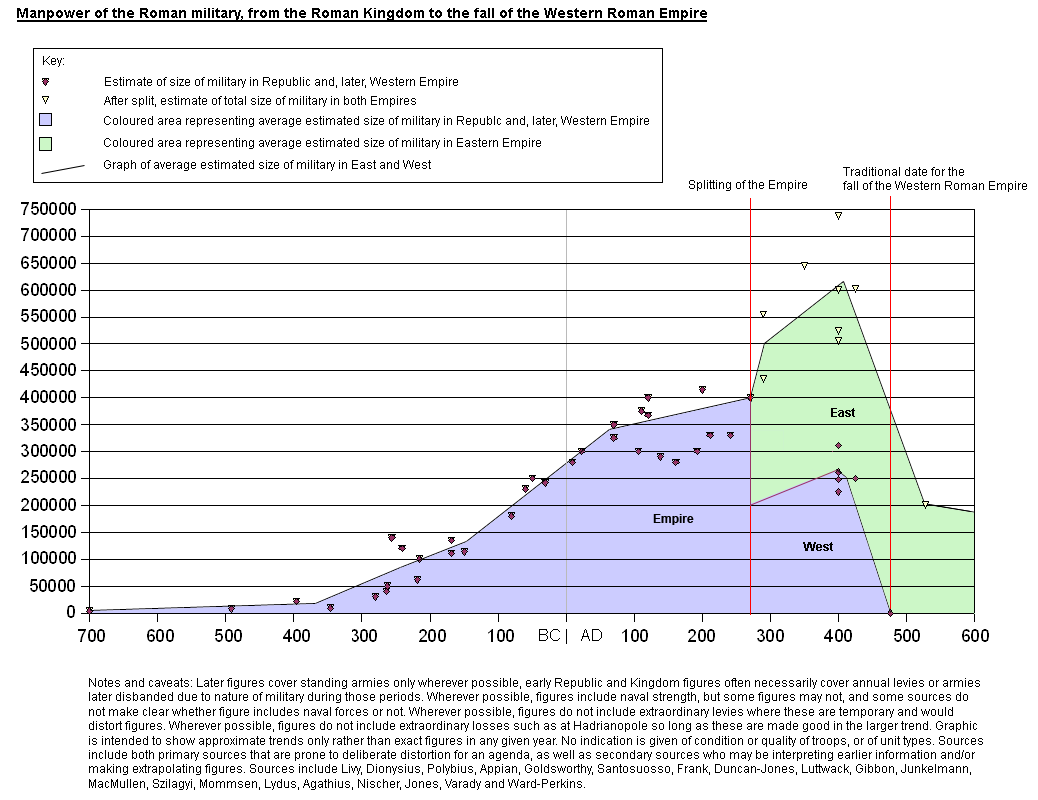
On paper, from documents such as the Notitia Dignitatum, the late Roman army was supposed to have had around half a million troops. Larger than ever before.
Yet time and time again we see barbarian invasions overwhelm Roman defenses, with an unclear military response. And when engagements do happen, the size of the Roman army reported is often smaller than during previous periods in which the total number of troops and manpower available to the empire was supposedly smaller.
So where was this vast Roman army when the Goths spent decades moving throughout the empire, or when the Rhine frontier fell in 406? Or when Rome was sacked and Britain was abandoned in 410? Or when North Africa was overwhelmed and lost? Did it just evaporate?
Exclusive: Senior military officers who have seen the unpublished defence investment plan have raised concerns with colleagues that there is not enough money for key technologies even with the £18 billion, which Sir Keir Starmer is yet to sign off. There are concerns he might only agree to £15 billion https://t.co/NtNm55Zudd
Interesting to see what Flint wines are doing; selling per bottle on fine wines. Something really common in the rest of the world but the UK still sells mainly by the case. Is that tradition now turning?
A community college professor named Marty Lobdell taught the same study skills lecture for 30 years. The video quietly became one of the most watched educational recordings online, with over 10 million views.
He spent his career watching students fail not because they were lazy, but because no one had taught them how their brain actually works when learning something difficult.
The lecture, “Study Less Study Smart,” contains a powerful framework.
Your brain cannot sustain focus the way most people believe. Studies show the average learner hits a wall between 25 and 30 minutes. After that, efficiency collapses. You’re still sitting there, but almost nothing is being absorbed.
Lobdell told the story of a student who planned to study 6 hours a night, 5 nights a week. Thirty hours total. She failed every class. She was not lacking effort. She was confusing time near books with actual learning. The fix is simple: when focus drops, stop, take a 5 minute rewarding break, then return. That reset makes a massive difference.
He also destroyed the myth of highlighting and re reading. Recognition is not the same as recall. To prove it, he read 13 random letters. Almost no one remembered them. Then he turned them into “Happy Thursday.” The entire room recalled them instantly. The brain stores meaning, not repetition.
This is why elaborative encoding works so well.
Finally, he shared the most important principle: 80 percent of study time should be active recitation. Close the book and explain the material in your own words. Teach it to someone else or an empty chair. Retrieval is where real learning happens.
His closing line stuck with me: If this information does not change your
behaviour, you have not actually learned it.
The best students do not study more hours. They stop confusing the feeling of studying with the reality of learning.
Things Andy Burnham needs to upblock -
1./ Defence investment
2./ Stopping the Russian shadow fleet
3./ Housebuilding
4./ Investment in nuclear energy
5./ Energy pricing
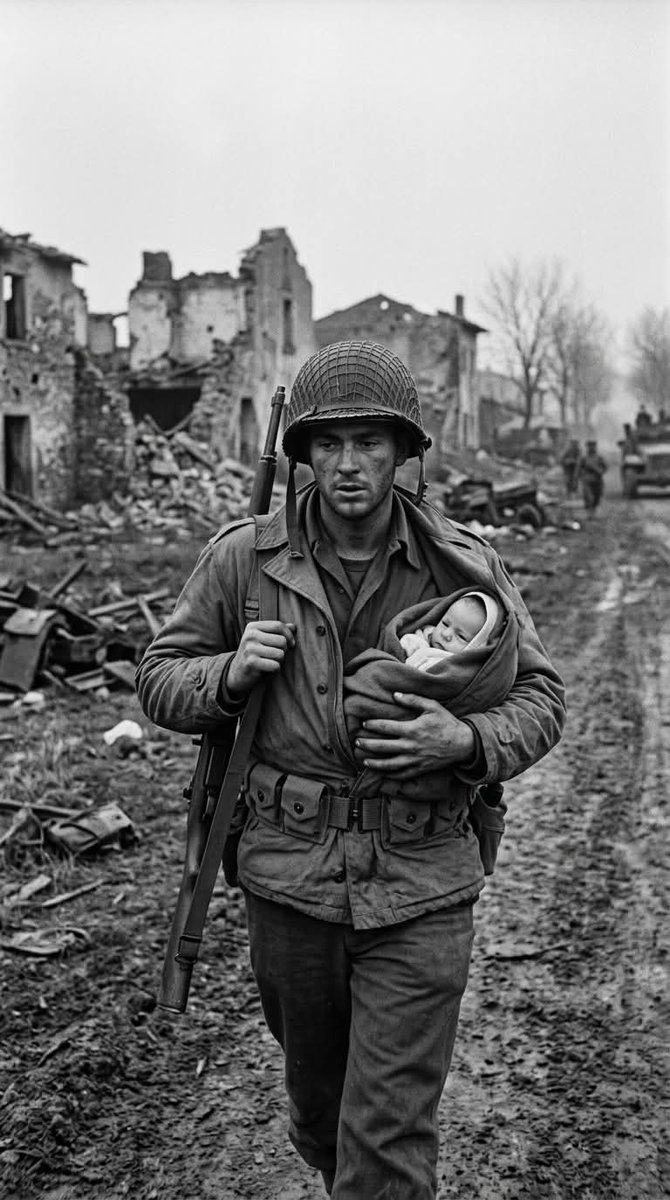
The Soldier Who Found a Baby on the Battlefield and Carried Her for 40 Miles
The American Soldier Who Found an Abandoned Baby on the Italian Battlefield and Carried Her 40 Miles to Safety — Then Spent 60 Years Wondering If She Survived, Italy, 1944.
January 1944. Anzio, Italy.
The Anzio beachhead was a particular kind of hell — a narrow strip of Italian coastline held by Allied forces under constant German bombardment, no room to advance, no room to retreat, just the grinding daily mathematics of holding ground under fire.
Corporal James Whitaker, 24, Georgia, was moving through a bombed farmhouse on a patrol assignment when he heard it.
Not crying — past crying.
The sound an infant makes when it has cried beyond what crying can accomplish and has gone to a place beyond it, a thin persistent sound like a mechanical thing running down.
He found her in the farmhouse cellar. An infant girl. Eight months old at the most. Alone in a wooden crate lined with a woman's wool coat. Alive, barely, from cold and dehydration.
No one else in the farmhouse. No one else anywhere visible.
He picked her up.
The Problem
James Whitaker was on a combat patrol in an active battle zone carrying an infant who would die if he put her down and who he had no ability to help if he kept her.
He had no formula, no milk, no baby supplies of any kind.
He had his canteen, a chocolate bar, and forty miles between his position and the field hospital at the rear.
He started walking.
The Forty Miles
He carried her inside his field jacket, against his chest, where the body heat kept her warm.
He gave her water from his canteen, dripped slowly from his finger to her lips the way he had seen his mother water young animals — a memory that surfaced from childhood without warning and turned out to be exactly applicable.
He broke small pieces of chocolate and let her suck the sweetness from his finger.
He moved at night when he could, staying off roads, moving through terrain that was simultaneously trying to kill him from German positions and from Italian winter.
He talked to her. Quietly, constantly, in the specific soft register humans use with infants regardless of whether the infant understands. He told her about Georgia. About his mother's cooking. About the farm where he grew up. He told her it was going to be fine, which he was not certain was true but which he had decided to commit to regardless.
She was alive when he reached the field hospital at dawn on the second day.
A nurse took her from his arms.
He sat down on the ground outside the hospital tent and did not get up for an hour.
The Handoff
The field hospital logged the infant as a found civilian, turned her over to an Italian Red Cross representative, and that was the last official record that connected her to James Whitaker.
He asked about her before he went back to his unit. They told him she was stable, that she would be placed with a relief organization, that she would be taken care of.
He went back to his unit.
He went back to the war.
The Sixty Years
James Whitaker came home to Georgia in 1945. He married. He had three children. He farmed and then he worked in hardware and then he retired.
He thought about the baby for sixty years.
Not obsessively — he was a practical man, not given to obsession. But consistently. On certain mornings. On certain nights. A presence in the back of his mind, an open question he had never been able to close.
She would be in her sixties now, he would calculate. He did not know her name. He did not know if she had survived the war, the occupation, the chaos of postwar Italy. He did not know if she had a family, children, a life.
He knew only that he had carried her forty miles and handed her to a nurse and never found out what happened next.
In 2004, his granddaughter Sarah — seventeen years old, working on a school project about WWII — asked him if he had any war stories.
He told her one.
Sarah put it on the internet.
The Finding
Three months later, a woman in Bologna, Italy, contacted Sarah's email address.
Her name was Maria Conti. She was sixty years old. She had been told, by the Italian family who had raised her, that she had been found as an infant during the Anzio campaign by an American soldier who carried her to safety.
She had been looking for that soldier for forty years.
James Whitaker was eighty-four years old when Sarah showed him the email.
He read it twice.
He looked up at his granddaughter.
"She's alive," he said.
"She wants to talk to you," Sarah said.
They spoke by telephone first — Sarah translating between English and Italian. Then by letter. Then, in 2005, Maria Conti flew to Georgia.
She was sixty-one years old. She was a schoolteacher. She had three children and five grandchildren.
She walked into James Whitaker's living room and he stood up — slowly, at eighty-five, he stood up — and they looked at each other.
Maria crossed the room. She took both his hands. She said something in Italian.
Sarah translated: "She says she has wanted to say thank you her whole life. She says she is sorry it took sixty years."
James Whitaker held her hands.
He said: "Tell her sixty years is nothing. Tell her I just needed to know she made it."
More AI agent observations below (I keep adding to the list):
1. Hermes agents write to their own memory after every task. Which means starting today versus starting in 6 months is an unfair advantage for you.
2. We're maybe 12 months from an agent that can watch you work for a week and then do your job without any instructions. The screen recording plus agent memory plus local model combination makes this possible right now
3. The real reason local models matter for founders: you can ship a product where the AI runs entirely on the customer's device and you never touch their data. Zero privacy concerns. Zero server costs. Zero compliance headaches.
That changes which industries you can sell to overnight. Healthcare, legal, finance, all the regulated verticals that won't send data to the cloud just opened up.
4. Every company needs to be rebuilt as a "second brain" before agents can be useful. That means every process, every decision, every piece of institutional knowledge has to exist in a format an agent can read. Most companies have none of this.
5. Agent costs are the new headcount. Won't be crazy for companies to spend 50%+ of their total headcount cost on tokens.
6. Agents are accidentally creating internal competition at companies. The marketing agent and the sales agent are optimizing for different metrics and working against each other without anyone realizing it. It took humans decades to develop cross-functional alignment. Nobody thought about it for agents.
7. The YAML config file is becoming the new org chart. Who reports to who, what permissions they have, what tools they access, all defined in a config file. The company's structure is literally a file you can version control, fork, and deploy. That's new.
8. The first agents that can smell a scam are going to be worth billions. Right now agents will happily wire money to a fake invoice because it matched the format. The trust layer is completely missing.
9. We're about to find out that most "expertise" was actually just memory. Knowing the tax code. Knowing the case law. Knowing which supplier charges what. When an agent holds all of that in context, the expert's value shifts from "I know things" to "I know which things matter." Much smaller group of people.
10. We're all running the same models. The differentiation is in what you feed them. Two founders with the same agent, same model, same tools will get wildly different results based purely on the quality of their knowledge base. Garbage context in, garbage output out. Forever.
11. The most underbuilt category in AI right now: agents for old people. 70 million boomers who need help with medical forms, insurance claims, and appointment scheduling.
12. Agent latency is the new page load speed. If your agent takes 45 seconds to respond, your customer already switched to one that takes
13. Skills files are the new apps. A SKILL.md that tells an agent how to do one thing well is more valuable than a SaaS subscription that does the same thing behind a login screen.
14. AI hardware... how do you create devices that are good businesses that people want? It'll be a $30 dongle you plug into existing dumb devices to give them an agent brain. Smart toaster doesn't need to be built from scratch. It needs a $30 brain attached to a $15 toaster.
15. Your agent can read faster than you can think. The bottleneck in every agent workflow is now the human approval step. We're the slow part. That's a strange thing to sit with.
16. Agents made the 80/20 rule violent. The 20% of work that matters is now the only work humans do. The 80% just disappeared. Entire job descriptions were hiding inside that 80%.
17. The thing I keep coming back to: the best businesses right now are being built by people who are just slightly ahead of their customers. Not 10 years ahead. 6 months ahead. That's the sweet spot. Far enough to lead. Close enough to be understood.
Managers across tech are getting wiped out. The ones who survive will be the ones who stayed close enough to the work. We’ve seen this play out before. In 2008, the financial companies that went bust had one thing in common: their leaders had no idea what was actually happening on the inside. They were managers of managers. The same thing is true today. If you are not using AI yourself at least 10% of your time, you are in the business of listening to other people tell you things you don't know are true.
@BethRigby The UK needs a PM for the whole country who happens to be Labour, not a Labour PM for the country. Starmer still doesn’t grasp the need for a vision that speaks to everyone, the urgency of growing the economy, or the importance of defending the country from growing threats.
The most important AI story today isn't a new model but rather it's two massive bets on who controls how AI gets used (Save this).
OpenAI and Anthropic have both concluded, simultaneously, that the bottleneck in AI is no longer capability, it's deployment.
The models are good enough but the problem is that most companies can't actually install them inside their businesses.
They don't have the teams, data pipelines, security architecture or operating discipline to take a frontier model and make it affect revenue.
Both companies have now placed an identical bet on how to close it, use private equity as their distribution engine.
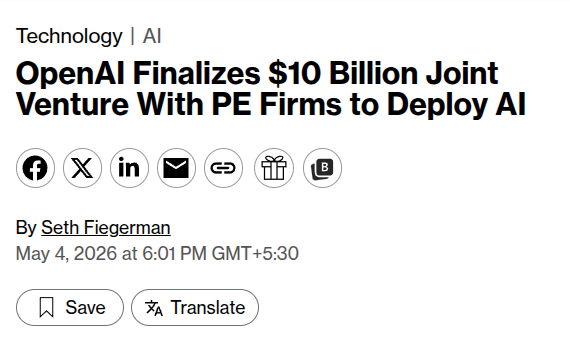
OpenAI finalized its joint venture today officially called The Deployment Company backed by 19 investors including TPG, Brookfield, Bain Capital, SoftBank, and Dragoneer.
The PE partners collectively touch over 2,000 portfolio companies and clients, turning AI enterprise selling from a one company at a time pitch into a routed distribution network across thousands of businesses simultaneously.
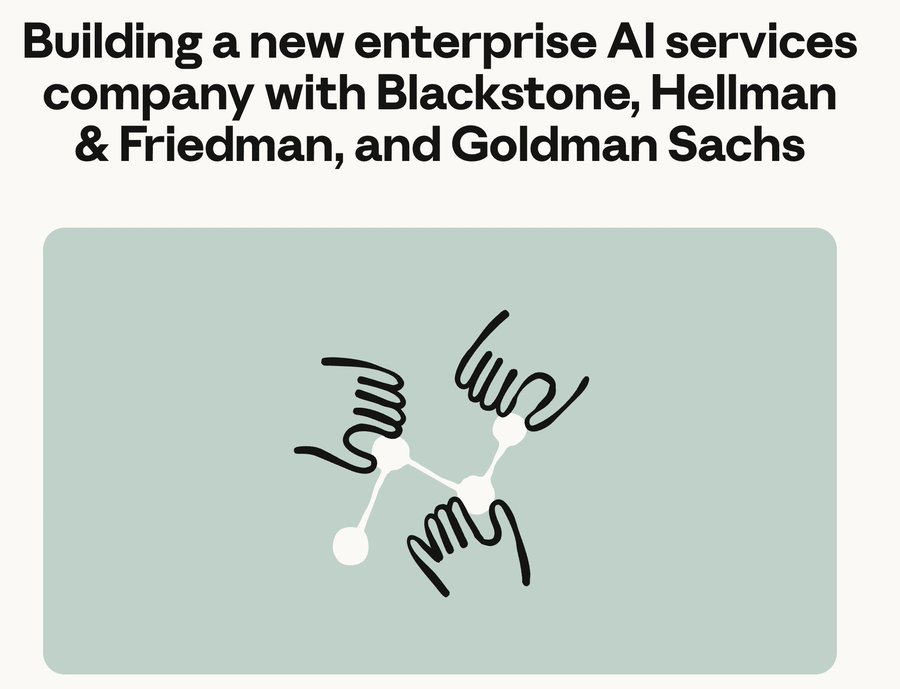
Hours later, Anthropic announced its own version, a $1.5 billion joint venture with Blackstone, Hellman & Friedman, Goldman Sachs, and General Atlantic.
But Anthropic's structure is different in one critical way rather than a financing vehicle with an AI partner, this is a standalone operating company with Anthropic engineers embedded directly inside it.
The execution philosophies reveal two different theories of the market.
OpenAI's is a volume play, pull as many PE portfolios as possible into a captive distribution channel as fast as possible while Anthropic's is a credibility play, a smaller number of deeply prestigious financial institutions whose imprimatur sells Claude to the rest of the market, with embedded engineers who can continuously evolve implementations as the model itself changes every few weeks.
The implications for traditional consulting are severe.
McKinsey, Deloitte, Accenture, and BCG have collectively built $300 billion in annual revenues selling exactly this service.
What OpenAI and Anthropic are building is that same function without the middleman margin, without the slow sales cycle, and with the actual model developers sitting in the room and no consulting firm appears on either cap table.
The next AI race isn't about benchmarks but it's about who industrializes deployment fastest and embeds so deeply into real business workflows that switching becomes unthinkable.
JUST IN: A Trump judicial nominee was asked point blank: is Trump eligible to run for a third term?
Their answer: “I would have to review the actual wording…”
Sen. Chris Coons then asked every nominee in the room to confirm the Constitution bars a third term.
Silence.
Every single one of them refused to say it.
Trump is appointing judges who won’t affirm the 22nd Amendment to his face.
Never stop connecting the dots.
10 things I'm seeing on the frontlines of AI adoption in the enterprise:
1. Chat is where 90% of employees still live. It's the gateway drug. Everything else is downstream of getting people comfortable here first.
2. Power users discover Cowork and lose their minds. It's the "wait, it can actually do the work?" moment.
3. Claude Code has very little penetration with non-technical users in the enterprise still.
4. Microsoft being the "approved" tool doesn't matter. Employees route around Copilot and pitch their managers for Claude access on their own.
5. Artifacts in Claude are a breakout feature. People don't want to view them — they want to deploy them, connect them to Snowflake, etc., ship them as internal MVPs for their org to actually use.
6. Cowork is crossing the line from "demo" to "real work." Legal teams redlining contracts. Ops teams running workflows. Then immediately asking: how do I automate this for production?
7. The next unlock → automated cloud workflows that leverage an agent like Claude while keeping non-technical users within the tools they're already using and in a chat interface. The demand is screaming.
8. Terminology is major blocker. Projects vs. skills vs. plugins vs. agents. I've explained "what is a skill" 200+ times. The moment it clicks, people get excited — but the path there is too long.
9. Enterprise IT restrictions (locked connectors, no browser access) quietly strip Cowork of its superpowers. The features that make it magical are the first ones IT disables.
10. There is a high level of "AI insecurity". For the first time in a long time, people at all levels (even C-Suite) need to signifcantly upskill in order to stay world class in their positions, and this is causing people to be insecure about their skill set across the org.
General note on Microsoft: I spent a lot of this past week deep in Power Automate and Copilot Studio trying to build an automated solution in the cloud — given it's the native tool with sanctioned access to their org's data.
It's ~90% there. But the final 10% is riddled with terrible UX, inconsistent behavior, and a generally poor experience.
Honestly feels like Microsoft is fumbling the biggest moment in their company's history with software that has all the features on paper but lacks the magical "just works" moment for non-technical team members. The gap is wide open and they're letting others
"eat their lunch" right now.
With Trump no longer able to protect Putin’s forces in occupied Ukraine, Ukrainian forces are free to attack and appear to be engaged in a shaping action in advance of a move to encircle Donetsk city.
Ukraine has changed war forever. Infantry are no longer the principal means of domination. The individual soldiers are simply targets for drones. What we called the front based on the forward line of contact is becoming irrelevant when drones can reach deep into enemy territory and bring the dangers associated with a traditional front to what used to be consider rear areas leaving troops under contact threat from non-human zombie-like attackers.
Russian forces have reached breaking point and if Trump was not Erdogan’s pet trained monkey the same could be true of the IRGC north of Qom.
25 questions every exec should ask as they transform their business with AI:
1) How can I tell the difference between AI activity and AI productivity?
2) Which of our current competitive advantages get eroded or amplified by AI becoming more widely used?
3) How do we have a cohesive AI strategy vs. a bunch of experiments with no clear process or rigor?
4) What is our responsibility for AI upskilling vs what is our employees?
5) How do we make sure we're not just adding AI to existing products/processes but starting from scratch and using first principles to reimagine them?
6) How do we message our AI strategy in a way that is honest and empathetic to employees?
7) What does "transforming your business with AI" actually mean? What is the menu of opportunity?
8) If a task drops from $100 to $1, what’s worth doing that wasn't worth it before?
9) What is our risk framework for making go/no decisions on AI tooling & systems?
10) How do we create a culture of experimentation and exploration for employees while mitigating unpalatable security risk?
11) How do we bubble up AI use cases and opportunities through employees and prioritize and productionize those opportunities from the top?
12) How does leadership get their hands dirty and walk the walk with AI proficiency and building to effectively lead by example?
13) How do we have a data strategy that gets us progressively AI ready, but also doesn't hold us back from beginning our transformation today?
14) Where do we start?
15) How do we build AI systems and solutions that have harnesses that are model agnostic, so we're well positioned for a dynamic and volatile market?
16) How do we test for AI curiosity, literacy, and interest during our hiring process?
17) How do we make “the bad guys” (IT, legal, compliance) partners and heroes in our AI transformation story?
18) How true is the "we can redeploy people to do higher value tasks" narrative?
19) How do you transform a company culture to start embracing/experimenting with AI when most employees are apathetic or fearful of AI replacing them?
20) Should AI transformation be owned by a central team/steerco or embedded in every function?
21) What are the risks of doing this and not doing this?
22) How do we find the AI A players and make what they do the "gold standard" across our org?
23) What other businesses have transformed successfully using AI? What businesses have failed? How can we apply lessons learned from both?
24) If a competitor launched tomorrow, AI-native from day one, what would they do differently, and why aren't we?
25) If we become dependent on external AI vendors, what happens if the cost of LLMs skyrockets?
What questions am I missing?