YOU WILL NOT BECOME A QUANT
not because you're stupid. not because you don't have access to information
all the content is freee - MIT posted Strang's linear algebra course, Harvard gives away probability theory PDFs, Stanford - optimization
u won't become a quant because you dont have the discipline to solve 200 textbook problems in a row
cuz the moment you see an integral, your brain says "tooooooo hard" and you open TikToooook
while you're watching another 5-minute video "how I made $10K in a day trading crypto," a guy your age is sitting down deriving the BlackScholes equation from scratch.
nooot copying. Nooot googling the solution. takes a blank sheet, writes dΠ = rΠ dt, and an hour later he has the formula that underpins a trillion dollar derivatives industry on his desk
in 18 months he'll be making $300K-$500K u'll be complaining on Twitter that "markets are manipulated" and "the rich always win"
the difference isnt luck. the difference is that when he saw conditional probability P(A|B), he didn't close the article
he sat down and solved 50 problems until it became intuitive. and you read the definition, said "got it" and moved on. Spoiler: you didn't get it
here's the truth nobody tells you: Jane Street, Citadel, HRT - they're not looking for smart people they're looking for people who can sit on one problem for 6 hours and not give up
cuz in real trading, nobody's going to hand you a ready solution. The market is 5,000 simultaneous equations with 50,000 variables, and they're all changing every millisecond
the average Jane Street employee made $1.4 million per year in 2025. That's AVERAGE. Not top trader. Not a legend. Just a regular guy who knows what eigenvalue decomposition is and isn't afraid to use it
and you? You still think trading is about "feeling the market move"" That if you post cool profit screenshots on Telegram, someone will believe you know what you're doing
quants don't feel. Quants calculate. While you're guessing "will Bitcoin go up or down," they've already calculated that at current volatility σ=0.65, correlation with S&P ρ=0.43, and accounting for conditional probability based on onchain metrics, the expected value of going long is negative. So they short. And they take your money
this article gives you the entire roadmap. literally step-by-step what to learn, which books to read, what code to write. All free. All accessible. 18 months at 2 hours per day
but you won't start. because lvl 1 homework is "solve all problems from chapters 1-6 of Blitzstein's textbook" that's 150+ problems. and your brain has already found an excuse: "I don't need this, I'll just trade patterns"
okay. keep going. keep blowing up accounts and believing "next time I'll get lucky" And somewhere, a guy who's sitting today deriving Itô's lemma will be making your annual salary in a month in 2 years
and the funniest part? You'll read this text, feel a sting, maybe even tell yourself "damn, I need to get serious" u'll open the textbook. You'll see the first formula
and you'll close it
cuz you don't want to BE a quant. You want to LOOK LIKE a quant. And those are different things
> Claude-BugHunter - free open-source bundle: 51 skills, 15 commands, 574+ patterns from real HackerOne reports
> Works as a co-pilot: loads the right skill automatically, nothing to memorize
> 6 phases: Scope -> Recon -> Hunt -> Validate -> Capture -> Report - each hands off context to the next
> The key part is validation. 7 questions before filing. One "no" = drop it. That's what separates paid findings from noise
> Burp is optional, works fine without it - just more copy-paste
> Money is real: $50 for low, $1k–$15k+ for critical. But first few months - $0, that's normal
> The tool doesn't replace skill - it removes friction. Your ceiling is still yours
Full guide in the article
A man spent 23 years building $1.4M by doing nothing - index fund, never sold. March 2020 he panicked and sold it all. That day was the exact bottom. Next day: +9.4%. He missed the recovery, lost over $1M.
23 years of discipline, undone in one afternoon. The skill that saves you isn't financial.
THE CO-AUTHOR OF "PRO GIT" GAVE A FULL TALK ON GIT'S INTERNALS - BECAUSE MOST DEVS MEMORIZE THE COMMANDS AND HAVE NO IDEA WHAT THE TOOL ACTUALLY DOES
An 80-minute session by Scott Chacon (GitHub co-founder) that refuses to teach git as a list of commands to copy, and instead shows you the data model underneath - the thing that makes every command finally make sense
-> The moment it clicks, git stops being scary magic. You stop memorizing "the incantation that fixed it last time" and start actually knowing what's happening
Most people learn just enough git to not get fired. Four commands, blind faith, and a prayer before every merge
In 2026 that's not enough anymore -> git is the literacy test for being in the room, and "I'll just reclone it" is the fastest way to look junior
An AI agent will branch, commit and rebase faster than you can read. When it tangles the history, untangling it runs on understanding the model in this one talk
Anyone can run git push. The person who understands the graph underneath is the one who saves the repo when it breaks
Bookmark & Watch it
i can't believe this 2 hour talk by Ed Thorp, the math professor who beat Las Vegas at blackjack with pure probability, then ran a hedge fund that was profitable for 29 straight years & never had a losing quarter, literally walks you through how he did it from scratch:
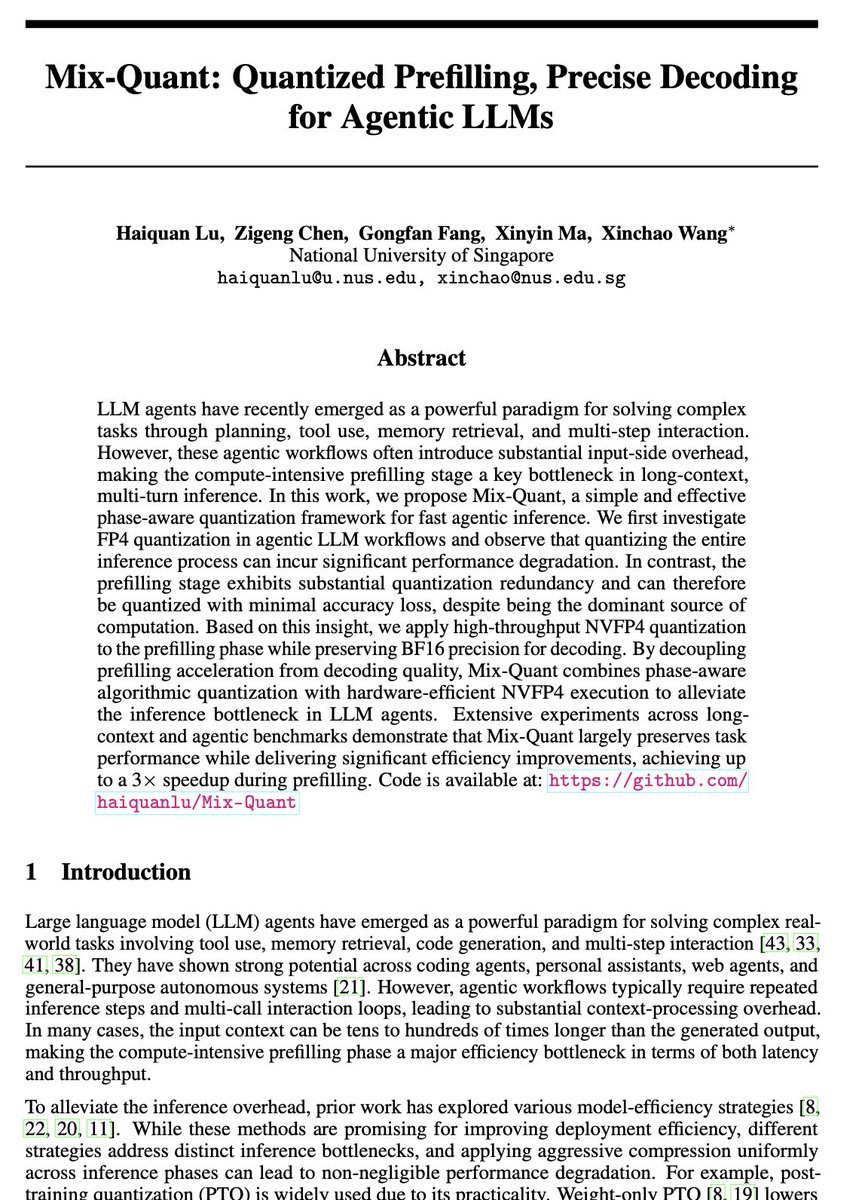
"quantize everything to 4-bit" - and you lose 10+ points on agentic benchmarks
turns out you only need to quantize the prefill. keep decoding precise
95.8% of attention is held by just 3% of tokens. that's why dirty prefill gets away with it. beautiful
25.0528, 121.5990 are the coordinates of the Taipei Music Centre in Taiwan, where Nvidia CEO Jensen Huang will deliver the Computex 2026 keynote on june 1
almost certainly they're announcing the N1/N1X chip. rumors point to nvidia arm chips for windows, developed in partnership with mediatek. per leaks: up to a 20-core arm cpu for everyday tasks, a blackwell gpu for graphics/gaming/ai, plus a dedicated npu for on-device ai, with a focus on power efficiency
so nvidia is entering the desktop/laptop cpu market directly, challenging x86 (intel/amd). major makers like dell, lenovo and asus are already prepping devices on these chips
also, windows and surface chief pavan davuluri already ruled out a new os version (meaning it's not windows 12), so on microsoft's end this is likely new arm surface hardware
if this plays out, i think it'll become serious competition for the macbooks that have dominated for so long with their M chips