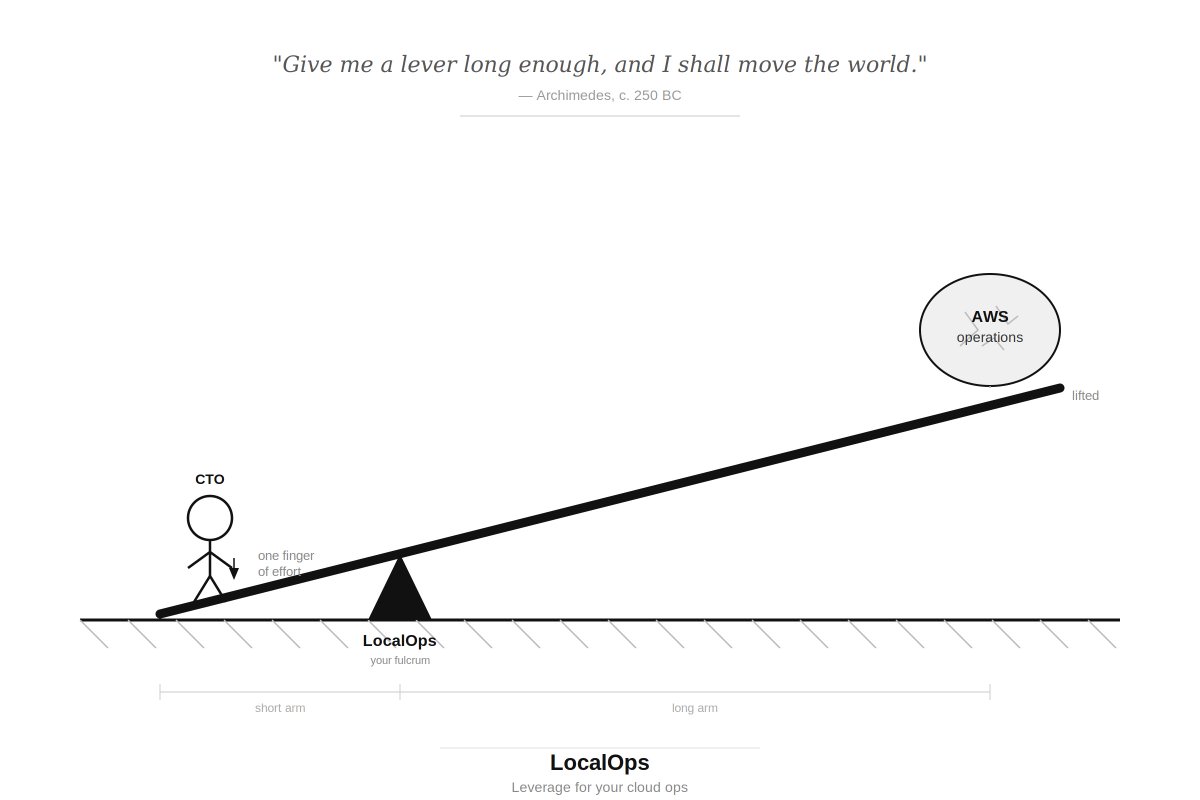
"Give me a lever long enough, and I shall move the world."
— Archimedes, 250 BC
He wasn't talking about brute force.
He was talking about mechanical advantage — doing more with less, from the right position.
CTOs at scaling companies don't lack ambition.
They lack leverage.
Every hour debugging deployment pipelines is an hour not building product.
Every cloud incident that wakes someone at 2am is a tax on your best engineers.
Every new hire spending weeks learning internal tooling is velocity you'll never recover.
That's the boulder. AWS operations at scale — heavy, complex, unforgiving.
LocalOps is the fulcrum.
We sit between your small team and the full weight of cloud operations — and we make it liftable with one finger.
That's our mission: to be a leverage for every CTO who trusts us with their cloud.
https://t.co/WQT0XvWvLf
#ai #cloudops #devops #aws
Building an Internal Developer Platform (IDP) is often a multi-year ego trip.
We tell ourselves we're building "custom" value, but we're mostly just rebuilding standard patterns that shouldn't require our time.
Most application engineers don't want to know what a VPC, a NAT gateway, or a subnet is. They want to ship code and forget the infrastructure exists. Yet, platform teams spend months, sometimes years, manually wiring together CI/CD, observability, and Kubernetes clusters from scratch.
The uncomfortable truth? If your platform team is spending 80% of their time on maintenance rather than building product-specific tooling, you've just built another layer of legacy debt.
Platform engineering should be about enabling independent operation, not creating a new bottleneck. Standardised, production-grade environments aren't a restriction; they're the only way to survive the transition to a fully-owned AWS stack.
See what a production-grade AWS environment looks like out of the box: https://t.co/I7NDMIOsrG
#PlatformEngineering #InternalDeveloperPlatform #CloudInfrastructure #DevOps #B2BSaaS
Self-serve infrastructure is usually a mirage. It’s often just a fancy UI that still triggers a manual ticket for the DevOps team in the background.
True self-serve means a developer can provision a production-grade environment, VPC, subnets, and EKS, without ever opening the AWS console. It means they can declare a database, a cache, or an S3 bucket in a simple config file and see it appear in minutes. The stress isn't about the tools; it's about control. We want engineers to move fast, but we're terrified of the security risks that come with infrastructure freedom.
Hardened defaults and automated provisioning aren't just "nice-to-haves". They are the only way to give developers speed without sacrificing compliance. If your engineers are still waiting 48 hours for a new staging environment, you don't have a platform; you have a queue.
Is your infrastructure a launchpad or a speed bump?
Explore how your teams can achieve self-service infrastructure access using a simple JSON: https://t.co/qp17fk9ewN
#PlatformEngineering #DevOps #AWS #DeveloperExperience #InfrastructureAsCode
You didn’t move to AWS for control. You moved for the feeling of control.
Most SaaS teams transition from Heroku or other PaaS solutions like Vercel or Render, because they want to ''own the stack''. They want to escape the black box and run production on infrastructure they fully control. But there is an uncomfortable reality that hits 90 days after the migration: You didn’t just gain control. You gained a second job.
The moment you move to your own cloud account, you inherit a mountain of operational overhead. Suddenly, your application engineers, the people you hired to ship features, are wrestling with VPC subnets, IAM keys/roles, security group rules, and EC2/Kubernetes cluster configurations.
We call this ''owning our infrastructure''. In reality, the infrastructure is owning us. The tension is real: The more granular control you have over your cloud primitives, the less control you have over your actual product roadmap. If your team is spending more time managing ''plumbing'' than building products, you haven't actually scaled. You’ve just built a more expensive way to move slowly.
Are you actually in control, or are you just busy?
#AWS #DevOps #CloudInfrastructure #PlatformEngineering #B2BSaaS #EngineeringLeadership #Kubernetes #DeveloperProductivity #TechStrategy #SRE #CloudComputing
Quick pro tip to save up to 80% on your cloud bills instantly - Move off of static EC2 based hosting architecture! Here is why.
Cloud bills quietly grow when companies pay for compute that isn’t doing any work. Many teams running EC2-based architectures size infrastructure for peak traffic. The problem with that is - Peak traffic happens maybe a few hours a week.
The rest of the time you’re paying for:
- idle EC2 instances
- oversized autoscaling groups
- underutilized Kubernetes nodes
- background services that rarely spike
Companies tend to provision capacity for 100% peak load, but average usage sits around 20–30%. Which means 70–80% of compute spend is idle most of the time. This isn’t because teams are careless. It happens because engineers optimize for reliability
- scaling infrastructure is complex
- most deployment setups require static provisioning
- EC2 instances are simpler to understand and operate
The result: predictable systems but paying 70-80% more every single month!
Your infrastructure should make scaling down just as easy as scaling up — ideally even scaling to zero when workload are idle.
One of the things we're building in LocalOps platform is making aggressive autoscaling and scale-to-zero the default behavior, not something teams have to manually engineer.
Because the cheapest server in the cloud is the one that isn't running.
If this is a problem in your team, talk to us. We will assess and potentially provide quick wins and practical guidelines to save up to 50% on your cloud wastage. Schedule a call now - https://t.co/cCpbxin7Je
#cloud #devops #finops #costoptimization #aws
A common trigger for SaaS teams moving to AWS isn’t cost.
It’s enterprise customers.
As companies move upmarket, customers start asking for:
Isolated deployments
- Stronger security and compliance controls
- Private networking requirements
- Infrastructure running inside controlled environments
These requirements are difficult to support on fully managed PaaS platforms.
Enterprise customers expect infrastructure flexibility.
AWS enables SaaS teams to meet these requirements while maintaining performance, security, and scalability.
Infrastructure is no longer just about running software.
It’s about enabling enterprise growth.
#EnterpriseSoftware #AWS #CloudInfrastructure #SaaS #DevOps #PlatformEngineering
Just released - Not just code, but connect your existing code pipeline (CI/CD) too & offer SaaS, BYOC, On-prem versions across AWS, Google cloud or Azure in minutes.
Checkout https://t.co/GomGbcj2P7
🚢 Launching our official blog: Keep Shipping — A Builder’s Chronicle. Subscribe now at https://t.co/GOEDq53ent
This is where we write about building and deploying on the cloud, mental models, real trade-offs, and strategies to make infrastructure boring, automated, and invisible—so teams can keep shipping.
If you’ve felt cloud complexity slow you down, you’ll feel at home here.
Hello .Net devs 👋 Let's make your service cloud-neutral & enterprise ready. No need to write Dockerfiles, Terraform or Pulumi scripts!
Offer SaaS, BYOC and On-prem versions using a singe platform.
Checkout our recent release: https://t.co/TxlLVvXqIq
Do join our Discord server. We just started it a couple of weeks back. There are not many users there but we founders hang out there to help out anyone using LocalOps. Direct line to us - the makers of the platform - https://t.co/80QyGBEixI
We're super proud of what we have enabled CTOs to do using @localopsco off late. Without writing a single Dockerfile, companies can deploy their code on any cloud environment including AWS/Azure/Google cloud or even on bare-metal Kubernetes clusters. #startups#fintech#byoc #bfsi #healthcare
Let your services auto-heal, on any cloud you deploy to. Just add a few lines of JSON code to define health checks and auto-restarts!
Checkout our new release: https://t.co/T3wnYEnerA
#aws#gcp#azure#byoc#paas#devops#Startups