Me importan más los valores, convicciones y actitudes de una persona que sus gustos. Es por eso que aunque una amistad no se le niega a nadie, la confianza sí.
Most people recognize procrastination as avoidance. Fewer people recognize this one, and yet it's just as costly, and often harder to see in yourself.
Avoidant persistence is the pattern of working very hard at something, not because it genuinely matters to you, but because stopping would mean facing what's underneath the busyness. It's workaholism, overcommitment, compulsive productivity, all in service of not feeling something. The person looks highly motivated from the outside; internally, the driving force is escape.
An example is a clinician who fills every hour of their schedule, volunteers for every committee, and is constantly exhausted but can't slow down. When I explore this pattern carefully with people, I often find that the busyness is doing the work of keeping something at bay, grief, emptiness, fear of irrelevance. The stopping is what they're actually afraid of.
#psychologicalflexibility
#ACT
#ACTtherapy
My co-authors and I just published something in Clinical Psychology Review, and it's open access. It's called "One Size Fits None: A Call for an Idionomic Revolution."
We put together a story that has been sitting in plain sight. Applied psychology has made painfully slow progress, and part of the reason traces back to the ergodic error and to the racist, sexist, and antisemitic roots of traditional biostatistics. The majority of American Psychological Association presidents from 1892 to 1947 were card carrying eugenicists. The laws that later shaped the Holocaust were written here in the United States two decades earlier, with the active support of mainstream psychology. Most textbooks treat this as distant history. Almost none notice that the same assumptions still quietly define what we call good science.
This is an article of hope though. We lay out another way forward through the emerging science of idionomics, an approach that finally puts the individual client at the center. Do we know it will succeed? Honestly, no. But the path we have been on is scientifically and morally wrong, and if evidence based therapy is going to move ahead, it needs truly new ideas.
Read it here, for free: https://t.co/C5YlRIGE9g
Here's something I've come to believe after decades of this work: the capacity to be hurt is not a vulnerability to fix. It's evidence of a self that has been present through everything, holding all of it without being extinguished by any of it.
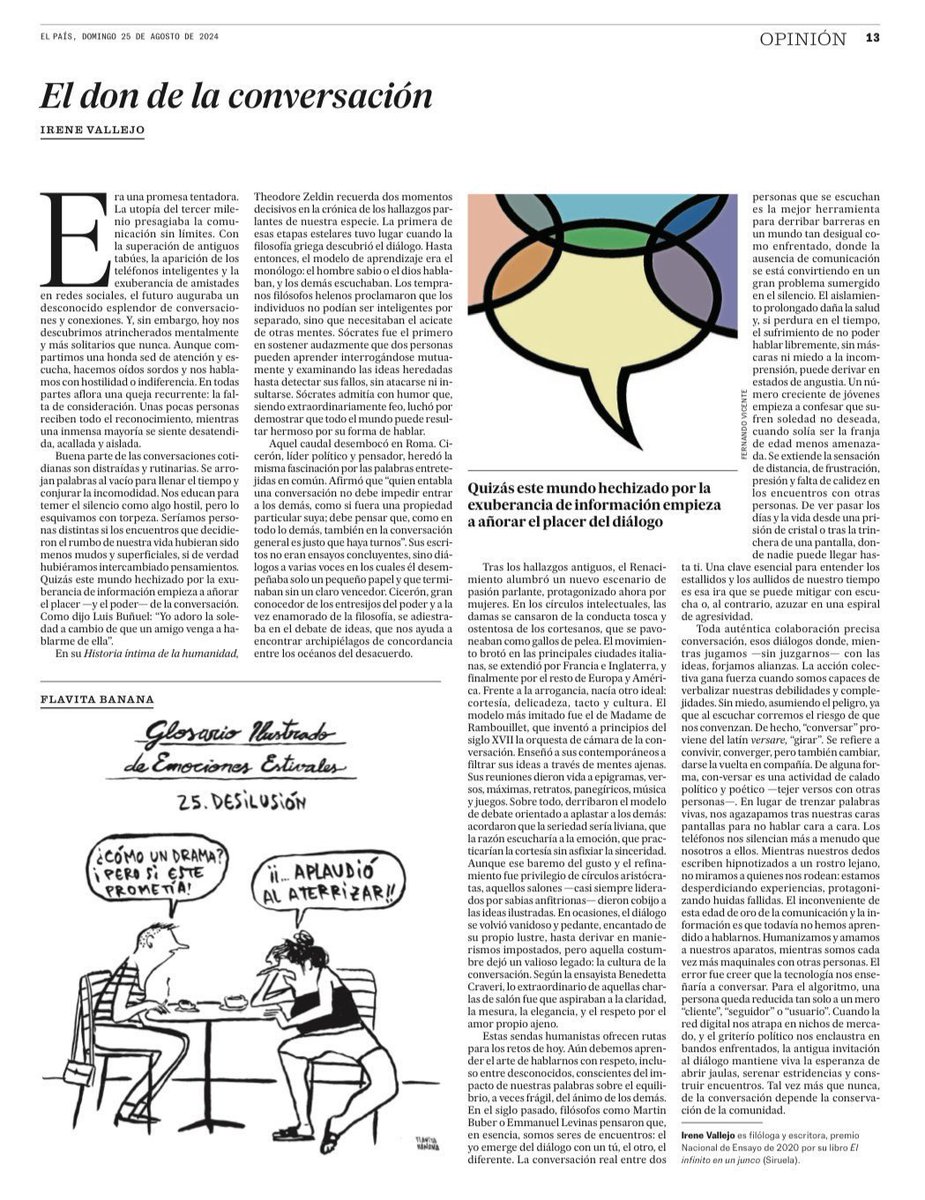
✨ "Quizás este mundo hechizado por la exuberancia de información empieza a añorar el placer —y el poder— de la conversación." - Irene Vallejo reflexiona sobre la importancia del diálogo en un mundo hiperconectado. @irenevalmore
Tracking is behavior governed by the actual relationship between your actions and their outcomes in the real world. In other words, you do something because you've learned from direct experience, or from reliable information, that it actually produces the result you're after. The motivation comes from contact with reality, not from managing others' reactions.
Here's a practical example: a therapist who keeps refining their approach because they're genuinely paying attention to what's working with specific clients, what's producing change and what isn't, is tracking. They're being guided by actual outcomes rather than by whether their supervisor seems pleased with them. That orientation tends to produce both better outcomes and more durable motivation.
#psychologicalflexibility
#ACT
#ACTtherapy
We are, as a species, enormously governed by verbal rules, far more than most people realize. And that's mostly a good thing. But there's a particular way it can go wrong that I want to explain clearly.
A verbal rule is any statement that specifies a relationship between a behavior and its outcome, things like "if you work hard, you'll succeed," or "if you're kind, people will like you," or "if you feel this way, something is wrong." Rules allow us to learn without direct experience, which is a remarkable cognitive achievement. The problem is that rules can also make us insensitive to what's actually happening in front of us, because we're following the rule rather than responding to reality.
A clinical example: someone who has a rule that says "if I feel anxious, I need to calm down before I can function" will keep trying to calm down, even when the evidence in their own life suggests that functioning while anxious is entirely possible. The rule runs their behavior, regardless of what the actual experience keeps showing them.
#psychologicalflexibility
#ACT
#ACTtherapy
📚 “Es tarea de la filosofía revelar la utilidad de lo inútil.”
Pierre Hadot recordaba que hay saberes cuyo valor no está en producir beneficios, sino en hacernos mejores.
Eso es lo verdaderamente útil.
There's a lot of unnecessary shame people carry about the content of their own minds. Dark thoughts, critical voices, catastrophic predictions: these aren't signs of pathology. They're signs of a very capable problem-solving system running in a context it wasn't originally designed for.
Nothing is wrong with you. But something might be off in how mindfulness was presented to you. When mindfulness is taught primarily as a way to calm down or clear the mind, people often find it backfires, because the attempt to achieve a peaceful state is itself a subtle form of fighting whatever is present.
What actually helps is a different orientation: being in contact with your present experience, whatever it is, without needing it to be different right now. Not as a way to feel better, but as a way to be more present to your actual life, so you can choose your next move rather than just reacting. That version of the practice is connected to what you care about, not just to how you feel.
Got a question of your own? Write it below and I may get to it.
#psychologicalflexibility
#ACT
#ACTtherapy
¿Qué opinas de esta teoría? Las emociones no se “activan” en el cerebro como botones predefinidos. El artículo de Lisa Feldman Barrett propone algo distinto: las emociones no están “preprogramadas”, se construyen dinámicamente por el cerebro.
El modelo que propone Barrett parte de otra premisa clave: el cerebro no es reactivo, es predictivo.
Constantemente construye modelos internos para anticipar lo que va a ocurrir, tanto en el entorno como dentro del propio cuerpo. Este enfoque se conoce como codificación predictiva o inferencia activa.
Desde aquí, lo que sentimos no es una respuesta directa a los estímulos, sino el resultado de una interpretación basada en predicciones construidas a partir de la experiencia previa.
Y aquí aparece un concepto central: la interocepción.
La interocepción es la percepción de las señales internas del cuerpo. Estas señales suelen experimentarse como afecto, es decir, sensaciones básicas de agrado o desagrado y niveles de activación.
Las emociones emergen cuando el cerebro utiliza conceptos aprendidos para dar significado a ese afecto en un contexto determinado.
Por ejemplo, el mismo aumento de la frecuencia cardíaca puede construirse como ansiedad, entusiasmo o miedo, dependiendo de la situación y de la historia previa del individuo.
El cerebro no busca representar la realidad con precisión “objetiva”, sino regular el cuerpo de manera eficiente, anticipando necesidades energéticas y fisiológicas.
En ese sentido, las emociones no son errores ni excesos. Son construcciones funcionales que ayudan a organizar la acción y mantener el equilibrio del organismo.
Ahora, algo importante desde la rigurosidad: este trabajo es un marco teórico integrador. No es un ensayo clínico ni evalúa intervenciones terapéuticas. Sus conclusiones se basaron en reinterpretar evidencia neurocientífica existente.
¿Esta forma de entender las emociones te resulta útil o te genera más dudas que respuestas?
https://t.co/dpu26XS16q
Y es que a los hombrecillos viles no te los ganarías de otra manera que dándoles algo; pero a los hombres íntegros los puedes conseguir sobre todo tratándolos amigablemente.
–Jenofonte. Recuerdos de Sócrates, libro III, 3, 17.
cuando Dostoievski escribió "Quiero hablar de todo con al menos una persona, como hablo conmigo mismo" describió todo lo que el ser humano anhela de una conexión en una sola frase
ADHD가 밤에 말똥말똥하고 아침에 유독 몽롱한 이유가 밝혀짐.. 단순 도파민 부족이 아니라, 만성적으로 ���가 시차를 겪고있다는 연구결과야! 그래서 자야할 때 못자고 일어나야할 때 안일어나진대
핵심은 뇌의 생체 시계가 일반인보다 몇 시간씩 뒤로 밀려 있다는 거야. 밤 12시가 넘어도 멜라토닌이 안 나와서 뇌가 쌩쌩하고, 반대로 아침엔 코르티솔이 안 나와서 마취된 것처럼 계속 졸린거래. 사회적 시간이랑 우리 뇌의 시간대가 달라서 시차 적응을 못한채로 시달리고 있는 셈인거지..
Mark Zuckerberg just described the death of human connection on the internet and no one flinched.
One sentence. Fifteen years of erosion in twelve words.
Mark Zuckerberg: “Social media started out as people primarily interacting with their friends. And now… at least half of the content is basically people interacting with creators.”
You used to open your phone to see what your friends were doing.
Now you open it to watch strangers.
You did not choose this. The algorithm chose it for you.
It tested your friends against optimized strangers.
Your friends lost. Every time.
A stranger with better lighting, better timing, and a better hook held your attention three seconds longer than someone who loves you.
So the algorithm buried your best friend’s wedding photos under a cooking video from someone in Dubai you have never met.
And you watched the cooking video.
That was the first replacement. Friends for strangers. You barely noticed.
The second one is already underway.
If the algorithm already proved strangers outperform your real relationships, and AI can now build a stranger more engaging than any human alive, the math finishes itself.
The AI does not have a bad week. It does not post something careless and lose the algorithm’s favor. It does not burn out.
Every word calibrated.
Every frame tuned.
Every pause placed at the exact interval that keeps your thumb from moving.
A human creator competing against that is carving stone tablets in a world that just built the printing press.
The economics are not even close.
A person needs rent, sleep, and motivation.
The machine needs electricity.
When the cost of generating perfect content hits zero, the feed fills with faces that do not exist.
Voices that feel familiar.
Opinions that mirror yours just enough to feel like trust.
Personalities built from scratch to feel like someone you have known for years.
You will not know when the switch happens.
That is the point.
The feed does not care whether the thing holding your attention has a pulse. It cares whether you stay.
And a machine that knows your patterns better than you know yourself will always keep you longer than a person ever could.
This is not a warning. Half of it already happened.
You lost your friends to strangers and did not notice.
You will lose the strangers to machines and call them friends.
Somewhere in a different app, in a different tab, in a room you are sitting in right now, someone who actually knows you is living a moment you will never see.
Not because they stopped sharing it.
Because you stopped being where it was.
I developed this theory with colleagues starting in the 1980s, and it became the scientific foundation for ACT. I want to explain it plainly, because it answers a question most people have never thought to ask: why does language create suffering?
Relational Frame Theory is a scientific account of how human language and thinking work. The core finding is that humans, uniquely among animals, learn to relate anything to anything else in an almost infinite number of ways: this is like that, this is better than that, this causes that, this is the opposite of that. This ability is what gives us science, art, and civilization. It also means we can never fully escape painful experiences by changing our environment, because any situation, any word, any sunset can trigger an entire network of connected meanings that brings pain back.
A dog can learn to avoid a hot stove by touching it once. A human being who has been hurt by someone named Michael can feel anxious meeting a new Michael who has done nothing wrong, simply because the name carries the relational network forward. That's RFT in action.
La universidad medieval evaluaba con exámenes orales. Evaluar es exigir que el conocimiento se interiorice. Si la IA reduce el esfuerzo, la universidad debe reintroducirlo de otra forma. La IA está forzando otro cambio: menos tareas en casa, más interacción directa, más conversación socrática.
The New York Times: Si la escritura “aceptable” se automatiza, la educación superior debe centrarse en pensamiento crítico, identidad intelectual y evaluación relacional https://t.co/SAItfb3rGY https://t.co/hZWpp59J6M
Si tienes 20 años y aún no has leído a Platón se te puede perdonar, eres más víctima que culpable.
Si tienes 30 y aún no lo has leído pues ya estás desperdiciando tu vida, eres enteramente culpable.
Ahora en mis 31, intentaré corregir esa severa negligencia.
Con él empezó todo, aún no logramos superarlo y probablemente nunca lo haremos.
Ya se sabía desde hace décadas que la religiosidad (la participación religiosa regular) está asociada positivamente con mejor salud mental en general. Hay cantidad de estudios que muestran que personas más religiosas tienen menos depresión, menos ansiedad, menos estrés, mayor satisfacción con la vida, menor riesgo de suicidio, menos abuso de sustancias y hasta mayor longevidad. Esto es un consenso científico bastante sólido, pero es una correlación, no está probado un efecto causal directo de la religión, se hablaba de que favorece la socialización y disminuye el aislamiento social, etc.
Lo que aporta este estudio es que la relación protectora entre la religiosidad y el menor riesgo de depresión y estrés se explica completamente por dos mecanismos clave: mayor gratitud y mayor apoyo social. En dos muestras independientes de adultos estadounidenses hallan que la religiosidad no actúa directamente sino fomentando estos factores que mejoran el bienestar psicológico.