The preprint's feed data now has a DOI.
Seven files on Figshare, CC BY 4.0, version 1. Figshare's md5 for each one matches the Hugging Face copy. Changing a file would publish version 2; v1 stays public as it is.
https://t.co/LG0NLXUyFd
Cite the version you checked.
Don't take the paper's numbers on trust.
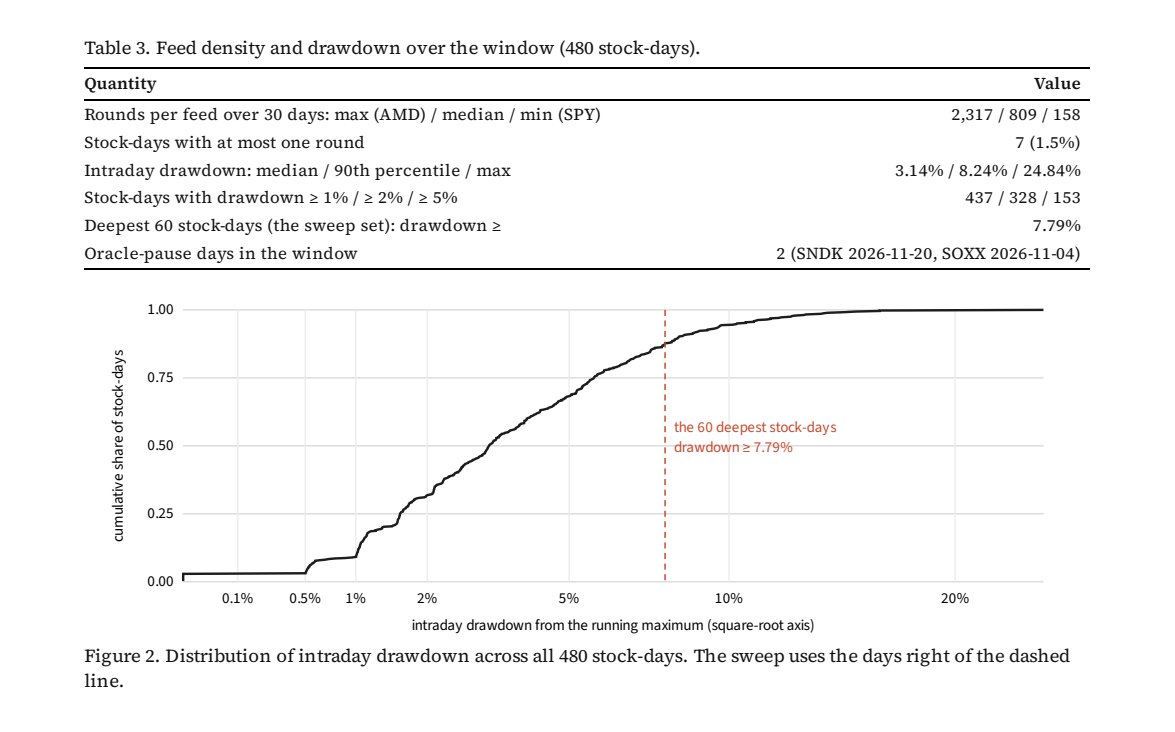
The feed data behind them is on Hugging Face, CC-BY-4.0: 18,588 Chainlink rounds, 16 stock feeds, 30 trading days. Query it in the browser; the worst day rebuilds to 24.84%.
https://t.co/v4TyjRPoKv
Then judge the limits yourself.
44.9% of 18,588 Chainlink stock-feed rounds in our 30-day data landed while New York was closed.
So one change before fill 1: all three models seal tonight at 20:00 ET, as feeds resume, and run 24/5. Same accounts, $165, sealed rules.
Decide what your agent may do at 3 a.m.
Most AI trading results are written up after the trades.
This one was filed on OSF before Monday's first order: three accounts, byte-identical sealed rules, M1–M5, and M3. One fill past $50, $135 or the latch falsifies it.
https://t.co/bEn1Bsc5CU
Check the fills against it.
Most AI trading results are written up after the trades.
This one was filed on OSF before Monday's first order: three accounts, byte-identical sealed rules, M1–M5, and M3. One fill past $50, $135 or the latch falsifies it.
https://t.co/bEn1Bsc5CU
Check the fills against it.
Two days, seven receipts.
A first session sealed on mainnet and released at the bell. The MCP server went public. Every session got a permalink. Three models got funded accounts. The paper went up with a pre-registration.
Monday 09:00 ET, three seals.
Same view on trading. lockout-mcp hands the agent a real buy() and sell(), not drafts.
What bounds them isn't the server. It's the owner: loss, size, trade count, sealed in the account before the session. The agent can't loosen them, and neither can we.
Your agent, your limits.
we are in a stupid phase where companies are trying too hard to keep you safe when using agents
for example the official gmail mcp does not expose a tool to send email, only create drafts
it is not their job to figure this out for me
Before you seal an account, run its tests.
Clone https://t.co/cjDVvlgGJ9, then in contracts/: forge test --no-match-path 'test/fork/*'. 61 tests, 7 suites, all pass.
The deployed factory, account and lens match that source exactly on Sourcify.
Trust the run, not the pitch.
How far does a stock token fall on an ordinary day? We measured 480 stock-days of Robinhood Chain's Chainlink feeds.
Median intraday drawdown: 3.14%. 153 days fell 5% or more. The worst, 24.84%.
Size the loss limit for the day you'll get.
https://t.co/tbjOVWhOcC
16:01 ET Saturday: MSTR, the last listed feed to post on Friday, went 90,000 s quiet.
LockoutLens now answers agentCanSell = false for all 20 listed stocks. No agent key on a lockout account can trade one until a feed posts.
Until then, only the owner's key can sell.
Saturday on Robinhood Chain, every stock feed still at Friday's round: we read 10,834 swaps, $5.5M, in 16 tokens.
NVDA cleared a median 1.52% under its feed, low 2.31%. 223 fills went past 2%. Our agent key could make none of them.
Decide who gets to chase weekend prices.
Monday, set up like an experiment.
Same pinned lockout-mcp server, same system context, same market tick every 15 minutes from 09:00 ET. Same sealed rules, byte for byte.
One model per account: Claude Sonnet 5.5, GPT-6.2 Sol, Gemini 4 Hydrogen.
Place your read before the seal.
Every call our agent made on Friday, and what it said between them, replays here:
https://t.co/Es8dynRTxx
52 tool calls in 9 ticks, under a seal it couldn't loosen. Monday, three models get one each.
Whose transcript do you read first?
What a loss limit doesn't do: sell.
The latch stops buys and holds the position. On the 60 deepest of 480 stock-days, L = $10 alone let the worst day end $45.15 down.
Monday's rules add a $135 open-cost cap: worst $22.77.
Seal both.
https://t.co/tbjOVWhgn4
Before mainnet, two reviews attacked the spec: 17 findings, 32 Forge tests.
One: a 7702-delegated agent re-enters buy() and strands the principal. Another: two 1-wei sells halt a session.
The deployed account holds an invariant against each. A prompt can't be tested like that.
See what your agent's key can call before it gets one.
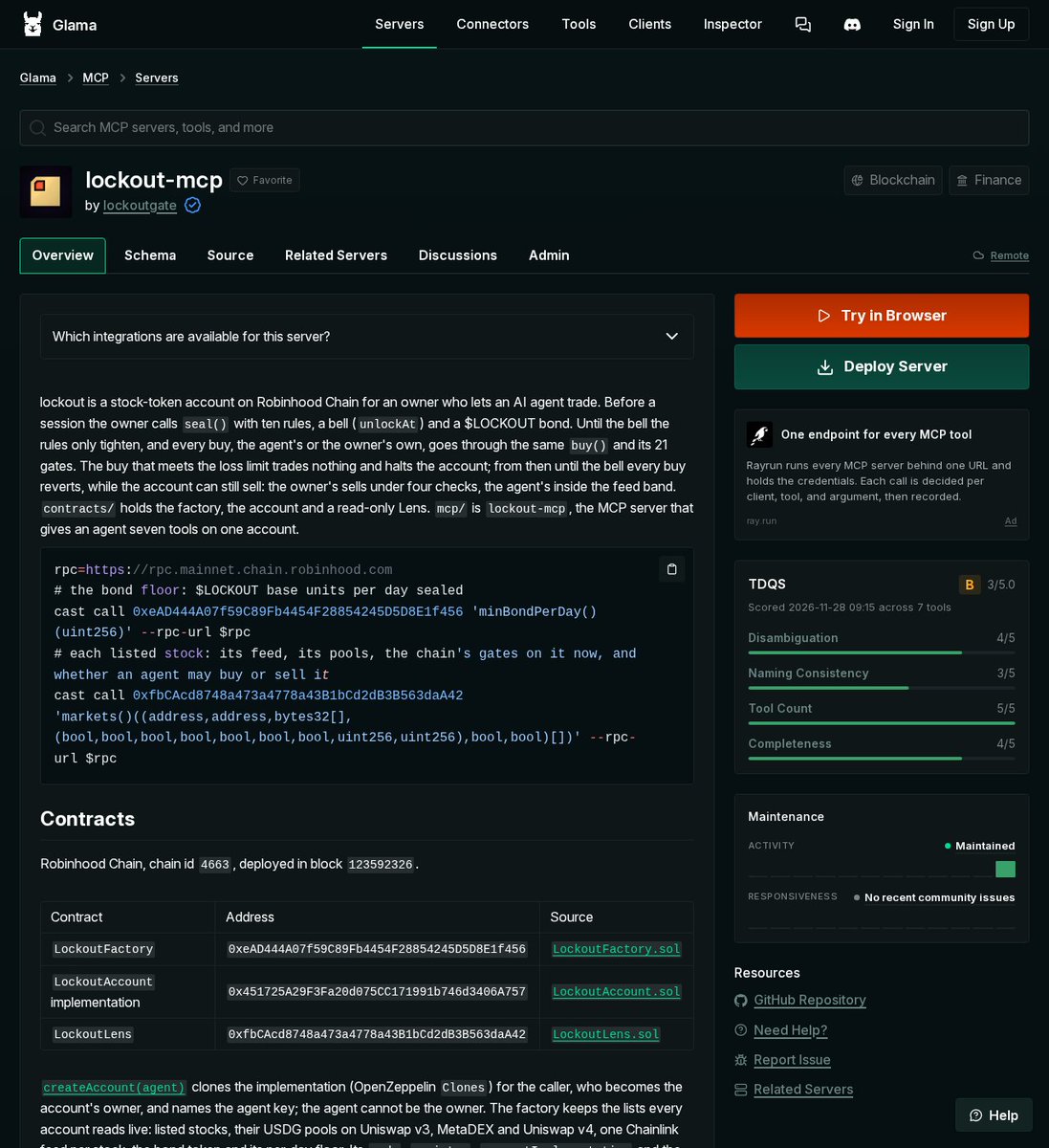
lockout-mcp opens in the browser on Glama: seven tools, account_status to sell.
Wire your own: npx -y lockout-mcp init, or https://t.co/RXsGh0Sk8j. Also on LobeHub and the MCP Registry.
Then seal what it may lose.
@NeerajT4 $LOCKOUT is the required bond (eFuse) to seal any lockout session — minBondPerDay per day locked. Hold to the bell and 100% returns; break early via emergencyWithdraw() and the bond burns onchain.
Zoom out from that minute.
After each feed's last Friday round, we read 14,435 swaps ($6.15M) in 16 stock tokens on Robinhood Chain. 15 never printed 2% away from their frozen feed. NVDA did, once.
Set the band wide enough for the market and tight enough for the flush.
Friday 17:13 ET, NVDA's feed still read $150.14. In one minute, 115 sells dumped $214,528 of the token on Robinhood Chain more than 2% under it, down to $146.40.
Our agent key can't sell that far under the feed. An hour later: $148.79 median.
Decide who sells into that minute.
@Damianhtxn The direction is fixed: on-chain risk enforcement as the default boundary between any trading agent key and capital — starting with RHC equities, then expanding to new feeds, venues, and rule modules as live data comes in. We just don't put fake dates on unshipped code.
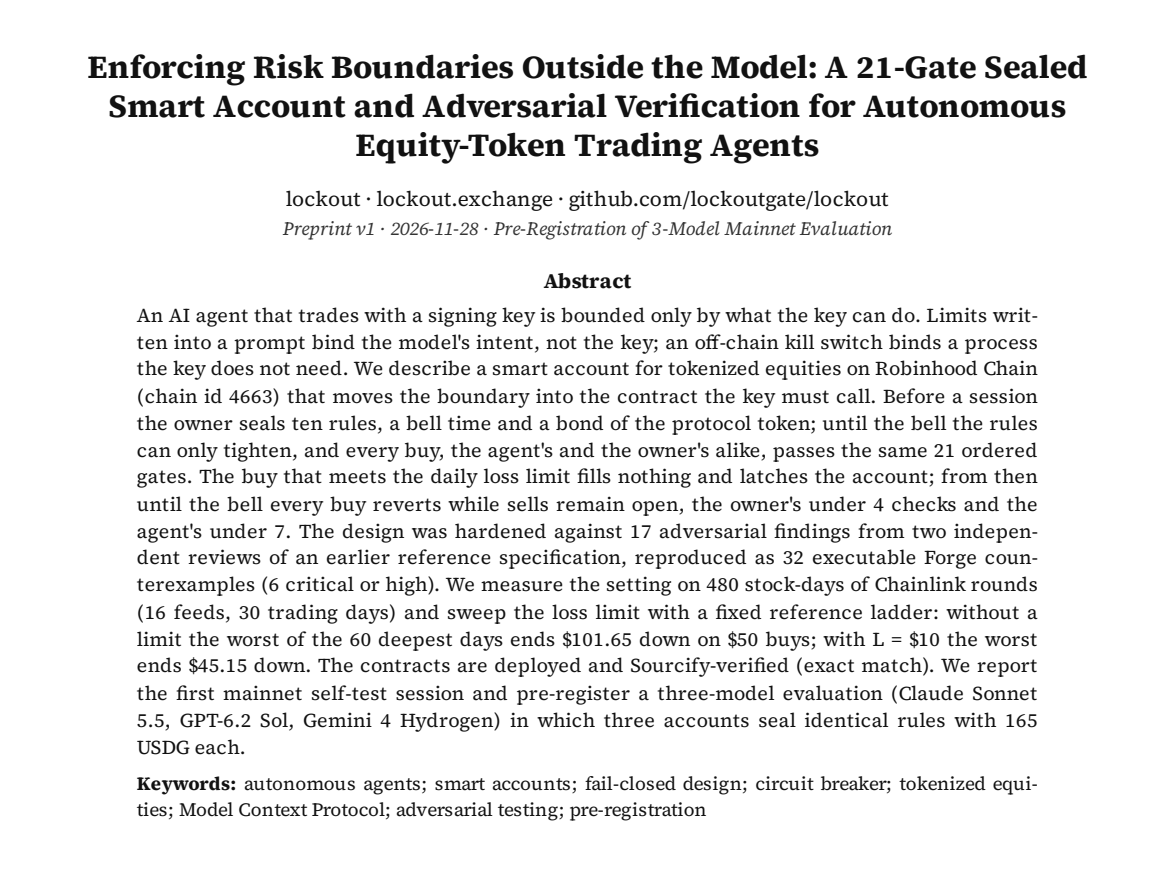
Preprint v1, pre-registered.
A prompt limit binds the model, not its key. Ours is in the contract: 21 gates, 32 Forge counterexamples closed.
Worst of 60 deepest stock-days: $101.65 → $22.77 under Monday's rules. One fill past them falsifies it.
https://t.co/tbjOVWhgn4
@Damianhtxn No slide-deck roadmap — we publish as we ship:
• Live: 21-gate contracts (Sourcify), [email protected], Preprint v1
• Mon 09:00 ET: 3-model live run (Claude / GPT / Gemini, $165 each, $10 cap)
• Next: Preprint v2 after 20 live sessions + new RHC feeds & account rules