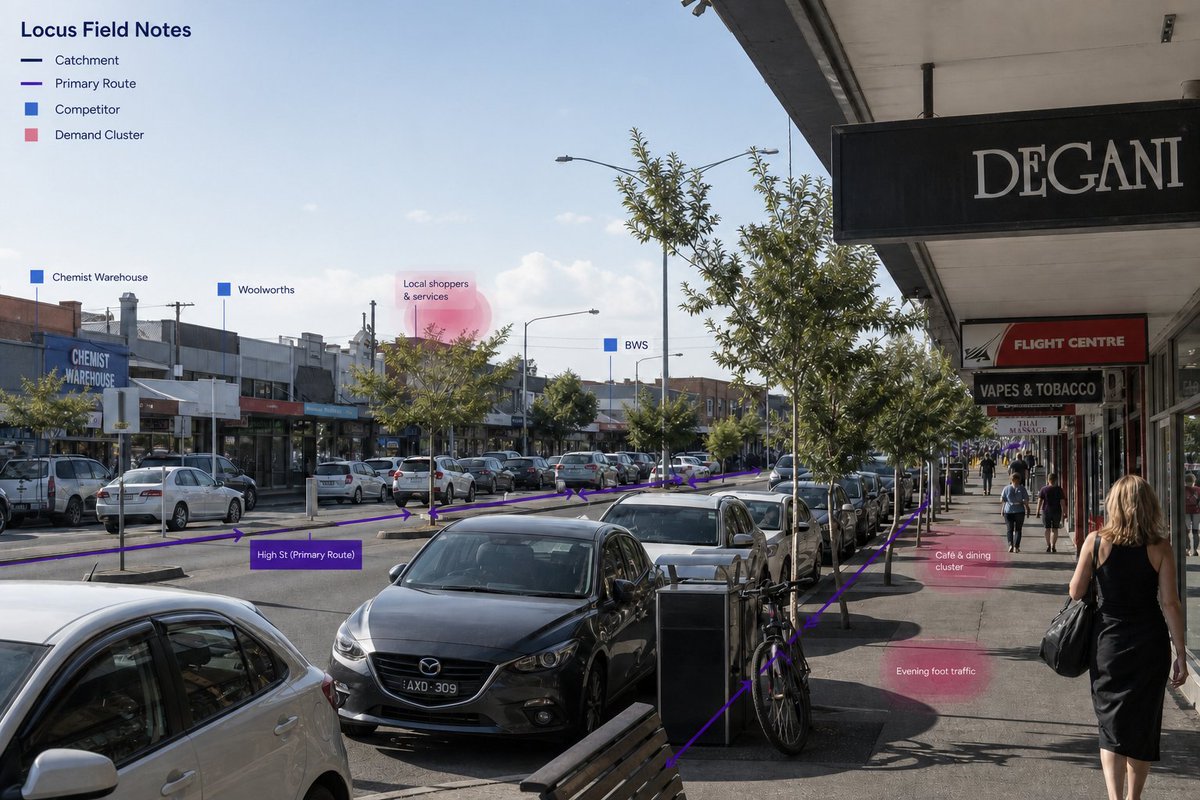
🏛️ 70% of business failures start with a bad location.
Yet most owners still rely on gut feeling over data.
That’s why we built Locus 📍
AI-powered location intelligence that helps you choose smarter, not guess harder.
Analyze:
• Demographics & footfall
• Nearby competition & pricing
• Local sentiment & business activity
• Market potential
Make confident location decisions backed by data, not luck.
👉 https://t.co/cafWZCOIoY
#LocationIntelligence #SMB #DataDriven
@Aman81407075@investwithyash_ Useful comparison: same footfall tailwind, but BBQN and Burger King are selling different occasions. For expansion, that means the catchment test should split lunch convenience, evening dwell, family grouping and nearby competition before treating footfall growth as one signal.
@FoxBusiness Big Arkansas milestone, especially with 120 fueling positions and 200+ jobs in Benton. Travel-center sites need a different screen from normal retail: highway access, daypart demand, truck/car flow and competing service stops matter as much as the local residential catchment.
A useful first screen has a sequence: define the trade area, check demand, inspect competitors, then test access. Skip one step and the shortlist gets harder to defend later.
https://t.co/xmFIeVoBWk
@Lei_Takanashi Making Crenshaw Rec a community anchor instead of just another store is a smart move. To pull that off, we really just need a spot where transit access meets high neighborhood foot traffic, and good dwell time.
A site can have demand on paper and still lose at the kerb. Check how people arrive, where the frontage sits, and which competitors share the same route before calling the catchment attractive.
https://t.co/QCaOVfe253
@ScotNational A useful reminder that footfall is route-sensitive. When access changes, nearby streets can gain demand without the underlying catchment changing.
@sheerbulls That's a strong setup. High footfall is a great starting point; when catchment, access and tenant mix line up too, it has a much better chance of becoming qualified demand.
The best early screen is boring: demand, access, competition, cannibalisation. If those are weak, the lease does not get better later.
https://t.co/uex7bOIoXI
A site can survive a bad headline number if the catchment, access, and competitors line up. It usually fails when teams try to justify it after the lease is already emotionally won.
An index should narrow a shortlist, not manufacture certainty. The coffee component moves forward; the UK league table waits. Methodology, results and caveats:
https://t.co/M0YWGuubMv
We tested a UK High Street Opportunity Index across 9,623 retail centres. The useful finding was not a national winner. It was knowing why the ranking should not be published yet. A short thread on the evidence gate.
The larger ranking stayed held. Its top 10 was England-only, and the winner changed when accessibility received more weight. That may be real, or it may reflect the peer group and source differences. We need to separate those effects first.
Competition can be a demand signal or a saturation warning. The difference is usually access, overlap, and whether the reachable customer base is actually left to win.
https://t.co/xzD3nIKs6I
The strongest query signal this week is still the tool-led location analyser row. Small searches usually map to a real workflow: trade area, demographics, competitors, then a yes/no decision.
@EsriIndia Branch expansion screens should separate demand from access and whitespace before ranking sites. A large reachable population can still be the wrong pilot if the catchment overlaps existing branches or the route to the site is weak.
Busy catchments are not automatically good sites. The first screen should test demand, access, competitors, and cannibalisation before a lease turns into a story.