Don't localize. Loekalize. Games from and to Japanese, Chinese, Korean and Dutch. Plus the Japanese language and East Asian news, read in the original.
Your mood contains a knife. You have spent three agonizing hours staring at one single page of your textbook when your friend suggests ちょっと気分転換しよっか, meaning it is time for a 気分転換 (kibun tenkan). This combines 気分, your mood, and 転換, a switch.
It is a short break to flip your emotional state. But look closely at the word for mood, 気分 (kibun). Hidden under the character 分 sits 刀, which is a knife. You are now left wondering why there is weaponry in your emotions.
Your quest for 気分転換 leads you to the konbini, where you find one solitary strawberry shortcake remaining. Your friend suggests 半分こしよう, meaning let's split it, and reaches for the knife.
The cake is severed, but your friend's half is suspiciously larger and possesses the entire strawberry. A "split in half" is almost never actually half. While a fair split is 五分五分 (gobu-gobu), fifty-fifty, your friend has delivered a 四分六 (shibu-roku) split, forty-sixty.
So much for the 気分転換: your mood just got worse.
That cake is the literal anatomy of the kanji 分. The top part, 八, represents two halves moving apart, much like two friends immediately after a 半分こ. Below that sits 刀, the knife used to cut and divide.
This suggests the knife in your mood is a blade through the heart, but that is far too dramatic.
The real clue is on the packaging. The box says 二人分 (futaribun), meaning "for two". Similarly, 一人分 (hitoribun) is one serving, and 取り分 (toribun) is your specific cut. In these cases, 分 is a portion, specifically what the knife sliced off for one person.
This logic extends to 腹八分 (hara hachibu), which means stopping when you are 80% full. Apparently, your friend's version of 80% involves eating 60% of the cake. Then there is 気 (ki), the invisible energy surrounding and inhabiting you.
When that energy belongs to the sky, it is 天気 (tenki), the weather.
The truth is that the knife in your mood is not there to stab you. It is there to carve portions. 気分 is simply one person's portion of 気, the specific slice of energy cut for you at this moment.
Looking at the cake situation, your friend's 気分 is currently at 100%, while yours is at 40%. The forecast for your 気分 today is cloudy with scattered homework. This brings us back to 気分転換: 転, turn, and 換, swap. You swap that miserable slice of 気 for a fresh one.
Next time you 半分こ, you are the one holding the knife. That is the best 気分転換 there is.
Learn Japanese, in English: https://t.co/T38fIjOmlC
Japanese lessons in Dutch, in Leiden or online: https://t.co/EqhYBqKU5w
Kanji strokes: animCJK.
#Japanese #LearnJapanese #Kanji #JLPT #WordOfTheDay #Japanology
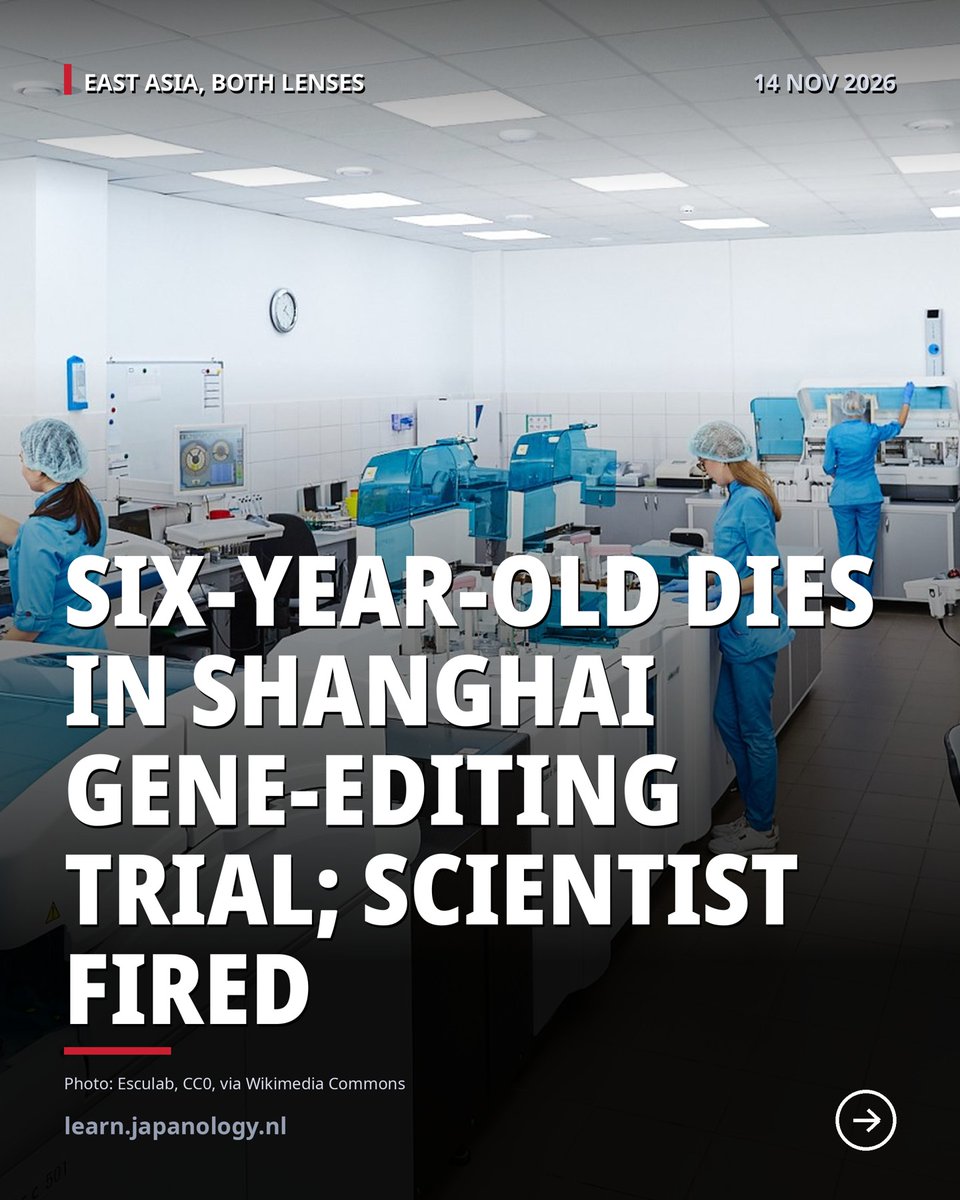
A six-year-old girl is dead after a gene-editing trial in Shanghai, and the scientist responsible has been fired. Official records from 13 November reveal that her family paid 5.337 million yuan to fund the research, while the paper's first author personally pocketed 900,000 yuan plus top-shelf liquor.
The girl, known as Mei in the press, suffered from Snijders Blok-Campeau syndrome, a rare brain-development disorder for which no treatment exists. Her parents turned to researcher Qiu Zilong to design a custom therapy. She received the injection at Shanghai's Xinhua Hospital on 24 March 2025 and died one week later. The hospital's ethics board had approved the trial before the additional safety data they requested actually arrived. When the team later published their findings in Nature, they did not disclose her death; it was the journal Science that exposed the truth. Both Qiu and the first author, Yang, have now been dismissed.
The most critical detail in the notice concerns consent. While the form listed serious complications, the notice claims it "but did not give emphatic notice of the risk of death." This suggests a risk hidden in fine print may no longer be considered sufficient warning for a family. The notice concludes with 举一反三 jǔ yī fǎn sān ('from one example, infer three'), a phrase often simplified in English as 'learn lessons'. In Party parlance, it typically signals the start of wider investigations, and Shanghai's health commission has already launched one into similar research. Beijing followed a nearly identical pattern after the 2008 melamine milk scandal, where foreign pressure preceded domestic discipline. For families with children facing untreatable diseases, this could result in fewer and slower experimental trials in China, and consent forms that name death plainly.
Meanwhile in Tokyo, the trade ministry, METI, has presented an expert panel with a draft under the Unfair Competition Prevention Act. The rules target the commercial use of a person's voice or likeness without permission, and Yomiuri reports that examples include audio data built from a voice actor's voice. The draft exempts impressions, 声まね koemane ('voice mimicry'), and people who naturally sound alike. In Japanese, that term traditionally refers to a human impressionist. This leaves a void: is an AI soundalike, tuned to be close but not identical to an actor, mimicry or theft? That is where the legal battles will ignite. One panel member has already stated "profit-making purposes on social media should also be covered." For Japanese voice actors, including those in the games I translate, this could determine if they can stop a clone of themselves.
The Nvidia saga has taken another turn. The company's board has approached Rene Haas, CEO of SoftBank-owned Arm and a member of SoftBank's own board, to succeed Jensen Huang. At the same time, Sankei argues in an editorial that following the spy affair, Trump can no longer easily compromise with Xi at the APEC summit in China on 18 and 19 November.
Want this in your inbox? Once a week I send the Japan and China stories that don't make the English feeds, read in the original. Free, one click to unsubscribe: https://t.co/UiOEIosBCv
#Japan #China
Doubt is simply a foot that has surrendered. A man at a station counter says "Excuse me, I have a question...", すみません、質問があるんですが. Out loud a 質問 (shitsumon), in his head nothing but 疑問 (gimon), doubts. And dictionaries file that 疑 under 疋 (hiki), a drawing of a leg and foot.
Rewind twenty minutes to Shinjuku Station. He meets a friend in two minutes. East, West, South, New South Exit. His map app says turn right. To the right: a brick wall. His feet stop dead while the crowd slams into him like waves.
He finally gambles on an exit and emerges in Yoyogi. The next station over.
Enter 疋. Its ancient form is a foot, and its base is 止 (tomaru), to stop. On 3,000-year-old oracle bones, it even refers to catching a tiger alive in a snare. Caught alive: Pokémon-style capture, 3,000 years early.
In Japan, this became a counter for animals, the same hiki used in 一匹 (ippiki) and 二匹 (nihiki). The Tale of Genji uses it to count 40 horses; Prince Genji's parking must have been a nightmare. One hiki was also worth ten mon coins.
One unverified story claims men who released 100 dogs at a hunt earned 1,000 coins, meaning one dog cost ten. Kiko is now worried about her own price.
疋 also reads so. 疎 in 過疎 (kaso): a village emptying out. In Tokushima there is even a village with more scarecrows than people. Then there is 楚 in 清楚 (seiso), meaning neat and pure, as seen in the 清楚系 anime heroine. In 楚, the foot at the bottom is merely for sound.
The actual meaning is the 林 on top, a thorny shrub whose branches became the rod for lazy pupils. Every pure heroine contains a teacher's rod. And 礎 in 基礎 (kiso), foundation: 石, stone, plus 楚, the stone under a pillar. When that stone turned damp, rain was coming.
A weather app over 2,000 years old: just check under your pillar. 疎, 楚, 礎: all three read so.
Plot twist: the bottom right of 疑 is not 疋 at all. The 説文解字, a dictionary from around 100 AD, identifies it as 子, a child, and 止, to stop. Picture a kid frozen at the candy aisle.
Scribbled over and over, the two fused into a 疋 look-alike, so dictionaries filed it by appearance. And 疑 reads gi, not so. Yet the foot remains real, since 止 began as a drawing of a foot. To doubt is to have your feet stop.
So our man asked at the Yoyogi counter: "Which way is Shinjuku Station?"
Learn Japanese, in English: https://t.co/T38fIjOmlC
Japanese lessons in Dutch, in Leiden or online: https://t.co/EqhYBqKU5w
Pictures via Wikimedia Commons: Shinjuku Station south exit by Nesnad (CC BY 4.0); 礎石 by Yaritsusozai (CC BY 4.0); Shuowen Jiezi, Xu Xuan edition, and ancient forms of 疋 and 疑 (public domain). Kanji strokes: animCJK.
#Japanese #LearnJapanese #Kanji #JLPT #KanjiOfTheDay #Japanology
@Probably_Stolen Chinese players identify regions quickly through street food. A jianbing cart indicates Tianjin, a skewer stall shows Xinjiang, and cheung fun signals Guangzhou. Bilibili comments will argue over which city your vendor grew up in.
Microsoft 365 was down for over twelve hours in 74 countries, Japanese traders went back to the fax machine, and this morning mail to Exchange users still bounced straight back to me.
Cattitude, my CAT tool, just kept running. European through and through: own server in the Netherlands, own code, own mail. Translators confirmed segments like on any other day.
You do not need a cyberattack to lose a working day. One single point of failure is enough, and 430 million people share this one.
Fourteen characters live on a button, yet the Dutch insist on shoving nineteen in there. Every game translator has endured this tragedy and knows the desperate tricks used to survive: abbreviations, butchered letters, or those pathetic three dots at the end. The player notices every single one of these crimes.
Thus, I birthed Shorten to Fit into Cattitude. With one click, it scrutinizes the source text hunting for phrasing that is shorter but still means the same thing. No abbreviations, no missing letters, nothing added. When two lines are crammed into one box, it trims them in tandem and distributes the cuts rather than murdering a single line. It then delivers the result unconfirmed, because the final word belongs to the translator.
59 seconds, with a cat: https://t.co/kJCoiopU8M
#translation #localization #CATtools
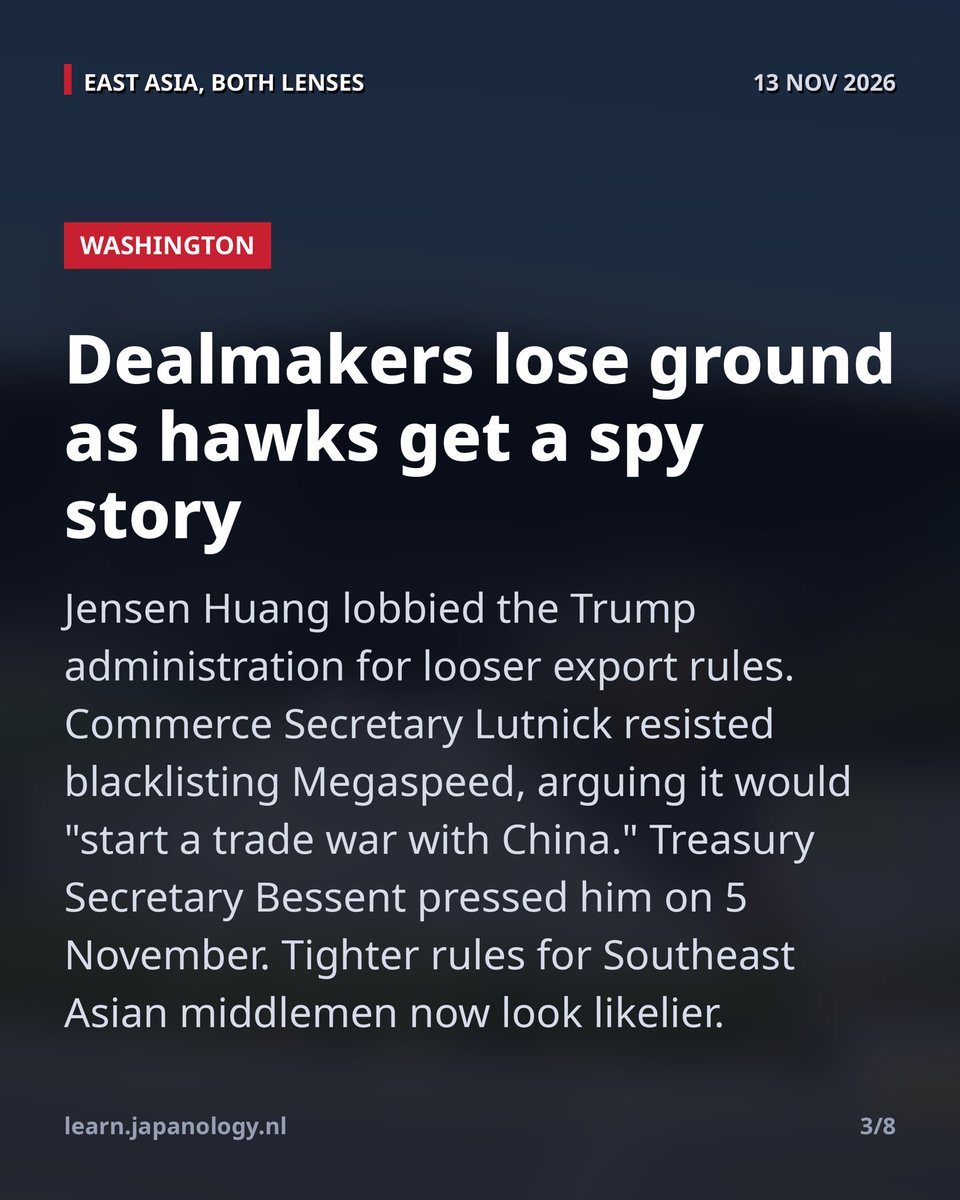
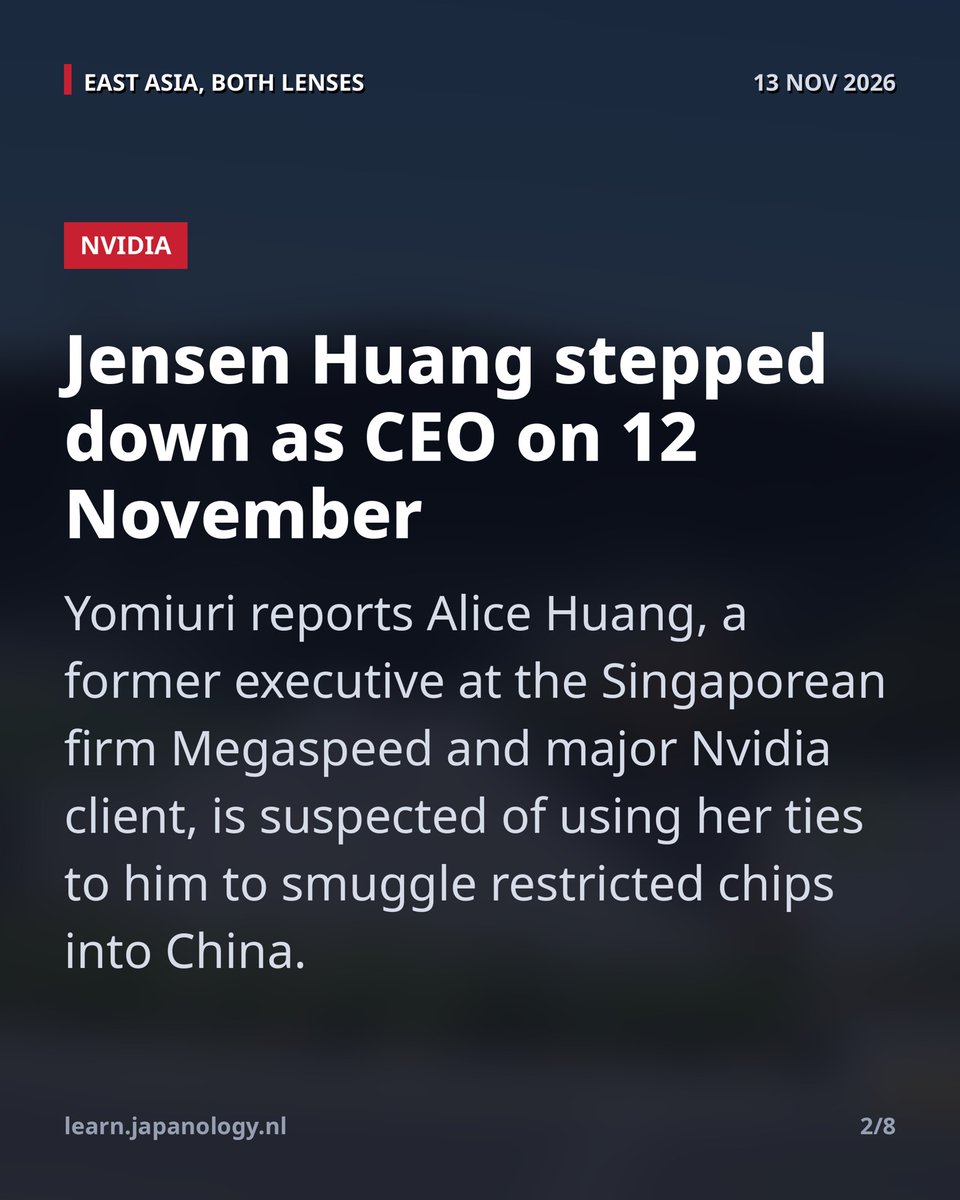
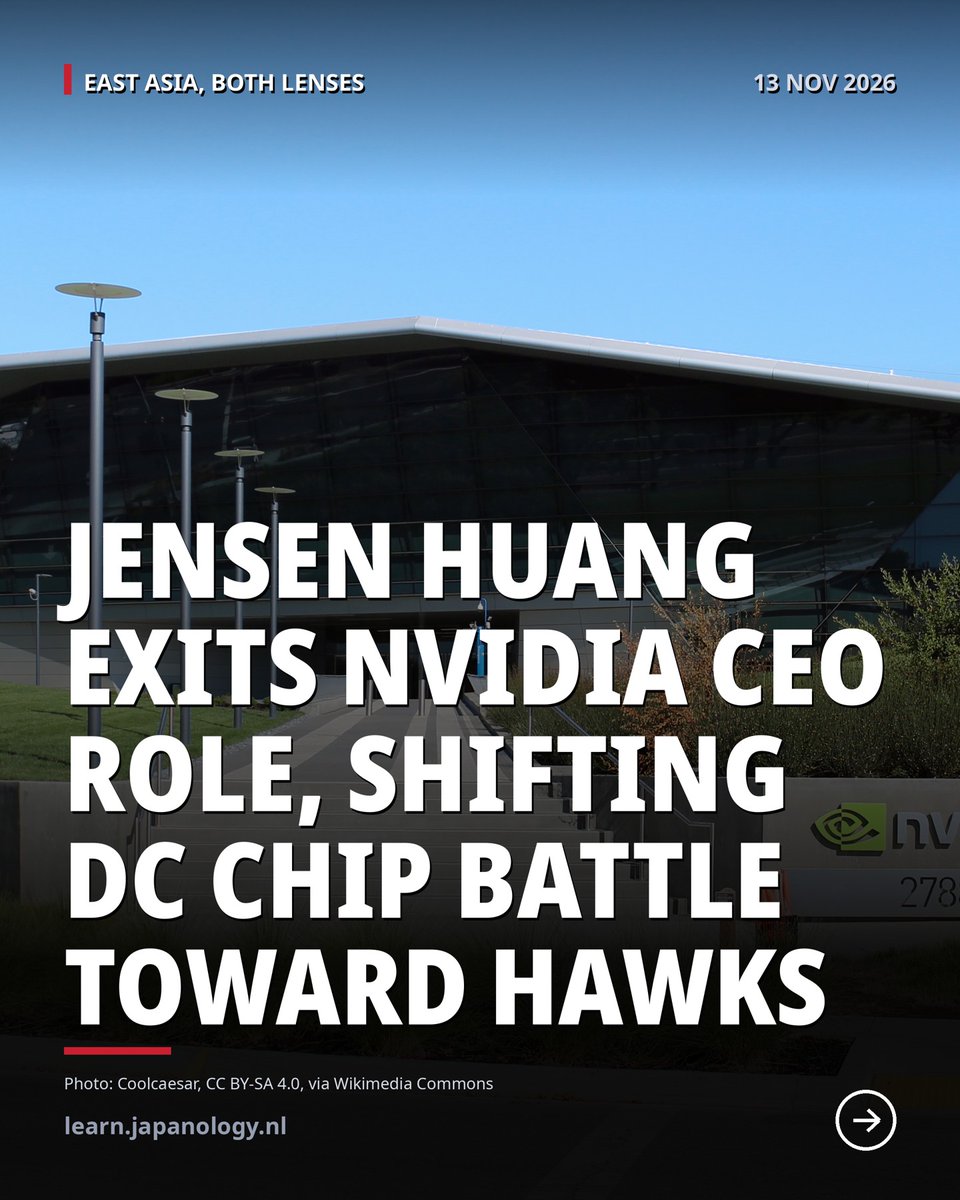
A Chinese spy has cost Nvidia its founder, and Tokyo's chip stocks are now bracing for the fallout. Jensen Huang resigned as CEO on 12 November, a move that shifts the battle in Washington over AI chip sales to China toward the hawks.
Yomiuri reports that Alice Huang, a former executive of the Singapore firm Megaspeed and a major Nvidia customer, is the woman in question. She is suspected of using her closeness to him to route restricted chips into China. Jensen Huang had personally lobbied the Trump administration to loosen those export rules. Commerce Secretary Lutnick resisted blacklisting Megaspeed, arguing it would "start a trade war with China." At a 5 November meeting, Treasury Secretary Bessent pressed him on exactly that. The dealmakers have lost their most prominent face just as the hawks gained a spy story, so tighter rules on Southeast Asian middlemen look likelier. English wires say he "resigned." Nikkei writes 事実上の解任 jijitsujō no kainin ('de facto dismissal'). The stock fell as much as 14% before closing 4.34% down. In Tokyo, firms feeding Nvidia's supply chain dipped on the turmoil, then rebounded on AI optimism.
Tokyo may be quietly shoring up its own supply in response. Sankei reports that Ito Koichi, 67, a career China specialist and former consul general in Guangzhou, will take over Japan's office in Taipei, Taiwan's capital, in early December. That office is Japan's embassy in all but name, because Tokyo does not formally recognize Taiwan. The two sides may sign a broad trade framework on AI, semiconductors and economic security at their December meeting, modeled on Taiwan's 2023 deal with Britain. Taiwan's TSMC, the world's largest contract chipmaker, already mass-produces at its plant in Kumamoto in southern Japan. If Washington cannot agree with itself on chips, Tokyo may want a supply line less exposed to American politics, and its new envoy, who knows Beijing's reflexes, could help build it.
Then there is the yen. It touched the high 159s per dollar on 12 November, its weakest since 2 September. Stubborn US inflation has markets expecting another US rate hike. Unless the Bank of Japan matches it, that could widen the gap between what dollar and yen savings pay. Money may then leave the yen, weakening it and making dollar-priced fuel and food dearer for households in Japan. Vice Finance Minister Mimura replied: "Isn't it still too early to forget the memory of summer?" He was pointing to the joint Japan-US currency intervention (governments buying yen to prop it up) at the end of July, and phrasing the threat as nostalgia. It lets Tokyo warn traders without spending more reserves for now. If they stop believing him, 160 could become a target rather than a wall.
Want this in your inbox? Once a week I send the Japan and China stories that don't make the English feeds, read in the original. Free, one click to unsubscribe: https://t.co/UiOEIosBCv
#Japan #China
A Japanese dentist telling you ぜんぜん、怖くないですからね (this won't be scary at all) is the precise moment to flee for your life, and the kanji in 怖い (kowai), scary, hides a riddle of its own: a heart on the left and 布 (nuno), cloth, on the right.
Imagine standing on the glass floor of Tokyo Skytree, 340 meters above the concrete. Your friend is currently fusing themselves to a pillar while screaming むり、むり! 高所恐怖症なの! (no way, no way, I have 高所恐怖症!), yet a five-year-old child is casually hopping across the void.
This involves 高所 (kōsho), high places, 恐怖 (kyōfu), fear, and 症 (shō), a medical condition. Apparently five-year-olds have not discovered phobias yet.
Let us dissect 怖. On the left is 忄, risshinben, which is just 心, the heart, squeezed upright. Feelings get this heart, as in 忙しい (isogashii), busy, 性格 (seikaku), personality, and 慣れる (nareru), to get used to. On the right sits 布, cloth.
A white sheet terrifying your heart sounds like a ghost story, which makes it a wonderful way to memorize the character. It is also completely wrong.
The real evidence is hiding in plain sight. 財布 (saifu), wallet, 毛布 (mōfu), blanket, and 恐怖 (kyōfu), fear, all share the sound fu.
Even the 説文解字, the dictionary compiled by Xu Shen around 100 AD, lists the primary form of this word as 悑, using 甫 (ho) instead of cloth, and mentions 怖 only as a variant. You can swap the fabric for something else and the terror remains identical.
The cloth is a phonetic decoy, not a ghost. The heart does all the heavy lifting while 布 simply provides the reading fu.
This same trick repeats across other heart kanji: 忙 uses 亡 and both read bō (多忙, tabō, swamped; 死亡, shibō, death), 性 uses 生 and both read sei (性格, seikaku; 先生, sensei), and 慣 uses 貫 and both read kan (習慣, shūkan, habit; 貫通, kantsū, piercing).
If you recognize the right side, you can often guess the on'yomi. The cloth was never a ghost. However, a dentist promising that a procedure won't be scary is still an absolute nightmare.
Learn Japanese, in English: https://t.co/T38fIjOmlC
Japanese lessons in Dutch, in Leiden or online: https://t.co/EqhYBqKU5w
Pictures via Wikimedia Commons: Tokyo Skytree at night by VaneTrz20 (CC0); Glass floor @ Tokyo Skytree by Guilhem Vellut (CC BY 2.0); a page of the Shuowen Jiezi, Xu Xuan edition, photographic reprint (public domain). Kanji strokes: animCJK.
#Japanese #LearnJapanese #Kanji #JLPT #KanjiOfTheDay #Japanology
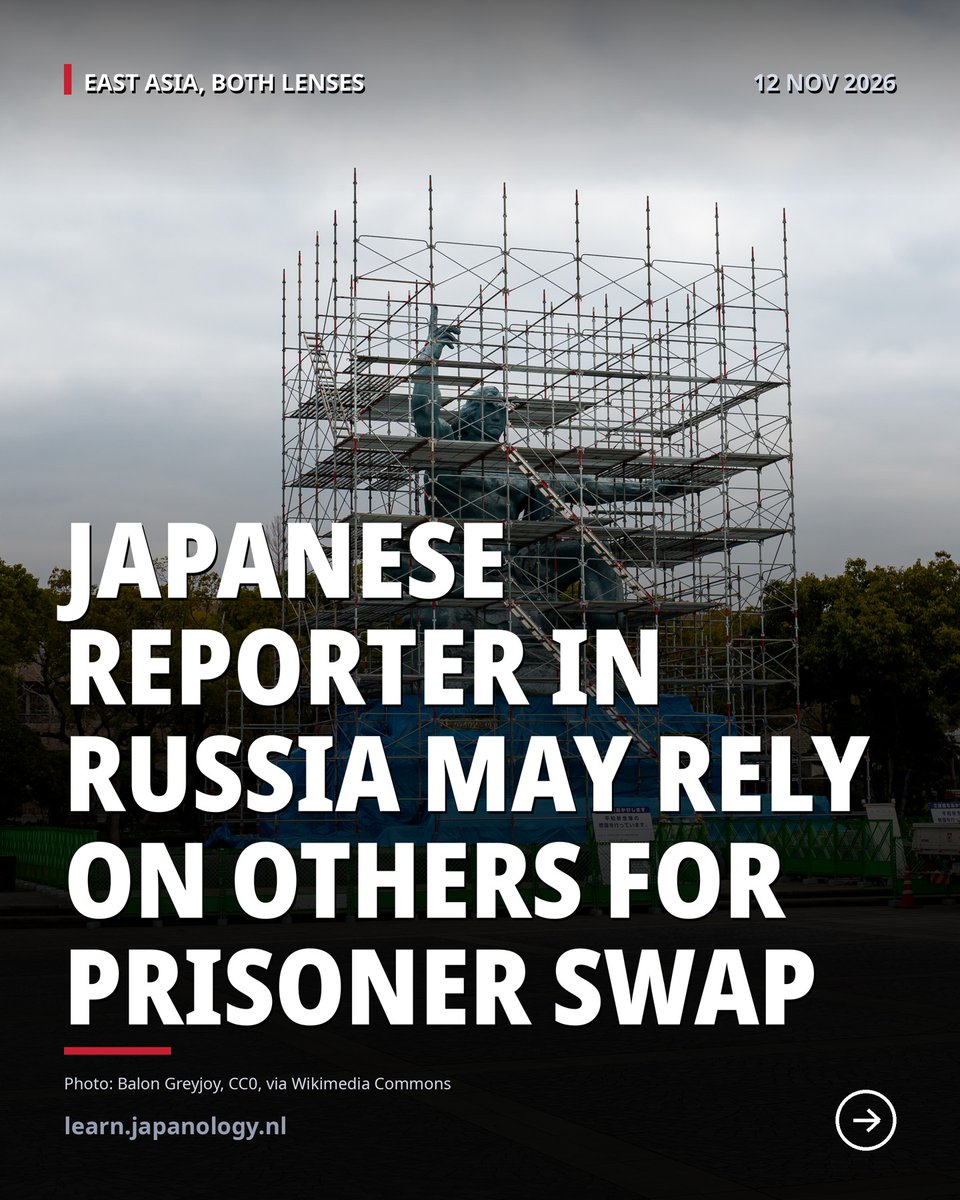
A Japanese reporter has been held by Russia's security service for a month, and his fate may now depend on Berlin. Germany holds a Russian hacker Japan extradited, while US envoys meet Vladimir Putin today. Moscow is trading prisoners again, but not with Japan.
The FSB detained a Hokkaido Shimbun correspondent on spy charges on 13 October in Yuzhno-Sakhalinsk, located on the Russian island just north of Japan. On 11 November, negotiators from Russia, Ukraine, and the US in Abu Dhabi agreed in principle on a large prisoner swap. That same day, Japan's newspaper association demanded his release and urged Tokyo to exert "maximum diplomatic effort." Today, Trump's envoys Witkoff and Kushner meet Putin in Moscow. The Committee to Protect Journalists has compared this case to that of Evan Gershkovich, the American reporter who returned home only as part of a US-Russia swap. Japan has no seat at the tables where detainees are traded and holds no prisoners Moscow wants. Its likeliest route may be securing the reporter's place in a Western-brokered swap.
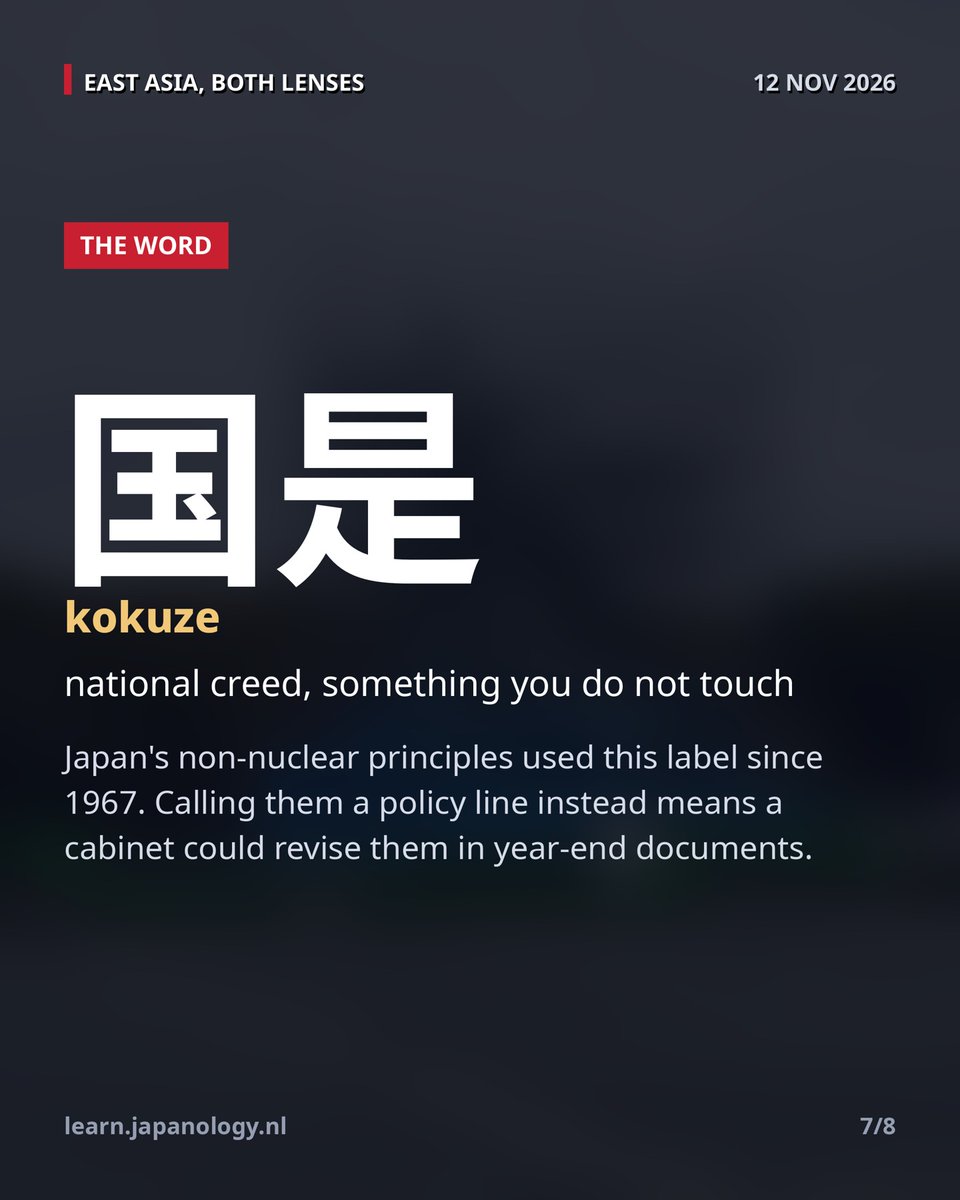
At the same time, Tokyo is leaning harder on the American nuclear umbrella. The government of Prime Minister Takaichi Sanae is considering an exception to one of Japan's three non-nuclear principles: 持ち込ませず mochikomasezu ('not allowing them to be brought in'). This would allow US submarines carrying nuclear cruise missiles to call at Japanese ports, possibly starting in 2032. Since 1967, these principles have been labeled 国是 kokuze. While English renders this as 'national policy', it means a national creed, something you do not touch. In August at Nagasaki, Takaichi called them a 政策上の方針 ('a policy line'), and a policy line is something a cabinet can revise in a year-end document. Tanaka Terumi, 94, of the atomic-bomb survivors' group Hidankyo, says the group has long demanded the principles be written into law rather than left as a national creed that changes with the government of the day. The timing is precarious. Japan is reshaping its doctrine around American deterrence just as Trump prepares his third meeting with Xi this year, while a US-China-Russia summit has been floated. Tokyo could pay the political price at home without getting a firmer guarantee in return.
Inside China, one smaller story reported widely by domestic media, mostly via a CCTV/CNR report, deserves attention. The Beijing Internet Court ruled against a platform whose algorithm labeled a user's text as undeclared AI content because it lacked "obvious human emotional features." The court ruled that any platform using an algorithm to flag AI content must explain how it works and how mistakes are fixed in terms users understand, and cannot refuse solely on trade-secret grounds. Because the text was written on the spot and the user could not be expected to produce drafts, the burden fell on the platform controlling the algorithm to back up its decision. Platform-governance disputes at that court rose from 2,970 in 2025 to 6,909 in the first ten months of 2026. As AI detectors begin deciding whose words count as human, a Chinese court has shifted much of the burden of proof onto the machine. Translated and polished text is exactly what these detectors misjudge, so I am watching who copies the ruling.
Want this in your inbox? Once a week I send the Japan and China stories that don't make the English feeds, read in the original. Free, one click to unsubscribe: https://t.co/UiOEIosBCv
#Japan #China
Every Japanese wedding reception opens with the MC announcing ただいまより、披露宴をはじめます (the 披露宴, hirōen, now begins), but look at the first kanji, 披 (hi): its right half is 皮 (kawa), skin, an animal hide. So why is a dead animal crashing the party?
The tension peaks halfway through the reception when the groom's best friend grabs a guitar and screams 新曲を、披露します! (let me debut my new song!). The room falls into a terrifying silence as he belts out lyrics detailing every single one of the groom's past heartbreaks.
While the bride's smile turns to stone, only Grandma claps with reckless abandon. This is 披露する (hirō suru), which means showing something to everyone for the first time, even things that should have stayed buried in a shallow grave.
If you dissect 披, you find the hand radical 扌 on the left and 皮 on the right. In its ancient bronze form, 皮 depicts a hand with a knife peeling the hide off an animal. Adding another hand creates 披, the act of manually opening something hidden to expose it.
Over 2,000 years ago, when the general Fán Kuài stormed into the tent at the Feast at Hongmen, the Records of the Grand Historian wrote that he 披帷, flung the curtain open. By 1231, a Japanese diary used 披露 for letting everyone know.
However, 皮 also moonlighted as a phonetic marker, lending the sounds hi or ha to various characters. You see it in 彼 as in 彼氏 (kareshi), boyfriend, and お彼岸 (ohigan), as well as 被 as in 被害 (higai), damage, and 疲 as in 疲れる (tsukareru), to get tired, and 疲労 (hirō), exhaustion.
It is a cruel linguistic coincidence that 披露 sounds exactly like 疲労, because there is always extreme exhaustion following a wedding reception.
The sound also appears in 波 as in 波長が合う (hachō ga au), to be on the same wavelength, and 破 as in the anime staple 破壊 (hakai), destruction.
The mystery is solved: the skin was never actually at the party. Much like peeling back a hide, you are simply opening something by hand to reveal it, while 皮 provides the sound hi. A banquet that opens up the couple's marriage to everyone is thus a 披露宴.
As for that guitar song, it could have stayed closed.
Learn Japanese, in English: https://t.co/T38fIjOmlC
Japanese lessons in Dutch, in Leiden or online: https://t.co/EqhYBqKU5w
Pictures via Wikimedia Commons: Han tomb mural from Luoyang, often read as the Feast at Hongmen (public domain); bronze form of 皮 (public domain). Kanji strokes: animCJK.
#Japanese #LearnJapanese #Kanji #JLPT #KanjiOfTheDay #Japanology
OpenAI wants your silence for a blue checkmark.
Section 10 of the Business Hub terms: you "irrevocably and perpetually" agree never to sue over anything ever published on your own sites.
Your listing shows up anyway. I didn't claim mine.
@Jontalksgaming Isekizima reads like 遺跡島 in Kunrei-style romanization, with zi where most English titles would write ji. A Japanese player gets ruins island from the title alone, so the English subtitle is more or less its translation.
A Dutch municipality just introduced one of its election candidates to the English-speaking world as "Horses Fuck".
This was not a calculated power move. Hilversum provides its election information in other languages, which is incredibly sweet, since nobody actually forces them to. They handed the job to an AI.
The AI gazed upon council candidate Hester Bais, apparently concluded that "Hester" is Norwegian for horses and "Bais" is a spicy close match for the French "baise", and thus she was christened Horses (H.) Fuck.
Number 5 on the list. Running for city council. Horses Fuck.
The AI was on a roll. Care home Nieuw Kerkelanden was rebranded as New Churchlands. "Stem" became "voice" instead of "vote", so English-speaking residents were cordially invited to cast their voice. Meanwhile, in Arabic, the political parties became al-haflat: parties as in festivities.
So Arabic-speaking Hilversum was informed that twenty celebrations are battling for council seats on November 18. Honestly, that sounds like a way better election.
The municipality's spokesperson said: "We use AI for that, but we can't check all translations word for word."
That single sentence is the entire tragedy. Checking a translation word for word is not a luxury upgrade. It is the actual job. It is literally why translators exist.
Ms. Bais says she laughed her head off, and that it is worrying nobody at the municipality noticed. Respect on both fronts. The error was scrubbed after the local press spotted it.
If nobody reads the output, you don't have a translation workflow. You have a horse problem.
Don't localize. Loekalize.
Source: https://t.co/nDi6T6LsAW, via NH Nieuws.
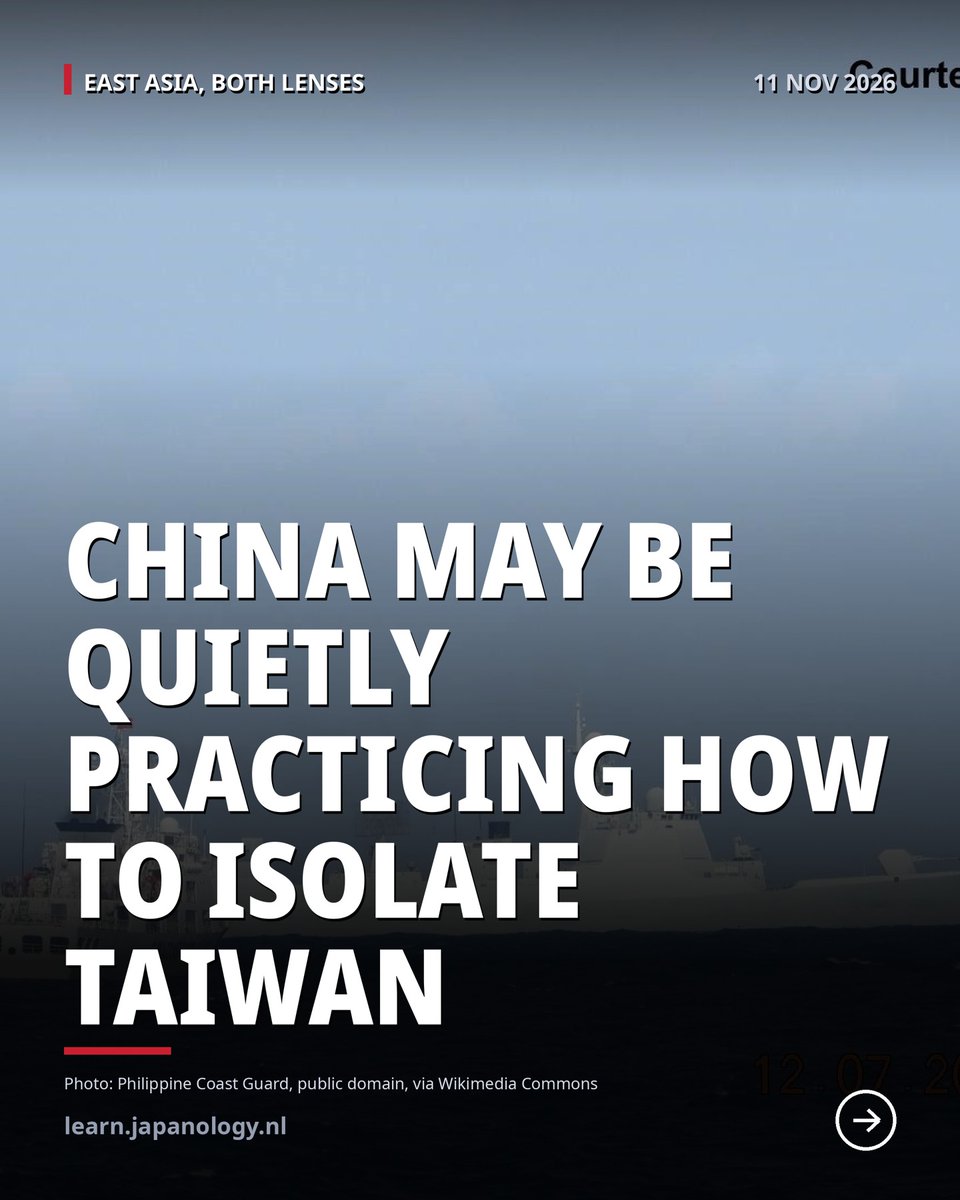
China may be quietly rehearsing how to isolate Taiwan. In Tokyo, the leading business paper is already calling next week's summit in China a "new Yalta". On 3 November, Joseph Wu, secretary-general of Taiwan's National Security Council, posted that more than 100 Chinese navy and coast guard ships were spread from the Yellow Sea to the Western Pacific.
Beijing announced nothing. By 6 November, the US think tank ISW (Institute for the Study of War) concluded that this is a large exercise built around isolating Taiwan. Sankei's headline turns on 常態化 jōtaika ('normalization'). English would say "routine". The Japanese word means the exceptional becoming the new baseline, and Sankei frames it as deliberate. While the world reacts to an announced drill, a silent one may signal to Taipei that isolation could come without warning.
The timing is critical. A week from now, at the APEC summit in Shenzhen on 18 and 19 November, Xi Jinping could host Trump and Putin. China, Russia and the US say talks on a possible three-way meeting are under way and Trump says he expects one, but it has not been confirmed. Nikkei's phrase 新ヤルタ shin Yaruta ('new Yalta') hits harder in Japan than in English. Yalta was the 1945 deal that brought the Soviet Union into the war against Japan and handed it the Kuril Islands, which is where today's Northern Territories dispute comes from. Nikkei also says Xi is doing a weakened Trump a favor in the sense of 恩を売る on o uru, which means creating a debt that will be called in later. On 10 November, Tokyo showed the ruling parties its draft security strategy. It says the world "is entering a historical and fundamental period of transformation" and names an America turning inward. Japan is tying its Taiwan planning to Washington at the very moment Washington may be bargaining with Beijing over Japan's head.
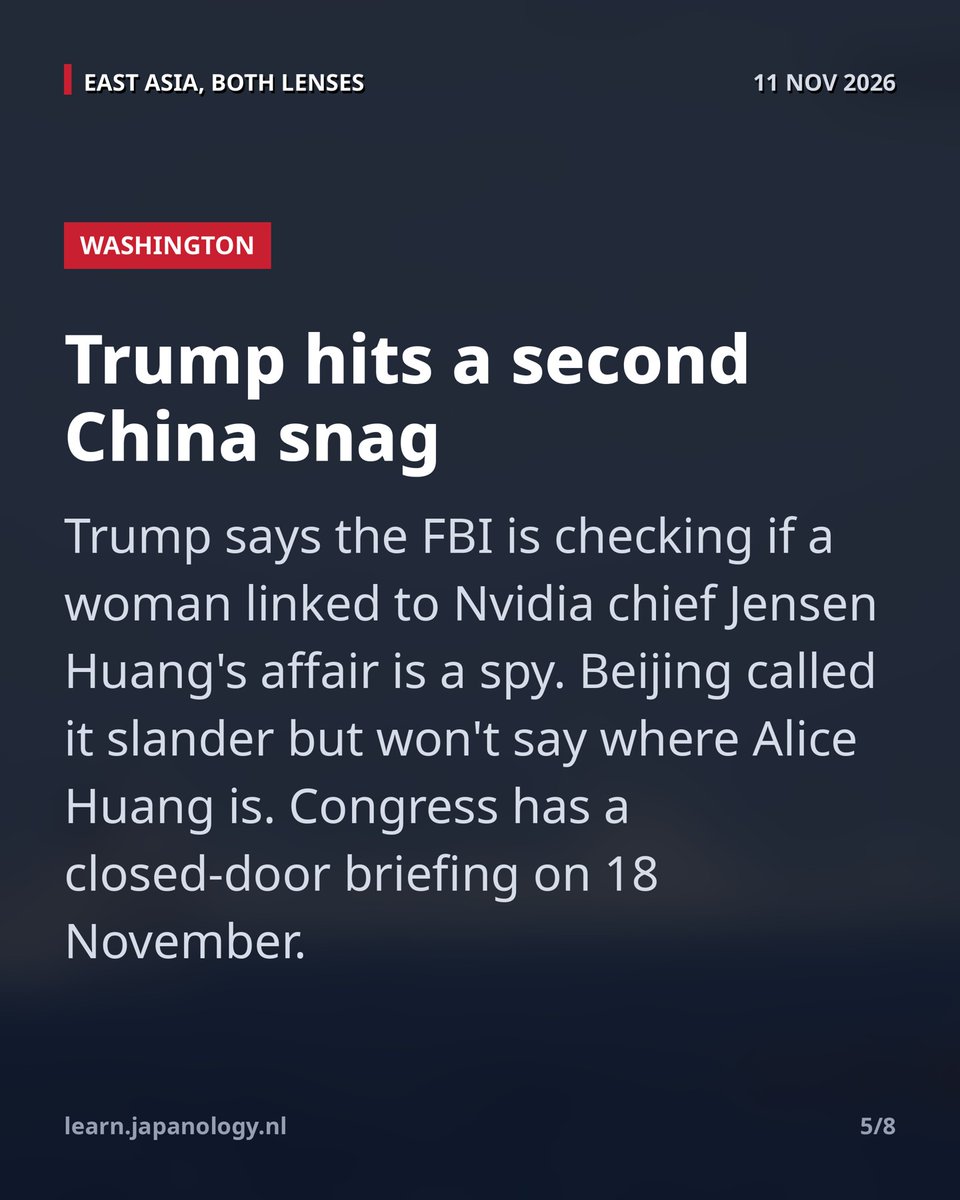
Trump faces a second China problem. He says the FBI is investigating whether a woman involved in the affair of Nvidia chief Jensen Huang is a spy. China's foreign ministry spokesman Guo Jiakun said the "so-called 'Chinese spy' narrative is pure catching at wind and grasping at shadows, slander and smear." That is a stock idiom for baseless rumor. However, he refused to say whether Alice Huang is a Chinese citizen or where she is now. That non-answer is unlikely to help end a story Washington is already pursuing. Congress gets a closed-door briefing on 18 November, the day Shenzhen opens. Hawks in both parties are already citing it to push tighter export rules on Nvidia's chips. National security can still unite a divided Senate, but White House opposition may decide it.
One last story is close to my own work. In Beijing, a platform's algorithm decided that an original answer posted by a user surnamed Tang lacked 明显人类情感特征 míngxiǎn rénlèi qínggǎn tèzhēng ('obvious human emotional features'). It labeled the text undeclared AI content, hid it and muted the account for a day. The Beijing Internet Court ruled against the platform. The platform has to explain its detection in terms a user can understand. It cannot hide behind trade secrets, and it cannot demand drafts of text that was written on the spot. Anyone whose writing is plain, edited or translated now has a Chinese precedent that can shift part of the burden of proof onto the machine.
Want this in your inbox? Once a week I send the Japan and China stories that don't make the English feeds, read in the original. Free, one click to unsubscribe: https://t.co/UiOEIosBCv
#China #Japan