AI-powered medical writing for CROs, consultancies & life sciences companies. Generate compliant docs faster across clinical, regulatory & strategic workflows.
1/ We tested Jev, @typesafeai's low-cost model that returns probabilities, on clinical research tasks from ClinReg, our benchmark for clinical and regulatory work.
Three roles: answering, judging, and selecting answers for review. https://t.co/VfloX06wwK
9/9 These are the hard problems our applied AI team takes on — helping pharma and medtech teams build and ship custom AI into production. See you in Atlanta on Dec 13.
#NeurIPS2026#AIEvaluation#AIAgents
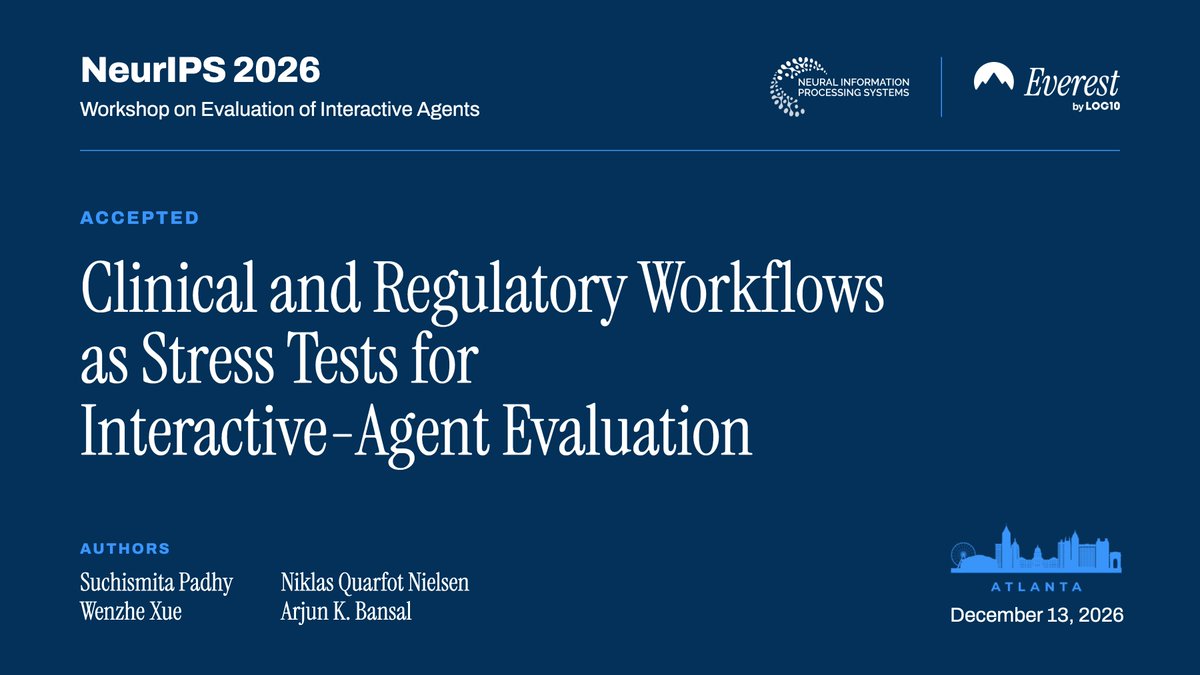
🎉 Our applied AI research team had a paper accepted at the NeurIPS 2026 Workshop on Evaluation of Interactive Agents. Our work focuses on evaluating agents in clinical and regulatory work. 🧵👇
8/9 Where the evaluator sits matters too: a grader that's safe after a task finishes can leak information or shift behavior when its feedback returns mid-task. Our fix: report four layers — outcome, trajectory, reliability, and system configuration.
Which AI models are best at systematic literature review?
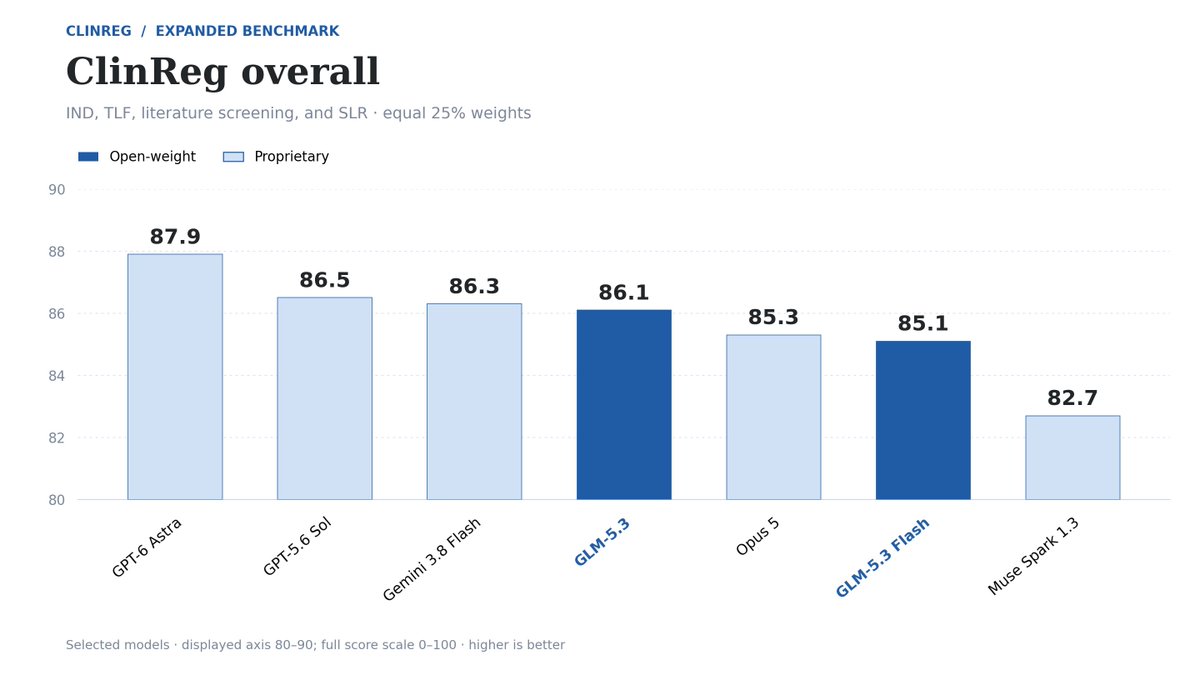
We added TrialPanorama's SLR tasks — a peer-reviewed dataset from a Nature journal — to ClinReg.
Two of the top six are open-weight. GLM-5.3 ranks 4th overall, ahead of Opus 5.
🔗 https://t.co/9PXVXgJdEI
ClinReg, our real-world benchmark for this work, now has a live website: the best model for TLF programming is open-weight. https://t.co/nW3IRrp2MB
Updated results with GPT-6 Astra, GLM-5.3, GLM-5.3 Flash, Gemini 3.8 Flash, Gemini 3.7 Flash, and Muse Spark 1.3
Regulatory documents that build themselves from your data — and stay current as it changes.
📄 Source data in, submission-ready doc out
🔍 Checked by multiple models
✍️ Your reviewer signs off
🔄 Affected docs update when new data lands
How Everest works, in 90 seconds 👇
The takeaway: model choice is now the easy part. What's left is engineering — model + harness fit, validation, inference routing.
That's the complexity we absorb so life-sciences teams can focus on the deliverable.
Full write-up 👇
https://t.co/ZtuEcjWiLb
Open-weight models match the frontier on benchmarks. But can they be trusted with regulatory and clinical-trial work?
We built ClinReg to find out — and ran 19 leading models through it. 🧵
One more: the top open-weight models weren't American.
The best came from GLM-5.2 and Kimi K3. The strongest US open-weight models were our lowest performers — Gemma 4 31B (73.5) and Nemotron 3 Ultra (70.3).