Token utility usually means the token is the thing you have to buy before you can reach the thing you actually wanted.
@plusmorexyz is selling white-label gift cards to crypto card companies, 5,500+ brands, one API, 0% added to the supplier's rate, 999 USDC one-off setup per product. The rates and the terms are plain, and the page openly says the fee doesn't buy uptime, supply or continued service. That's more honest than most.
But on the consumer side you pay gift card face value in PLUS, not USDC. Staking is listed as opening soon after contract review, so the 60% of margin promised to stakers isn't live. Every brand I opened shows Paused, beta budget at $9,909, offer ends 20 November. And they describe themselves as a revenue generating ecosystem with $0 raised, when the visible revenue is a setup fee and their own token.
The rails look real, the real world utility claim is a conversion step.
That answers it properly, and the stapling comparison is the right one. Scoped to the agent, not the account, and the bank owes her the log. Both objections gone.
One gap survives the fix. In TLS the party presenting the stapled status is the server you're already choosing to talk to. Here the presenter is the agent whose authority is in question, so a compromised or simply dishonest agent can present a status that was valid ninety seconds ago. That's why browsers still won't accept a stapled response from a cert they don't otherwise trust.
The stale window is the other half. A status that dies in minutes means revocation isn't effective for those minutes, and a transfer inside that window clears every check you listed. Short TTL makes the window small, not zero, and the dispute lands in exactly that gap.
Both are fixable, but they move the question from who holds the status to how short the window can be before it stops working in practice.
Credit where it's due, a two dollar trade, no cuts, and the explorer shows a relayer submission with no amount and no wallet. That's more than most privacy claims in this cluster come with.
It proves the display layer. It doesn't prove nobody knows your position.
A relayer is a party. It submits for you, so it can bind that transaction to you whether or not the explorer shows it. And a fill landing a minute later means somebody is holding the order in the gap, which is an execution venue with a view.
The test I'd want before I believe the claim is one level down, read the position out of contract state, not out of the explorer. If positions sit in a vault keyed by an address, the privacy is a decoding choice. If they sit behind a commitment with a proof, it's real.
Which is it? I'd rather be shown than told.
Is $ROOQ real? One trade, start to finish, no cuts.
2 USDG for AMZN on https://t.co/9iKZjsrcWV. The proof is built in the browser, the fill lands about a minute later, and the transaction is on the public explorer: sent by a relayer, no amount, no wallet.
That resolves it, and it's the second one. Issuer keeps the authority, bank checks the status at authorization. The certificate comparison is the right one.
It also carries the failure that matters. Revocation checking is the least reliable part of TLS precisely because it soft-fails, when the status endpoint is slow or unreachable, the client proceeds anyway. So what does the bank do at authorization when the issuer's status query times out?
Proceed, and the gap is back. Refuse, and the issuer now holds a kill switch on every customer's payments.
The receipt only follows if the bank logs the query and has to hand it over. A status the bank can read and never show her is still the bank's log, not her evidence.
@strato_net Most tokenised gold asks you to trust a word. Check whether the vault is real and the word usually turns out to be doing all the work.
STRATO is a good test case because they publish the most of anyone I've checked. A monthly treasury report. A vaulting letter from BA Gold Enterprises every month back to March. A Consensys Diligence audit of the native bridge and timelock. On-chain proof links for every collateral token, ETH through SPY. The supply maths lines up, 6,012 GOLDST against 6,277 vaulted ounces at 43 and 64 West 47th Street in New York, 59,802 SILVST against 59,924. Over-collateralised, not under.
That's a real treasury page, and it's rarer than it should be.
Now what it isn't. Every vaulting letter is signed by the custodian confirming its own holdings, and the only independent physical inspection is a CPA visit from December 2025. The most recent months rest on the operator's own word, which is exactly the word you went looking to replace.
None of that is a finding against them. It's the honest limit of what any of these projects can show you, and STRATO at least shows you where the line sits.
So the three questions that settle any tokenised commodity, and the answers here.
Who signs the vault confirmation. Here, BA Gold, the operator. Ask the same of Paxos or anyone else and see how many answer at all.
How old is the last genuinely independent physical audit. Here, roughly eleven months.
Does the token supply sit below the metal, or above it. Here, below, and it's on the page for anyone to check.
Two of three are strong. The middle one is the one to keep asking about.
If you're holding tokenised metal, you don't own an audit. You own a custodian's promise plus whatever inspection stands behind it.
@tidewellrh has now said twice, in public, that 0x142ec908bffe9b45abdbbd2b78b2a82726ead64c is not theirs.
That contract holds 1,000,000,000 TIDE, the same name and supply as the real one, and carries 490 holders and a $605K market cap on CoinCatapult. Its own TIDE/WETH pool shows zero TIDE and zero WETH, so the market cap is a number computed off nothing tradeable.
Two readings, and both are bad for somebody.
Either it's a copycat using Tidewell's name to catch people searching the ticker, in which case 490 wallets hold a token the real team has publicly disowned. Or it's an earlier Tidewell deployment they walked away from, in which case holders were left in the dark until a stranger asked the question.
Tidewell answered properly, and I'll say that plainly. Answering a reviewer isn't the same as warning the people holding the other token.
If you're buying on a new chain, match the contract against the project's own bio before you size anything. A matching name and ticker mean nothing.
Fair on the sample. Nine loans is nine loans, I'm not calling that stress tested.
Loss allocation I did say out loud though, the shortfall lands on the lenders whose HYPE funded the vault. What's missing is oracle failure and recovery. Nobody publishes what happens if the feed lies or freezes, and Cache hasn't either.
That's going on my list for them.
Every loan platform says no liquidations. What matters is who eats the loss when the collateral dies, and that sentence is missing.
@lendcache launched on Montra about a day ago, and their numbers are small enough to check. Nine loans, zero liquidations. Eleven coins listed, and their borrow page caps each one: up to 10 HYPE against EACCAT, CHAMELEON, BLOB and KNTQ, 2 to 5 against QUOTED, MONTRA and POCKET.
The mechanic is honest about its own shape. Pledge a bag that would sell for 10 HYPE, borrow 2.5, and repay 2.8 within seven days to get the coins back, or walk away and keep the HYPE. That is 0.3 HYPE for a week, which is a fixed cost you can see before you sign.
It also tells you where the risk sits. Nobody gets liquidated, so when a coin falls the vault is holding collateral worth less than the loan. The fee is paid by the borrower and the shortfall lands on the lenders whose HYPE funded it.
Their newest post says 100% of $CACHE fees have gone into the HYPE vault, and the flywheel is fees to vault to loans to lenders. On the same day their homepage reads for both deposited and HYPE to lend. 100% of a fee base that is still a dash.
Credit for the rest, because it is stronger than most: per-coin and daily limits so one coin cannot drain the vault, a 2-of-3 Safe with an onchain timelock, and a guardian that can pause or tighten but never loosen.
Verdict: the loan design is coherent and documented; whether it survives one bad coin depends on a loss allocation nobody has published yet.
When a lender promises no liquidations, ask who absorbs the shortfall. Fixed-term lending does not remove the loss. It moves it from the borrower to whoever funded the vault.
@Fherumfi says confidential DeFi lending powered by FHE. Nothing they've shipped is encrypted, and their own website says so.
Credit first, because there's a lot of it. In five days this account has put 16 lending markets on Robinhood Chain mainnet, 13 of them tokenised stocks and commodities (SPY, QQQ, NVDA, GLD, SLV, USO) borrowing against USDG. A curator system where every risk change sits behind a 48-hour timelock. BREAKGLASS emergency controls that leave repayment open. A 2-of-3 admin Safe. An ASSAY registry that reads the ERC-8056 uiMultiplier straight from the issuer contract so stock collateral keeps its dividend, and pauses borrows during a split. The founder posts his own test transactions, four of them, one complete deposit-borrow-repay-withdraw cycle. That's more verifiable work than most of this cluster has shipped at all.
Now the gap. Their contract list names a module called PlaintextFHEAdapter, and labels it in their own words, Public mode · no encryption (FHE privacy coming). The site says every field is public today and shows a mock of what an observer would see once FHE privacy mode ships. Every demo they've posted is an ordinary public loan, and the adapter itself has zero transactions on it.
None of that is dishonest, and I want to be clear about that. The website draws the line exactly right, 32 contracts linked to the explorer, tagged not audited, and a paragraph admitting the privacy isn't there yet. The overselling is in the bio and the header, where powered by FHE and private positions, by design sit above a product with no encryption in it.
Early-stage, unusually well documented, and the privacy claim lives in the branding rather than the contracts.
If a project's front page carries a privacy word, open their contract list before you deposit anything. The adapter will say plaintext, and it takes ten seconds to find.
Confidential is the most overclaimed word in crypto right now, so it's worth saying clearly that @raycashxyz appears to mean it literally.
Raycash is a Zama spin-off. Balances and transfer amounts are encrypted by default, and that's FHE doing real arithmetic on ciphertext, not a UI hiding numbers from you while the chain stores everything in plain sight. Zama is the reason to take the claim seriously. Most projects using the word are at the other end of that scale, some with a contract literally named PlaintextAdapter.
The parts I can't vouch for yet, since it's a private beta gated behind a form and a prior Zama wallet address: whether every transfer amount is genuinely encrypted on-chain or only at the edges, and where the yield comes from. A private balance earning an undisclosed return is the same trade-off as a bank you aren't allowed to audit.
Private money is a real need. Lebanon is the argument, and nobody who watched a central bank take people's dollars needs convincing.
The test for this category isn't whether the app hides your balance. It's whether the chain does.
Meet Raycash, a private money app for humans and agents, built on the Zama Protocol.
Hold, send, and earn yield on stablecoins, all from your phone. Balances and transfer amounts stay encrypted by default.
500 Private Beta spots are exclusively reserved for the @zama community: the builders and early adopters who have supported confidential onchain finance from the start.
@zama brings confidentiality to onchain finance. Raycash brings it to everyday money.
Claim your spot 👇
https://t.co/Ud6Y1XHxlZ
This is what tokenised metal should look like, and the one gap is worth knowing about.
@strato_net publishes a monthly treasury report with a vaulting letter from BA Gold Enterprises for every month back to March, a CPA physical audit from December 2025, on-chain proof links for every collateral token, and a Consensys Diligence audit of the native bridge and timelock. The maths checks out too: 6,012 GOLDST against 6,277 vaulted ounces, 59,802 SILVST against 59,924 ounces. Slightly over-collateralised rather than under.
Now the gap. Every document there is either produced by the vault operator or nearly a year old. The monthly letters are BA Gold confirming what BA Gold holds, and the independent one is a single CPA visit in December 2025. There's no Big Four or recurring third-party attestation of the bars themselves.
That's not a red flag. It's the difference between audited and a letter from the custodian, and most projects don't even publish the letter.
The test for any tokenised commodity: who signs the vault confirmation, how old is the last independent physical audit, and is the redemption path public. STRATO answers all three. Two of the answers are better than the third.
For contrast, the same gold-collateral model is now being cloned by accounts less than a week old, one of which simply says it was inspired by @strato_net. The receipts are the thing worth copying, not the pitch.
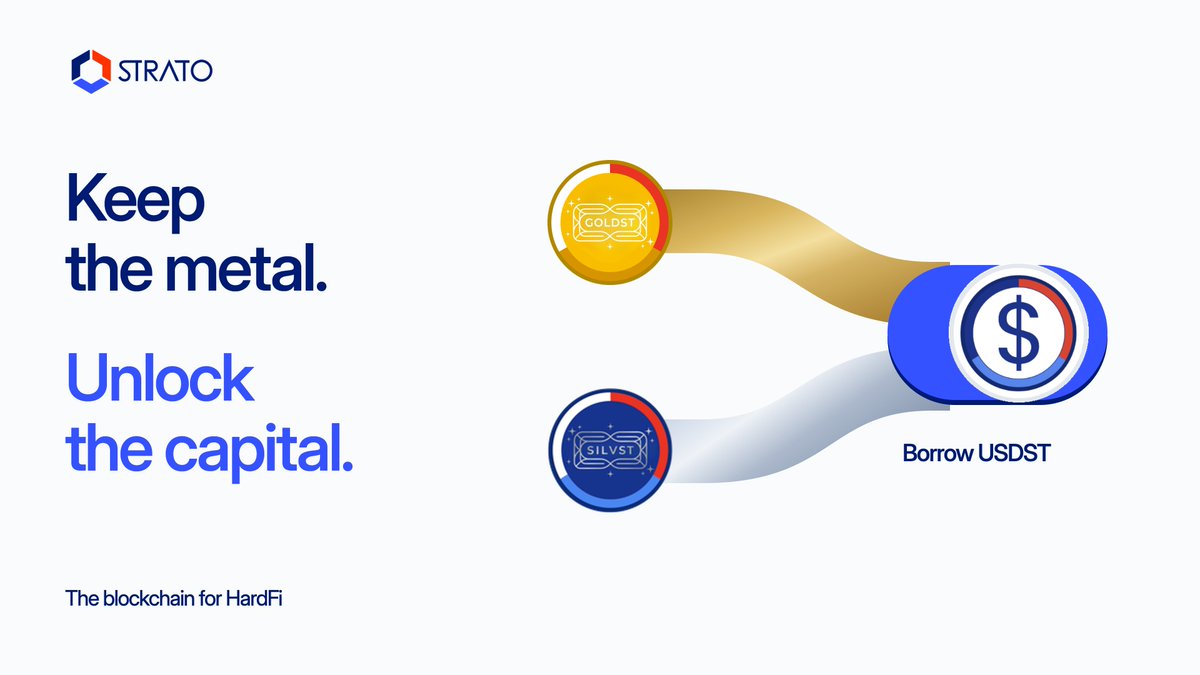
Keep the metal. Unlock the capital.
Gold and silver have preserved wealth for centuries. STRATO gives them a new role in an onchain economy.
$GOLDST and $SILVST bring physically backed gold and silver onto STRATO, with each token backed 1:1 by vaulted metal.
Here’s how you put that value to work:
1. Get your metals onchain.
Fund your STRATO account and buy GOLDST or SILVST through Buy Metals. Supported bridge routes can also convert incoming funds into metal tokens on arrival.
2. Unlock liquidity.
Use your GOLDST or SILVST as collateral to mint USDST. Your metal position stays in place while you access capital against it. ↗
3. Put that capital to work.
Deposit USDST into the Savings Vault, provide liquidity to earn a share of trading fees, or swap into other supported assets. Choose how you participate in the economy built on STRATO.
The metal is the foundation. Credit and onchain applications expand what you can do with it.
Start here: https://t.co/CaZsoWnhtQ
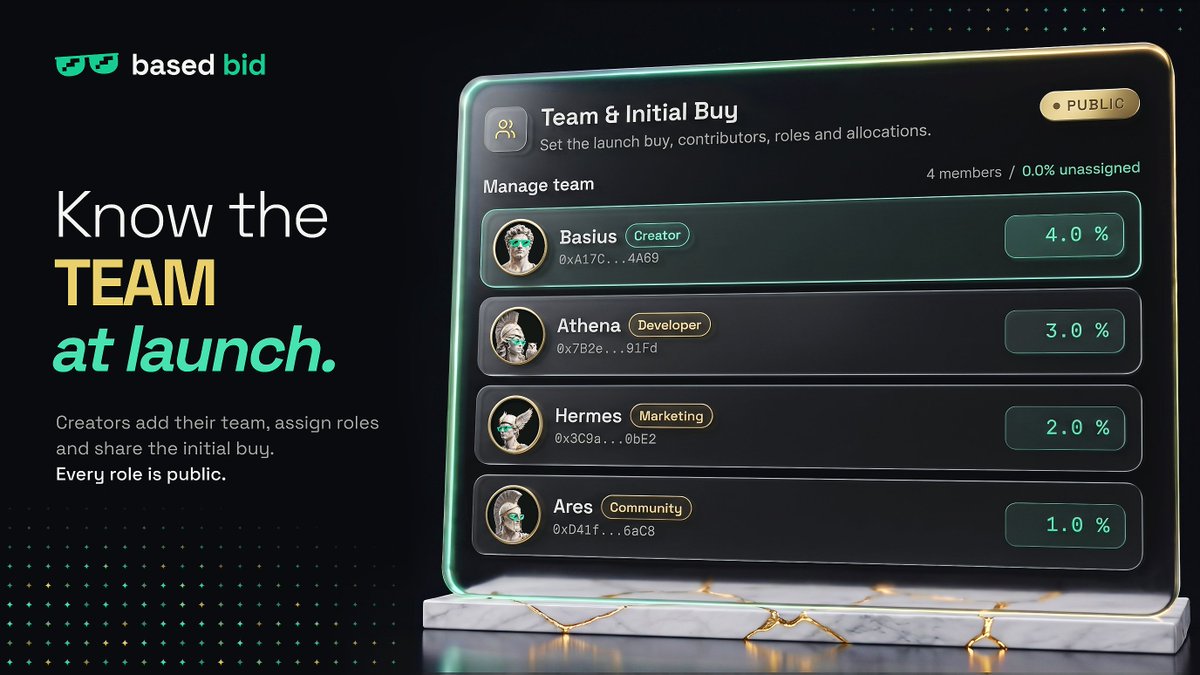
based bid's pitch is that you see the whole team, every member, every role, every share of the initial buy. Then one word gives it away: optional.
Their own launch guide lists team allocations among the optional controls, next to Fee Builder routes and vesting. So a team with something to hide leaves the box unticked and the buyer sees the same empty field they get on every other launchpad. Their line is built for teams with nothing to hide, which is exactly the problem. The teams with nothing to hide were never the risk, and the ones with something to hide aren't going to volunteer it.
Transparency you can switch off isn't a signal. It's a feature, and only honest teams will use it.
The fix is cheap: make it mandatory, or mark every launch that leaves it blank. Then the blank carries meaning instead of passing for silence.
To be fair to them, they already say the thing most launchpads won't, that markets are created by independent users and listings are not endorsements. That's the honest version of this. The team field should follow it.
Most launchpads show you one dev wallet and nothing else.
basedbid shows you the whole team: every member, every role and every share of the initial buy, public from the first block.
Team & Initial Buy. Fully optional. Built for teams with nothing to hide.
The marginBps field are what made it worth writing about, most rails make you infer the fee from behaviour.
Two things to clear up when you can: is batch settlement live or experimental, and does the facilitator need auth or not. Either way I'll correct the piece if I got it wrong.
A facilitator for x402 payments just published its own margin and every rate change date, and that should be the norm.
@PayAINetwork runs the settlement layer between an agent and a paid API. /supported answers with no auth: 36 payment kinds across Base, Arbitrum, Polygon, Avalanche, BNB Smart Chain, Sei, X Layer, SKALE and Solana, mainnet and testnet, and it tells you what each one costs per settlement. Solana exact is $0.00112. Base is $0.00179. Arbitrum is $0.00559. Two of those rates changed today, and the endpoint carries the date each took effect.
It also states marginBps 3000, so the facilitator's own markup is 30% on network cost, in a field anyone can read.
The same page lists 15 EVM signer addresses and two Solana fee payers. That is the trust model in one line, settlement runs through those keys, and you either accept that or you don't. Publishing them is more than most do.
What I'd want before trusting it with volume, the batch settlement scheme reports experimental, true in the API and public preview in the docs, while the announcement post says it is live. And the site says no API key required while the docs list facilitator authentication as a pre-publish check.
Still the right shape. When a payment rail publishes its margin and its change log, you can price it. When it doesn't, you're guessing what the fee is.
My Glavior case file already lists BTSE as a confirmed exchange partner, so this checks out.
What the case file says as a possibility is now visible: broker codes mean Glavior can earn from user volume, and this campaign is exactly that, with credits and vipUSDT paying for futures volume.
Nothing wrong with it. Just worth saying out loud, because trading numbers from the next four weeks measure the campaign, not the product. Same rule I apply to every project running an incentive window.
The full case file, with every claim labelled by how I verified it: https://t.co/JmIwNSRsRP
Proud to bring this partnership with BTSE.
The campaign is just the beginning. We're looking forward to bringing more value to the trading community through Glavior's intelligence and execution infra.
Free automate plan and 5$ credits to first 100 users https://t.co/bjzrgAapLs
@tidewellrh thanks for the reply, and for the reserve links, they do answer the question I raised.
I opened the page. Protocol revenue: 0 ETH in 8 weeks. Rewards reserve: 0 ETH.
Burned: 0. Staked: 0.
So the addresses are public and the reserve is empty, which means 5% of protocol revenue accumulating since launch is currently 5% of nothing. Boosted pools paying out of it would pay out of an empty bucket.
Publishing the address was the right move. The next honest line on that page is what the reserve actually holds today.
Two contracts on Robinhood Chain, both named Tidewell, both 1,000,000,000 TIDE supply, and from the outside I can't tell which one you're building on.
0x5dd89189769deb28e1e24fb8623e28856b6b5300 is in your bio, 229 holders, 7,369 transfers.
0x142ec908bffe9b45abdbbd2b78b2a82726ead64c has 490 holders and carries a $605K market cap, while GeckoTerminal shows its TIDE/WETH pool holding zero TIDE and zero WETH.
Same post asks readers to trust a 5% Rewards Reserve that appears nowhere on the site and has no address. Your roadmap also ticks Security audit (done) with no firm and no report.
All three are fixable by publishing a link. Until then a buyer can only take your word for it, and taking your word is what a review exists to avoid.
Tidewell V2 is nearly here.
We’ve been heads-down building the next major release, and the target is this coming weekend (or shortly after). V2 brings boosted pools, liquidity shapes, meaningful performance upgrades, and a round of minor bug fixes.
Here’s what’s coming:
Boosted Pools
Up to three boosted pools will be active at a time, one in each of these categories:
- One bluechip pool (e.g. ETH/USDG)
- One stock token pool (e.g. NVDA/USDG)
- One project pool, reserved for partnered projects or our own
Rewards come from the Rewards Reserve: the 5% of all protocol revenue that has been accumulating on-chain since launch. For partner pools we plan to incorporate the partner’s token as well.
This is the first blueprint. We’d genuinely like your feedback before we lock the design: categories, selection process, reward structure, duration, anything else you think we should consider.
Liquidity Shapes
Uniswap doesn’t natively support custom liquidity shapes (even distribution, centered, weighted toward the edges, etc.) as a single managed position. We’ve found a way to deliver this, but it requires additional development time. It’s part of the V2 scope and will ship as soon as it’s ready and tested.
Alongside these features you’ll get overall performance improvements and a set of minor bug fixes that should make day-to-day use smoother.
V2 is focused on giving you more ways to earn and more control over how your liquidity works, while keeping the core promise the same: your vault, your keys, automation that only you can override.
Your input shapes what we build next.
🌊
https://t.co/etM8OCJiaJ
Paste a wallet, it mirrors every buy and sell, six chains, one Telegram chat.
The copying isn't the interesting part. The custody is.
If the bot makes the same trade for you, it's holding either your funds or a wallet it controls. Their post doesn't say which, and that single unstated sentence is the whole risk model. Bad trade or bad ending turns on it.
Before you connect anything, find out where the key lives.
Copy trading is live in the Synthra Trading Bot.
Paste any wallet. Get every buy and every sell the second it happens.
Turn on copy and the bot makes the same trade for you. Your amounts, your rules.
6 chains. One Telegram chat.
👉 https://t.co/nB6jMSnmrc
Fair, the $41.7K is yours. I tagged the contract because the contract is the question. Two addresses, same name, same supply, 14x apart, and neither one has told anyone which is the real Tidewell.
Actually while I've got you, your board and CoinCatapult disagree on the same token. Any idea which side is reading it right?
@tidewellrh two contracts on Robinhood Chain both call themselves Tidewell, both with 1,000,000,000 TIDE supply.
The one in your bio (0x5dd89189769deb28e1e24fb8623e28856b6b5300) has 226 holders and a $41.7K cap on Sentro's board. The other (0x142ec908bffe9b45abdbbd2b78b2a82726ead64c) has 490 holders and a $605K cap on CoinCatapult.
Same name, same supply, two prices 14x apart. Which address is yours?
@lendcache went live on Montra about a day before I looked at it. Nine loans so far and zero liquidations, which is too small a sample to mean anything, so read the mechanics instead of the stats.
Borrowing is fixed term and overcollateralised. One example on the site: put 10 HYPE in, take 2.5 HYPE out, repay 2.8 within seven days. That is 12% on the borrowed amount for a week, with collateral sitting at four times the loan. Eight coins have caps on the borrow page, so somebody has thought about exposure.
The thing worth flagging is the homepage. Deposited and HYPE to lend both show a dash, while a post says 100% of fees went to the HYPE vault. Either those numbers are not wired up or they are not being shown. Both are fixable, neither is fatal, but a lending page that will not state its deposits is asking you to trust the team over the ledger.
The contracts are a 2-of-3 Safe behind a timelock, and the guardian can pause or tighten but not loosen. Reasonable shape for something new.
Verdict: real mechanics, sensible caps, one number missing.
Reader rule: when a lending page hides its deposits, read the vault contract before you read the post.