When I hear the word validator, the first thing that comes to mind is this.
Someone or something that checks whether something is correct, trustworthy, or acceptable before it is approved.
So,a validator is a verifier.
The exact role changes depending on the context, but the idea remains the same.
• A teacher validates an exam by checking whether the answers are correct.
•At an airport, a scanner validates your boarding pass before letting you through.
•In software, validators check that the information you enter is properly formatted before it’s accepted.
•On a blockchain, validators verify transactions, enforce the network’s rules, and help everyone agree on the state of the network
In every case, validators answer one question:
“Can this be trusted?”
For GenLayer, validation goes beyond checking whether a transaction is valid.
GenLayer validators operate LLM-backed nodes that evaluate evidence, reason through complex problems, and help the network reach consensus on decisions that involve interpretation rather than simple computation.
They don’t just secure the blockchain.
They adjudicate it.
This is how Validation Works
When an Intelligent Contract is executed, GenLayer doesn’t rely on a single validator or a single AI model.
Instead, the network follows a structured review process.
First, a validator is randomly selected to act as the proposer (also called the Leader Validator).
The proposer executes the Intelligent Contract using its LLM-backed node, gathers the necessary evidence, and produces an initial judgment.
That judgment isn’t automatically accepted.
Other validators independently perform the same evaluation using their own nodes.
Rather than copying the proposer’s answer, they reason through the task themselves and compare their conclusions.
If enough validators independently reach an equivalent conclusion, the network accepts the result through GenLayer’s Optimistic Democracy consensus mechanism.
If validators disagree, the decision doesn’t immediately fail. Instead, it can move into an appeal process, where additional validators review the evidence before the final judgment is committed on-chain.
This process ensures that important decisions aren’t controlled by one validator, one AI model, or one organization.
Trust emerges from independent verifications.
This matters because many real-world decisions aren’t black and white.
Consider questions like:
•Did a freelancer complete the agreed work?
•Does this content violate community guidelines?
•Is an insurance claim supported by sufficient evidence?
•Does a contract satisfy the agreed conditions?
These aren’t questions with one universally correct answer.
They require reasoning, context, and judgment.
GenLayer’s validators provide a decentralized way to perform that reasoning.
Instead of trusting one AI model, multiple independent validators evaluate the same evidence before the network reaches a conclusion.
The result is a process that is more transparent, more resilient, and less vulnerable to bias or manipulation.
Validators on GenLayer still perform the responsibilities expected of blockchain validators. They help secure the network and verify transactions.
But their role extends much further.
They:
•Execute Intelligent Contracts using LLM-backed nodes.
•Inspect web data and supporting evidence.
•Independently verify AI-generated judgments.
•Participate in Optimistic Democracy to reach consensus.
•Resolve disagreements through on-chain appeals.
•Finalize accepted outcomes on-chain.
In a world where AI can generate almost anything, trust becomes the most valuable resource. GenLayer doesn’t ask you to trust one model, one company, or one person. It asks independent validators to reason, verify and reach consensus together, because the future of AI is about intelligence that can be trusted.
@RuzgarFlns
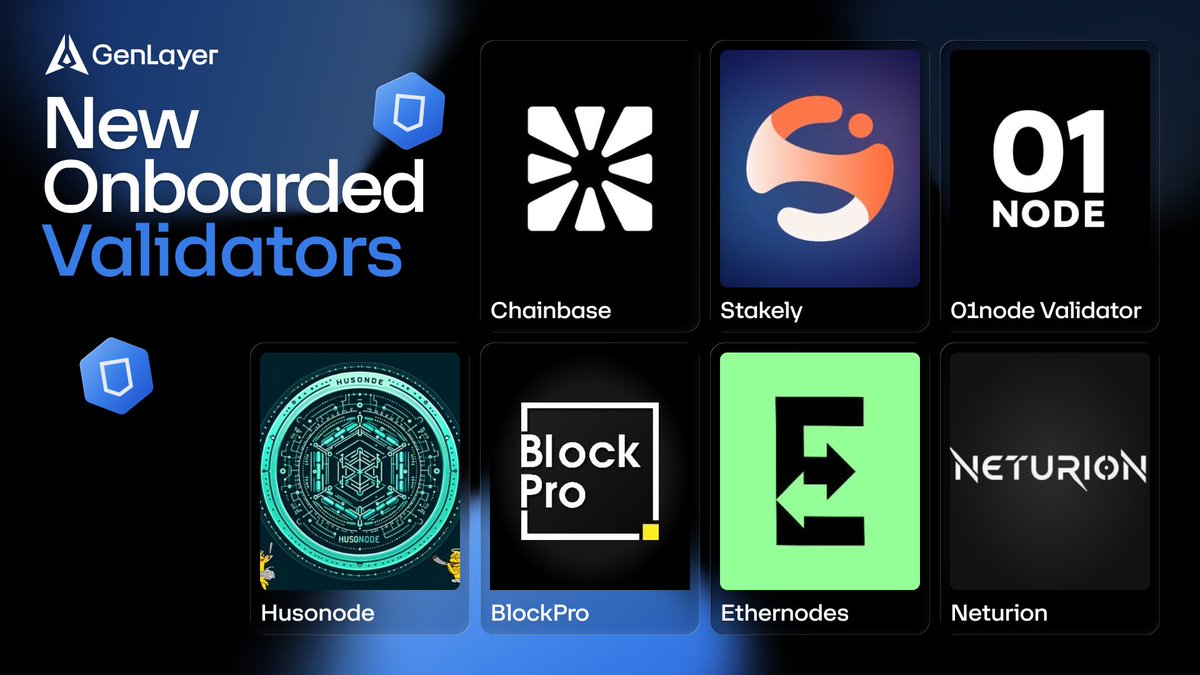
The recent addition of seven new validators makes GenLayer’s trust layer even more robust!
Every new validator adds another independent participant to the consensus process, making AI-powered decisions more decentralized, resilient, and difficult to manipulate.
@Favblakboy@RallyOnChain@GenLayer Well explained Blak!
RLPs are more than just rewards, they’re the incentive layer that keeps creators, projects, and communities aligned as Rally scales.
🚨 Rebrand Alert 🚨
The AI & Blockchain Brain Game is now the GenLayer Brain Game 🧠
Same challenging questions. Same Wednesday competition. Fresh new identity.
Here’s my take for the ongoing @GenLayer Brain Game Design Contest.
🚨 Rebrand Alert 🚨
The AI & Blockchain Brain Game is now the GenLayer Brain Game 🧠
Same challenging questions. Same Wednesday competition. Fresh new identity.
Here’s my take for the ongoing @GenLayer Brain Game Design Contest.