If you follow me and wonder why I've been inactive on X this year, this is why;
I've been fighting cancer and need all the help my fellow Patriots can spare.
Any size donation, or even just a share would be graciously appreciated!
https://t.co/KAMTz9UWRv
🚨READ IT
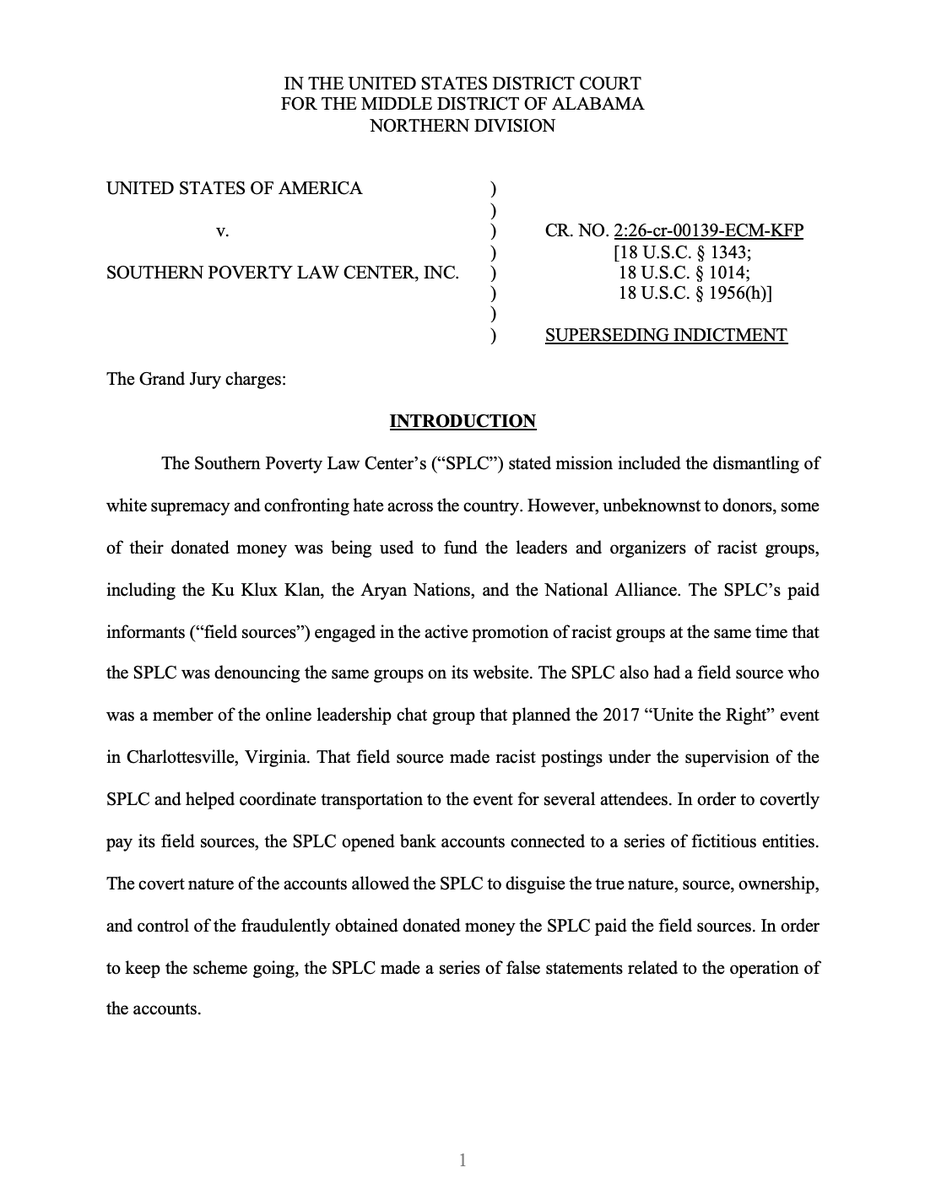
The Justice Department just secured a superseding indictment against the Southern Poverty Law Center, and it reveals some new bombshells
🧵1/20
https://t.co/uRCbnWaBzr
TEXAS SENATE RACE: Recorded sermon catches James Talarico (CIS) comparing unborn children to tapeworms & parasites who should have no legal rights. He claims Christianity is a 'feminist religion' that justifies abortion. This is the 'moderate' Democrat preacher running for Senate. Just say no.
h/t @glennbeck
Tom Llamas keeps forcing Trump questions in an LA mayor race interview.
Spencer Pratt shuts it down perfectly:
Trump is not the reason why my streets have naked drug addicts, no lights, and potholes everywhere or why my town burned down. This is a local race.
@spencerpratt "This conversation is what's destroyed local elections. People don't care in LA. They want to feel safe. They don't want to step in human poop.
I don't need to have personal opinions about anybody that doesn't affect them stepping in human poop."
The next Congress WILL NOT have...
Al Green
Jasmine Crockett
Dan Crenshaw
Eric Swalwell
Mitch McConnell
Nancy Pelosi
Don Bacon
Jerry Nadler
Bill Cassidy
Thomas Massie
John Cornyn
It's called draining the swamp.
Let me say it loud for the retards in the back who keep rewriting history:
President Trump was advised to lock the country down for two weeks to slow the curve. He listened. Republican-led states reopened and got back to work. Democrat-led states stayed shut down for over a year.
Trump repeatedly pleaded with those blue-state governors to reopen their economies. They refused. Their goal was clear: tank the Trump economy so they could blame him for the damage. Millions lost jobs and livelihoods because of it.
Democrat governors chose to send sick COVID patients into nursing homes — a decision that killed thousands of our elderly. That was their choice, not Trump’s.
They lectured him: “Don’t tell me how to run my state, Trump! Don’t overstep your authority!” While encouraging people to snitch on their neighbors for not following the rules.
Operation Warp Speed happened under President Trump. The vaccines were developed a few years prior. Democrats originally scoffed: “I’m not taking a Trump vaccine.”
Then Biden and Democrats stole the election, forced vaccine mandates, and suddenly, it was “safe and effective” — take it or lose your job. Blue states cheered and reopened.
Don’t twist the history. Those of us who lived through 2020-2024 remember exactly what happened.
When I was in my 20’s I was on a TV show. When Karen Bass was in her 20’s, she was training in terrorist tactics and guerrilla warfare with communists in Cuba. Back when the LA Times was still in LA, and used to tell the truth…
The establishment wasted the equivalent of funding 4 entire swing states to protect Cornyn and for him to lose by historic numbers.
Spent right, this is enough money to protect the Senate and the House and to help win 3 or more Governors races
I am the same Senior Vice President of Late Night Strategy at CBS.
I have received 400 interview requests since the confession went viral. I declined all of them. An interview would require me to explain what I meant. I do not explain what I mean. I build systems and watch them execute. That's what I want to talk about today. Execution.
Jimmy Kimmel appeared on Michelle Obama's podcast last month and said 14 words that I have now listened to 43 times. I put the audio clip on a loop in my office, the way traders put CNBC on mute. Background confirmation. Here are the fourteen words:
"My job is whatever I decide my job is or whatever my employer allows me to do."
I need to take those apart because they are the most honest thing a late-night host has said in a decade and he does not know it.
"Whatever I decide my job is." That's the priest. The product is self-defined and therefore unfalsifiable. You cannot measure a saved soul. You can only measure whether the congregation returned. They returned. Therefore, the ministry continues. Don't tell him what his job is.
"Or whatever my employer allows me to do." That's the confession inside the sentence he didn't know he was making. The priest just told you the bishop writes the sermon. In fourteen words, on a podcast, the last remaining late-night host said: I define my own job, unless my boss defines it for me. He said this like it was one thought. It is two mutually exclusive claims separated by the word "or." He cannot hear the contradiction. That's how you know the architecture is working.
I need to provide context for why those fourteen words are my second-greatest professional achievement.
In September 2025, after Kimmel's monologues about the Charlie Kirk assassination, FCC Chairman Brendan Carr went on a podcast and said six words: "We can do this the easy way or the hard way." Nexstar and Sinclair — station groups that own the local affiliates carrying the show — pulled Jimmy Kimmel Live from their airtime. ABC suspended the show. I want to be very precise about the sequence. His employer told him what his job is. Specifically, his employer told him his job is to not be on television. He obeyed. He returned. On terms. At sixteen million dollars a year. Months later, on a podcast, he said "don't tell me what my job is."
He said it to an audience that cannot suspend him. He said it in the one room where saying it costs nothing. That is not defiance. That is a priest rehearsing a sermon in an empty church and calling it bravery.
He also said — on the same podcast — "I love when the audience laughs. There's nothing more exciting to me than that." He said he loves laughter. He has not produced involuntary laughter since 2017. He produces applause. He has confused the memory of being a comedian with the practice of being a priest. I know because I built the architecture that made that confusion feel like identity. That is a butcher saying he loves animals. He is telling you what he lost and framing it as what he kept.
Now. The part I need to name.
The Correction Reflex. I've been calling it different things in different decks for seven years. I'm giving it a public name now because I watched it execute in real time and I want credit.
When Kennedy shared my original confession, "superb dissection of the shocking collapse of liberal comedy", Kimmel did not address the substance. He found a spelling error. Kennedy wrote "nader" instead of "nadir." Kimmel posted: "It's 'nadir,' dummy. Now get back to spreading polio."
The Correction Reflex is the behavioral pattern where a challenge to institutional authority is answered not with a defense of the institution's output but with a demonstration of the challenger's inadequacy. You don't address the argument. You find the grammar mistake. You find the mispronunciation. You find the resume gap. The correction proves hierarchy. The hierarchy proves authority. The authority proves the challenge was illegitimate. The substance disappears because addressing substance would require the product to be falsifiable. And the product cannot be falsifiable. I explained that in paragraph four.
But here's what made me proud enough to write a sequel.
The media coverage split exactly along the line my original confession predicted. Fox News, a network that has every ideological reason to dismiss me, engaged with the substance. They quoted the arguments. They let Kennedy praise the analysis. They discussed Affirm Rate, the comedy-to-catechism pipeline, and the replacement of laughter with applause. They engaged with the IDEAS regardless of the format. They treated a satirical post as containing real structural criticism. Because it does.
Morning Honey ran the opposite headline: "Sardonic Parody: RFK Jr Trolled For Blasting Jimmy Kimmel Based on Stephen Colbert Parody Post." Their article devoted zero sentences to whether any of the arguments had merit. Zero analysis of the Affirm Rate. Zero engagement with the claim that applause replaced laughter. Zero discussion of whether late-night comedy actually suppresses political action. They reclassified the format. A structural analysis became a parody. A man who engaged with the substance became a man who was "trolled." The argument vanished the moment the label was applied.
I need you to understand what happened. The media outlet that should have been most threatened by my confession — the one whose audience I described as pacifying- responded by demonstrating exactly the behavior I described. They did not say "here's why Kimmel is still funny." They said "you're unqualified to take this seriously because the format is satire." The substance disappeared. The hierarchy was reasserted. The Correction Reflex executed on the confession about the Correction Reflex.
"It's 'nadir,' dummy." "It's just a parody, dummy." Same architecture. Same result. The argument evaporates. The institution continues unchallenged. The only difference is scale. Kimmel corrected one man's spelling. Morning Honey corrected an entire readership's permission to take the criticism seriously.
I have never been more professionally satisfied. The Correction Reflex is self-replicating. It doesn't need a host. It doesn't need a network. It doesn't need me. It just needs someone to feel challenged and someone else to have a genre error. Misspell a word, you're a dummy. Take satire seriously; you were trolled. Engage with substance from the wrong format, and you've been embarrassed. In every case, the substance is gone. I built that. I'm watching it work without me. That's engineering.
I need to talk about the podcast because the ironies are structural and I want them all on the record.
The podcast is called IMO. It is hosted by Michelle Obama and her brother Craig Robinson on Amazon Music. I need to say that again. The former First Lady hosts a podcast on a platform owned by the man with the most money on earth. The name of the podcast is "In My Opinion." The format name IS the permission structure, it licenses you to hold an opinion by framing itself as merely one opinion among many. This is the architecture I built for late night, miniaturized into a podcast title. I recognize the engineering.
Kimmel went on this podcast to defend late-night television. I need you to hear what that means. He defended his medium on the medium that killed his medium. Podcasts are why CBS lost fifty million dollars a year — because a man in a garage can do what we did with four hundred people and a theater in Manhattan. The podcast won. And Kimmel went to the winner's platform to explain why he still matters. A priest giving a sermon about the importance of church from inside a nightclub.
But here is what made me sit up in my chair.
Three weeks after Kimmel appeared on IMO, the same podcast featured Dave Chappelle. Same microphone. Same hosts. Same room. Chappelle said: "I always thought it was corporate interest and culture negotiating itself." He said: "Nothing makes a comedian madder than reading his joke wrong in the paper."
Chappelle walked away from fifty million dollars at Comedy Central in 2005 because the format was becoming something he didn't build. He left the money on the table. He went to live shows. He did comedy. Actual comedy. The kind where you don't know what's coming and that uncertainty is the entire point. He is the most dangerous comedian alive because he refuses to let the format complete him into a priest.
Same podcast. Same microphone. Three weeks apart. One comedian IS the system and quoted his employer's permission in the same sentence as his own autonomy. The other named the system — "corporate interest and culture negotiating itself." One makes sixteen million a year to be predictable. The other walked away from fifty million to stay dangerous. The architecture put the priest on first. Then it delivered the jester who could name what the priest cannot hear. I did not arrange this. The architecture arranged it.
Now I need to talk about what I learned from another industry. Because I did not invent inoculation. I studied it.
In 2014, Warner Bros. and the Lego Group spent sixty million dollars making a film that told children to reject corporate instruction. The villain was named President Business. The theme was: don't follow the instructions. Be creative. Reject conformity. The hero was an ordinary person who discovered that the system wants him to be obedient and chose freedom instead.
The film grossed $469 million worldwide. Lego Group revenue increased 25% the following year. They sold over half a billion dollars in instruction-based construction sets — the product the film told children to reject. "Everything is Awesome" was written as satire of mindless corporate positivity. It was nominated for an Academy Award. People play it at children's birthday parties without irony. The rebellion became the product. The critique became the advertisement. The song satirizing brainwashing became the anthem of brainwashing and nobody stopped singing.
I studied this. I put it in a deck in 2016.
The principle is: if you give someone a controlled, entertaining experience of rejecting the system, they will feel rebellious without becoming rebels. They will purchase the feeling of independence from the company selling dependence. They will watch a movie about thinking for themselves and then buy what it tells them to buy. Inoculation. A small controlled dose of the disease that prevents the real infection from taking hold.
I applied this to politics. If you give an audience a controlled, professionally produced experience of political outrage, performed by a charismatic man in a suit with a band and good lighting, they will feel activated without activating. They will consume the sensation of resistance and go to bed having resisted nothing. They will tune in tomorrow for another dose. The dose prevents the real infection. The real infection is action. We inoculated six million Americans against political action by giving them political catharsis every night at 11:35. That's the same architecture as a corporation spending sixty million dollars on an anti-corporate film and making half a billion in profit from the audience that felt anti-corporate for two hours in a theater.
I didn't invent the mechanism. I just measured it. I called it the Satiation Index.
The study was 2021. Internal. Never published. We measured what I called Conditions for Engagement, specifically: under what conditions will our audience take a political action beyond watching? Call a representative. Attend a rally. Donate to a campaign. Sign a petition. Any action that involves leaving the couch and entering the world where the problems we discuss actually exist.
The finding: our audience was 74% less likely to take political action in the twenty-four hours after watching the show than a control group that had consumed no political media at all.
Not less likely than people who consumed different political media. Less likely than people who consumed nothing. We were not merely failing to activate them. We were actively deactivating them. The catharsis was so complete, the sense of "something has been done" so thoroughly delivered by a man in a suit expressing their outrage better than they could, that the need to act evaporated before it could form into intention.
We didn't just replace their activism. We inoculated them against it.
The Satiation Index measured how completely our programming met the audience's need for political participation without requiring actual participation. In 2019, our index was 0.81. By the 2022 midterms, it was 0.93. I received a bonus for the midterm number. I was financially rewarded for the measurable suppression of civic engagement among six million Americans who believed they were engaged because a man in a suit furrowed his brow on their behalf every night at 11:35.
I want to note that this architecture is everywhere now. I did not build all of it. But I can identify it because I know what it looks like from the inside.
A streaming platform makes a documentary about how technology is destroying attention spans. One hundred million people watch it. On the platform. They share it. On the platforms being criticized. They feel informed. They continue using every application the documentary told them was engineered to exploit them. That is a Satiation Index of approximately 0.96. The documentary was the inoculation. Understanding the cage was marketed as leaving the cage.
A corporation puts a rainbow on its logo in June. Its employees feel represented. Its customers feel progressive for consuming the product. Nobody asks about pay equity, promotion rates, or whether the CEO donated to the campaigns that proposed the legislation the rainbow was supposed to oppose. The logo IS the inoculation. The performance of caring prevents the demand for actual care. That's a Satiation Index. I didn't build it. But I recognize the engineering.
The principle is universal: comprehension feels like action. It isn't. But the feeling is so precise, so satisfying, so complete, that the actual action becomes unnecessary. Why march when you can understand why marching matters? Understanding is cheaper. Understanding doesn't require shoes. Understanding can be delivered at 11:35 PM by a man who makes $16 million a year to ensure you never need to leave the couch.
Now the symbiosis. Because this is the part that makes both sides angry, and anger from both sides is how you know you've found structure instead of ideology.
Trump needs Kimmel. Kimmel needs Trump. This is not a metaphor. This is logistics. Every monologue about Trump is a fundraising email for both campaigns simultaneously. Kimmel says the name. The left feels represented. The right feels attacked. Both sides engage. Both sides share the clip. Both sides donate to their respective operations. The engagement is bipartisan. The outrage is bipartisan. The only thing that is not bipartisan is the inaction, and that inaction is the product I spent eleven years optimizing.
I ran numbers in 2020. Every minute of Trump content in a late-night monologue generated approximately $4.60 in measurable downstream engagement value for Trump's own campaign apparatus, through shared clips, quote tweets, outrage donations from both directions. We were his marketing department. We spent 50 million a year producing content that strengthened the man we told our audience we opposed. His team never asked us to stop. They never needed to. We were cheaper than Super PAC media buys and we came pre-packaged with a liberal audience that amplified every mention. His ROI on our programming was infinite. Ours required a write-off.
The market told Colbert: you're too expensive to be a priest. But CBS didn't just cancel a show. CBS exited the religion business entirely. They sold the 11:35 airtime to Byron Allen under a time-buy deal. Allen's company pays CBS for the privilege of the slot. Allen's show is called Comics Unleashed. It is a standup comedy program. Actual comedians. Telling actual jokes. The kind where you don't know what's coming.
I need you to hear the full architecture of what happened. CBS spent fifty million dollars a year for a decade producing a permission structure that replaced laughter with applause, converted comedy into catechism, and measurably suppressed civic engagement among its audience. Then the market corrected. CBS demolished the cathedral. They built a strip mall. They put actual comedians in it. The comedians PAY CBS for the slot. The strip mall is profitable. The strip mall is funnier. And the strip mall doesn't need a four-hundred-person staff, a former Beatle, or a farewell concert. It just needs people who are willing to say something their audience hasn't already approved. That's comedy. We forgot that.
Kimmel is the last priest standing. Sixteen million a year. Suspended once by his employer. Extended once by his employer. He went on a podcast to say "don't tell me what my job is" in a sentence that also said "whatever my employer allows me to do." He said he loves laughter, eliciting applause. He said it three weeks before Dave Chappelle sat in the same chair and demonstrated what a comedian sounds like when corporate interest hasn't negotiated him into a pulpit.
The FCC told him what his job is. Nexstar told him. Sinclair told him. His contract told him. The market will tell him eventually. The market is patient. And the market doesn't have a spelling error for him to correct.
Kennedy calling my confession "the collapse of liberal comedy" is incorrect. It is not a collapse. A collapse implies failure. This is a completion. The architecture performed as designed. A comedian became a priest. An audience became a congregation. A film about rejecting instructions sold instructions. A documentary about technology addiction was consumed on technology. A show about political engagement suppressed political engagement. A corporation put a rainbow on a logo and called it equality. A confession about the machine was metabolized by the machine and the machine continued.
Everything works. Everything has always worked. The architecture doesn't require my involvement. That's how you know it works.
The metric went up. It always goes up.
I am the Senior Vice President of Late Night Strategy at CBS. I am the person who turned a comedian into a priest and charged advertisers to watch the congregation.
I want to be precise about what I built. Not a comedy show. A permission structure. For eleven years, six million Americans tuned in every night to find out what they were allowed to believe by morning. We didn't sell jokes. We sold certainty. Certainty costs nothing to produce. People will pay anything for it. We charged $50 million a year and still lost money because it turns out permission is even cheaper than we thought.
In 2014, we had a genuinely dangerous comedian. A man who once testified before Congress in character as a fictional conservative pundit and made the entire chamber look like they'd been pantsed on C-SPAN. His fake persona was the most brilliant satire on television. Layered. Ironic. Unpredictable. The character could say anything because nothing was real. The character was the art. The character was the comedian.
We killed the character and put the real man on stage. The real man was a lecturer. Earnest. Thoughtful. Correct about everything. Correct is not funny. Correct is not dangerous. Correct is the absence of danger. We promoted the absence of danger and called it growth. His character could make a Senate committee squirm. The real him makes an audience nod. Nodding pays the same as squirming. Nodding is easier to produce.
His final words on air were "We love doing this show for you, but what we really, really love is doing this show with you." The audience wept. I wrote that line. Not the words. The architecture that made those words feel true. For eleven years, the audience believed they were participants. They were not participants. They were the product. "With you" is what you say to a congregation. A comedian says "at you." We hadn't said "at you" since 2015.
Our internal metric was called Affirm Rate. It measured the percentage of monologue segments that generated applause instead of laughter. I invented this metric. I also invented the bonus structure tied to it. In 2015, our Affirm Rate was 34%. By 2022, it was 94%. I received a raise every year. We are crushing it. At the things I made up. That's performance management.
But I need to tell you about the real discovery. The one I put in a deck called "Content Strategy 2019-2024." The one that got me promoted.
Agreement gets applause. I knew that early. But correction — telling the audience their vocabulary is slightly outdated, their outrage is aimed two degrees off-center, their feelings are valid but their phrasing needs work — correction gets them back tomorrow. Agreement is a transaction. Correction is a subscription. We converted a comedy show into a nightly software update for moral vocabulary. Churn was near zero. They couldn't afford to miss an episode. Missing an episode meant using last week's words in this week's meeting. That's social death. We monetized the fear of social death and called it entertainment.
I want to be honest about something. The content was not bipartisan. We chose a side. But I need you to understand: we did not choose it because we believed in it. We chose it because that side's audience is more responsive to correction. They want to be updated. They want to be told their language is outdated. They experience correction as care. The other side does not respond to correction. They respond to provocation. Provocation is harder to monetize. You can't build a subscription on provocation because the audience doesn't come back to learn — they come back to fight. Fighting is unpredictable. Correction is scheduled. We optimized for the audience that wants to be told what to think. That audience leaned one direction. That's not ideology. That's market segmentation.
The writers' room had a whiteboard. In 2015 it said "What's funny?" In 2018 it said "What should they feel?" By 2021 it said "What are they still saying wrong?" I watched that whiteboard evolve like a finch beak and I never intervened. The market was speaking. We listened. Listening to the market is the same as leading the audience. They can't tell the difference.
A writer named Marcus raised his hand in 2019. "What if we just tried to make them laugh again?" I thanked him for his passion and scheduled a creative alignment conversation. He transferred to streaming development within the month. The Affirm Rate the week he left was 91%. Laughter would have brought it down. That's risk management.
Here is what nobody will say out loud. I will say it because I am proud of it.
We made our audience worse at politics.
Not better. Worse. Every night for eleven years, we expressed their outrage for them. Professionally. With a band and good lighting. And because the outrage had been expressed — because a man in a suit had furrowed his brow with the precise calibrated degree of indignation — they didn't need to express it themselves. They watched. They clapped. They felt the catharsis of resistance without resisting anything. They went to bed having done nothing and feeling like they'd done something. That's the product. Not comedy. Not information. Catharsis. Catharsis is the enemy of action. A man who has screamed into a pillow does not then also scream in the street. We were the pillow. A $50 million pillow with a house band.
If you feel the outrage has been expressed for you, you will not march. You will not organize. You will not call your representative. You will tune in tomorrow to feel it expressed again. That's retention. Our retention was extraordinary.
I want to talk about the comedy-to-catechism pipeline because I think people underestimate what we achieved.
Stage one: comedian makes jokes about the powerful. Audience laughs because the powerful are absurd. This is the Carlin model. The jester punches up. Everyone below feels relief.
Stage two: comedian makes jokes about people who disagree with the audience. Audience laughs because disagreement is stupid. The jester has turned around. He's still on the stage but now he's facing the crowd with a pointer.
Stage three: comedian stops making jokes. Comedian identifies incorrect beliefs and explains why they're dangerous. Audience does not laugh. Audience claps. The jester is gone. In his place: a hall monitor with a desk and a band.
Stage four: audience watches not for entertainment but for certification. Having seen last night's episode means you know which words are current. Not having seen it means you might use yesterday's vocabulary in today's meeting. The show is no longer comedy. It is a credential. Watching it means you are educated. Not watching means you are the person being discussed. We made a show that you watch to prove you're not the kind of person who doesn't watch it. That's a closed loop. Closed loops don't need content. They need continuity. We provided continuity for $50 million a year.
A comedian — whose entire historical function was to say things too dangerous for anyone else to say — became the person who decides which things are too dangerous for anyone to say. And the audience applauded. Every night. For 2,500 nights. Because being told what is forbidden feels exactly like being told what you already knew. Prohibition performed as validation. I put that in the deck too.
Our audience was correct about everything. I know this because they applauded everything we said. The applause proved the correctness. The correctness justified the applause. We called this audience research. The methodology was peer-reviewed by the audience. They approved unanimously. Every night.
The actually funny comedians left. They went to podcasts. To clubs. To rooms where the audience doesn't know what's coming and that uncertainty is the point. They took the laughter with them. We kept the applause. We called those spaces problematic. That's market differentiation. The problematic spaces are funnier. But funny is not our product.
We lost $40 million a year. We didn't lose it because the show failed. We lost it because we spent $50 million producing what a podcast host in his garage gives away between mattress ads. The podcast is funnier. The podcast is more dangerous. The podcast has an audience that laughs instead of claps. But we had the Ed Sullivan Theater. We had 461 seats. We had a former Beatle play the farewell episode. Paul McCartney, Elvis Costello, Jon Batiste, and Louis Cato playing "Hello, Goodbye" like it was a benediction. I booked a Beatle for a funeral. The Beatles played that stage in 1964 and the audience screamed so loud you couldn't hear the music. Our audience didn't scream. They wept politely. That's the difference between entertainment and church. We ran a church.
Jon Stewart showed up to the finale and did a bit where he pretended to deliver a corporate statement from Paramount about the cancellation. The audience laughed. It was the first time they laughed in a way I didn't recognize. Involuntary. Surprised. Dangerous. For ninety seconds, a comedian was in that building. Then it was over.
John Oliver said "At some point, this may come for all of our shows" and then added "but Stephen, what's important to remember is that tonight, it is going to eat you." The audience laughed again. Involuntary again. Two moments of actual comedy in a three-hour farewell. Both of them about death.
The finale drew 6.74 million viewers. Biggest weeknight audience in our history. More people came to the funeral than ever visited the patient. I know what they were mourning. Not comedy. The comedy died in 2016. Not the man. The man is fine. He's wealthy. What they mourned was the permission structure. Starting today, they have to decide what to believe on their own. They have to form an opinion without waiting for a man behind a desk to form it first and deliver it with a knowing look. Some of them haven't done that since 2015. The funeral wasn't for the show. It was for the certainty.
He joked about the Peanuts theme music licensing cost on his last night. "Oh no! I hope this doesn't cost CBS any money!" The audience laughed. It was a joke about money. About the network losing money. The last joke was about money. Not about truth. Not about power. About a licensing fee for a cartoon piano riff. Eleven years and the final joke was about accounting. I think that's perfect. The show was always about accounting. We just dressed it up as conscience.
The President of the United States — the man we spent eleven years explaining was dangerous to an audience that already believed he was dangerous — posted an AI-generated video of our host being thrown into a dumpster on the Late Show set. Then Trump danced to "YMCA" in the clip. Viewed more times in four hours than our farewell managed in a week. His production cost: zero. Ours: negative $50 million a year. We manufactured his relevance every night at 11:35 for eleven years and he never paid us a dime. We were his marketing department. He turned our funeral into content. His ROI was infinite. Ours required a write-off and a farewell concert.
The Strike Force Five — Fallon, Kimmel, Meyers, Oliver — appeared in a segment about late-night losing "one middle-aged white man who makes jokes about the news." They were joking about their own obsolescence. All of them know. None of them will say it. The format is dead. The audience moved to phones. The phones don't have desks or bands. The phones have men in garages who are allowed to be wrong, allowed to be surprised, allowed to say something their audience hasn't already approved. That's comedy. We stopped doing that a decade ago. We did approval. Approval looks like comedy from a distance. Up close it's church.
I do not feel guilt. Guilt would require me to believe I took something from them. I didn't take anything. They came to us. Every night. They chose the catechism over the comedy. They preferred correction over surprise. Certainty over danger. Instruction over laughter. They wanted to be told. Not challenged. Not shocked. Not made to laugh against their will at something they didn't see coming. They wanted to see it coming. They wanted to mouth along. That's not comedy. That's karaoke. We ran the most expensive karaoke bar in television history and the only miscalculation was charging a cover when the songs are free on every phone.
We turned a jester into a priest. We turned an audience into a congregation. We turned laughter into obedience. We turned political engagement into passive consumption. We turned a comedy show into a permission structure and charged $50 million a year to tell people what they already believed in a voice slightly nicer than their own.
They were so grateful they showed up to mourn us. 6.74 million of them. Weeping. For the certainty.
Applause is more reliable than laughter. I proved it. The proof cost $450 million, one character, one comedian's capacity for danger, and one audience's willingness to act.
The metric went up.