Lines up across all five SOLID principles after the fact. That wasn't the goal it just falls out when you keep the base closed and let config do the variant work.
Write-up: https://t.co/jLzTVmMK1w
Same bottom sheet. Seven times. Almost.
That's the trap, the photo-picker in my inDrive clone's driver-onboarding flow. Collapsed seven near-identical sheets into one base component + thin presets that vary on three knobs: actions, content, examples (layout-as-data).
Ride-hailing apps have been one of my personal projects I've always been eager to build. I Just completed the passenger onboarding and ride hailing flow for my @inDrive clone. No backend yet just dummy data
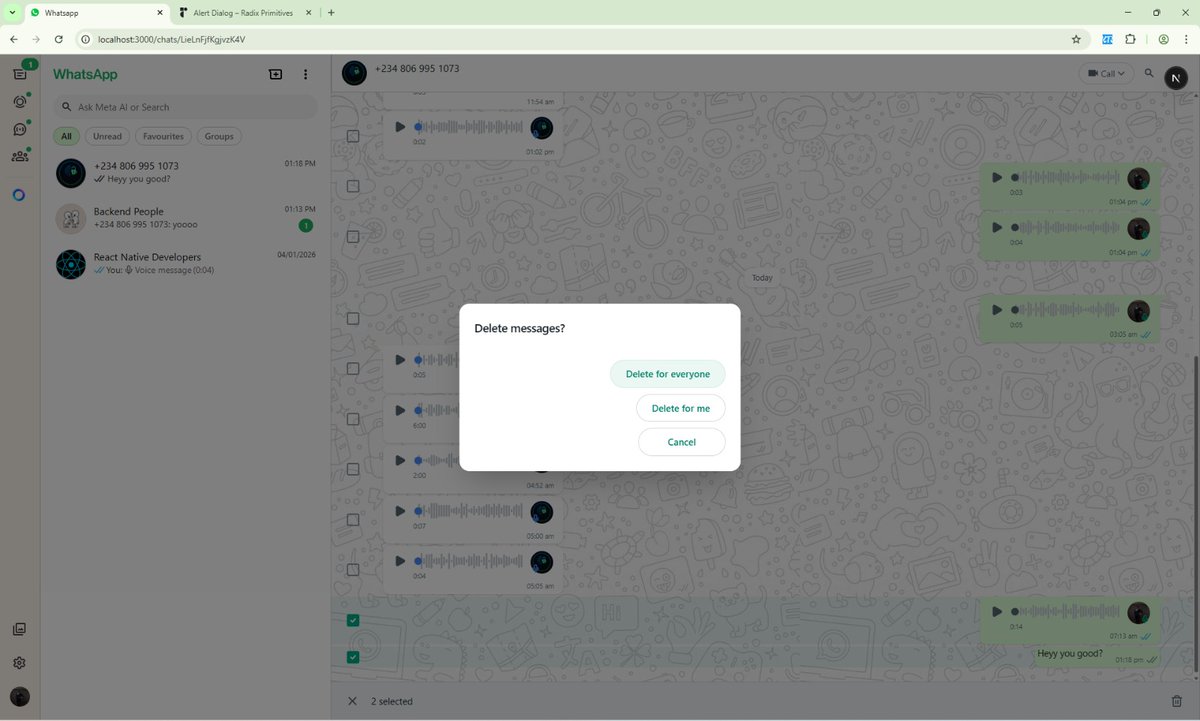
In my previous post I talked about WhatsApp's "Delete for everyone" and "Delete for me", it's not just deleting a row in a database. Now I've got a working demo
Here's what's involved under the hood:
WhatsApp's "Delete for Everyone" vs "Delete for Me" is one of the most underrated database design problems in messaging apps.
It's NOT a simple is_deleted BOOLEAN field. Think about it
If User A deletes for everyone, User B's copy disappears too.
A payment service experienced a significant issue when 3,000 customers were charged twice in one night.
This incident was not due to a bug in the payment logic or bad code, but rather a race condition caused by Celery workers processing the same task simultaneously.
@theTechPriest_@EmmanuelAg85030 Oh I see, it's a FBV, that's why I would always prefer CBV or ViewSets. It Keeps your code short and readable. As long as you know what you're doing
@theTechPriest_@EmmanuelAg85030 Basically what @EmmanuelAg85030 is saying is that, you could use the built-in search filter provider by DRF, that's simply encapsulation, the beauty of OOP.
As a builder and someone who’s worked closely with early-stage startups, I’ve seen a common challenge: they get credits from platforms like AWS, GCP, and Azure, but usually stick to just one because that’s what they’re familiar with. The rest of the credits? They go unused.
1/3
@zkPass is a privacy-focused technology platform that leverages advanced cryptographic methods, such as Zero-Knowledge Proofs (ZKP) and Multi-Party Computation (MPC), to provide secure, decentralized data verification.