I'm officially a Trencher now 🔥
just locked in early access to @TrenchersAI
Let's run it up together!
join the trenches → https://t.co/aAJmqJBxNB
#TrenchersAI https://t.co/h4ji6DdNtI
@paz_al3x@_Re_ No, it's real. Anthropic's official docs confirm: "Using OAuth tokens obtained through Claude Free, Pro, or Max accounts in any other product, tool, or service — including the Agent SDK — is not permitted." See https://t.co/sbK8AzTY2X
No complexity. No accident.
10/10 was caused by irresponsible marketing campaigns by certain companies.
On October 10, tens of billions of dollars were liquidated. As CEO of OKX, we observed clearly that the crypto market’s microstructure fundamentally changed after that day.
Many industry participants believe the damage was more severe than the FTX collapse. Since then, there has been extensive discussion about why it happened and how to prevent a recurrence. The root causes are not difficult to identify.
⸻
What actually happened
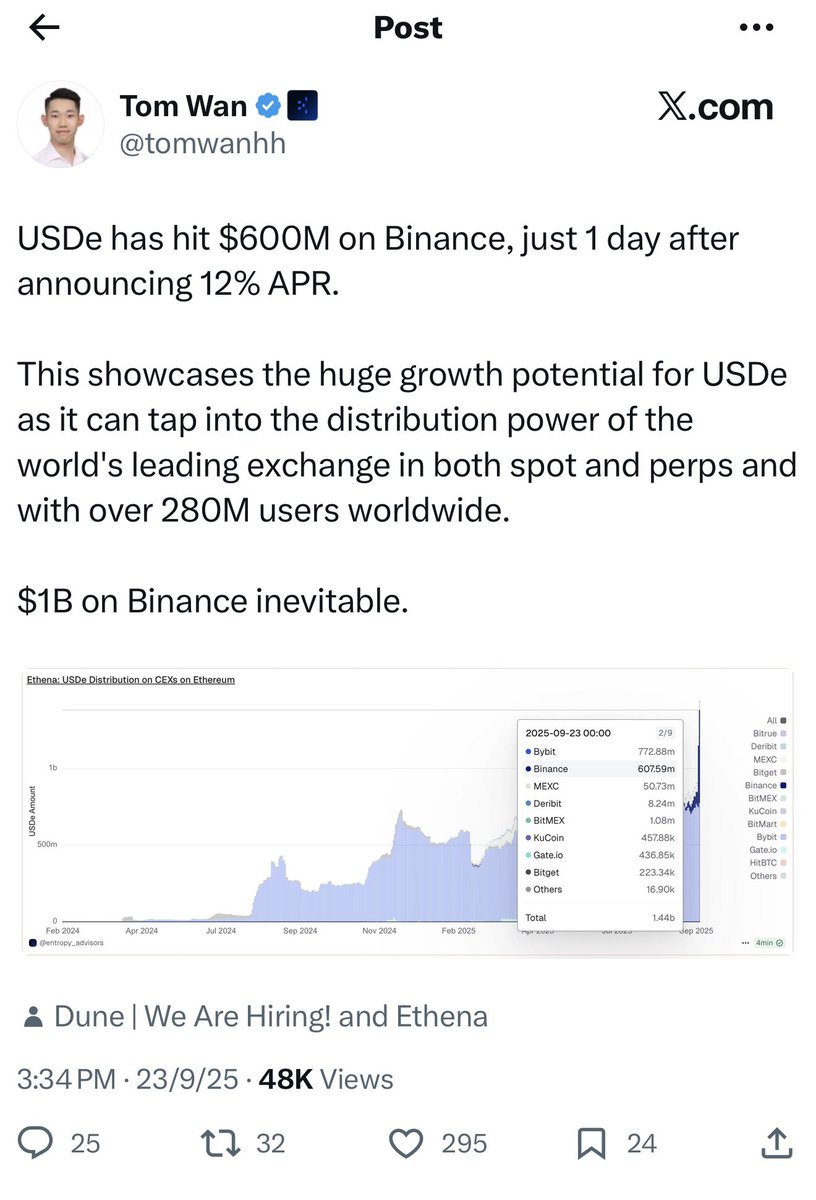
1.Binance launched a temporary user-acquisition campaign offering 12% APY on USDe, while allowing USDe to be used as collateral with the same treatment as USDT and USDC, and without effective limits.
2.USDe is a tokenized hedge fund product.
Ethena raises capital via a so-called “stablecoin,” deploys it into index arbitrage and algorithmic trading strategies, and tokenizes the resulting fund. The token can then be deposited on exchanges to earn yield.
3.USDe is fundamentally different from products such as
BlackRock BUIDL and Franklin Templeton BENJI, which are tokenized money market funds with low-risk profiles.
USDe, by contrast, embeds hedge-fund-level risk. This difference is structural, not cosmetic.
4.Binance users were encouraged to convert USDT and USDC into USDe to earn attractive yields, without sufficient emphasis on the underlying risks. From a user’s perspective, trading with USDe appeared no different from trading with traditional stablecoins—while the actual risk profile was materially higher.
5.Risk escalated further as users:
•converted USDT/USDC into USDe,
•used USDe as collateral to borrow USDT,
•converted the borrowed USDT back into USDe,
•and repeated the cycle.
This leverage loop produced artificial APYs of 24%, 36%, and even 70%+, widely perceived as “low risk” simply because they were offered by a major platform. Systemic risk accumulated rapidly across the global crypto market.
https://t.co/IK2gW4xUOP that point, even a small market shock was sufficient to trigger a collapse.
When volatility hit, USDe depegged quickly. Cascading liquidations followed, and weaknesses in risk management around assets such as WETH and BNSOL further amplified the crash. Some tokens briefly traded near zero.
The damage to global users and companies—including OKX customers—was severe, and recovery will take time.
⸻
Why this matters
I am discussing the root cause, not assigning blame or launching an attack on Binance. Speaking openly about systemic risks is sometimes uncomfortable, but it is necessary if the industry is to mature responsibly.
I expect there may be significant misinformation and coordinated FUD directed at OKX in the near future. Even so, speaking honestly about systemic risk is the right thing to do—and we will continue to do so.
As the largest global platform, Binance has outsized influence—and corresponding responsibility—as an industry leader. Long-term trust in crypto cannot be built on short-term yield games, excessive leverage, or marketing practices that obscure risk.
The industry needs leaders who prioritize market stability, transparency, and responsible innovation—not a winner-take-all mentality where criticism is treated as hostility.
Crypto is still early.
What we choose to normalize today will determine whether this industry earns lasting trust—or repeats the same mistakes again.
How to @openclaw on VPS safely: from fresh Ubuntu VPS → hardened private AI server in 30 min
1) Lock down SSH
→ Keys only, no passwords, no root login.
sudo nano /etc/ssh/sshd_config
# Set explicitly:
PasswordAuthentication no
PermitRootLogin no
sudo sshd -t && sudo systemctl reload ssh
2) Default-deny firewall
→ Block everything incoming by default.
sudo apt install ufw -y
sudo ufw default deny incoming
sudo ufw default allow outgoing
sudo ufw enable
3) Brute-force protection
→ Auto-ban IPs after failed login attempts.
sudo apt install fail2ban -y
sudo systemctl enable --now fail2ban
4) Install Tailscale
→ Your private VPN mesh network.
curl -fsSL https://t.co/MynNrCBRlo | sh
sudo tailscale up
5) SSH only via Tailscale
→ No more public SSH exposure.
# Verify Tailscale is working first!
tailscale status
sudo ufw allow from 100.64.0.0/10 to any port 22 proto tcp
sudo ufw delete allow OpenSSH
6) Web ports private too
→ App only accessible from your devices.
sudo ufw allow from 100.64.0.0/10 to any port 443 proto tcp
sudo ufw allow from 100.64.0.0/10 to any port 80 proto tcp
7) Disable IPv6 (optional)
→ Reduces attack surface if unused.
sudo sed -i 's/IPV6=yes/IPV6=no/' /etc/default/ufw
echo "net.ipv6.conf.all.disable_ipv6 = 1" | sudo tee -a /etc/sysctl.conf
sudo sysctl -p && sudo ufw reload
8) Clawdbot install
→ AI assistant on your private server.
npm install -g clawdbot && clawdbot doctor
9) Lock Clawdbot to owner only
→ Only you can message the bot.
{ "dmPolicy": "allowlist", "allowFrom": ["YOUR_TELEGRAM_ID"], "groupPolicy": "allowlist" }
10) Fix credential permissions
→ Don't leave secrets world-readable.
chmod 700 ~/.clawdbot/credentials
chmod 600 .env
11) Run security audit
→ Catches issues you missed - don't skip!
clawdbot security audit --deep
Verify everything:
sudo ufw status
ss -tulnp
tailscale status
clawdbot doctor
Result:
✅ No public SSH
✅ No public web ports
✅ Server only reachable via Tailscale
✅ Bot responds only to you
✅ Private AI server in 30 min
NOW you can start playing, not before.
You buckle your seatbelts before you step on the gas, hmkay?
923 Clawdbot gateways are exposed right now with zero auth (they just connect to your IP and are in)
That means shell access, browser automation, API keys.
All wide open for someone to have full control of your device.
Had Clawdbot check my setup:
- Config shows bind: "loopback"
- External port test: connection refused
(Not exposed)
If you're running Clawdbot, check yours:
bind: "all" means you're on that list
Fix: change to bind: "loopback" and restart.
It takes 10 seconds.
RT for exposure
We are revising our developer API policies:
We will no longer allow apps that reward users for posting on X (aka “infofi”). This has led to a tremendous amount of AI slop & reply spam on the platform.
We have revoked API access from these apps, so your X experience should start improving soon (once the bots realize they’re not getting paid anymore).
If your developer account was terminated, please reach out and we will assist in transitioning your business to Threads and Bluesky.
Just unlocked my Gas ID via ETHGas 🪪
I'm a Legendary Jack with 7.747 ETH spent on gas since Beacon Chain - now fueling my climb to the Gasless Future and earned 4000 Beans already.
Reveal yours at https://t.co/WFPozK68eT
Quick Narratives Check 🔥🎯
We were moving up, got a mild correction on the Maduro/Venezuela news.
If 1Q brings indirect QE through RMP, the bias still feels constructive.
Let’s check the narrative fast.
1. Robotics
1) Thesis:
• NVIDIA CEO Jensen Huang has previously predicted that 2026 will mark the adoption phase of robotics.
Likewise, Jim Fan, Director of Robotics at NVIDIA (@DrJimfan), has expressed strong expectations for 2026.
• With CES 2026 just days away, robotics is expected to be a major theme, and the market is watching closely for potential announcements.
2) Tickers:
$CODEC, $SAPIEN, $BREW, $VIRTUAL …
2. Token Airdrop Experiment by Nasdaq-Listed Companies
1) Thesis:
• $DJT → $CRO: DJT announced airdrop distribute on-chain via the CRO chain
• $DVLT has also announced a token-based dividend and soared +60%
• $Base should be considered part of this broader on-chain distribution experiment
• This signals a new phase where public companies experiment with tokenized dividends and shareholder distribution.
2) Tickers:
• $CRO
• Nasdaq: $DJT, $DVLT, $COIN
3. Caroline Is Back?
1) Thesis:
• Do you remember LUNA rallying nearly 3x during Do Kwon’s trial?
> Please remember we indicated that
https://t.co/PjNXunI0qq
• Now, Caroline Ellison, former CEO of Alameda Research, is reportedly being released in exchange for cooperation, with a scheduled release date of January 21.
• At a minimum, this is an event worth close attention.
2) Ticker:
$FTT
4. Mega Memecoin
1) Thesis:
• James Wynn going all-in on $PEPE could act as a catalyst for a broader large-cap memecoin rally.
2) Tickers:
$PEPE, $FARTCOIN, $PENGU
5. Institutional-Grade Blockchain
1) Thesis:
• Focused primarily on large U.S. institutions, including Tokenization of Nasdaq-listed equities
• 24/7 trading and settlement infrastructure
• This represents need of the institutional blockchain infrastructure.
2) Ticker:
$CC
6. Crypto M&A
1) Thesis:
• Good case: Nasdaq: $RZLV acquiring $SQD, including the token itself
• Bad case: Acquiring only the team while discarding the token, reinforcing skepticism toward tokens
• These cases highlight why token-inclusive M&A matters in crypto.
2) Tickers:
• Good: $SQD
• Bad: $AXL, $TNSR, $IRON
7. Tokenized TCG
1) Thesis:
• Iconic IPs such as Pokémon, One Piece, and Yu-Gi-Oh are entering a convergence phase with blockchain.
• Key catalysts include current market caps, Pokémon’s 30th anniversary, the Logan Paul effect, and the approaching conclusion of One Piece.
2) Ticker:
$CARD
8. x402
1) Thesis:
• The runway for the agentic economy lies in x402, enabling machine-native payments and autonomous agent commerce.
• Hint: We're preparing x402 content
2) Tickers:
$VIRTUAL, $KITE, $UB, $PAYAI, $DEXTER …
9. Privacy
1) Thesis:
• “Privacy is not optional.” Powered by Naval.
• If someone still doubts the importance of privacy after seeing $ZEC, it likely reflects a misunderstanding of the space.
2) Tickers:
$ZEC, $XMR, $DASH, $SESH, $NOCK …
10. MSTR MSCI Index Inclusion?
1) Thesis:
• If MSTR is included in an MSCI index, ETFs and index funds tracking that index must buy the stock, creating forced passive inflows.
• The expected decision date is January 15.
2) Tickers:
$MSTR …
11. USD1 Meta
1) Thesis:
Strength in the U.S. dollar ($1) narrative is spilling over into so-called USD1-themed memecoins, which are showing relative momentum.
2) Tickers:
$1, $WLFI, $AOL
12. $BCH what the heck?
1) Thesis:
Everybody knows $BCH is going up,
but nobody really knows why — if you do, let me know.
2) Ticker:
$BCH
+@ Obvious Adjacent Sectors
- Prediction Markets
- Neo Banks
Let me know if we missed anything. 🫡
@HeyAbhishek Perfect free AI learning list-FTW 🚀 My picks: CS50 intro to CS and Claude Code in Action. Which one are you diving into first? 👀 #AI#LearnForFree
2026 is the GREATEST time to build a startup in 30 years
I’m 36. I’ve sold 3 startups, helped build companies that raised billions, and backed teams from seed to unicorn.
20 MEGA shifts that make this the BEST time to build in a GENERATION:
1. Hardware got smart. Download open-source AI models from HuggingFace to cheap robots and they're suddenly smart. Opens up tons of use-cases.
2. SaaS is imploding. AI can replicate $500K software for pennies. Enterprise software that took 30 engineers now requires 1 and a Claude Code subscription. Founders will go more niche and more custom and outprice incumbents.
3. Outcome-based pricing is eating subscriptions. With AI agents handling work automatically, founders can guarantee results instead of selling features. This creates a massive arbitrage opportunity to steal market share from rigid subscription models.
4. Vibe marketing is the new marketing. AI agents/tools like Lindy, Gemini and Claude Code Using agents to do personalized outreach, ads and content creation it’s getting good. This is like getting on social in 2005.
5. Social is FYP-ified. Distribution no longer requires massive followings, just content that hits. Founders can build audience from zero without ads and then convert them to owned media channels (text/email).
6. Interfaces are vanishing. Conversations are replacing dashboards across industries. This removes training barriers and means customers can use sophisticated products immediately.
7. Companies are obsessed with efficiency and cutting costs right now. Corporate budgets are getting reallocated to AI. Companies are cutting traditional software spend to make room for AI-powered alternatives. This creates fast-tracked approvals for startups delivering 10x efficiency.
8. 99% of MVPs won't need VC. Low-cost MVPs combined with creator partnerships and AI automation allow bootstrapped scaling. For most software businesses, outside funding is now unnecessary.
9. Global teams. You don’t need to hire in your own city anymore. Opens up tons of arbitrage opportunities and ways to create products unlike before.
10. Millions of creators want to get paid. If you have the right product, the right network of creators, you can hit scale insanely efficiently. Never before did this exist. Next gen founders are building startups community first, software second.
11. Prototyping is nearly instant. With Lovable, Rork etc, you can test ideas in days, not months. MVP speed is basically 1x/week. This creates room for multiple products from small companies (multipreneurship), helps get to PMF faster,
12. LLM APIs create building blocks weekly. I can’t even keep up with how many new APIs/tools coming out from LLMs weekly. Example: Nano Banana pro comes out, probably 1000 ideas built on top of that can be $5M/year businesses.
13. $1m+ revenue per employee. With the leverage of LLMs, community and agents, employees are way more efficient. It won’t be uncommon to generate $1m per employee. This will lead to a rise of "multipreneurship", small teams owning multiple products /businesses. Holding companies will be as common as startups.
14. Superniche is the new niche. Because costs to create software startups is 1/100th, you can service little niches (i call them superniches) and still have a life-changing business.
15. Mobile app ecosystem about to 10X. 2 reasons. First is, adding AI to apps make apps more useful. More useful apps, make more money. Second,
16. Compliance and boring workflows are suddenly buildable. Permits, audits, insurance, payroll edge cases, filings, RFPs. These were “too annoying” for startups before. Agents thrive on rules, checklists, and repetition. The least sexy problems now have the best unit economics.
17. Claude Code killed the “engineering bottleneck.” The constraint is no longer “can we build it,” it’s “do we understand the workflow deeply enough.” The winning founders are ex-operators who encode tribal knowledge into agents. Code is cheap. Taste + domain insight is scarce.
18. The long tail of software is now profitable. Niches that capped at $200k ARR can clear $5M with near-zero marginal cost.
19. Services are quietly becoming software. Manual agencies are one agent away from product margins.
20. if AI can replicate $500K software for $20/month, what’s your moat? distribution, customer service, brand, data etc. REALLY good time to be a world class designer/marketer.
(and even more.... but this is getting long already!)
We've entered the rarest of windows...
when multiple technological shifts collide at once, creating a brief period where small teams can build things that were previously impossible.
THE FUTURE OF BUILDING STARTUPS IS DIFFERENT.
I know this...
This unique moment won't last forever. Markets will adapt. Giants will respond. The window will close.
But right now, a founder with clear vision and bias for action can build more in six months than was previously possible in years.
(note: if you need an idea to get creative juices flowing, grab one at @ideabrowser)
The next generation of great companies is being created right now, many by founders you've never heard of.
Some by people who would never have had a shot in previous cycles.
That's the beauty of these rare windows. The playing field briefly levels, and the future belongs to those who see it clearly and move first.
It's a sacred time, don't bookmark/share this, build something in 2026, will ya?
Happy building, my friends. 2026 is yours.
Am I wrong?
@sidi_jeddou_dev@opencode@tan_stack The throughline isn’t just 'best tools'-it’s independence: self-hosted stacks + AI copilots to ship faster with less lock‑in. Pattern: fewer vendor bets, more integration toil. The real risk: fragmentation and upkeep as you scale. Which combo actually stays coherent at scale?
@Zac_Aztec Excited to see Dark Forest back on Aztec. The real win isn’t the hype-it’s making private dApps easy for normal devs. If the tooling actually lowers the barrier, maybe that genre finally takes off. Grants are a nice nudge-what’s the onboarding plan and timeline? 🚀