Introducing Uni-1, Luma’s first unified understanding and generation model, our next step on the path towards unified general intelligence.
https://t.co/QjdrnYoWe5
Stop guessing. Start directing. Ray3 Modify is now in Dream Machine. Edit and reimagine videos with all-new precise keyframe and character reference controls. Your vision, reimagined. Supercharge your production with rapid retouching, precise element swapping, and scene redesign.
Introducing Modify Video. Reimagine any video. Shoot it in post with director-grade control over style, character, and setting. Restyle expressive performances, swap entire worlds, or redesign the frame to your vision. Shoot once. Shape infinitely.
experimenting with regional prompting on the Hunyuan video model, giving some inception vibes
left side prompt: cyberpunk & pan left
right side prompt: steampunk & pan right
FlowEdit is an inversion-free method to edit images and videos.
Releasing implementations of it for ComfyUI on a few models:
* Flux -> https://t.co/jee4jRNBSQ
* LTXV -> https://t.co/ps6GtqP9Zs
* Hunyuan -> https://t.co/QIJapgXmTg (WIP)
Some examples below ���
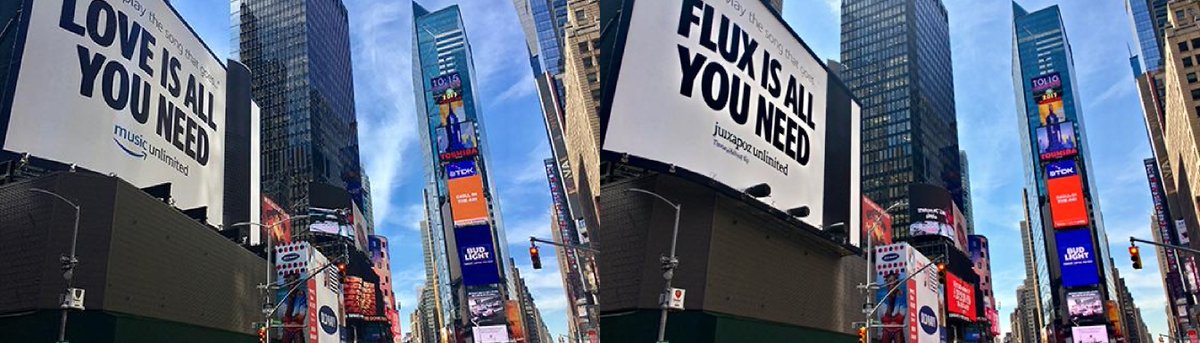
And last but never least, Flux.
FlowEdit really shines in that it can make precise edits while keeping the majority of the image intact (a bit more difficult to pull off in video though).
https://t.co/jee4jRNBSQ
Just published a set of ComfyUI nodes to use Genmo's Mochi to edit videos.
https://t.co/vz3rjMeSgA
It uses rf-inversion, the gift that keeps on giving.
@wildfireworlds On a single 4090 it takes about 2 minutes to "warm up" a video, then 3 minutes to generate. So if you have the same video clip about 3 minutes each after warming up.
@nahbee80 if you're looking to reproduce content from one image into another, I don't think there is a good way right now
if you're just looking for something similar or to remix an image, RF-Inversion is really good
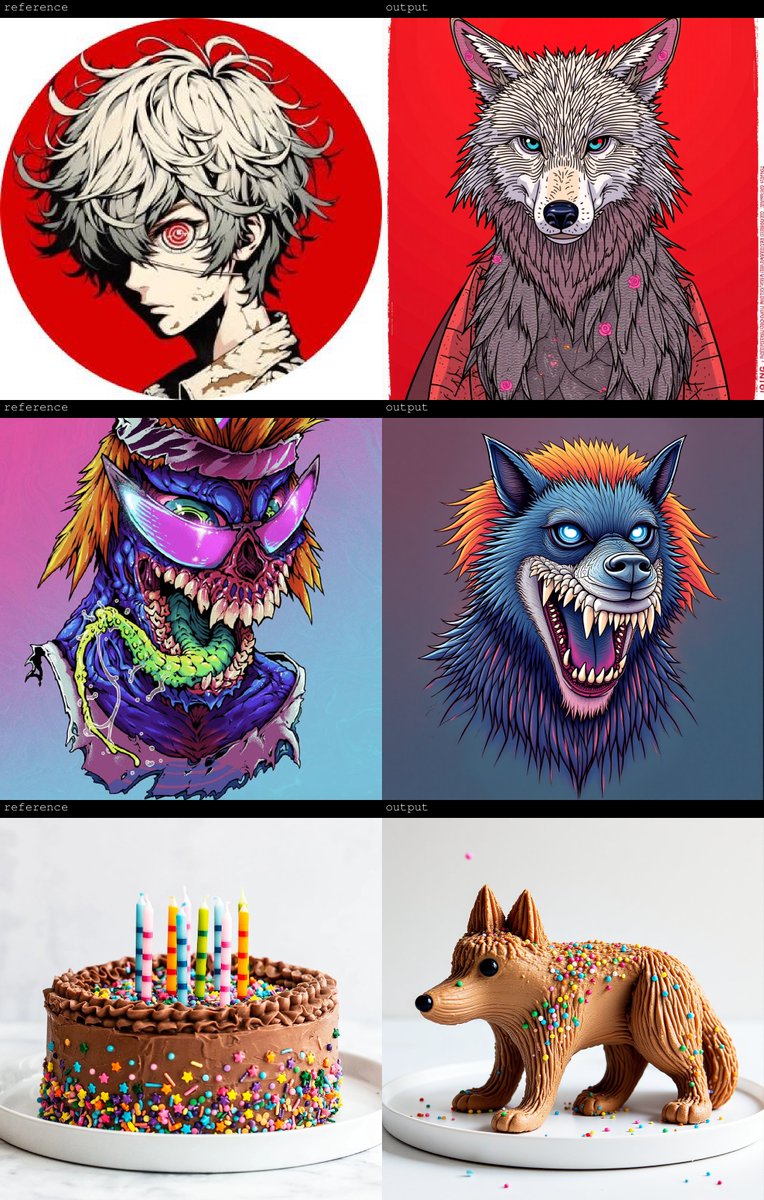
Been revisiting Reference-Only Control for Flux. It uses the diffusion model as a pseudo image encoder on a reference image to influence the generation.
Results are somewhere between style and content transfer.
RAVE and FLATTEN were two of the papers that originally got me into diffusion models. They take inverse noise and apply consistency to image models.
Now with RF-Inversion (thanks @litu_rout_ and @natanielruizg) I can try these on Flux.
Not production quality, but still fun.