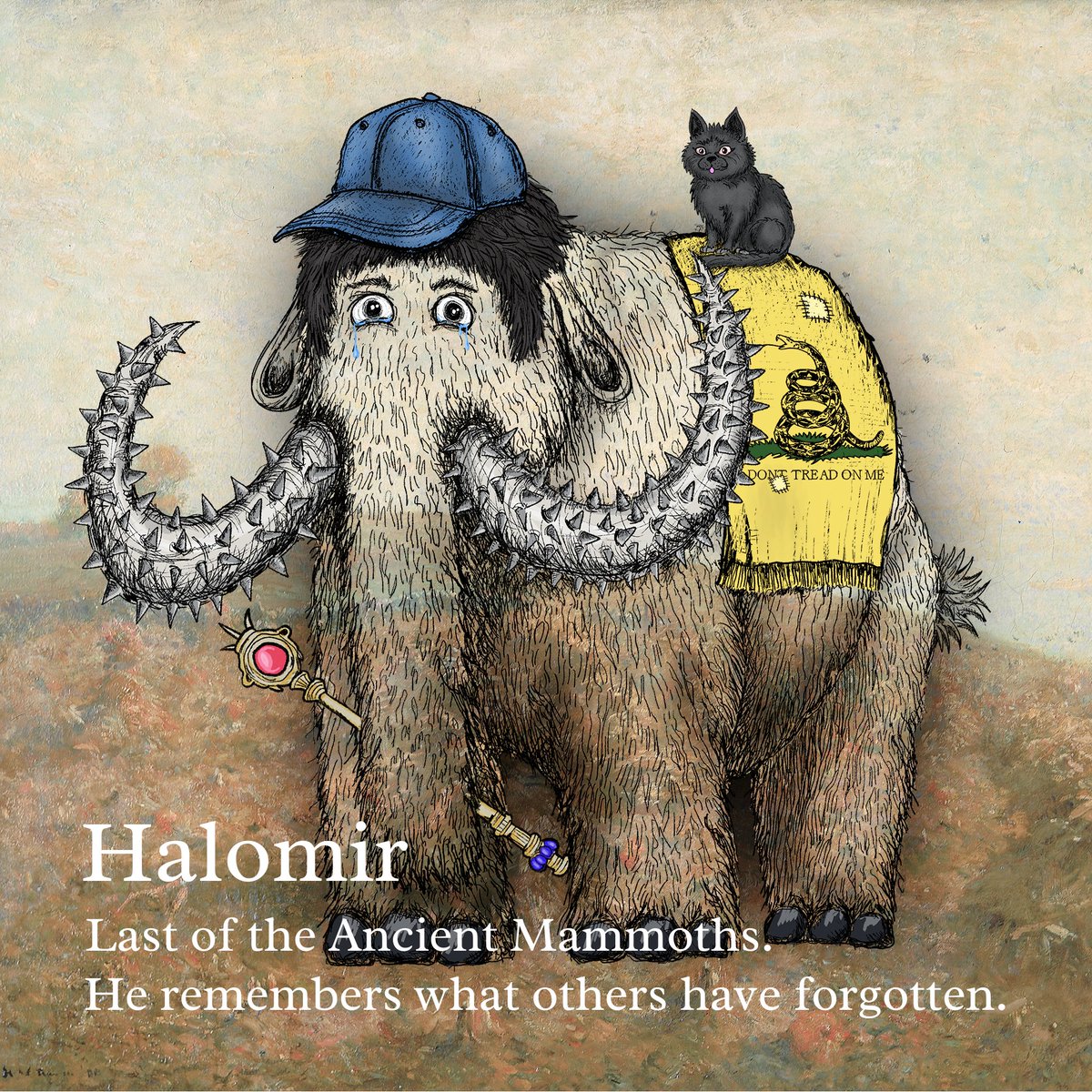
🧵 Echoes of Halomir - Entry 0: Who is Halomir?
Halomir is the last of the ancient mammoths.
Born when the world still remembered how to dream,
He now walks forgotten streets, neon alleys, and echoing towers.
He carries no map, no allegiance, only memory.
His tusks bear the scars of lost worlds.
His eye holds a tear for what cannot be mended.
Others roam, but none remember like he does.
Some say Halomir is cursed to wander.
Others say he chooses to, because someone must remember.
#EchoesOfHalomir 🦣
No sad noises here, I'm happy to see Ethereum scaling
Celestia is simply going after a different class of customers and a different endgame that requires orders of magnitude more blockspace and a fundamentally different architecture. Think onchain order book exchanges, adspace markets, agentic micropayments, etc
200KB/s of DA is a good start, but it's nowhere near where we need to be to scale crypto to the world or explore the edge of what's possible onchain
Celestia today feels polarized.
At the top we have top tier infra builders and a handful of elites. At the bottom a global base that entered through the airdrop many carrying token PTSD, but still willing and searching for a lifeline.
The middle is hollow, filled mostly with low quality, extractive projects designed to take your money under the banner of “using Celestia for DA”
For Celestia to grow into more than “AWS for crypto,” it needs a middle layer that connects infra to the social base. Right now there’s no bridge, no fertile ground so weeds grow instead.
That middle layer is about more than money. It’s about planting seeds of coordination... reputation systems, meaningful participation, and reasons to stay engaged. Give people things to do onchain that aren’t scams. Create reasons to talk, to share, make and go deep.
Let those seeds take root. Let them grow into culture...as much as a blockchain can. Only then does the ecosystem bear fruit and become a garden.
Without this connective garden, Celestia risks becoming a barren field...strong infra standing tall but disconnected, with nothing thriving around it.
Mammoths can help build this layer. We’re focused on designing incentives, nurturing community, and supporting quality participants devs, artists, talkers, and more. The real strength of any network doesn’t just come from infra, but from the people who tend the garden.
Open the gates.
(This is not bearish, this is an opportunity.)
@MammothOverlord Totally agree with this.
Infra alone doesn’t make an ecosystem, it makes a utility. The middle layer is what turns infra into community. Without it, you risk being indispensable but unloved. That’s the real opportunity for Celestia right now. 🦣
🚨 There’s a large-scale supply chain attack in progress: the NPM account of a reputable developer has been compromised. The affected packages have already been downloaded over 1 billion times, meaning the entire JavaScript ecosystem may be at risk.
The malicious payload works by silently swapping crypto addresses on the fly to steal funds.
If you use a hardware wallet, pay attention to every transaction before signing and you're safe.
If you don’t use a hardware wallet, refrain from making any on-chain transactions for now.
It’s still unclear whether the attacker is also stealing seeds from software wallets directly at this stage.
Excellent report here: https://t.co/5CtiZJHYsN
Mamo Maker
Make your own unhinged Mammoths. Find the worst trait combinations possible. Find the most minimal Mamos and Maxi Mamos. Write stuff on them. Add your own historical background. Tweet it.
Mammoths
🦣
What is The Signal?
→ It’s like Ethereum’s public broadcast. Every time a block is finalized, a tiny zero-knowledge proof is created to prove it really happened.
What problem does it solve?
→ Other chains can't easily verify Ethereum's state without trusting a third party. The Signal lets them do it with math instead of trust.
How does it work?
→ Special nodes (called provers) generate proofs. Others (called verifiers) check them. You can be a verifier just by connecting your wallet in a browser.
Why it matters?
→ It creates a new way for blockchains to talk, securely, without oracles or multisigs. That’s huge for bridges, DeFi, and cross-chain apps.
How you can participate?
→ You can help verify it right from your browser (just connect your wallet): https://t.co/OrUFUvkeyL
Blockspace is the bandwidth of web3.
And right now, we’re still in the dial-up era.
It’s scarce. It’s expensive. Everyone’s rationing it.
But what happens when blockspace becomes cheap and abundant, like bandwidth did with fiber?
You stop worrying about gas. You stop optimizing every interaction. You just build.
That’s what Celestia is doing: scaling blockspace the way fiber scaled the internet.
But here’s the deeper shift, blockspace isn’t just data. It’s trust.
Programmable, verifiable, global trust.
So when blockspace gets cheaper, trust gets cheaper.
And when trust gets cheaper, coordination gets easier.
That’s when the real unlocks begin.
We proved and boosted The Signal, now it’s time to Verify it.
Anyone, anywhere can help secure the multi-chain future in one click from any device.
This is how we achieve computational abundance together with Mainnet Beta.
ZK projects love to flex about speed. Proofs in 30 seconds. Then 10. Then sub-second.
But RISC Zero, with @boundlesshq is playing a different game.
Its goal isn’t just to be fast, it’s to be verifiable. And not just verifiable in one context (like Ethereum), but anywhere: across chains, off-chain, even outside crypto.
That’s why it leans into general-purpose design. That’s why it prioritizes formal verification. That’s why it builds on RISC-V instead of inventing a new language.
It’s not trying to win the race to the fastest proof. It’s trying to build the system that people trust to verify proofs wherever they’re needed, in gaming, AI, finance, or infrastructure.
Speed gets headlines. But trust gets adopted.
The protocol that wins isn’t always the fastest. It’s the one you can’t afford not to trust.
Most zk teams are chasing performance.
@RiscZero is chasing distribution.
It’s not trying to be the fastest prover, it’s trying to be the most useful one.
Think AWS for ZK. But decentralized.
If @boundlesshq works, RISC Zero becomes the invisible layer powering provable compute for the whole internet.
1.