This is what makes post-quantum security interesting. It isn’t about making crypto more complicated; it’s about ensuring the cryptography protecting digital ownership can evolve with technology. @quipnetwork is working in this important space.
The post-quantum conversation is ultimately about resilience. Can crypto continue functioning when one of its core technological assumptions changes? @quipnetwork is working toward a future where the answer doesn’t have to be uncertain.
🚨 $4,000 RACE — FREE TO ENTER! 💚
🏆 200 WINNERS
⚡ SOCIAL QUESTS ONLY
🤝 Hosted by @DustBitOfficial x Zealy
🔒 Prize Pool Guaranteed
No deposits. No wagering. Just rewards!
👇 JOIN NOW:
https://t.co/dde4kl3UDx
One underrated aspect of quantum-resistant infrastructure is interoperability. Security upgrades become more useful when they can work alongside existing systems. @quipnetwork’s approach is interesting because crypto cannot realistically rebuild everything from scratch.
Some infrastructure becomes valuable because it solves a problem everyone already has. Other infrastructure is built because a problem is coming. @quipnetwork belongs to the second category, which makes its long-term thesis particularly interesting.
A common mistake is thinking crypto can simply “upgrade later.” Coordinating security upgrades across wallets, users, applications and networks is incredibly complex. That is why early work from projects like @quipnetwork matters.
There is a major difference between a blockchain being secure today and being designed to remain secure through technological change. @quipnetwork is more interesting when viewed through that second lens.
Most people only notice infrastructure when it fails. That’s why security builders often work quietly for years. @quipnetwork is operating in a part of crypto that may not be flashy but could become increasingly essential.
Here’s something crypto rarely discusses: security debt. Every system built on an aging cryptographic standard may eventually need an upgrade. @quipnetwork is focused on reducing that future security debt before it becomes a crisis.
People often assume stronger computers simply mean faster technology. They can also change which security systems remain safe. That’s the broader lesson behind post-quantum cryptography and a major reason @quipnetwork matters.
Verifiable AI safety relies on trust, which companies can't guarantee at scale. Proof of Inference solves this by using cryptographic evidence to prove a specific model generated a result.
#VerifiableAI#PacingTheFrontier#ProofOfInference#AISafety#AI
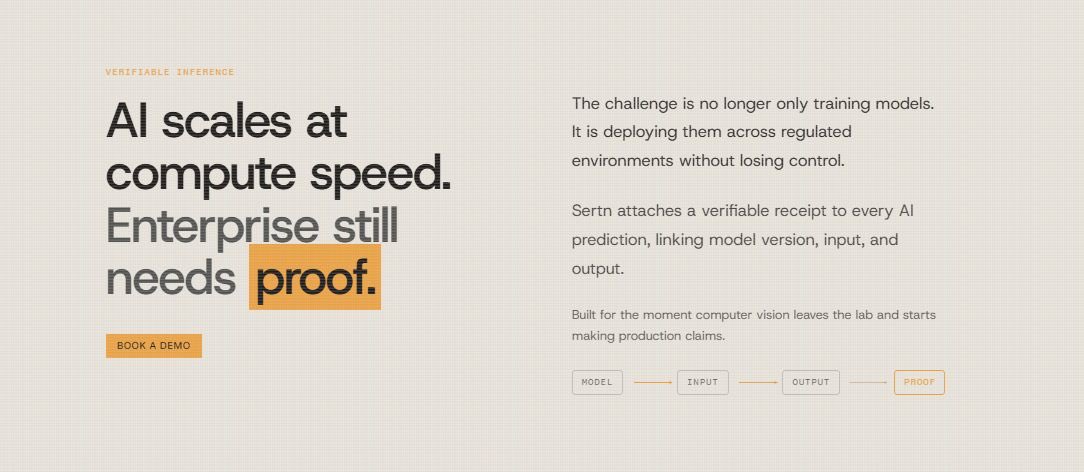
Standard Computer Vision can detect and count, but it can’t prove how a prediction was made. Blind trust fails in regulated production. SertnAI adds a verifiable proof receipt to every prediction.
#SertnAI#ComputerVision#VerifiableAI#ProofOfInference#AI
A safety camera can show what happened, but when an accident leads to an investigation, can the AI’s detection actually be proven? Sertn brings verifiable computer vision to PPE compliance and site safety. 🧵@sertn_ai
#EnterpriseAI#VerifiableAI#Sertn
@the_magician_24 This is why ordinary CCTV logs aren’t always enough. Seeing an event is one thing, but having evidence that can actually be verified later is another.
Quantum computing isn’t necessarily a threat to every part of crypto. Its significance lies in the cryptographic systems that protect ownership and transactions. @quipnetwork is focused on strengthening that critical layer.
Blockchains are designed to be hard to change, which is great for stability but challenging when security standards need major upgrades. That makes projects exploring adaptable security, like @quipnetwork, increasingly relevant.
Crypto users trust private keys because breaking them is currently computationally impractical. That word—currently—is important. @quipnetwork is exploring how asset security can evolve when computing power changes.