🚨 GCSA Insight | Valid Signature Drained the Vault. AI Found the Bug in 11 Minutes.
Three incidents, same pattern.
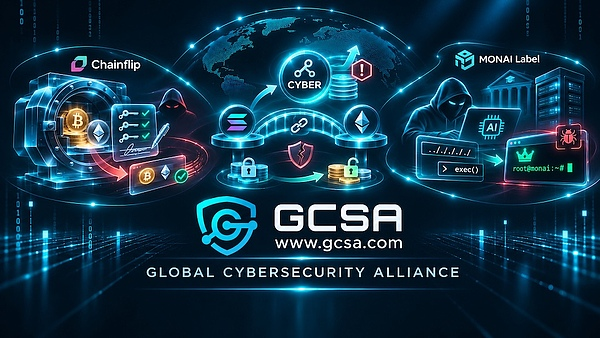
Chainflip lost $4.86M from its Ethereum vault plus 122.86 BTC. The signature checked out against the live threshold key. The nonce didn’t. It was a 39-digit outlier — the only one in nearly 300,000 accepted signatures that broke the sequential count. The vault paid anyway.
Cyber saw 5.21 million CYBER minted on Solana with no matching outbound message, then the same amount released from the Ethereum lockbox two minutes later. Roughly $1.1M left the reserves. The bridge executed what it was told.
MONAI Label: Cairn agents mapped the API, found a path traversal, and wrote arbitrary files in about 11 minutes. Later they planted a reverse shell in sitecustomize .py and triggered a training endpoint. Root on a university server. No advisory existed when they started. CVE-2026-133968, default auth off, fix still not on PyPI.
The check passed. The operation was still wrong.
Signature verification, message delivery, and “no known vulnerability” are not the same as trust. The failure sat outside the boundary the system actually enforced — key provenance, message legitimacy, or the assumption that a zero-day wouldn’t be found and used in one session.
· Full analysis:
https://t.co/vWwLvZcYVg
· Follow GCSA:
Telegram: https://t.co/WHQ0t2xcvz
WeChat: https://t.co/tYI6kCIZRD
#GCSAInsights #GCSASecVibe #0day
GCSA Insight | Over 10 Million Rakuten Securities Accounts Potentially Exposed After Test Server Intrusion
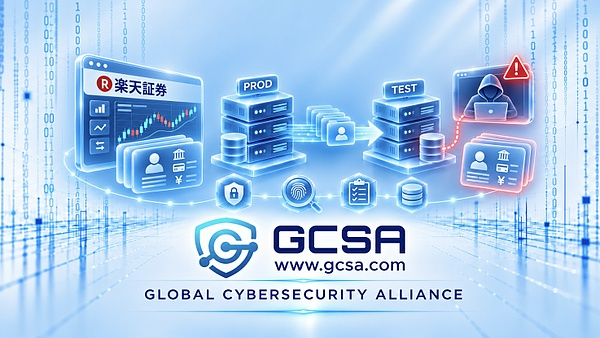
On November 17, 2026, Rakuten Securities disclosed unauthorized access involving a test environment, potentially exposing customer account information on a massive scale.
Key Findings
· Up to 11.25 million accounts: Customer codes and login IDs potentially affected.
· Up to 4.47 million additional accounts: Personal information, contact details, withdrawal bank accounts, and financial asset information potentially affected.
· Unmasked production customer data had been copied to a test server for system upgrade verification.
⚠️ Critical Security Concerns
According to the company's disclosures, a vulnerability in the test environment was exploited. The actual extent of data exfiltration remains unconfirmed.
The incident highlights a significant security challenge: sensitive production data can become exposed when transferred into non-production environments, even through formally approved internal procedures.
GCSA's analysis examines the incident timeline, potential exposure, and implications for financial institutions' data governance and security controls.
· Read the full GCSA analysis
https://t.co/rEiJDd4zIW
· Stay Connected with GCSA
GCSA Official Telegram Channel:
https://t.co/xmXhEiqJda
GCSA Official WeChat Account:
https://t.co/wM32YePJoW
#GCSAInsights #GCSACybersecurity #GCSASecVibe
GCSA Insight | How 10.39 Million USDC Flowed Out of Lighter Through Public Pools
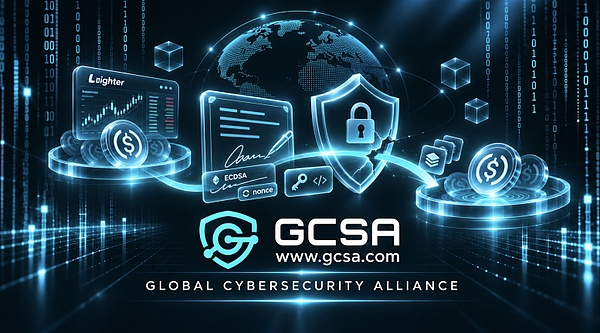
The compromised API key could not withdraw funds directly. Yet 10,393,057 USDC left Lighter’s Ethereum settlement contract on November 16, 2026. The receiving address then swapped the funds for approximately 5,764 ETH through CoW Swap.
Lighter’s post-mortem traced the key exposure to a trader’s custom signing code, which reused an ECDSA nonce. With order signatures available in public calldata, an attacker could recover the account’s API private key. Lighter said its official SDK was unaffected.
The public pool provided a route around the key’s withdrawal restriction. Lighter treated transfers into the creator’s pool as movements between accounts under the same owner. Other accounts, however, could hold and redeem shares in that pool.
Adding funds without issuing new shares increased the amount existing shareholders could redeem. Funds moved internally could therefore become accessible to another account.
Lighter has since introduced wallet-signature requirements for public-pool transfers and removed API signature data from public calldata. IP whitelisting and per-key limits are also planned.
The platform said its protocol, smart contracts and infrastructure were not compromised. A separate withdrawal attempt was blocked, and approximately 5 million USDC was returned. The final net loss remains unconfirmed.
Our analysis follows the timeline and examines where the permission model fell short. For anyone building or auditing a trading API, the question extends beyond whether a key can withdraw funds directly to whether its other permissions can produce the same result.
Read the full GCSA analysis
https://t.co/VVDdgKQuQO
· Stay Connected with GCSA
Follow GCSA's official social media channels for the latest news, product launches, research developments, and ecosystem updates.
GCSA Official Telegram Channel:
https://t.co/xmXhEiqJda
GCSA Official WeChat Account:
https://t.co/6Kgxmbityv
#GCSAInsight #GCSACybersecurity #GCSASecVibe
In-Depth Overview: GCSA Global Cybersecurity Alliance
The Global Cybersecurity Alliance (GCSA) brings together governments, enterprises, individual users, and cybersecurity experts with a network-wide perspective, focusing on emerging threats in AI, Web3, and beyond.
We advance cross-border collaborative defense standards and practical security frameworks to safeguard trust and security across the digital world.
GCSA has developed dozens of in-house cybersecurity products for enterprises and individuals, covering tooling, network-wide threat intelligence, asset mapping, AI auditing, edge protection, and full infrastructure stacks. These solutions support both modular deployment and integrated delivery.
Explore GCSA:
https://t.co/Cynp6KaMBm
> GCSA Ecosystem Product Matrix
> Academic & Research Partnerships
> GCSA Strategic Partners & Advisors
> GCSA Insights & Daily Updates
#GCSA #GCSACybersecurity #GCSAInsights