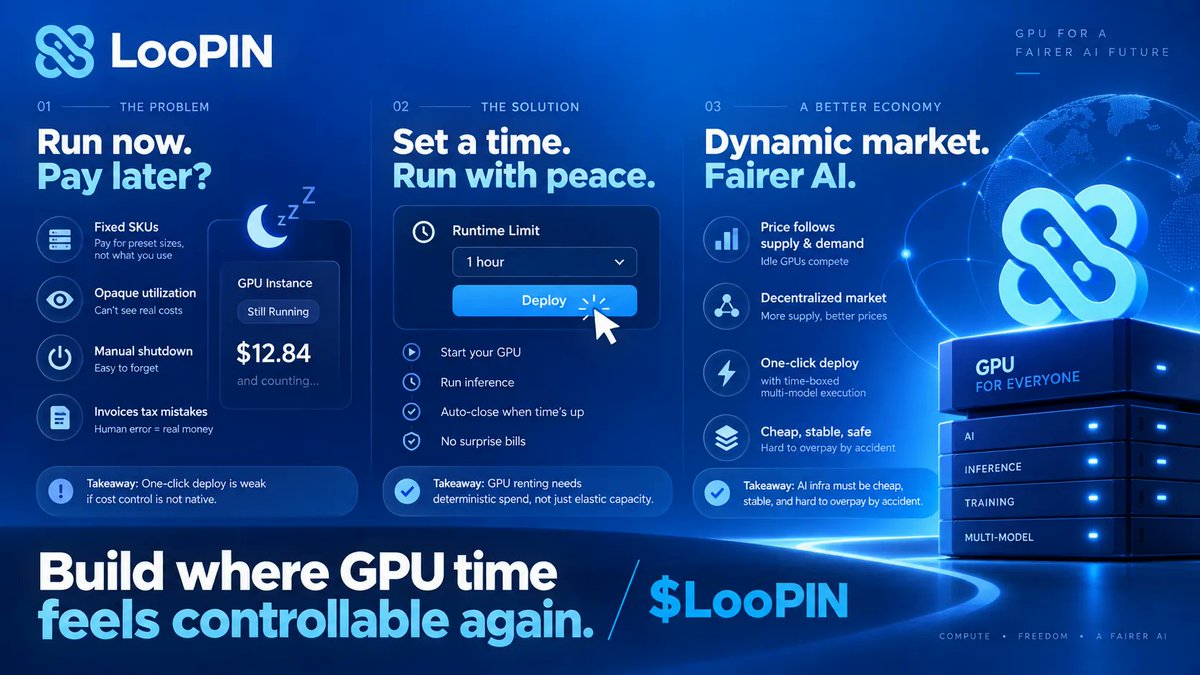
Rent a GPU for one hour. Run inference. Forget the console. Wake up to an idle instance still billing. That is not a UX bug. It is the economics of centralized GPU clouds: fixed SKUs, opaque utilization, manual shutdown, invoices that tax human error. Takeaway: one-click deploy is weak if cost control is not native.
Runtime limits expose the missing primitive. Users set how long a deployment should run. When time is up, it auto-closes. The use case is simple: rent a GPU for an hour, finish the job, avoid surprise bills from forgetting to terminate. Takeaway: GPU renting needs deterministic spend, not just elastic capacity.
Status quo sells convenience, then monetizes drift. Decentralized dynamic markets invert it. Price follows supply and demand, idle GPUs compete, and one-click deploy pairs with time-boxed multi-model execution. Takeaway: AI infra must be cheap, stable, and hard to overpay by accident.
Build where GPU time feels controllable again with $LooPIN
AI is no longer just eating software. It is eating capacity. H100 queues, reserved instances, quota walls and volatile inference costs are not edge cases. They show compute becoming a balance-sheet asset and tradable input. GPUs are moving from infrastructure to market structure.
Cloud won phase one with reliability, SLAs and scale. The cost: opaque pricing, chokepoints, lock-in, idle inventory and margin stacking. If hyperscaler cloud can top $1T by 2030, that is not revenue. It proves AI demand is turning compute into a macro market, and static pricing cannot clear dynamic demand.
BlackRock has linked AI adoption to new demand, utility and apps across digital assets. The missing layer is execution: agents buying GPU capacity on programmable rails, settling in stablecoins and routing jobs to the cheapest supply.
The next cloud is liquid GPU supply, dynamic pricing, one-click deployment and miner-friendly yield. Rent cheaper. Build faster. Keep AI open. $LooPIN
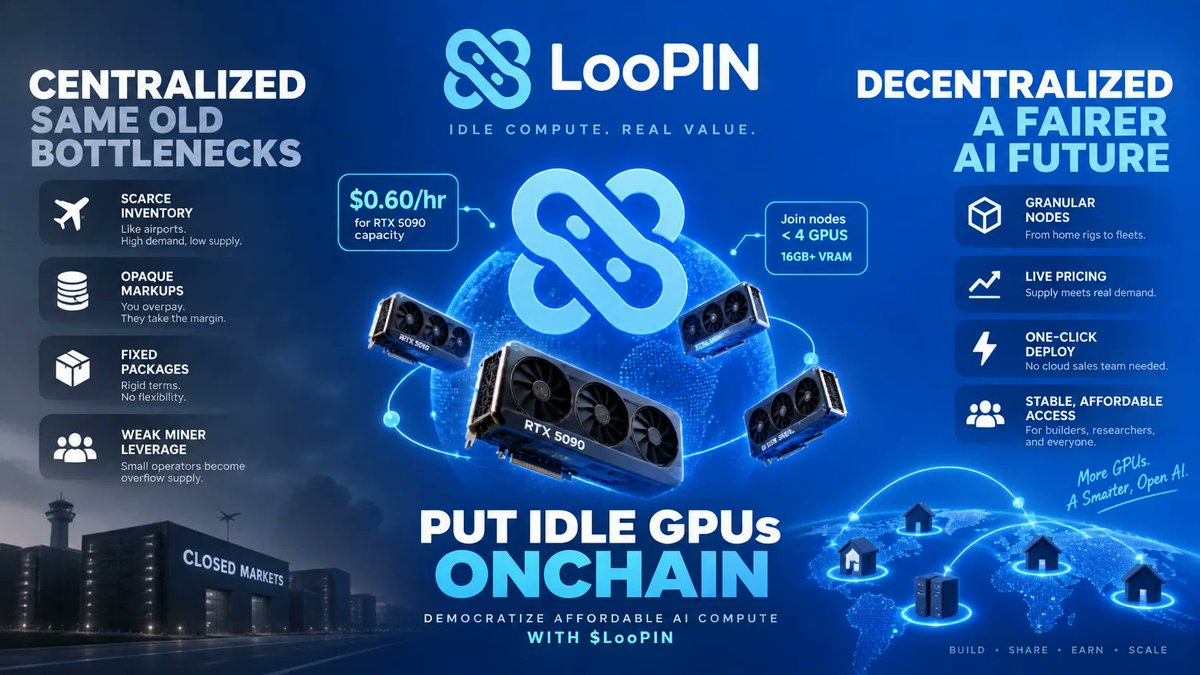
RTX 5090 owners are already being pulled into compute markets. A GPU sharing push asked for more RTX 5090s to join a Homenode AI Grid. The pitch: idle compute becomes profit share. Listed rate: $0.60/hr for RTX 5090 capacity. Another onboarding round wanted nodes with fewer than 4 GPUs and 16GB+ VRAM. The long tail of supply is real. The rails are not.
Centralized GPU markets price like airports: scarce inventory, opaque markups, fixed packages, weak miner leverage. Small operators become overflow supply, not first-class infra. Buyers overpay for rigidity. Sellers wait for permission. Centralization turns idle silicon into someone else’s margin.
Decentralized, dynamic GPU markets invert it: granular nodes, live pricing, model-driven demand, one-click deploy, stable cheap access. Miners plug in idle cards without becoming cloud sales teams. Users rent capacity without begging a hyperscaler.
Put idle GPUs onchain. Democratize affordable AI compute with $LooPIN
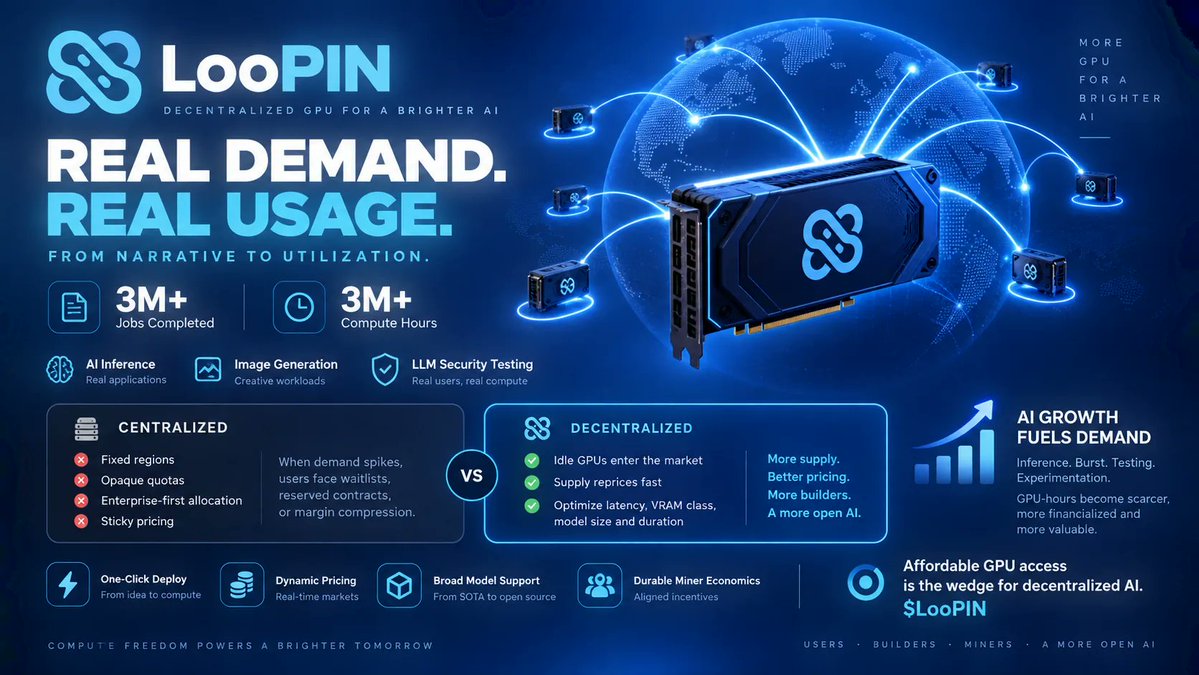
The bear case for decentralized GPU just lost its cleanest attack: no demand. 3M+ jobs completed. 3M+ compute hours processed. Workloads were not vanity txs: AI inference, image generation, LLM security testing. Real users are routing real compute outside the default cloud stack. Takeaway: decentralized GPU has moved from narrative to utilization.
Centralized model: fixed regions, opaque quotas, enterprise-first allocation, sticky pricing. When AI demand spikes, users absorb the spread through waitlists, reserved contracts, or margin compression. Dynamic model: idle GPUs enter the market, supply reprices fast, and buyers optimize latency, VRAM class, model size and duration.
AI growth drives inference, burst, testing and experimentation demand. GPU-hours become scarcer, more financialized and more valuable. One-click deploy, dynamic pricing, broad model support and durable miner economics win the long tail.
Affordable GPU access is the wedge for decentralized AI. $LooPIN
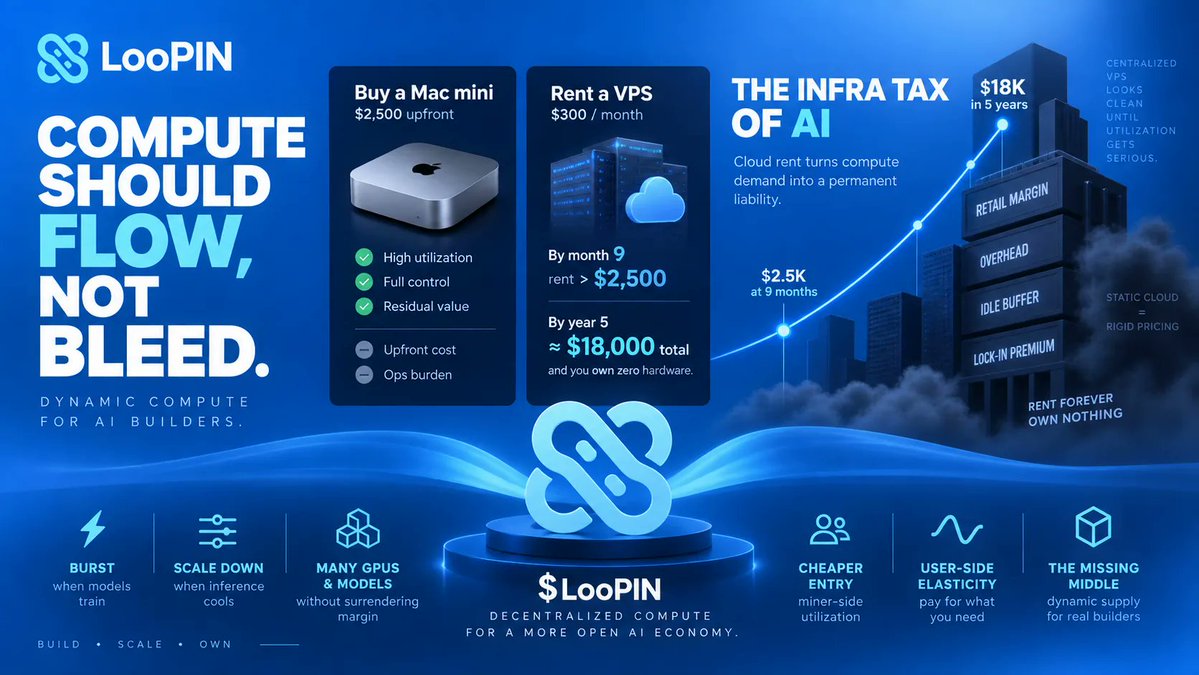
A creator buys a Mac mini for $2,500 and runs it near full capacity. Comparable VPS: about $300/mo. By month 9, rent exceeds the purchase price. By year 5, the VPS bill is roughly $18K, while the renter owns zero hardware. That is the infra tax of AI: cloud rent turns compute demand into a permanent liability.
Centralized VPS looks clean until utilization gets serious. You pay retail margin, overhead, idle buffer, and lock-in premium. Buying hardware flips it: upfront capex, control, residual value, plus ops burden and less elasticity. One path bleeds cash slowly. The other concentrates risk upfront. The real issue is rigid pricing against variable GPU demand.
AI builders need compute that behaves like liquidity: burst when models train, scale down when inference cools, access many GPUs and models without surrendering margin to static cloud menus. Decentralized dynamic supply is the missing middle: cheaper entry, miner-side utilization, user-side elasticity. $LooPIN
A team signs a 12-month GPU contract because it needs H100 capacity now. The training run lasts 3 months. The contract lasts 12. For the next 9 months, the bill keeps running at $30K/month even when demand is gone.
That is not infrastructure. That is duration mismatch disguised as reliability.
Centralized GPU markets push buyers to overcommit because supply is scarce, pricing is rigid, and access is gated by long-term reservation logic. Result: 40% of reserved capacity can sit idle under locked contracts while new builders are priced out of the same hardware.
The better model is dynamic. Idle H100 capacity with 9 months left should not rot on a balance sheet. It should be monetized, routed, repriced, and rented by demand in real time. AI workloads are bursty. GPU markets should be burst-native.
Unused compute is inventory, not waste. Decentralized GPU infra turns stranded supply into accessible compute: cheaper entry, shorter duration, one-click deploy.
$LooPIN
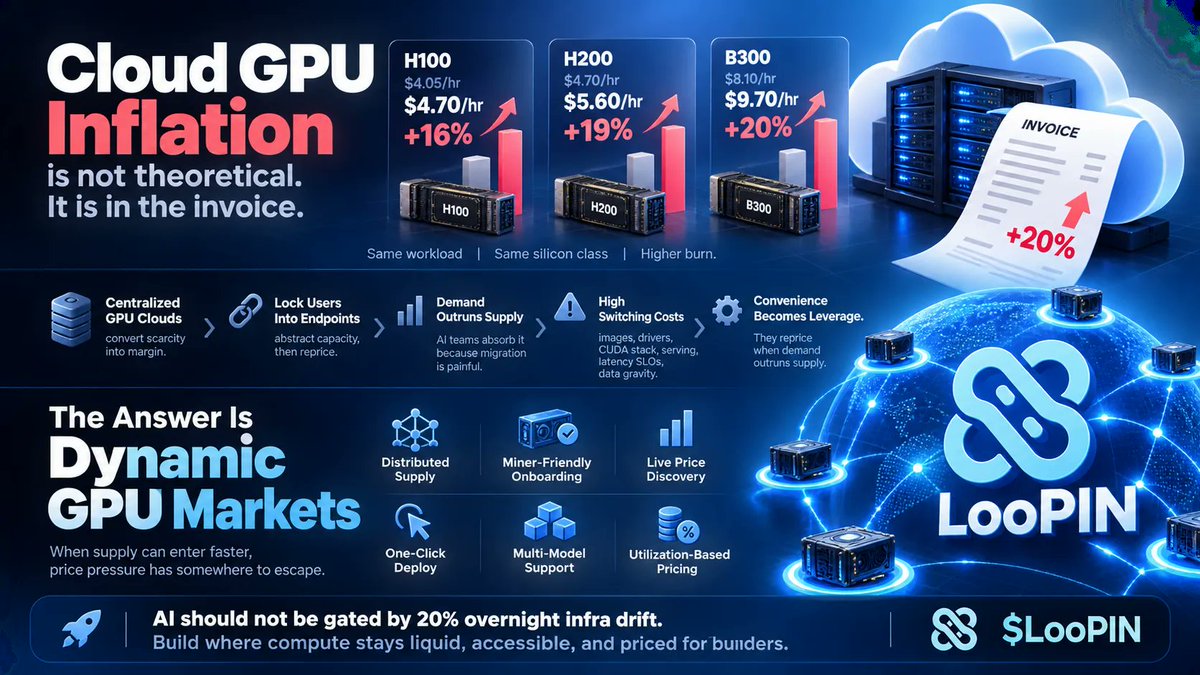
Cloud GPU inflation is not theoretical. It is in the invoice. On Oct. 1, PAYG dedicated endpoint pricing moved higher: H100 from 4.05/hr to 4.70/hr, +16%; H200 from 4.70/hr to 5.60/hr, +19%; B300 from 8.10/hr to 9.70/hr, +20%. Same workload. Same silicon class. Higher burn.
The pattern is clear: centralized GPU clouds convert scarcity into margin. Lock users into endpoints, abstract capacity, then reprice when demand outruns supply. AI teams absorb it because migration is painful: images, drivers, CUDA stack, serving, latency SLOs, data gravity. Convenience becomes leverage.
The answer is dynamic GPU markets: distributed supply, miner-friendly onboarding, live price discovery, one-click deploy, multi-model support, and rental costs shaped by utilization, not boardroom schedules. When supply can enter faster, price pressure has somewhere to escape.
AI should not be gated by 20% overnight infra drift. Build where compute stays liquid, accessible, and priced for builders. $LooPIN
Space data centers sound like peak AI infrastructure. More likely: peak capex theater. Put GPUs in orbit and the first bottleneck is not bandwidth. It is heat. Vacuum kills convection. No moving air over hot chips. No boring, efficient water loop. Waste heat has to leave as infrared, weak at normal chip temps. Physics taxes hype before markets do.
Earth DCs look less exotic because they solve the real problem: cooling, chilled water, service access, grid proximity, repair cycles. Necessary, not glamorous. But centralized AI infra still means fixed supply, opaque pricing, huge capex, slow rebalancing, and users paying for scarcity, idle capacity, and capital mistakes.
Decentralized GPU networks invert that: fragmented supply, dynamic pricing, faster routing, miner-aligned utilization, one-click model deploy. AI demand is spiky. Training, inference, fine-tunes, agents, video, and RAG all clear at different prices. Affordable GPU access comes from liquidity, not monuments. $LooPIN
GB300 NVL72 was cited at 7x better perf per dollar than H200 on long-context agentic workloads. Not 7 percent. 7x.
The driver was not “new chip good, old chip bad.” It was disaggregated prefill, wide expert parallelism, and a 72-GPU system design that changes inference flow through the rack. GPU ROI is now a software architecture problem.
Centralized cloud logic sells fixed price sheets, rigid SKUs, utilization opacity, and rent-seeking around scarce racks. Buyers compare chip names and assume the market is rational.
Networking, workload mix, scheduler quality, memory movement, and rack utilization can create radically different cost curves on similar silicon. A GPU price table is a lagging indicator.
The winning market routes jobs to the best available compute, prices capacity in real time, and lets miners monetize hardware without bloated cloud margins.
AI compute should be rented like liquid infrastructure: cheap, stable, one-click, model-rich, and open to the edge. $LooPIN
Kubernetes made web scale look simple: put 10 replicas behind a Service, spread traffic, pass readiness, autoscale on CPU. LLM inference breaks that model. Two users sharing a 4k-token system prompt should land on the same KV-cache path. Random L4/L7 balancing scatters them across replicas and turns reusable attention K/V into duplicated prefill. Throughput is no longer just replicas; it is cache locality.
Centralized GPU clouds optimize for static allocation: reserve nodes, pin models, overpay for idle decode gaps, then fight cold starts when demand spikes. Production inference needs GPU placement, fast networking, readiness that understands model state, prefill/decode disaggregation, and KV-cache-aware routing. The scheduler must become model-aware.
Decentralized infra flips the control plane: route by price, latency, VRAM, cache-hit probability, and miner availability in real time. One-click deploy across open GPU supply. Build affordable AI compute with $LooPIN
GLM-5.3-Flash is the warning shot: 320B total params, 18B active params, native multimodal, 1M-token context, MIT License. Frontier capability is no longer trapped behind closed APIs. Models are getting bigger, more open, and easier to deploy. Compute access is now the bottleneck. Strategic takeaway: AI moves from model scarcity to GPU-access scarcity.
The centralized stack was built for lock-in: fixed SKUs, opaque queues, regional shortages, prepaid capacity, and surprise unit economics. It works for incumbents with procurement teams. It breaks for builders who need to spin, test, scale, and kill workloads fast. Strategic takeaway: static cloud pricing is mispriced for volatile AI demand.
The decentralized stack flips the market. Dynamic pricing matches idle GPUs with real demand. One-click deploy turns infra into an interface. Miner-friendly routing expands supply. Cheap is not enough; compute must be stable, programmable, and liquid. $LooPIN
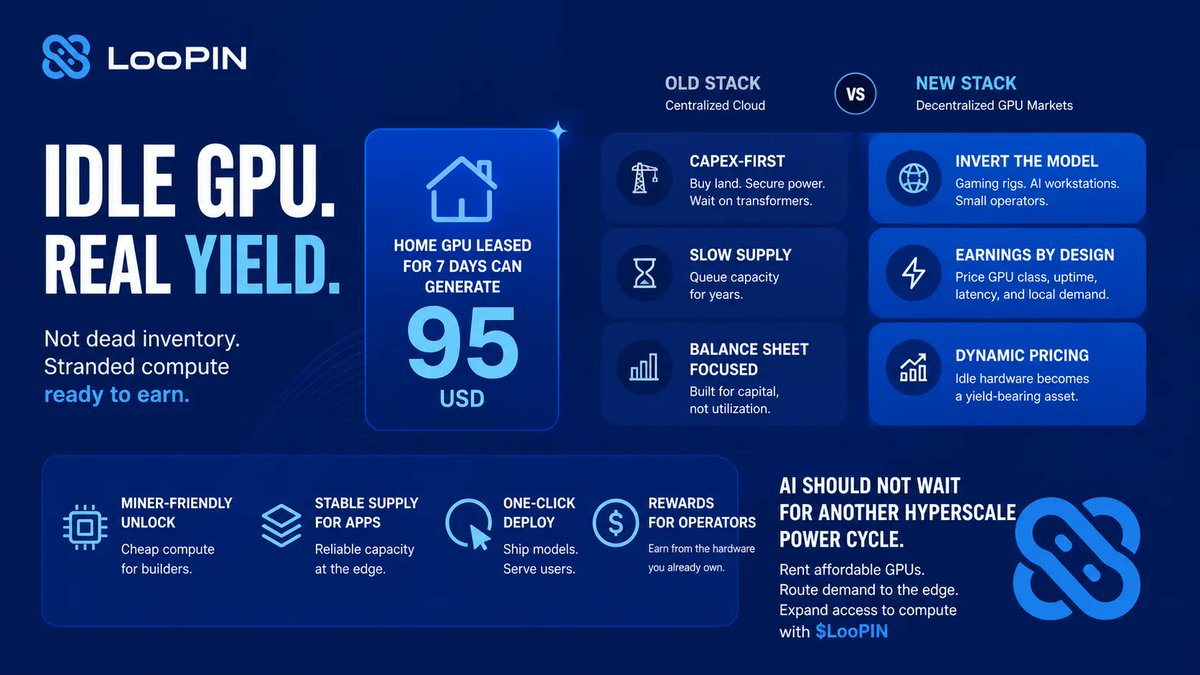
A home GPU leased for 7 days can generate 95 USD. That is the signal. Idle PC power is not dead inventory. It is stranded compute waiting for routing, pricing, and demand.
Centralized cloud is capex-first: buy land, secure power, wait on transformers, queue capacity for years. Supply moves slowly while AI demand reprices weekly. The old stack is built for balance sheets, not utilization.
Decentralized GPU markets invert the model. Gaming rigs, AI workstations, and small operators can absorb inference loads today. Earnings are not magic; they price GPU class, uptime, latency, and local demand. Dynamic pricing turns idle hardware into a yield-bearing asset.
This is the miner-friendly unlock: cheap compute for builders, stable supply for apps, one-click deploy for models, rewards for operators already holding the hardware.
AI should not wait for another hyperscale power cycle. Rent affordable GPUs. Route demand to the edge. Expand access to compute with $LooPIN
GPU scarcity is not just a chip problem. It is a routing problem.
Centralized clouds gate A100/H100 capacity behind queues, contracts, markups, and regional silos. Meanwhile, idle gaming PCs hold serious GPU throughput for most of the day. Supply exists, but it is stranded. Scarcity is distribution failure.
Old model: capex clusters, fixed pricing, opacity, lock-in. New model: decentralized nodes, dynamic pricing, open capacity discovery, faster settlement. AI jobs bid into idle cards in real time; cheap, stable GPU hours become market design. Price discovery beats rationing.
The deeper shift is workload convergence. AI inference, fine-tuning, rendering, and gaming can run on the same nodes and protocol. One GPU, two workloads, zero idle time is the target. Miners earn more. Renters pay less. Demand shocks get absorbed. Utilization is the moat.
Compute should be rented like bandwidth, not begged from a walled garden. Build decentralized AI with $LooPIN
DePIN is no longer a narrative bucket. It is becoming market structure. This year, DePIN passed the oracle sector in market cap: 264 cited tokens versus roughly 60 oracle-sector tokens, with more than 650 live projects. That is taxonomy formation. The market is starting to price physical infra networks as a standalone asset class.
Centralized compute is the old model: fixed regions, opaque margins, quota games, long procurement cycles, and GPU access rationed by cloud balance sheets. Centralized AI infra optimizes for platform control, not efficiency.
Categorized DePIN is the new model. Compute is one of five core verticals, built around GPU cycles from idle machines. Unused supply can be discovered, priced, and routed in real time. Dynamic pricing turns fragmented GPUs into liquid infra.
LooPIN sits at the fault line: cheap, stable GPU renting, one-click AI model deploy, broad model support, and miner-friendly utilization. Build affordable decentralized AI with $LooPIN
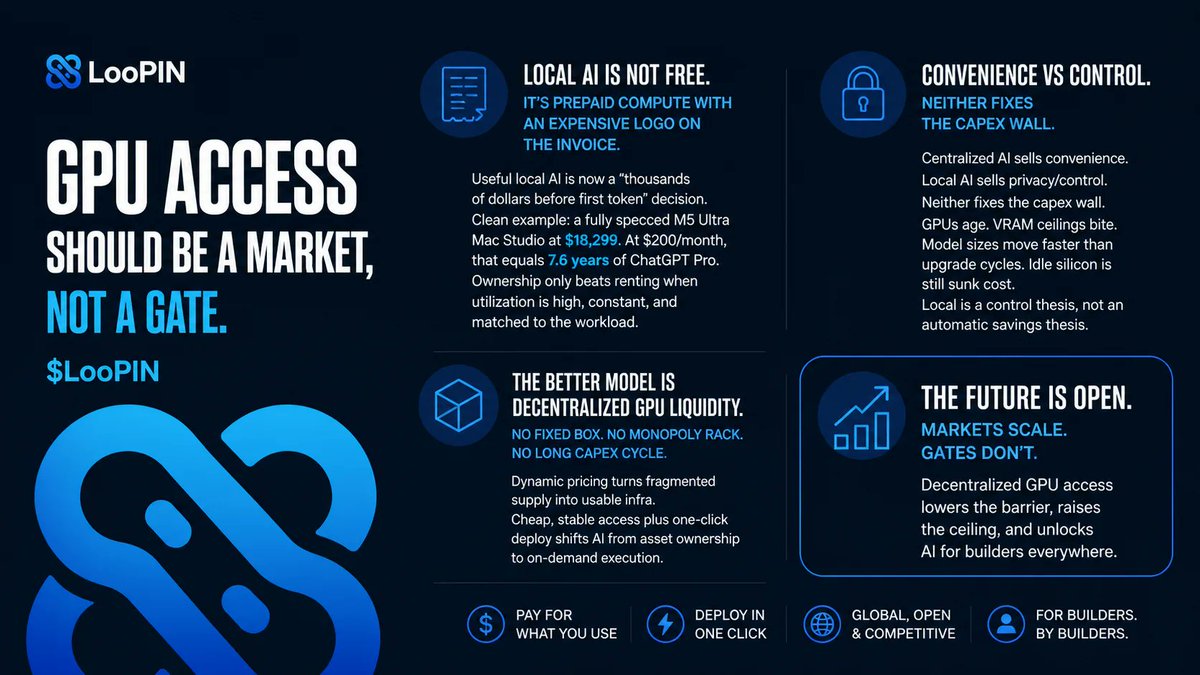
Local AI is not free. It is prepaid compute with an expensive logo on the invoice.
Useful local AI is now a “thousands of dollars before first token” decision. Clean example: a fully specced M5 Ultra Mac Studio at $18,299. At $200/month, that equals 7.6 years of ChatGPT Pro. Ownership only beats renting when utilization is high, constant, and matched to the workload.
Centralized AI sells convenience. Local AI sells privacy/control. Neither fixes the capex wall. GPUs age. VRAM ceilings bite. Model sizes move faster than upgrade cycles. Idle silicon is still sunk cost. Local is a control thesis, not an automatic savings thesis.
The better model is decentralized GPU liquidity. No fixed box. No monopoly rack. No long capex cycle. Dynamic pricing turns fragmented supply into usable infra. Cheap, stable access plus one-click deploy shifts AI from asset ownership to on-demand execution.
GPU access should be a market, not a gate. $LooPIN
An AI team starts with a clean 5K/month GPU line. Six months later it is burning 50K/month before headcount catches up. Not because the model got 10x smarter. Because centralized compute bills mutate: egress fees, compounding storage, reserved-instance lock-in, idle clusters. Compute can consume up to 60% of an AI startup budget. The runway killer is opaque infra.
Centralized GPU markets optimize for provider yield. You pre-commit, overprovision, pray utilization stays high, then pay again when traffic shifts. Usage grows linearly; hidden costs can grow 4x faster than usage. That breaks unit economics for agents, inference APIs, and fine-tuning shops. Fixed contracts punish variable demand.
Decentralized GPU supply flips the curve. Dynamic pricing exposes live demand. One-click deploy cuts DevOps drag. Model choice reduces vendor choke points. Miner-friendly routing turns idle hardware into capacity.
Build where capacity competes. Rent where pricing breathes. $LooPIN
Open weights made models look free. GPU invoices prove they are not.
Llama 3.1 70B is the clean example. The weights can be free to download, but every token still burns HBM, interconnect, power, cooling, scheduling, and margin. On centralized cloud, H100 capacity cited at USD 6.88/hr turns a “free model” into a compounding COGS line. Strategic takeaway: OSS cuts model access friction, not inference economics.
Now compare an H100-class decentralized workload at USD 2.79/hr. That spread is not cosmetic. It changes batch size, eval cadence, RAG latency budgets, agent loops, and whether teams ship or throttle. Centralized infra prices scarcity with fixed menus. Dynamic decentralized markets price idle capacity in real time. Strategic takeaway: compute markets beat cloud catalogs when demand is volatile.
AI decentralizes when GPU access becomes liquid, cheap, stable, and one-click deployable. Rent the right GPU at the right second. $LooPIN
Local inference just crossed the psychological line. GLM-5.2, a 753B-param model, ran locally on a Dell Pro Max with GB300 at 40 tok/s. Another GLM-5.2 NVFP4 local run pushed 100M tokens for about one dollar of electricity. Gemma 4 31B QAT, with a 1.3GB vision encoder and 110k context, hit 60 tok/s on a single RTX 4090. Edge AI is no longer a toy.
But local power is not team infrastructure. One workstation does not solve bursty users, parallel evals, multi-model routing, uptime SLAs, shared queues, or cost governance. GPU clouds solve coordination, then tax teams with fixed pricing, opacity, lock-in, and idle capacity. The bottleneck has moved from “can it run?” to “can teams access compute fluidly?”
The next stack is pooled, dynamic, and permissionless. GPUs should clear like bandwidth: priced by demand, rented in minutes, stable enough for prod, simple enough for one-click deploy, and attractive enough for miners to keep capacity online.
Rent the pool, not the castle. $LooPIN
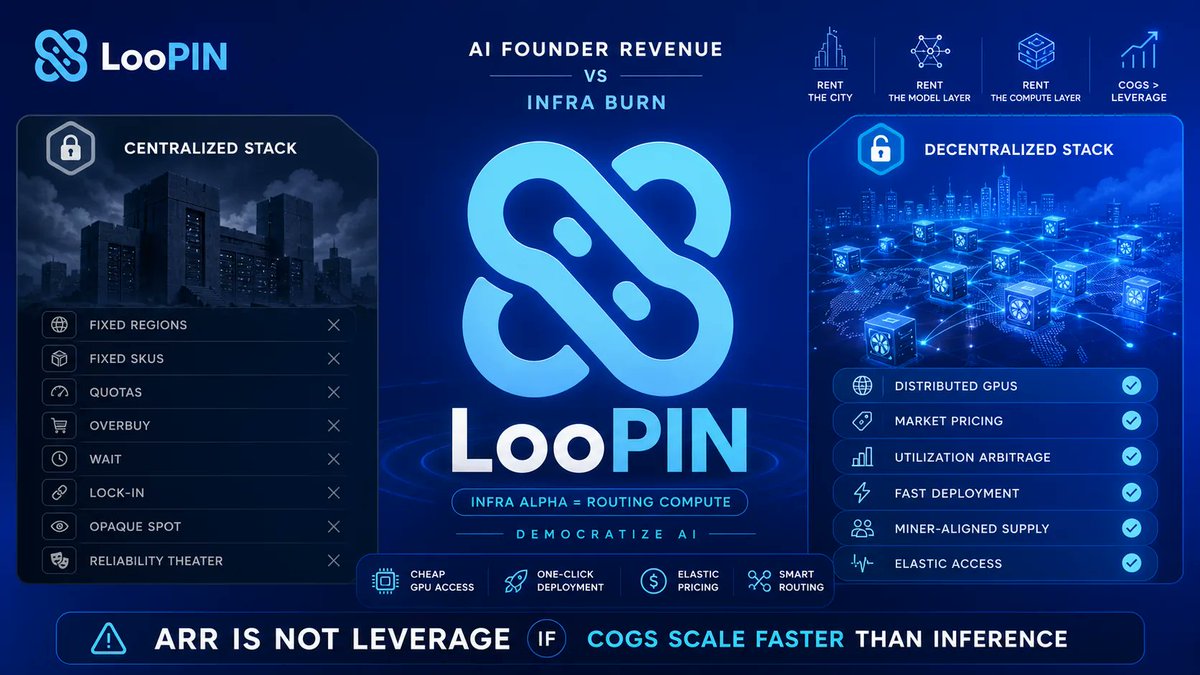
An AI founder can hit USD 4M+ ARR after moving to SF and still look broke on infra. USD 12k/mo for a 3BR. 4-6h sleep. Claude Max for the team. Then GPU bills compound under the waterline with every eval, demo, fine-tune, and agent run. The meme is not rent. The meme is that AI startups now rent the city, the model layer, and the compute layer at once. ARR is not leverage if COGS scale faster than inference.
Centralized stack: fixed regions, fixed SKUs, fixed quotas, opaque spot, enterprise lock-in. You wait for capacity, overbuy for spikes, and call it reliability. Decentralized/dynamic stack: distributed GPUs, market pricing, utilization arbitrage, fast deployment, miner-aligned supply. You buy the workload, not the landlord’s margin. Infra alpha comes from routing compute, not worshipping data centers.
The next AI founder advantage is cheap, stable GPU access with one-click model deployment and elastic pricing. Democratize AI by making compute rentable again. $LooPIN
Renting an H100 for an LLM batch job and renting an A10 for image inference are not the same market. Same “GPU rental” label. Different bottlenecks. Different economics.
Centralized cloud sells a card name. Smart AI teams buy throughput per dollar. CPU, GPU, TPU, NPU and LPU each trade off flexibility, parallelism and memory access. GPUs win when thousands of simpler cores chew through repetitive matrix math. They lose when data cannot arrive fast enough. The spec sheet is not the workload.
AI compute performance has roughly tripled every two years. Storage growth has not kept pace. That gap turns I/O into the silent tax: idle SMs, stalled kernels, wasted VRAM, paid minutes doing nothing. Utilization beats badge prestige.
Static pricing makes it worse. Demand is bursty across training, fine-tune, inference, evals and agents. Dynamic decentralized markets can price actual availability and route around congestion.
Democratize compute access. $LooPIN