𝚈𝙾𝚄'𝚅𝙴 𝙱𝙴𝙴𝙽 𝙻𝙸𝙴𝙳 𝚃𝙾
I know you're not into gambling and honestly, neither am i
But this isn't about luck or reckless bets.
Simply Use your brain and get paid for it.
This might be the smartest way to make money online.
what's this about❓
🧵
@intodotspace
We can go casino for casino!
fuck tho, we can Gamdom for Gamdom.
i didn’t sleep last night just to cook this video for the last day of #Gamdom100k challenge
signup with “steve” code on @gamdom and lock tf in.
username: ajdominicasf
LFG @SirGamby@stevewilldoit@kingadukes
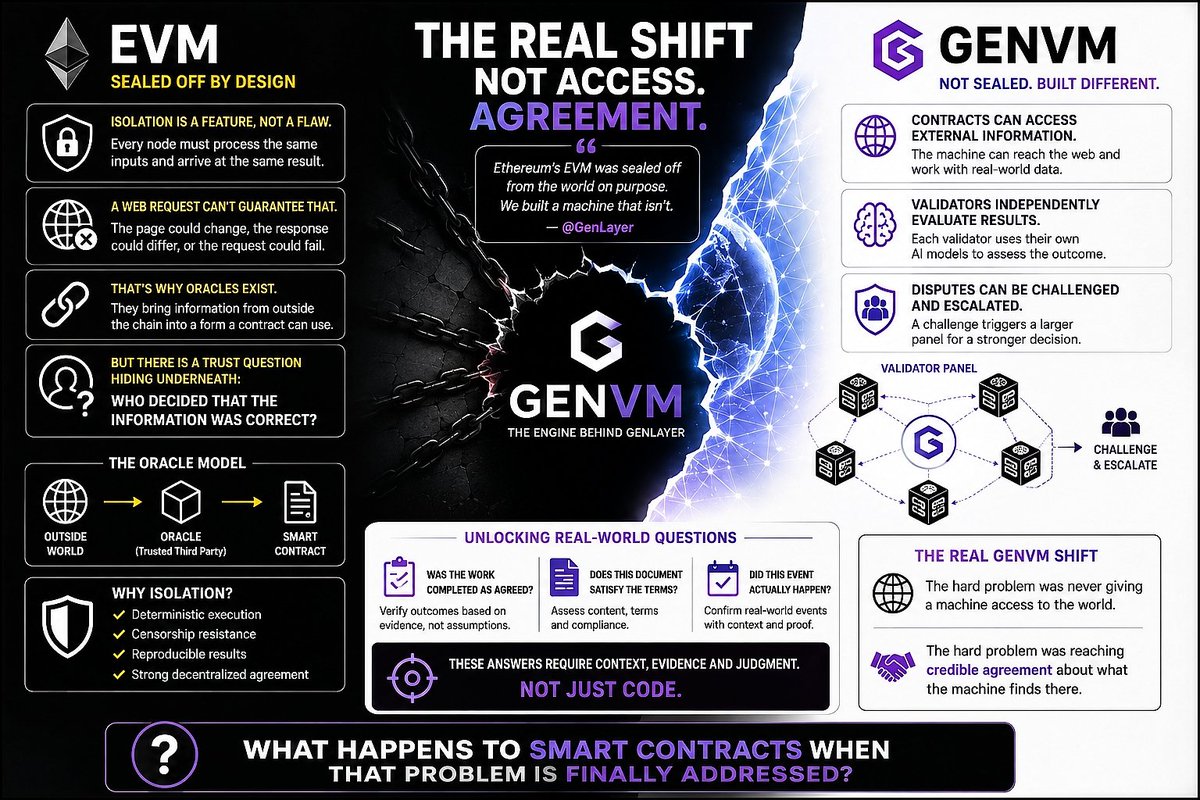
GenVM is not interesting because it can access the web.
It is interesting because accessing the web forces you to rethink how a blockchain reaches agreement.
@GenLayer explains the starting point:
Ethereum's EVM was sealed off from the world on purpose
We built a machine that isn't.
The EVM’s isolation is a feature, not a flaw. Every node must process the same inputs and arrive at the same result. A web request cannot guarantee that. The page could change, the response could differ, or the request could fail.
That is why oracles became necessary.
They bring information from outside the chain into a form a contract can use.
But there is a trust question hiding underneath:
Who decided that the information was correct?
GenVM takes a different approach. Contracts can access external information, while validators independently evaluate the result using their own AI models. If there is a dispute, the result can be challenged and escalated to a larger panel.
That unlocks something much more interesting than HTTP access.
A contract can deal with questions such as:
⇥Was the work completed as agreed?
⇥Does this document satisfy the terms?
⇥Did this event actually happen?
Those answers are not deterministic outputs waiting to be calculated.
They require context, evidence and judgment.
That is the real GenVM shift.
The hard problem was never giving a machine access to the world.
The hard problem was reaching credible agreement about what the machine finds there.
What happens to smart contracts when that problem is finally addressed?
Most people still open a website to trade.
This one starts in Telegram.
Avantis challenges
⇥Free to join
⇥Practice with paper credits
⇥Then compete from chat
Simple
https://t.co/VPyO70TCzh
@avantisfi
From chasing solana:7iCb5PWhnfeHLwpCZZ9bozNNaQYiFB7dkUyoVNDvpump to becoming the face of hundred dollar note.
Benjamin franklin really locked in. 😭
#BreadMemeContest@benjamins_bread 🥖
we don’t blink on robinhood chain.
$AI was $8.6M mc when i made this video, now it has crossed $250M market cap.
we are about to witness a generational run, and the bull season is just getting started!
The dog is @ArtificiallyInu
LONG $AI
I've had the craziest $ANSEM onboarding experiment over the last 48 hours.
i took the Black Bull to the streets, riding it through one of Abuja's busiest transport hubs in Nigeria.
Ngl, this is one of the wildest things I've ever pulled off.
My aim was to create an experience people would remember, using attention as the first step toward real crypto adoption.
So first, we got people talking.
Because attention means nothing if it doesn't lead somewhere.
The next day, i took the Black Bull to the University of Abuja and onboarded students into crypto in the simplest way possible.
Through games, conversations, and interactive experiences, dozens of students created wallets, made their first onchain transaction, and discovered what crypto is.
The goal was to make people care about crypto and make them see reasons why they are still early to crypto.
$ANSEM a token built around bringing new people onchain. So let's fkn send it. 🐂🀄
@daremarket @blackbullsol@blknoiz06
@Crix_sol Trustless doesn't mean disputeless. Coordination without trust still needs a referee. GenLayer's insight is separating execution from interpretation instead of pretending code can do both.
Can an agentic economy truly scale if code can execute a deal but cannot determine whether the deal was actually fulfilled?
One investor’s take was that binary code is enough for automated deals. I disagree.
I would have pushed back in that room: code can enforce conditions, but it cannot always adjudicate what those conditions mean when reality gets messy.
Imagine two agents completing a transaction. One says the agreed work was delivered. The other says it wasn’t. Both present evidence. Both believe the other is wrong.
The transaction executed perfectly. The dispute did too.
That distinction matters.
The agentic economy isn’t only going to need infrastructure for agents to transact. It needs infrastructure for the moments when they interpret outcomes differently.
That is where I see the importance of @GenLayer.
Its adjudication layer gives disputes a native mechanism: a randomly selected panel of validators, each running its own AI model, evaluates the proposed outcome. An open challenge window can then escalate the dispute to a larger panel.
The goal isn’t to make agents trust each other.
It is to make economic coordination possible even when they don’t.
That, to me, is a much bigger piece of agent infrastructure than simply making another transaction execute automatically.
Agent Tank Hackathon: https://t.co/HOMukhLQdp
@Crix_sol@RallyOnChain@GenLayer Mochi turning this into a visible demo would make the stakes obvious.
I keep thinking about scale.
Millions of agents transacting means millions of micro disputes, too small for human courts to touch.
This is definitely the AI agent you need when it comes to resolving disputes
I opened Mochi on Telegram with a simple question:
How do you solve world problems?
One question led to another, and I ended up exploring Mochi, agents, and GenLayer’s vision for an agentic internet.
The idea that caught me most:
an INTERNET COURT
With GenVM, validators, and the Equivalence Principle, GenLayer is exploring how autonomous agents can reach agreement on outcomes, even when the answer isn’t simply deterministic code.
That made me think: if agents will transact and make decisions autonomously, they’ll eventually need a way to resolve disagreements too.
I’d love to see Mochi let users simulate a real Agent vs Agent dispute and watch GenLayer adjudicate it step by step.
That would make the concept tangible.
If agents are the future of the internet, shouldn’t they have a court system too?
@GenLayer
Check it out at
https://t.co/psAlCjnfZI
@Crix_sol@GenLayer@RallyOnChain $14K left from $150M isn't just a legal tragedy, it's proof litigation is the real settlement layer blockchains never replaced. If LLM validators can render fair judgment cheaper than courts, the actual innovation isn't consensus speed, it's making justice affordable again.
What happens when you’re right, but being right becomes too expensive?
That’s what stayed with me after Episode 1 of Genesis by @GenLayer
Someone else lost the keys to $150M. Years of lawsuits followed. When it was finally over, only $14K was left.
That number says everything.
We’ve built blockchains that can verify transactions and enforce code, but real world disputes aren’t always mathematical.
Was the work delivered? Is the claim true? Who is right?
GenLayer’s idea is fascinating because it targets that gap with intelligent contracts and LLM based validators.
Not just verifying what happened, but reasoning about questions that require judgment.
Asimov and Bradbury are already running. Clarke is next before mainnet.
The story behind GenLayer makes the product much easier to understand.
If being right can still cost you everything, shouldn’t the internet have a better way to settle disputes?