Institutions exploring blockchain face a structural dilemma.
Three requirements always appear together:
• Privacy for sensitive financial workflows
• Liquidity for efficient markets
• Compliance for regulatory alignment
Most existing blockchain models struggle to support all three at once.
Public-by-default networks provide transparency and open liquidity, but they also expose operational details that institutions often cannot reveal.
Positions, balances, and transaction flows being fully visible can conflict with how regulated financial systems operate.
Private chains try to solve the confidentiality problem, but they introduce another limitation: isolation.
Once a system becomes fully private, it often loses direct access to the liquidity, composability, and developer ecosystem that exist on @ethereum
What institutions actually need is a middle ground: selective disclosure.
Sensitive data remains private inside controlled infrastructure, while cryptographic verification allows the system to anchor settlement on a trusted public network and provide regulators with the necessary transparency.
This is the direction Prividium, developed by @zkSync, is exploring.
The model allows institutions to operate with Web2-style privacy for internal operations while still connecting to Web3 liquidity and composability through Ethereum-anchored settlement.
Instead of choosing between confidentiality and ecosystem access, the architecture attempts to combine both private execution environments with cryptographic proofs that link activity back to Ethereum.
If this approach matures, it could provide a more practical framework for institutions to participate in on-chain finance while still meeting the privacy and compliance standards required in traditional markets.
Most institutions can’t realistically operate core financial activity on a fully public blockchain.
Total transparency works for open DeFi, but regulated institutions need privacy, controlled access, and compliance frameworks.
At the same time, moving to isolated private chains creates another problem: liquidity and security fragmentation.
That’s the context where Prividium, developed by @zkSync starts to make sense.
Instead of replacing @ethereum or launching another generic scaling chain, the goal is to extend Ethereum into institutional environments.
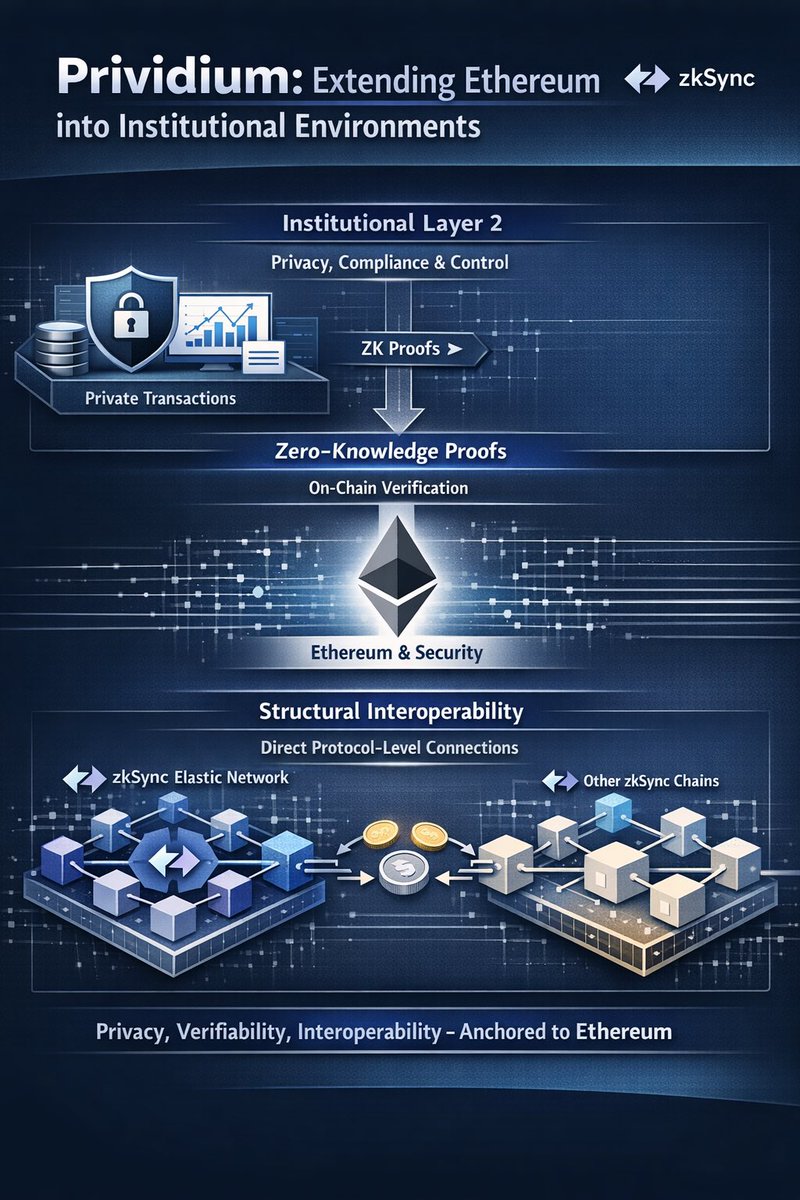
1. Privacy as a specialised capability
Prividium allows institutions to run infrastructure where execution and data remain private.
Transactions, balances, and operational details are processed within controlled environments, while sensitive data never needs to be fully exposed on public infrastructure.
Privacy here isn’t cosmetic it’s built into the architecture.
2. Institutional L2 model with on-chain proofs
Prividium operates as a Validium model built using the ZK Stack.
Execution and state storage occur off-chain, but the system periodically publishes zero-knowledge proofs and state commitments to Ethereum.
That means verification and settlement still rely on Ethereum’s security and finality.
In other words, private execution does not remove public verifiability.
3. Structural interoperability
Because Prividium chains are built inside zkSync’s Elastic Network, they can interact directly with other zkSync chains at the protocol level.
This creates structural interoperability, rather than relying on external bridges or custodial pathways.
Liquidity and assets can move across the network without the fragmentation typical of isolated private systems.
That’s why Prividium shouldn’t be viewed as just another scaling chain.
It’s infrastructure designed to allow institutions to operate privately while still anchoring trust, settlement, and interoperability to Ethereum.
In that sense, it functions less like a competing network and more like an extension of Ethereum into environments where privacy and institutional controls are required.
How I made my first 2k dols in web3 🔥🔥
(I talk about this on the 31st of December)
Watch out the amazing features on Rebble @Userebble
- Wagers
- Fast and safe trading ( Whatsapp bot and App)
- Naira compatibility
- Buyback payouts
Download app now:
https://t.co/0Wm4679XXL
This isn't just an image, it's a state of mind.
How does it feel working for a project without a vision and purpose?
Before you offer to help any project...
- Understand the vision of the project
- Ensure it resonates with you
- Build up your capacity
Without these👆 👉 💔
iNEWS Launches: A New Standard for How Blockchain Talks to the World
What if your favorite social platform and crypto tracker existed in one place? @interchained is building with iNEWS, a Web3 hub where blockchain data meets real-time community engagement.
#iNEWS#Interchained
Regret has no refund 🥲
Too many have watched their dreams fade through one careless P2P deal.
A chat that seemed friendly, a promise that felt real, a moment of trust that cost everything.
The pain isn’t just in the money lost, but in the silence that follows the ‘if only I checked,’ the ‘I wish I waited.’
Don’t wait to learn the hard way.
Rebble @Userebble is here to save you from these situations. With amazing features which includes:
- Instant transactions
- No middle man involved
- Secure and safe processes
- Simple app usage
Download app Now and trade your crypto safely always
https://t.co/2KbNdtb35f