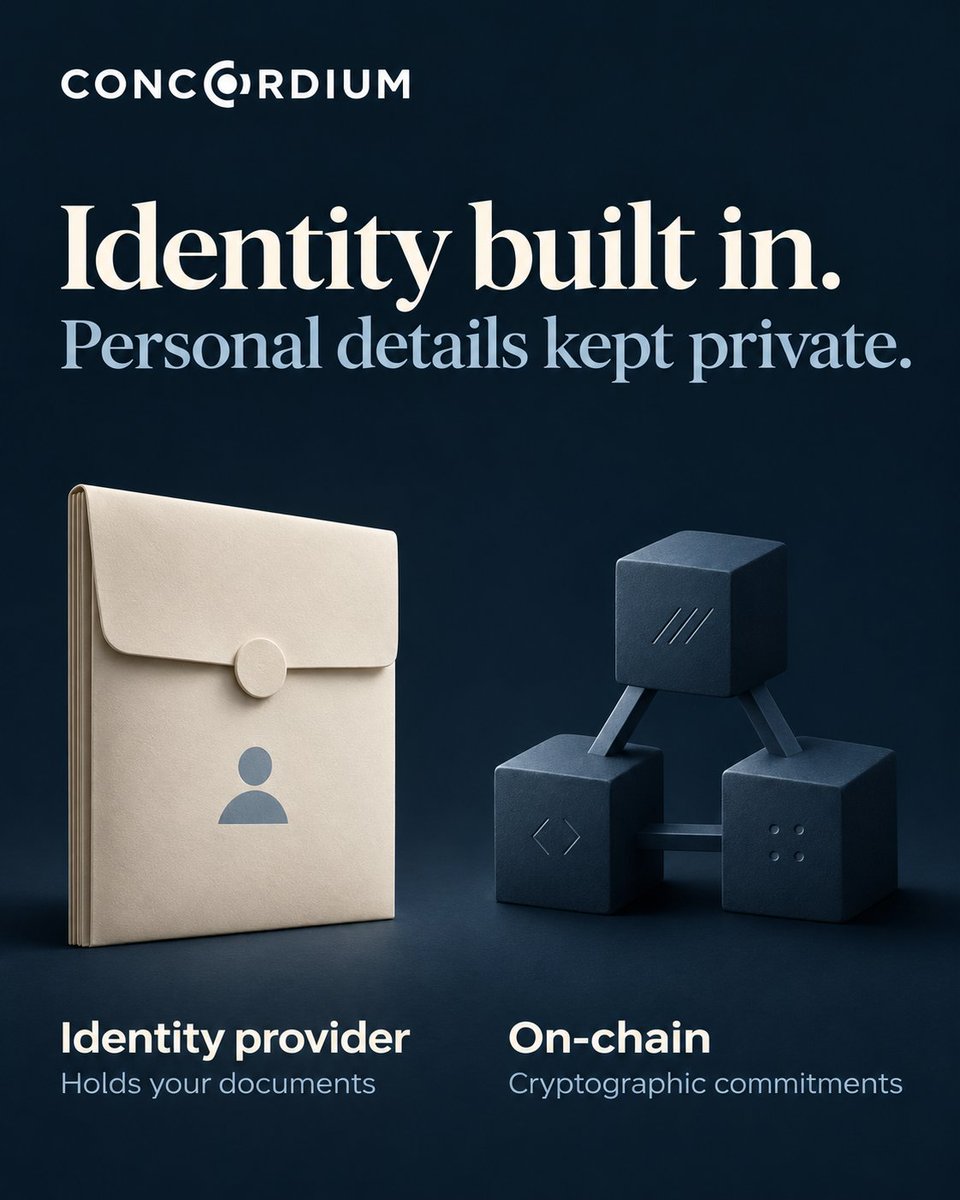
Being verified doesn’t mean everyone gets to see who you are.
Think about an online shop that needs to check whether you’re 18 or older. What does it actually need to know? Whether you meet the age requirement. Your name, exact birthday, and passport number don’t help it make that decision.
With @Concordium, an independent identity provider checks your ID when you set up your credential. Later, you can use a zero-knowledge proof to show the shop that you’re 18+. The shop verifies the proof without seeing your passport or birth date, and those details don’t have to be published on-chain.
That separation matters. If five websites need to check your age, that doesn’t have to mean five more copies of your ID sitting in five different databases.
The next time a site asks for your ID, it’s worth asking what it actually needs to verify.
https://t.co/L658NuPG7b
You’ve picked what you want, added it to your basket, and reached checkout. Then comes the request to upload your ID.
I’d want to know why the shop needs all those details.
If it’s checking whether I’m old enough to buy something, it needs a reliable answer to that question. My passport contains much more, and handing over another copy means trusting another business to keep it safe.
That’s what interests me about @Concordium ’s Verify and Pay. It brings a private age check and a stablecoin payment into one confirmation. The shop gets the payment and proof that you meet the age requirement, without seeing your passport or birthday.
It also saves you from completing the age check on one screen and making the payment on another.
Of course, a shop needs an address to deliver your order. But each detail it asks for should have a clear purpose.
I want to finish a purchase feeling confident about both where my money went and what happened to my personal information.
When people hear “identity built into a blockchain,” it’s easy to picture names, birthdays and passport details sitting on a public ledger.
With @Concordium, the identity check and the public record serve different purposes.
An independent identity provider checks your documents when you create your credential. The chain holds cryptographic commitments to identity attributes. Those commitments keep the underlying values hidden while allowing you to prove specific things about them.
For example, a website can verify that you’re 18 or older through a zero-knowledge proof, without receiving your birthday or passport.
“Protocol-level” means identity verification is part of the network’s account system. It describes how accounts are established, rather than making everyone’s personal details publicly searchable.
There’s also a controlled process for lawful accountability. Linking an account to a person requires the prescribed legal process and cooperation between independent parties.
That distinction matters whenever we discuss identity on public networks. A verified account can support trust while keeping the documents behind it private.
https://t.co/L658NuPG7b
If a website asked me to type in my birthday, I could enter any date I wanted. So what makes an online age check worth trusting?
With @Concordium, an independent identity provider checks your ID and confirms it belongs to you when you set up your credential. That’s the part that connects the birth date in your credential to a real person and a real document.
Later, when a website needs to know if you’re 18 or older, you can use that credential to generate a zero-knowledge proof. The website can check that you meet the age requirement without seeing your birthday or a copy of your ID.
Here’s why the provider matters. If the wrong birthday went into your credential, the math could still check out. A proof can tell the site whether the date meets the cutoff. It can’t tell whether someone entered the correct date in the first place.
I like that the two jobs are separate. The provider checks your ID, and the shop gets just enough information to decide whether you can make the purchase.
https://t.co/L658NuPG7b
How can a website verify you’re 18+ if it never sees your birthday? And what stops someone from using a different birthday to pass the check?
That’s where a cryptographic commitment comes in. Think of it as a tamper-proof seal for your date of birth. The seal keeps the date private and ties you to the same date when you use it later. Cryptographers call those two properties hiding and binding.
In @Concordium’s age-check example, an independent identity provider checks your ID first. Your date of birth is then locked into a commitment. When a site asks if you’re 18 or older, you use a zero-knowledge proof to show that the committed date meets the cutoff. The site can verify the answer without seeing the date.
The provider’s check matters. If the wrong birth date was recorded in the first place, the commitment would lock in that wrong date just as securely. The provider checks the source, the commitment locks in the value, and the proof shows whether it meets the site’s requirement.
https://t.co/L658NuPG7b
@Jovia_creates@sodabubblelabs@AvishaiY Imagine your competitors knowing who you pay and how much. That's a serious concern. Curious to see what Bubble brings to the table.
Think about how many websites you’ve shown your ID to. Now think about how many of them only needed to know one thing about you.
Say an online shop needs to check that you’re 18 or older. With @Concordium, an independent identity provider checks your ID when you set up your credential. You can then use that credential to generate a zero-knowledge proof that you meet the shop’s age requirement. The shop can verify the proof without seeing your birthday or passport.
Here’s where reuse makes a difference. The next site can verify its own age check without asking you to upload the same document again. Each time, you share proof of the specific detail the site needs to confirm.
That means fewer businesses receive copies of your ID in the first place. And if one of those sites has a data breach, there’s no copy of your passport from that age check sitting in its database.
https://t.co/L658NuPG7b
I’d pause if a website asked me to upload my passport just to check if I’m 18 or older. It needs one answer. My passport gives it a whole lot more.
❌ Myth — If a zero-knowledge proof uses your birthday, the website gets to see it.
✅ Fact — With @Concordium, the website can verify you’re old enough without seeing your birthday, your exact age, or your passport.
So who actually sees your ID? An independent identity provider checks it when you set up your credential. Later, when a website needs to check your age, it verifies a proof from that credential. Your passport doesn’t go to the website.
The first check still matters. If the wrong birthday goes into the credential, the proof can’t catch that mistake. It can only check whether the date in the credential meets the age requirement.
Next time a site asks you to upload an ID, ask yourself what it actually needs to know. If it’s just whether you’re old enough, why give it your whole passport?
https://t.co/L658NuPG7b
When an AI agent moves from one network to another, can the new platform verify who’s behind it?
@Concordium is already working on that. Six platforms now read its Agent Registry, including XDC AI, and the Verified by Concordium badge is available across 200+ chains.
What stands out to me is what platforms can do with a shared registry. They can check the same identity information, so an agent can carry its verified identity into a new ecosystem without starting the process over.
As agents begin making payments and interacting with apps across networks, that gives each platform a way to check who it’s dealing with.