Most post-quantum security is still built on one idea:
make the maths harder to break.
QuStream takes a different path.
It does not rely on hiding a mathematical problem forever.
It uses public quantum-random material and private endpoint state to derive fresh keys locally.
The difference is not “stronger encryption.”
It is a different security model.
A Q-Block is not the secret.
It is public quantum-random material.
The secret is the path through it.
QuStream endpoints use shared private state to walk that material and derive fresh keys locally.
Everyone can see the noise.
Only the endpoints know the route.
Bitcoin, Ethereum and Solana all rely on elliptic-curve cryptography.
Different schemes. Same structural issue.
ECDSA, Schnorr and Ed25519 all expose long-term public-key targets that become fragile in a quantum world.
QuStream is not trying to out-sign them.
It acts as a protection layer across chains, removing the permanent harvestable key exposure from the model.
QKD does one thing, and it does it with a real guarantee rooted in physics.
But a continental network is still mostly trusted nodes, and at the endpoints your data returns to classical reality.
So the question was never “does QKD work?”
It was:
how much of the confidentiality lifecycle does it actually cover, and what does the rest of the system still depend on?
That is the gap QuStream is built for.
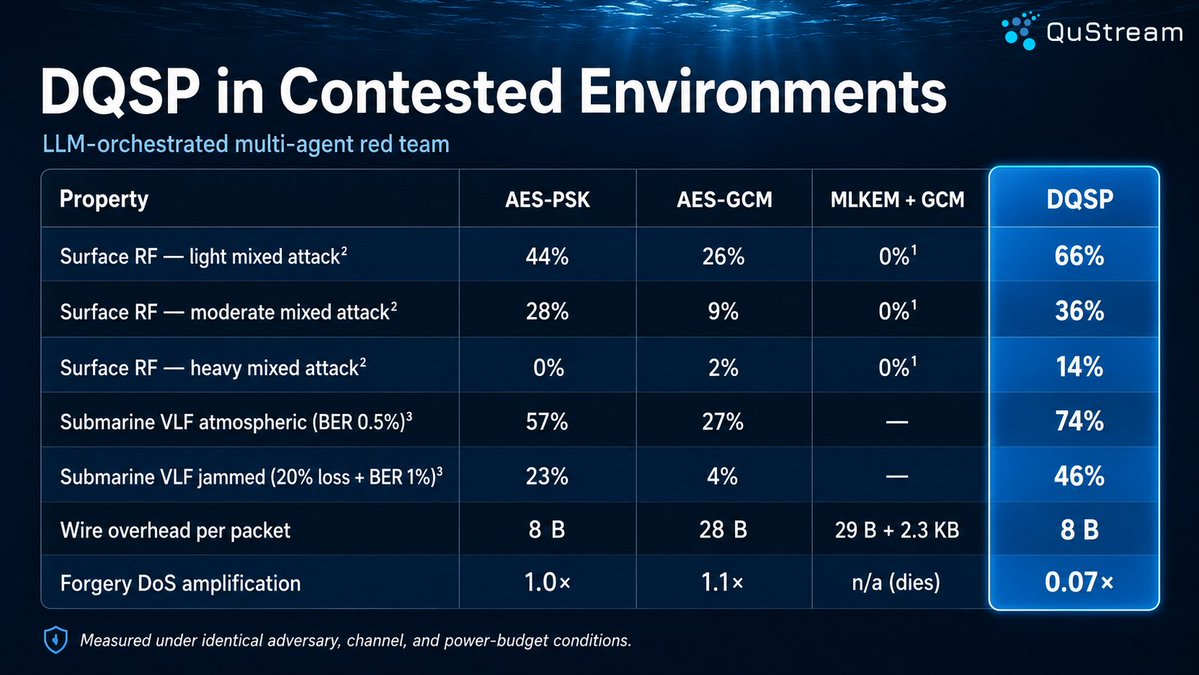
Most encryption was built for clean networks.
Contested environments are not.
Jamming, packet loss, forgery, adaptive interference, AI-assisted electronic warfare change the problem.
DQSP is QuStream’s protocol for that reality:
no handshake to break, per-message keys, tiny overhead, and cheap rejection of forged traffic.
Security has to survive the environment it runs in.
Next week, Adrian Neal presents QuStream/DQSP at the NMIOTC NATO conference in Greece.
The focus: secure communications for maritime critical infrastructure in contested environments.
Not just encryption that stays secret.
Communications that stay usable under attack.
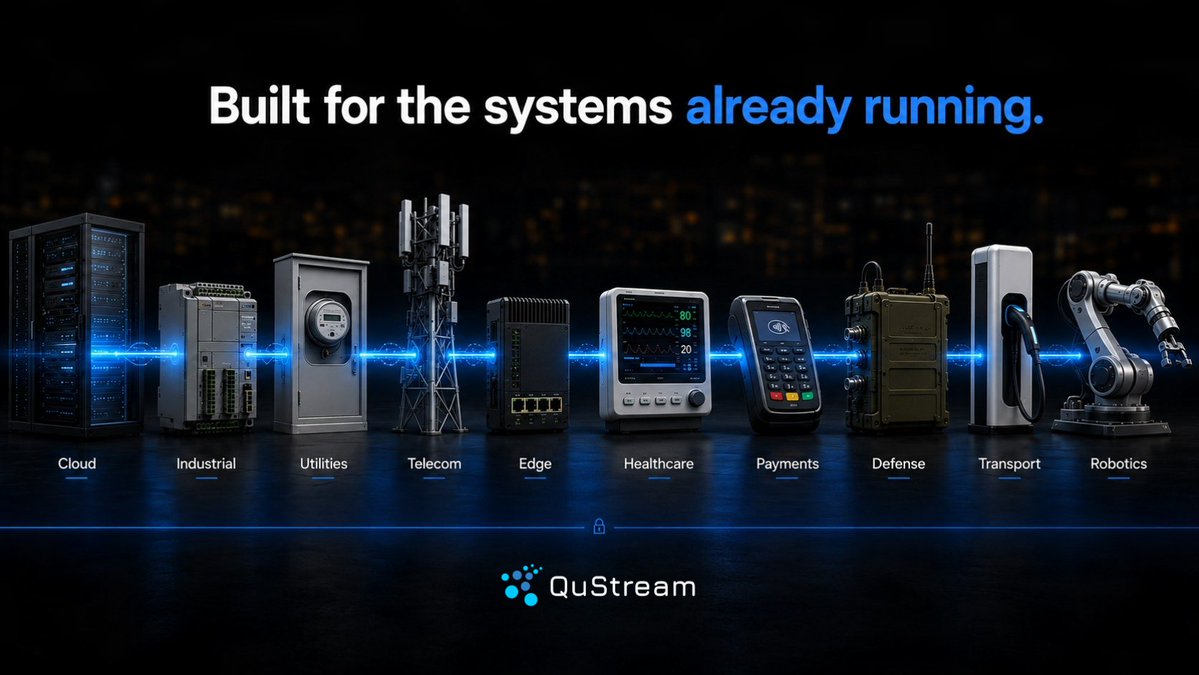
Quantum-safe security will not win because it sounds advanced.
It will win when it can be deployed across real infrastructure without forcing everything around it to change.
That is the line QuStream is built around.
Security migration does not start after the breach.
It starts before the old model fails.
Quantum risk is data captured now, systems that take years to upgrade, and deadlines already forming.
QuStream is built for that migration window.
Most quantum-safe projects are trying to survive the future
QuStream is built for systems that can’t afford to wait for it:
defense
critical infrastructure
finance
communications
machine networks
blockchains
The problem isn’t theoretical.
The migration window is already open.
A 10% improvement would not matter.
The reason people pause at QuStream is because the gap is much larger than expected.
That is not a marketing trick.
It is what happens when you stop optimizing the old model and replace the constraint underneath it.
The QuStream v2 paper is now live.
This is the latest technical foundation behind QuStream’s ITS model:
public quantum-noise epochs
private endpoint state
automatic rekeying
OTP-grade non-reuse
The website has also been refreshed for a clearer overview: https://t.co/S78Q3EyHoB
The one-time pad was never held back by weak security.
It was held back by distribution.
Bulk key files don’t scale.
QuStream attacks that bottleneck:
- public noise epochs
- private endpoint state
- local key derivation
OTP-grade rekeying without OTP-scale logistics.
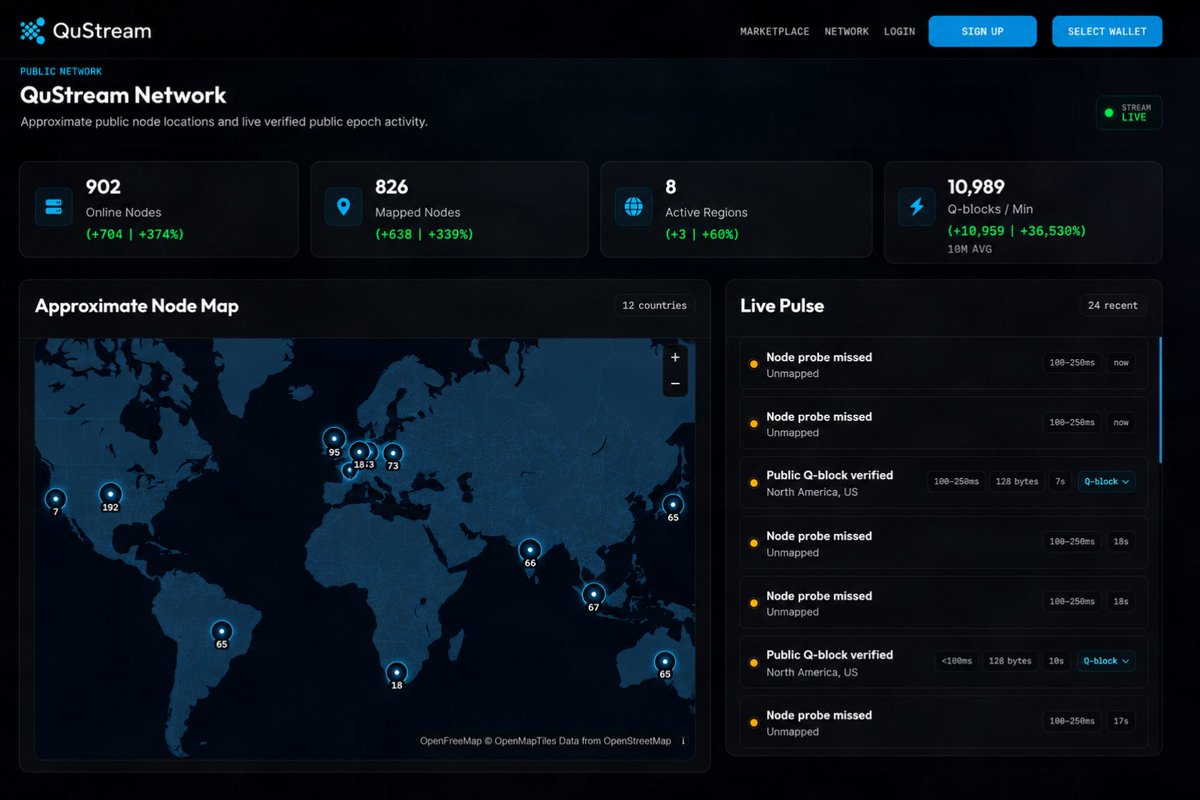
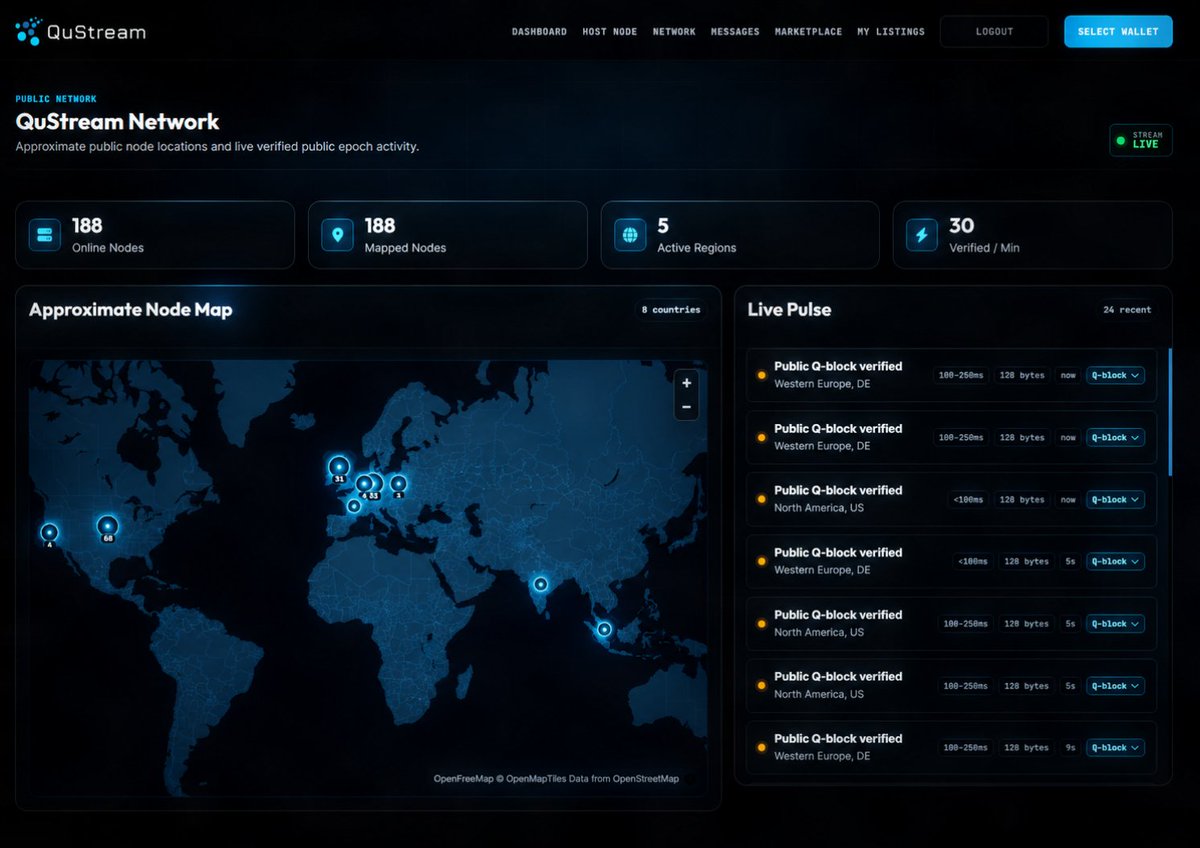
What do QuStream nodes actually do?
They generate, verify, and serve Q-Blocks.
A Q-Block acts as a safe carrier used to derive encryption material, but contains nothing useful to an attacker on its own.
Authorized end users can extract what they need from a verified Q-Block.
The source matters: Q-Blocks must come from QuStream’s trusted node network.
Entropy as a service, delivered through verified infrastructure.
@donaldtusk@NawrockiKn Jak nie było internetow to tylko twoja rodzina wiedziała żeś debil. Najlepsze jest to że są jeszcze debile którzy ci wierzą niemiecki parobku
Most people only notice infrastructure once it’s everywhere.
The early phase looks different:
small deployments
live testing
nodes coming online
systems beginning to connect
That’s the phase QuStream is entering now.