My first K-theory paper, joint with Maru Sarazola, on a chain complex model for the K-theory of finite sets using a whole lot of double categories (thread) https://t.co/AgWNrSpMPx
@bgavran3 @tailcalled@u_map_prop@david_i_spivak Mostly though it's to access all the terminology available in a monoidal category without having to change every "oid" to an "ad" or redefine all the same concepts for comonads. Afaik things like bicomodules and coclosures haven't been treated specifically in functor categories
@bgavran3 @tailcalled@u_map_prop@david_i_spivak Yeah we've been leaning towards treating polynomials as combinatorial objects rather than functors, since for many of the applications the functors perspective isn't really needed. But we still use the terms mostly interchangeably in person and sometimes comonad makes more sense
@dzackgarza Assuming you mean just the map not it being a weak equivalence, I just call it a functor, as any functor is colax in this way with respect to limits. I think this is why lax monoidal functors tend to be more interesting, since even for cartesian products they're not guaranteed
@fairbanksjp@u_map_prop I am proud to report that this is the second mathematical Toblerone reference I am aware of, the first referring to a composable diagram in Cat-enriched double categories with a long horizontal sequence of tall stacks of (ravioli/chocolate) shaped cells in the Cat direction
@bgavran3 But maybe that's just a long winded way of saying that "Poly" can unambiguously refer to polynomials while "Cont" or "Con" is a lot less clear, and I like being able to use the first few letters of the thing as the name of the category.
@bgavran3 In this case, I see why container would be a reasonable name (I do love drawing them as boxes) but the form of polynomials is nice to work with formally and calling the associated category Poly seems uncontroversial from there especially when the term container isn't being used.
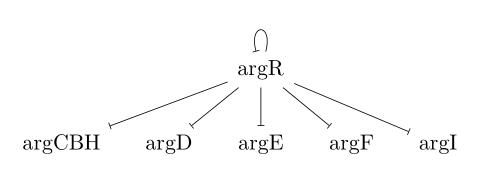
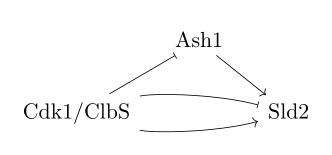
A compositional account of motifs, mechanisms, and dynamics in biochemical regulatory networks
https://t.co/NXWCnAv8A8
Regulatory networks depict promoting or inhibiting interactions between molecules in a...
🧵 👇
Which word should describe how lax something is, like a functor or type of higher category? Laxness, like pseudoness? Maybe laxity? Is pseudosity appropriate? Other suggestions welcome
@8ryceClarke I like this a lot, it feels much more faithful to the situation than my hack. I'd probably want to use a double subcategory of Q(C) so I can be picky about which squares and which directions the arrows go, but that's an ok parameter. Why lax double functors over strict, I wonder?
Does anyone know of a formalism for functors F: C -> Cat which are lax in a sort of specialized way? Like a lax functor would have 2-cells F(f)F(g) -> F(fg), but maybe I want 2-cells F(f)F(g) -> F(h)F(k) for certain commuting squares fg=hk in C.