At the Democracy Defense Project we continue to push for early counting of votes in Wisconsin. It works in far larger states like Florida and Texas. Wisconsin voters are already on board. Wake up sleepy Madison.
Let's kill the quirk in Wisconsin Election law that stops us from counting ballots until after the polls close. The images that linger are trucks pulling up to Milwaukee counting centers late on election night feeding into wild claims of voter fraud.
Look Florida and Texas--far bigger states--make early counting work. So should we. From WTMJ Milwaukee
https://t.co/nyOzJQ29az
At the Defend Democracy Project we were pleased to see 76% of WI voters support the pre-processing of ballots to speed up vote counting. It’s time for leaders in Madison to advance these types of reforms to improve our elections and rebuild trust in our democratic system.
https://t.co/2Hx1SAtS9U
So what did my political orphans do in the Presidential election?
Check this out. Self-identified independents accounted for a larger share of voters than Democrats and were tied with Republicans, Edison Research exit polling data showed. The independent turnout share was up 8 percentage points from 2020, when it was at 26%.
Here at the lost political middle podcast we are not surprised. We told you so!
I joined forces this week with two other political podcast hosts to give our own twisted post-mortem in our final episode of '24.
Joining me is Justin Robert Justin Young, a journalist, comedian and host of "Politics, Politics, Politics," and Andrew Heaton a comedian, author and political satirist who hosts "The Political Orphanage."
As always podcast episodes and my blog at https://t.co/F5ps5VzPKf
If you've ever run for office, you wake up after the election and think of all the folks who volunteered for your campaign. All across America that's happening today for candidates who won and those that loss.
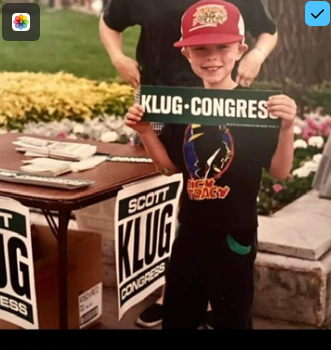
I remember my volunteers spray painting stencils on sheets of plywood in an auto body shop to later post them in farm fields on a cold Wisconsin fall morning. The never ending stream of strangers who stuffed envelopes filled with flyers boosting the campaign. The new friends who opened up their homes to throw fundraisers some packed with people wall to wall--and some with a few lonely souls who thought a long shot Republican could knock off a 32-year incumbent in Democratic Madison. Many of those same people showed up again in the next 3 election cycles before I bowed out keeping my term limit pledge. I never felt that I adequately thanked all of them. And that's a photo of my oldest son dragged in to volunteering. The one who turned 40 on election day.
Here in battleground Wisconsin many of us couldn’t sleep last night. As a political orphan I was tossing and turning. Trump or Kamala? Kamala or Trump? Completely bewildered, the thousands of campaign ads warring in my mind. How could I ever make up my mind without a Washington Post endorsement?
If Jeff Bezos hadn’t pulled the plug would any of us have a single doubt about what the paper would do? As I learned at Northwestern’s journalism school, dog bites man is not a story. Man bites dog! Now there is a headline.
Since the Post started doing endorsements for President it has never picked a Republican. Never. Not once since in its history. Its longtime publisher was a Kennedy devotee.
Look around. The Wall Street Journal hasn’t backed a presidential candidate since Herbert Hoover. The largest chains — Gannett, McClatchy and Alden Global’s MediaNews Group and Tribune Publishing all have stopped endorsing. USA Today, which endorsed a presidential candidate for the first time in its 38 years in 2020, has reverted to neutrality.
The Minneapolis Star Tribune also announced it was ending the practice last month writing “We are confident in the ability of informed citizens to decide whom they wish to vote for based on what they see, hear and research.”
Amen. Note to Washington Post reporters, get over yourselves.
To read more https://t.co/F5ps5VAnzN
Frustrated by the media coverage of the election? Boy, am I with you. Look, I spent a third of my career working as a journalist. And then became a Republican Congressman. Add in an MBA and that makes me unicorn of sorts.
What is frustrating you with media coverage today is not driven by some weird cabal of the right or left. It is driven by economics. And by a demographic and geographic bubble.
Flip the channel between Fox and MSNBC and you’ll discover parallel universes. Places I choose not to visit. Faced with mounting economic pressures, even the mainstream media has been forced to tilt. Could anything be smugger than the Washington Post cutline “Democracy dies in Darkness.”
Since Craigslist destroyed classified advertising which accounted for 45% of newspaper revenue, papers fold weekly. National news magazines have disappeared. The print industry is desperate for subscribers. Meanwhile consumers are cutting the cord, eroding revenues for CNN and every other platform.
So where are we today? Only 31% of Americans trust the media. 36% have no trust. 33% don’t have much all. That’s from a Gallup poll this month. When I graduated from Northwestern in the post-Watergate era it was at 71 percent.
And then there are the nagging questions of fairness when only 7% of journalists identify as Republicans. Longtime Politco media columnist Jack Shaffer took a deep dive after the 2016 election. If you want to know why the Washington and New York press corps missed Trump’s election, consider these facts.
“Nearly 90 percent of all internet publishing employees work in a county where Clinton won, and 75 percent of them work in a county that she won by more than 30 percentage points. When you add in the shrinking number of newspaper jobs, 72 percent of all internet publishing or newspaper employees work in a county that Clinton won. “
As Jack concluded ‘“so when your conservative friends use “media” as a synonym for “coastal” and “liberal,” they’re not far off the mark.”
Since I spent 8 years as a Member of Congress and 13 years as a journalist, listeners and readers ask me all the time where can I find solid political coverage that is not slanted?
I’d suggest two things. Look at the website “All Sides” which rate major news outlets for bias. The site was founded by three Silicon Valley veterans who were crestfallen that rather than bringing people together, the internet was driving us apart. The website plays it straight.
If you are looking for balanced, old fashioned, both sides of an issue reporting, nobody does a better job than “Tangle News” founded by veteran political journalist and podcaster Issac Saul. In episode 3 of our Lost in the Middle Election Countdown specials we get his insights on the state of the election and our mutual concerns about America’s mainstream press. You can find the full episode and our other reporting on the Lost Political Middle: America’s Political Orphans.
Hey Political orphans, proud independents, confused swing voters join me tomorrow for an appearance on 5 things I learned about America. Part Ted Talk/Master Class. And better yet, it's free. 7:00 CT. We'll talk about the 44% of Americans who want collaborations in politics, not Ted Cruz or AOC.
And why independents are now the largest bloc of voters in Nevada, Arizona and New Hampshire. and tick, tick, the election is oh so close.
https://t.co/IN3IzyHvA2
# five things I learned about America hashtag#political independents hashtag#swing voters hashtag#swing states hashtag#undecided votes
Tick, tock. Not much time left but 13% of U.S. voters are still undecided. That makes partisans and political junkies crazy. We ccontinue our Lost in the Middle election countdown specials with comedian and pundit Justin Young who hosts the popular podcast Politics, Politics, Politics. You can find our entire episode at https://t.co/F5ps5VAnzN @JustinRYoung
Hey fellow orphans somedays the upcoming election makes you want to cry. But we think it’s even better to laugh.
In the first of our four special election countdown episodes at Lost in the Middle we talk to comedian and political podcast host Andrew Heaton who calls in from a phone both at the Royal Scotland Club in Edinburgh. We like to think he was wearing a kilt, but we really don’t know. Our buddy is the host of the popular podcast “The Political Orphanage” You can find our discussion at https://t.co/F5ps5VzPKf
#Andrew Heaton #Political Orphange #election update #independent voters
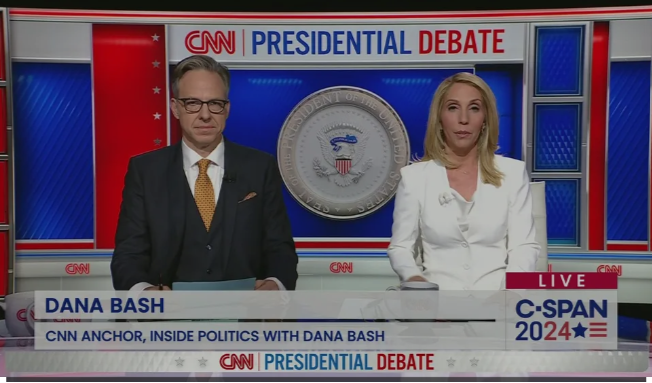
We are 48 hours out from the first debate. Pretend you’re sitting in an anchor chair ready to pounce. If you ever worked in tv you know the smart ones in the studio are the producers whispering the questions in the anchor’s earpiece, said the guy who once had anchorman hair and carried pancake make up in his suit pocket.
If you could ask the first question on September 10th, what would it be? Write your suggestions in the comment period below.
One simple ground rule. I want a question for Trump and one for Harris. They can both be the same. Zero points for being snarky.
I really want to know what’s on your mind. I have been thinking about this exercise in my own head for the last several days.
You should treat this exercise seriously, but I know some of you will still channel your inner middle schooler, so I won’t act surprised.
I will double back Tuesday and post the best. And I will post my questions too.
But to put you in the mood, first here is the story of my night in Boston listening to Al Gore’s sighs.
Not long after I left Congress, Brady Williamson, a Madison lawyer, and Democratic strategist called me and pitched me on the idea of landing a 2000 Presidential debate in Wisconsin. We thought it would be a great way to show off our city, and as political junkies we thought it would be a blast.
There were a few steps in the dance.
First, we had to raise $500,000 to stage it. We didn’t need it all up front but we needed several hundred thousand dollars to show the community’s commitment. Hat in hand we were able to get a local foundation and several large corporations to pony up. We checked that box much easier than we expected.
Keep in mind this is at its foundation, the Presidential debate is a television production, so the next step was scouting potential sites with the team from the now defunct Presidential Debate Commission. We were all hoping they would zero in the recently built Frank Lloyd Wright inspired convention center sitting on the shores of Lake Monona. Too many curves and weird angles, we were told. Clearly, they had never looked at any of Wright’s other designs since all of his buildings are unique or bizarre depending on your perspective.
Next, we visited a vintage theater downtown with a second-floor balcony that would provide a great vantage point for the cameras, but by the time they built out the set for the hosts on the first floor there would be little room for an audience.
In the end they picked the Dane County convention center which was essentially a big open box with no charm. Bingo. A blank slate to create the staging.
Like players waiting anxiously for the NFL draft, we waited for the call. Would we make the cut? Was there a chance we could have the first debate?
When we jumped on the call a few weeks later, wide eyed optimism turned to despair.
Oh, don’t draw the wrong conclusion. We were winners. Sort of. They loved Madison and appreciated the outpouring of support for the event in Wisconsin. Ugh! They wanted us to host the Vice-Presidential debate between Dick Cheney and Joe Lieberman. Then they told us the date. We checked out calendars. Whew. We were off the hook. They had picked the week of the World Dairy Expo. (insert Wisconsin joke here) Seriously the Expo was an event that filled up every hotel room in south central Wisconsin. We had to take a pass.
Soon Brady Williamson called with a consolation prize. We had tickets for the first Presidential Debate in Boston. Two things stood out. Christie Brinkley with her eggplant-colored leather pants was in the row in front of me. Not a good look
And for the next 90 minutes Al Gore famously sighed into his mike every time George W. Bush answered a question. This is not my Republican spin. It made Reuter’s list of the 5 worst moments in Presidential debates. “In his first debate with Republican George W. Bush, Democratic Vice President Al Gore drew negative reviews for sighing loudly while Bush spoke.” It was loud on tv. It was worse in person.
So back to your homework assignment. Your goal is to make Donald Trump or Kamala Harris sigh loudly.
Ask away. Civility matters. Ask a serious question. Don’t be a jerk.
The voters of tiny Dixville North New Hampshire are often cited as a bellwether of the Presidential election. Reporters stand outside the hotel where the voting takes place with a turnout usually in the teens. Reminds me of the same way journalists track the spring awakening of a Pennsylvania groundhog. Neither it turns out, are very reliable.
America's 50 states have 3242 counties. But in our latest episode of “Lost in the Middle “we will explain why you only need to focus on 7 of them on election night. Hard to believe but that’s where we are today. Just 7 in a shrinking number of swing states.
We profile the counties to watch election night. Gwinnett County, Georgia: Dane County, Wisconsin; Jackson County, Michigan; Maricopa, Arizona and Washoe County, Nevada. And finally, you don’t have to be Steve Kornacki to remember the 2000 trainwreck that was, and perhaps will be again, Miami-Dade County, Florida.
But while there is consensus on the places to track, Political Scientist Larry Sabato says be skeptical. Places that have been indicators for generations can suddenly go poof.
Download episodes and subscribe at https://t.co/F5ps5VzPKf
Great discussion about the lost political middle with Mike Baranowski and the team at the Politics guys podcast. With 9 weeks left in the election we arm wrestle over the voting decisions of independent and swing voters.
We know you've got a long Labor Day drive ahead of you. Can you really listen to sports talk or NPR for 6 hours? https://t.co/32qegBhkzt
So sweep up the confetti and streamers in Chicago. The conventions are done. The election is 10 weeks away.
The bases are geeked, but nobody is paying attention to the lost middle.
Millions of Americans are still political orphans.
Listen to the only podcast in America focused on the swing voters who will decide this election. Download the podcast +Subscribe to the blog.
"Great storytelling. A Hell of a lot of fun! “Former Congressman Jack Quinn (R-Buffalo)
“My hope is that Americans far and wide learn that the only hope forward in our democracy is not through the extremes but right up the middle.” Former Congresswoman Chris Bustos (D-Illinois)”
https://t.co/F5ps5VzPKf
In 2016 I was asked by the U.S. State Department to spend a week in the Nordic countries: Sweden, Finland and Iceland, with Larry Larocco, a former Democratic Congressman from Boise and close friend, to explain the dynamics in the upcoming Trump-Clinton election.
Our presentation to college classes, editorial boards and business groups like the Swedish-American Chamber of Commerce was Political Science 101. First, most Europeans can’t wrap their arms around the fact that the American system is really 50 separate state elections all of which then funnel into the puzzling mathematics of the electoral college. Along the way we were also peppered with questions about Trump’s economic policies, Clinton’s approach to the Middle East and just who in the hell was going to win.
I’ve saved my PowerPoint from that trip because over the years I have often reused some of the slides. I just dug through it last month to do similar presentations from the RNC for the State Department, to remote audiences gathered at the U.S. Embassies in Lithuania, Croatia and Tunisia.
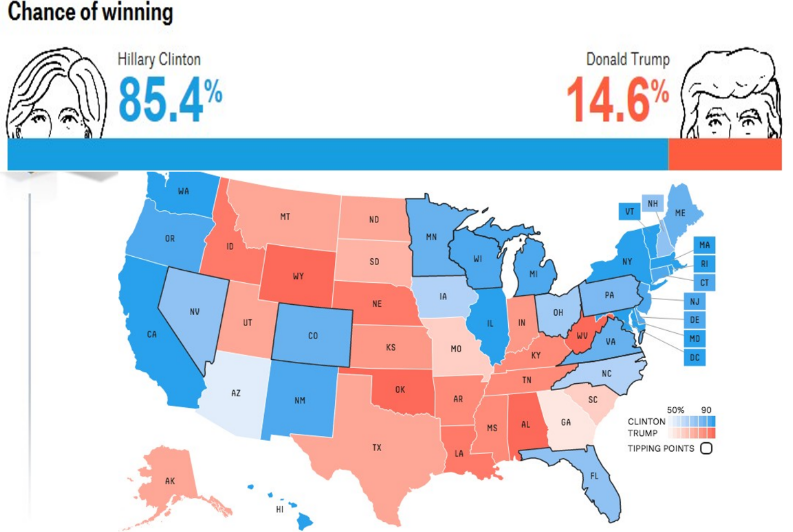
Attached with this column is the last slide in that 2016 deck. It is a late October projection on who would win the 2016 election. Look at the odds. Hillary in a landslide. I grabbed it from one of the nationally respected polling sites. Note they had her winning the blue wall: Wisconsin, Michigan and Pennslyvania. She lost all three.
On Friday, the well-respected Cook Political Report now has Harris ahead or tied with Trump in six of seven battleground states. On the eve of the convention, she has pulled ahead in the key swing states of Pennsylvania, Michigan, Wisconsin, North Carolina and Arizona, and tied with Trump in Georgia. Nevada is the only battleground state that Trump still leads, the poll found.
As subscribers to my podcast and fans of my blog on the “Lost Political Middle” (both found at https://t.co/rag0Exhkml) I am not thrilled with either candidate. As a former Republican Congressman, I cannot abide Trump’s personal conduct and outrageous behavior and Harris’ proposals for rent control and policing grocery store pricing sounds like Romanian economic policy from the 1970’s.
I understand why Harris’ fans are over the moon about her candidacy. In just a few weeks’ time she has erased Trump’s polling lead, and her crowds are a sign of an enormous wave of enthusiasm. The contrast in energy between the two camps is palpable. But like an early lead in an NFL play-off game (I am looking at you my Green Bay Packers) The last half of the 4th quarter often wins games as the 49ers proved. And in politics, so do the last few weeks.
Remember in 2016 Sam Wang, a neuroscience professor at Princeton University and co-founder of the blog Princeton Election Consortium, which analyzes election polling, called the race for Clinton. He was so confident that he made a bet to eat an insect if Trump won more than 240 electoral votes. Nothing like a grasshopper meal live on CNN.
Pollsters will claim they have fixed their models since the ‘16 races, but I not so sure. Traditional phone calls to land lines haven’t worked for decades. Now they must use a combination of online polls, cell calls, text messages and landlines and then bake in some assumptions to come up with an updated projection.
But whatever the secret sauce experts concocted in some mad scientist’s polling lab, the projections have remained flawed. Early election night in 2020 Democrats had the champagne chilled early because polls showed Biden likely winning North Carolina and Florida which meant game over. Instead, the nation stayed up late at night waiting for the usual slate of true battleground states to trickle in. Errors in seven key Senate races were even more egregious which caused political campaigns in both parties to misallocate resources to states they were doomed to lose, or not add enough firepower in states they could have won.
As Pew Research concluded “Most preelection polls in 2020 overstated Joe Biden’s lead over Donald Trump in the national vote for president, and in some states incorrectly indicated that Biden would likely win or that the race would be close when it was not”.
I keep looking at this week’s polls of Michigan, Wisconsin and Pennsylvania and still thinking about the train wreck in election polling in the UK. Pollsters are still trying to cope with what’s called the “Shy Tory” factor, the conservative voters who won’t respond to polls or lie about who they will vote for as a middle finger to the establishment. The elections in 1992 first got it wrong where the projections of a one-point Labor Party victory were in reality an eight-point Conservative Party win. Same flaws in 2015 and even this summer which wildly underestimated the votes for the Liberal Democrats and Reform parties. Looking back in recent years they were also wrong about Brexit, the vote to leave the EU and half of the pollsters were dead wrong on the Scottish vote to break away from the UK.
The race will tighten in October. It always does. The Trump folks rolled out of Milwaukee with confidence that was sky high. The Harris camp will do the same later this week in Chicago.
Today it’s all seashells and balloons for the Harris camp. Her exuberant supporters on one side of the political divide should take a cleansing breath as should the jittery Republicans on the other.
Ten weeks is a lifetime in politics. I keep that PPT slide to remind myself that polling is ephemeral. Never as good as it looks for the leaders, never as bad as it looks for today’s losers.
Hey lost in the middle podcast fans---does the current state of America make you want to to cry. Here's option B. How about making you laugh! Great discussion this week on the Live from America Podcast --weekly show that combines political commentary with humor. Hosted by the comedy cellar owner Noam Dworman and producer Hatem Gabr with my favorite guest. Yours truly
https://t.co/Y4bKNelBLN
Most Americans are understandably focused on the US coverage of the RNC. What you probably don't realize is that more than 2,000 foreign journalists were in Milwaukee too. I enjoyed working with U.S. State Department to brief reporters from New Zealand, Japan, Norway, Australia and Egypt on the mechanics of picking a nominee. And also having an opportunity to do a series of remote presentations to audiences at the U.S. embassies in Tunisia, Croatia and Lithuania. Don't undersell the value of soft diplomacy. We are still deeply admired around the world.
Visit the Kennedy museum in Dallas Texas and you’ll find an entire wing focused on conspiracy theories. Sixty years later new theories still get published.
Is anyone surprised that within minutes of the Trump shooting the extremes pointed fingers at each other? Trump haters said it was a false flag operation to ramp up sympathy for the former President.
Shadow of Ezra, an anonymous conspiracy theorist account on X, wrote that “The Deep State tried to assassinate Donald Trump live on television.” a TikTok user who posts under the handle @theoldermillenial.1 told his 1.2 million followers, “I guess because the court cases weren’t going so well, they decided to try a different avenue. Guys, don’t forget, this is what the left is capable of.”
Those of us disgusted with current American politics, those of us who are political orphans need to remind friends and family that the shooting in Pennsylvania is the predictable outcome of the bile in today’s political incivility. It has to stop.