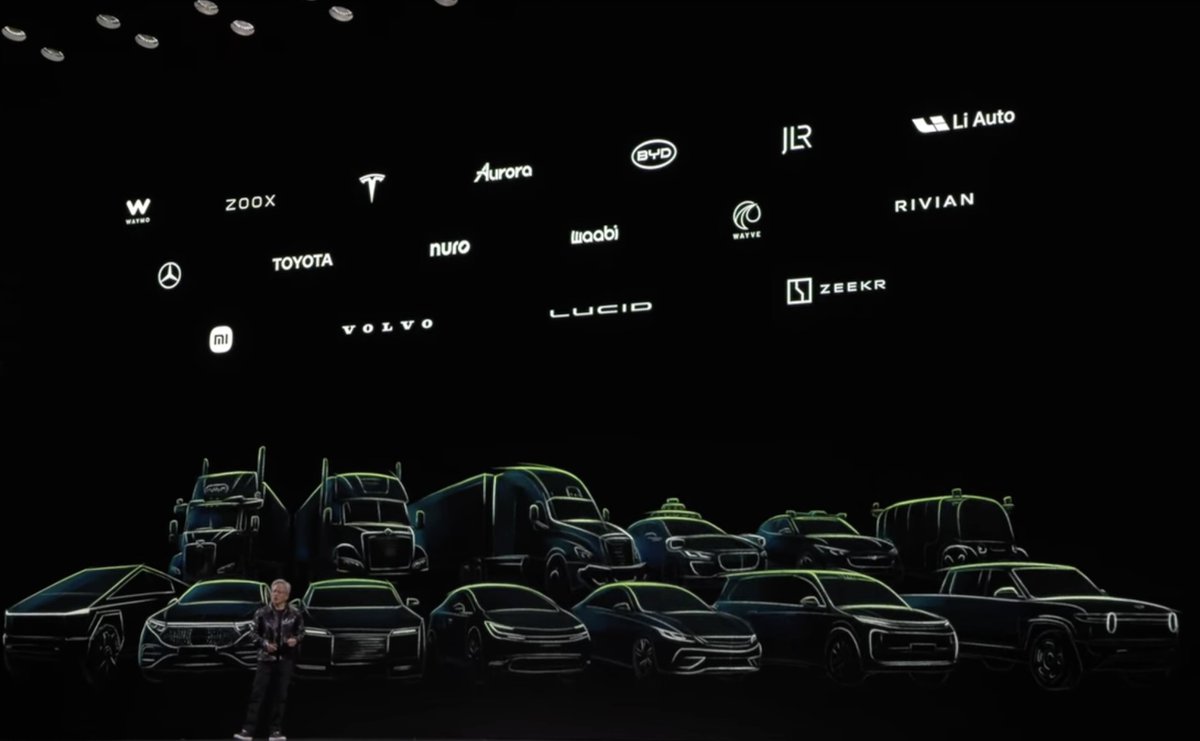
Physical AI's moment is here, and self-driving is the first manifestation of Physical AI that will scale.
We have built a Physical AI Platform that enables true scale and generalizes across form factors, geographies, and environments. It is proven in autonomous trucking and we are now expanding to robotaxis.
Our Platform combines a verifiable end-to-end AI model capable of reasoning with the world's most advanced neural simulator—powering the @Waabi_ai Driver. This approach enables, for the first time in the industry, a shared brain across both applications, meaning the same AI model will drive both trucks and robotaxis. This is important as any progress will directly benefit both verticals.
Furthermore, our capabilities already cover highways and surface streets, which has enabled our Direct to Customer model in trucking, providing a big product advantage with the rest of the industry. This also means that we have already all the core capabilities needed for robotaxis, allowing us to enter very fast and seamlessly this new market.
To achieve this, we have raised $1B USD of new capital, the largest fundraise in Canadian history. This capital will be used to accelerate commercial progress in autonomous trucks and to fuel our expansion into robotaxis. This funding includes an oversubscribed $750M Series C led by @khoslaventures Ventures and @G2VPLLC , as well as additional capital from @Uber tied to robotaxi development.
We are thrilled to work with Uber to deploy robotaxis powered by the Waabi Driver on the Uber platform, the largest ridesharing network globally. Through this strategic partnership, we will deploy 25,000 or more Waabi Driver-powered robotaxis, substantially accelerating the adoption of robotaxis at scale.
I am incredibly grateful to our team for making this vision a reality, to our investors, partners and customers for believing in what we are building together.
Read more: https://t.co/Hgirs9YMuS
.@Waabi_ai CEO @RaquelUrtasun discusses its $250M deal with Uber to deploy 25,000 robotaxis.
"We will have a single AI system, a single physical AI platform, single brain that will actually drive both robotaxis as well as trucks."
Today, we are thrilled to announce that we have raised $1B USD of new capital to accelerate commercial progress in autonomous trucks and expand to robotaxis!
For the first time in the industry, this enables one shared brain to power both applications—trucks and robotaxis. This means any progress in one vertical directly improves the other.
This funding includes an oversubscribed $750M Series C round led by @khoslaventures and @G2VPLLC, as well as additional capital from @Uber tied to robotaxi development. We are excited to work with Uber to deploy 25,000 or more Waabi Driver-powered robotaxis on the Uber platform, substantially accelerating the adoption of robotaxis at scale.
Thank you to our incredible team, investors, partners, and customers for helping us achieve this milestone. Here's to pioneering the future of Physical AI, together.
Testing autonomous trucks against aggressive lane changes, sudden obstacles, and unavoidable accidents—all without real-world consequences. That's Mixed Reality Testing: fusing real trucks on real roads with unlimited safety-critical scenarios generated in real-time by Waabi World.
Introducing Mixed Reality Testing: The comprehensive safety solution the AV industry needs.
We've developed a totally new paradigm that combines real trucks with virtual scenarios generated in real-time by Onboard Waabi World. Like augmented reality goggles that blend physical and virtual worlds, MRT enables the Waabi Driver to drive autonomously down a real test track while simultaneously sensing and reacting to intelligent, simulated actors that create complex safety critical situations.
MRT eliminates the traditional constraints of closed-course testing. We can conduct exponentially more tests than ever before and in a continuous fashion, with extraordinary levels of diversity and realism. Traffic jams materialize instantly, pedestrians jaywalk unpredictably, aggressive drivers weave through traffic, children dart into the street - all tested safely without real-world consequences.
This breakthrough builds a foundation for AVs we can truly trust and accelerates the path to safer roads for everyone.
See MRT in action: https://t.co/4AQaziYAPq
Today we're unveiling something truly extraordinary—one of the coolest and most transformative technologies: Mixed Reality Testing (MRT). Since launching @Waabi_ai World four years ago, we've been building towards this pivotal moment - bringing our virtual testing capabilities into the physical world to fundamentally transform what's possible in autonomous vehicle development.
For over 100 years, closed-course testing has been the staple of vehicle safety testing. But creating scenarios on a physical test track resembles elaborate movie-stunts—it’s difficult to reproduce tests consistently, those tests do not capture the diversity of the real-world, and the range of safety-critical scenarios we can test is very limited because of the risk of damaging equipment or, worse, endangering lives.
MRT changes everything! In the same way that augmented reality goggles blend the physical world with a virtual world, MRT enables the Waabi Driver to drive autonomously down a physical test track while simultaneously experiencing numerous intelligent, simulated actors that coexist in this hybrid reality and react to each other and to the physical world in naturalistic ways. All this is possible by leveraging Onboard Waabi World, a version of Waabi's neural simulator that runs in a few milliseconds on the onboard compute. As Onboard Waabi World generates new scenarios, the real physical sensor readings are modified instantaneously so the Waabi Driver can react to the blend of real and virtual elements while driving in the physical world. This fusion creates a first-of-its-kind reality that unlocks unlimited testing possibilities previously impossible to achieve safely or practically.
Traffic jams can materialize instantly, motorcycles can weave between lanes, crowds of pedestrians can jaywalk unpredictably, children can dart into the street from behind parked cars, animals can wander across the road, debris can appear in lanes creating hazardous obstacles. The possibilities are endless.
This breakthrough eliminates all traditional constraints of closed-course testing. We can do exponentially more tests than ever before and in a continuous fashion, with extraordinary levels of diversity and realism. Most importantly, we can push the boundaries of safety testing without real-world consequences.
MRT represents the culmination of years of work toward safe, scalable autonomous deployment. It's been central to our testing approach for over two years and fundamental to achieving feature-complete autonomous driving capabilities earlier this year.
But this is just the beginning. MRT’s impact extends beyond self-driving trucks – we’re laying the foundation for a future where any physical AI system can be tested and validated safely - from robotaxis to humanoid robots, manufacturing automation to healthcare robotics.
Learn about Mixed Reality Testing: https://t.co/OLMlq7TTyZ
Looking ahead to 2025, physical AI will change everything. After collaborating with Jensen for a decade, I’ve seen first hand how his leadership philosophy is exactly what is driving AI forward. We both believe that innovating to empower others rather than create barriers accelerates progress.
@Waabi_ai and @nvidia established a long-term strategic partnership in March 2024 to deploy generative AI powered autonomous trucks at scale with the @NVIDIADRIVE Thor platform. This was followed by @nvidia's investment in our USD $200M Series B, and now we’re exploring the exciting Cosmos platform – with each milestone our partnership just gets stronger!
This moment was captured backstage after his @CES keynote: Jensen wondering if his jacket was too bold (never in Vegas!). Great to see our self-driving truck and collaboration displayed in Jensen’s keynote as well.
"The next frontier of AI is physical AI" – the Waabi Truck took center stage at Jensen Huang's @CES keynote, showcasing how @nvidia is helping robotics and AV pioneers accelerate autonomous innovation, through platforms like Cosmos.
Honored to be named among @TechCrunch's most disruptive companies of 2024.
At Waabi, we're pioneering generative AI to reimagine autonomous trucking and transform the way we interact with the physical world.
Foundation models in autonomous vehicles require radical generalization - moving beyond location-specific training to create adaptable AI that can scale across diverse geographic environments and navigate complex, unpredictable scenarios.
Take a look back at @nvidia GTC where @RaquelUrtasun unpacks what’s powering our autonomous commercial trucks operating on public roads.
Unloading the pallets. 🗃️
These robots will handle all the pallets.
People often talk about palletization, and much less about depalletization - that is, unloading individual SKUs from a pallet and placing them on a conveyor belt.
Can robots do it faster than humans? Yes, it achieves an amazing performance of up to 1,200 cases per hour (ca. 10,000 a shift!). 💨
It also guarantees punctual replenishment of storage and pick zones. @CovariantAI Brain-enabled robots can handle mixed, rainbow, or single pallets. Thanks to AI Brain they learn over time and share good practices over the entire robot network – which leads to real-time improvements.
This is a very non-ergonomic process for a human operator. Using AI-enabled robots from Covariant reduces strain and injuries on associates. 🚧
Efficient, safety-improving & adaptive!
Also, great to see FANUC Europe robots in action!
Congrats to @pabbeel & Covariant team! 🖤
~~~
Our Robotic Foundation Model, trained on data from real-world warehouse operations and simulated scenarios, enables our robots to identify objects, understand 3D spaces, and predict optimal grasping and placement.