Check out Muse, your personal AI agent. Redeem my code in Settings within 48 hours of joining and we'll both get 1 billion Muse tokens.
Code: I0SRVE
https://t.co/00ImAhczo2
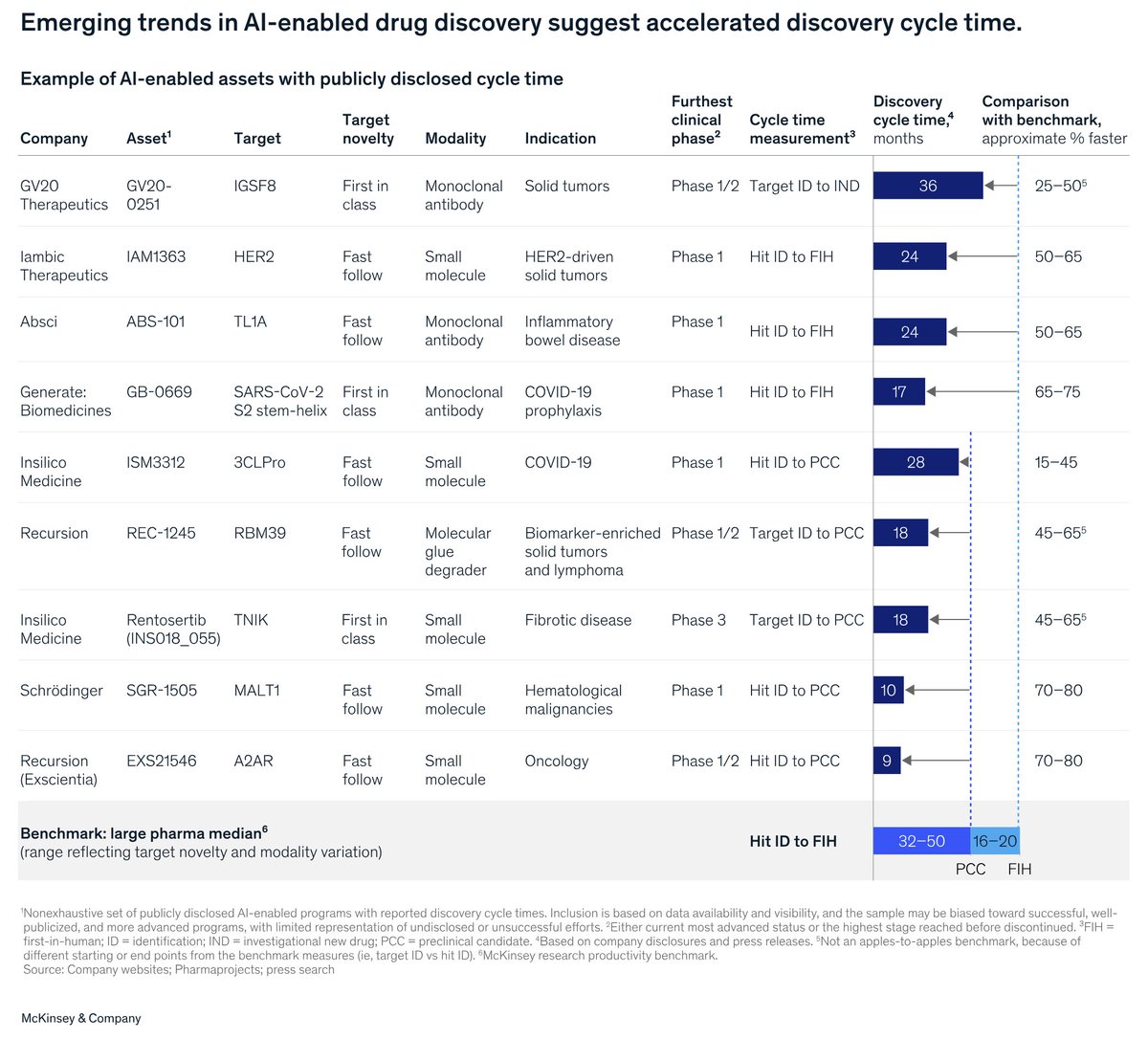
Is AI actually speeding up drug discovery?
According to new McKinsey research, there are early signs that it is: all of these candidates were AI-enabled, with discovery time cut by ~15-80%.
(Incredibly bullish)
Drop your GPU. I'll tell you exactly what MiniMax H3 runs on it.
Mapped every card from 8GB to 128GB this week. Two of those tiers I ran myself. The rest is community data with receipts.
Here's my own hardware:
24GB (RTX 4090): 5s at 1152x640 in 2:47. 10s in 12 minutes. 2x faster once Turbo LoRA is calibrated, and the CUDA drive is updated.
128GB per node (2x DGX Spark): 5s at 1728x960 with the full enhancement takes about 7 minutes. Running both Sparks in parallel on a 10s story: about 10 minutes.
The amazing open source community has pushed lower. I just gathered as much info as I can.
The floor is 8GB. Someone ran full 15-second clips on an RTX 5060 with 32GB system RAM. A 5060 Ti 16GB got a 41-second clip working but had to cut some corners to fit.
The point is: it runs. The configs exist. People are making it work on cards that cost $300.
So. What GPU and System RAM do you have? Examples:
RTX 5060 (8GB)
RTX 3060 (12GB)
RTX 4070 (12GB)
RTX 4090 Laptop (16GB)
RTX 5060 Ti (16GB)
RTX 5070 Ti (16GB)
RTX 3090 (24GB)
RTX 4090 (24GB)
RTX 5090 (32GB)
DGX Spark GB10 (128GB unified)
RTX 5000 Pro (64GB)
RTX 6000 (42GB)
M5 Pro Mac
Drop it below. Resolution, step count, expected timing, and the flags that actually matter from my research