A Norwegian neuroscientist spent 20 years proving that the act of writing by hand changes the human brain in ways typing physically cannot, and almost nobody outside her field has read the paper.
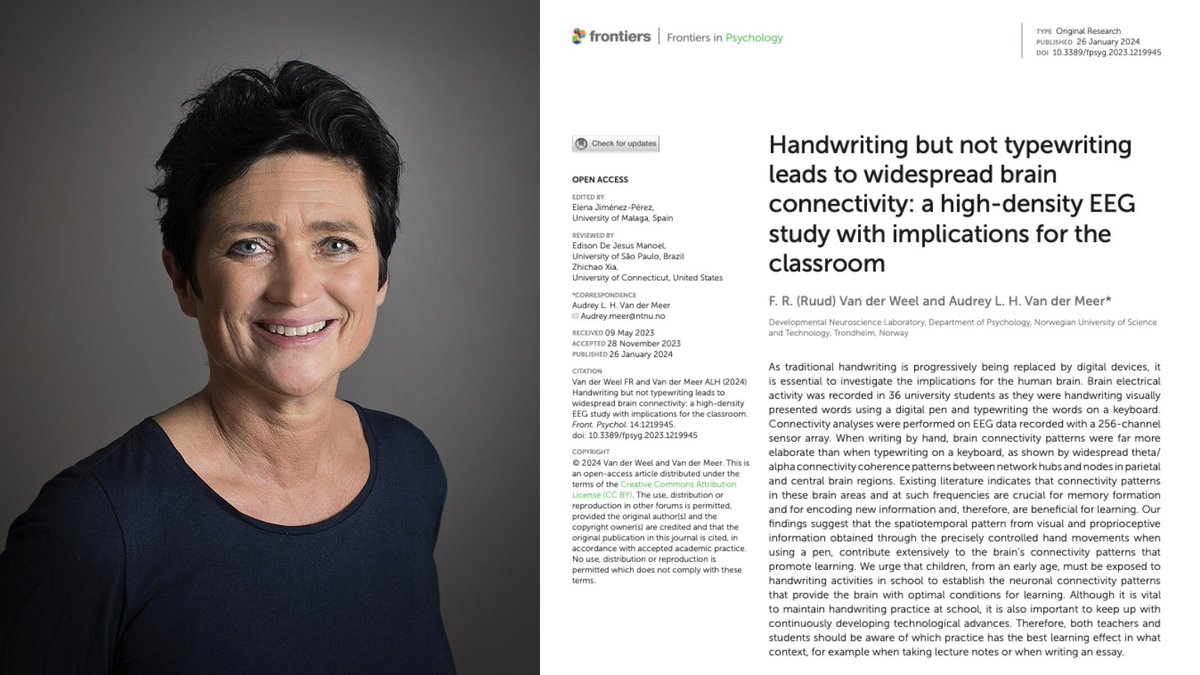
Her name is Audrey van der Meer.
She runs a brain research lab in Trondheim, and the paper that closed the argument was published in 2024 in a journal called Frontiers in Psychology. The finding is brutal enough that it should have changed every classroom on Earth.
The experiment was simple. She recruited 36 university students and put each one in a cap with 256 sensors pressed against their scalp to record brain activity. Words flashed on a screen one at a time.
Sometimes the students wrote the word by hand on a touchscreen using a digital pen, and sometimes they typed the same word on a keyboard. Every neural response was recorded for the full five seconds the word stayed on screen.
Then her team looked at the part of the data most researchers had ignored for years, which is how different parts of the brain were communicating with each other during the task.
When the students wrote by hand, the brain lit up everywhere at once.
The regions responsible for memory, sensory integration, and the encoding of new information were all firing together in a coordinated pattern that spread across the entire cortex. The whole network was awake and connected.
When the same students typed the same word, that pattern collapsed almost completely.
Most of the brain went quiet, and the connections between regions that had been alive seconds earlier were nowhere to be found on the EEG.
Same word, same brain, same person, and two completely different neurological events.
The reason turned out to be something nobody had really paid attention to before her work. Writing by hand is not one motion but a sequence of thousands of tiny micro-movements coordinated with your eyes in real time, where each letter is a different shape that requires the brain to solve a slightly different spatial problem.
Your fingers, wrist, vision, and the parts of your brain that track position in space are all working together to produce one letter, then the next, then the next.
Typing throws all of that away. Every key on a keyboard requires the exact same finger motion regardless of which letter you are pressing, which means the brain has almost nothing to integrate and almost no problem to solve.
Van der Meer said it plainly in her interviews.
Pressing the same key with the same finger over and over does not stimulate the brain in any meaningful way, and she pointed out something that should scare every parent who handed their kid an iPad.
Children who learn to read and write on tablets often cannot tell letters like b and d apart, because they have never physically felt with their bodies what it takes to actually produce those letters on a page.
A decade before her, two researchers at Princeton ran the same fight using a completely different method and ended up at the same answer. Pam Mueller and Daniel Oppenheimer tested 327 students across three experiments, where half took notes on laptops with the internet disabled and half took notes by hand, before testing everyone on what they actually understood from the lectures they had watched.
The handwriting group won by a wide margin on every question that required real understanding rather than surface recall.
The reason was hiding in the transcripts of what the two groups had actually written down.
The laptop students typed almost word for word, capturing more total content but processing almost none of it as they went, while the handwriting students physically could not write fast enough to transcribe a lecture in real time, which forced them to listen carefully, decide what actually mattered, and put it in their own words on the page.
That single act of choosing what to keep was the learning itself, and the keyboard had quietly skipped the choosing and skipped the learning along with it.
Two studies. Two countries. Same answer.
Handwriting makes the brain work. Typing lets it coast.
Every note you have ever typed instead of written went into your brain through a thinner pipe. Every meeting, every book highlight, every idea you captured on your phone instead of on paper was processed at half depth.
You did not forget those things because your memory is bad. You forgot them because typing never woke the part of the brain that would have made them stick.
The fix is the thing your grandmother already knew.
Pick up a pen. Write the thing down. The slower road is the faster one.
🧬Impressive study on the genetic history of the domestication of ... baker’s yeast.🥖
The authors analyzed 2,950 genomes of Saccharomyces cerevisiae and arrived at several interesting conclusions.
It turns out that “home” sourdough starters are not simply collections of random wild yeasts from flour, air, or the local environment. Many sourdough strains instead form genetically related groups close to yeasts from Asian solid-state grain fermentations, including sake, rice wine and baijiu. In the phylogenetic tree a large proportion of home sourdough/dough strains cluster with Asian fermentation lineages (pink cluster) rather than with local North American wild, wine, or beer isolates.
Commercial baker’s yeast, however, follows a different evolutionary trajectory. In the genetic tree, these strains fall into the Baking & Brewing clade, associated with Europe. Commercial strains also more often show polyploidy, aneuploidy, and copy-number variation. This is consistent with the idea that industrial selection and mass production may have led to different genomic adaptations from traditional sourdough fermentation.
From a genetic perspective, one of the most interesting observations is that not all strains underwent genome “simplification” during domestication. Many lineages associated with domestic and traditional fermentations did not show a significant reduction in genome size compared with wild yeasts.
The question of how sourdough yeasts became so widely distributed, however, remains open. The authors propose several non-mutually exclusive explanations: historical admixture between lineages, dispersal by humans, spread through traditional fermentations, modern introduction of commercial strains, and the role of household and bakery microbiota.
Overall, the study shows that baker’s yeast is not a single simple evolutionary lineage, but rather a complex network of histories shaped by human culture, fermentation technologies, and repeated mixing between populations.
https://t.co/JxcRR8Bb1n
#BakerYeast #Domestication #Phylogenetics #sourdough
What a privilege it is to carry heavy grocery bags, to have laundry to do, to sleep in freshly changed sheets, and to eat your favorite meal. What a privilege it is to laugh, to love, to be cared for, and to begin again.
It’s a gentle reminder that a meaningful life isn’t built only on big milestones, but on the small, often overlooked moments that quietly sustain us.
Merci pour cette institution d'excellence ouverte à tous. Plusieurs fois, j'ai écouté les podcasts de grands experts du monde travaillant sur la génomique humaine et pathogène. Des conférences auxquelles je n'aurai sans doute eu aucune possibilté d'assister sans cette institution
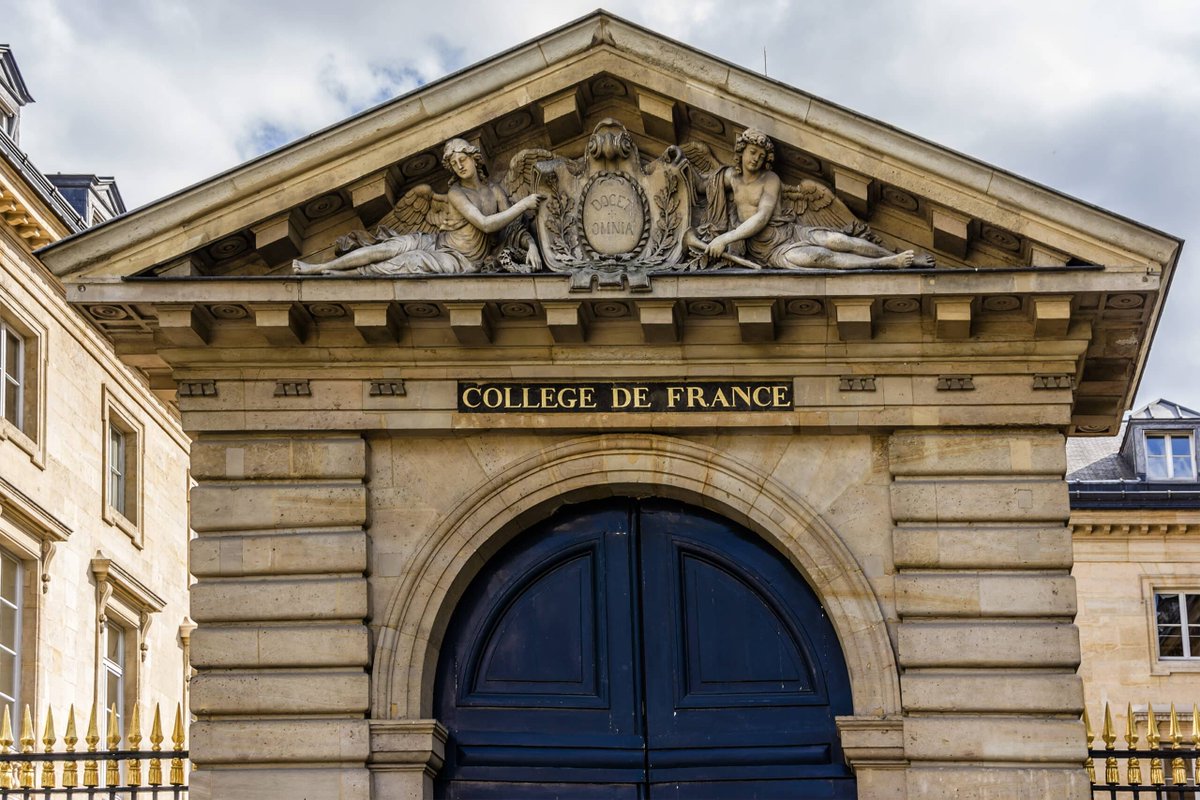
Le 24 mars 1529, François Ier crée une institution pour une seule raison : la Sorbonne refuse d'enseigner le grec et l'hébreu.
Les théologiens considèrent que le latin suffit. Tout ce qui vient de l'Antiquité grecque les effraie.
François Ier ne négocie pas. Il nomme deux professeurs, les paie sur ses deniers, et leur donne une mission : enseigner ce que la Sorbonne refuse d'enseigner. Gratuitement. À tout le monde.
La Sorbonne est furieuse. Elle tente de faire interdire les cours. Elle échoue.
Deux chaires deviennent douze. Le grec, l'hébreu, les mathématiques, la médecine, la philosophie.
L'institution s'appelle d'abord le Collège des lecteurs royaux.
Aujourd'hui, c'est le Collège de France. Ses cours sont toujours gratuits. Toujours ouverts à tous. Sans inscription, sans diplôme, sans condition.
Près de cinq siècles plus tard, rien n'a changé. C'est l'un des derniers endroits en France où le savoir n'a pas de prix.
Scientific societies need to rethink what, and who, they reward.
Too often, awards go to people who have never engaged with the society, who show up once, collect a prize, and disappear. They’re celebrated for a Nature or Science paper, or for the prestige of the labs where they trained, not for their actual, independent contributions to the field or to the community.
Meanwhile, the people who truly sustain these societies, the ones who build community, mentor the next generation, take on volunteer leadership roles, organize meetings, support students, and push the discipline forward through their own research, are overlooked because their work isn’t defined by a single “big paper” or elite connections.
Somewhere along the way, we forgot the purpose of scientific societies: to advance our discipline as a community, not to reward opportunism.
Harvard scientists just shattered one of biology’s oldest rules.
We were taught:
Viruses can’t make their own proteins. They hijack yours. That’s why they’re “not alive.”
Except giant DNA viruses just crossed that line.
Researchers found they carry a full eukaryotic-style translation complex (vIF4F). Translation machinery.
Inside a virus. They can keep making proteins even under stress that shuts down normal viral replication.
If a virus brings its own protein-making tools…
Is it still just a parasite?
For decades we’ve drawn a clean boundary:
Cell = alive
Virus = not alive
Nature doesn’t care about our categories.
Maybe viruses aren’t just evolutionary side notes.
Maybe they helped build complex life.
Paper in Cell 👇
https://t.co/QyGzZf9e6o
Harvard news: https://t.co/YKAfEngdS3
What I thought would make me a great PI:
• Publishing 20 papers a year
• Rewriting every student draft
• Being the sharpest person in the room
What actually makes me effective:
• Teaching principles once
• Building systems that work without me
• Watching students publish independently
Everyone chases the first list. But it caps your lab's output at whatever you can personally touch.
Professors - talk to students at conferences and events. Not everyone can just walk up and start a conversation. You have status, and it can be intimidating. Create balance. Smile. Introduce yourself. Ask them about their research.
Reading is progress. Collecting data is progress. Downloading papers is progress. Emailing is progress. Note-taking is progress. Writing is progress. Teaching is progress. Deleting is progress. Referencing is progress. Rewriting is progress.
Because of medicine:
You survived pneumonia that killed millions. Your grandparents lived long enough to meet you. You can drink clean water without fearing cholera. A broken leg didn’t become a life-ending infection.
Science saves lives.
Australia just recorded zero cervical cancer cases in women under 25 - for the first time since records began in 1982.
This is what happens when a country commits to HPV vaccination and screening. We protect our girls and save lives.
On apprend que la pilule contraceptive masculine est stoppée car ses effets secondaires sont "trop gênants".
En gros : dépression, irritabilité, prise de poids, acné, douleurs, risques vasculaires… Ah, donc c’est trop dangereux pour eux, mais parfaitement acceptable pour des millions de femmes depuis 1960 ?
Ce double standard est un résumé parfait de notre société… La santé des hommes est un impératif, la santé des femmes est un compromis.
On exige des femmes qu’elles ajustent leur humeur, leur corps, leur libido, leur fertilité, pour que les hommes puissent vivre confortablement, tant que la douleur est féminine, elle est invisible.
Tant qu’elle ne touche pas les hommes, elle n’existe pas, la contraception masculine reste un fantasme, parce que le confort masculin, lui, n’est jamais négociable.