Independent researcher & commentary on global finance, economics, and geopolitics. Mapping worldly events with astrological timing cycles.
Not financial advice.
The U.S. market probably forms an important high or an unstable blow-off phase between Aug 19 and Sep 8, corrects meaningfully from late September into the Oct 29–Nov 3 window, rebounds after Nov 13, experiences another major turning point around Dec 10–13. #Astrology#forecast
First, they targeted $NVDA Then $MSFT. Now, the entire U.S. transportation system. At this rate, banking and power infrastructure could be next.
The pattern is becoming increasingly alarming.
Jensen is out.
Cyberattacks are escalating.
#Powergrids and #banking systems could be the next targets.
The threat is growing, and critical infrastructure may be at serious risk.
@wallstengine#CRED is an Indian fintech company founded in 2018 by Kunal Shah. It offers a platform for credit card bill payments, rewards, credit score tracking, loans, and financial services, making money management easier and more rewarding for users. #META
#CRED is an Indian fintech founded in 2018 by Kunal(now WhatsApp CEO). It helps users manage credit cards, pay bills, track credit scores, and earn rewards. CRED also offers loans, shopping deals, and other financial services through its app. #Takes#META
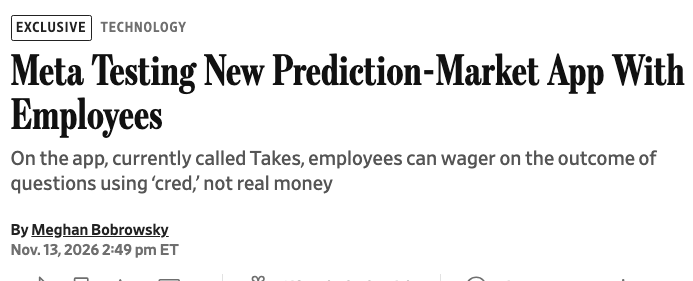
$META IS TESTING A PREDICTION-MARKET APP WITH EMPLOYEES: WSJ
Meta employees are testing a new app called Takes, where users make predictions about real-world events using virtual points called “cred” instead of real money.
Correct predictions earn points, while incorrect ones lose them. One question asks whether former Apple CEO Tim Cook will become Nvidia’s next CEO.
The app isn’t publicly available, and whether or when it will launch remains unclear.
AI powered #Cyberattacks on JAPAN, um now USA ?????
Stocks and ETF to watch: $CRWD $PANW $FTNT $ZS $NET $RBRK
ETFs:
• First Trust Nasdaq Cybersecurity $CIBR
• Amplify Cybersecurity $HACK
• Global X Cybersecurity $BUG
Which would you hold until 2030? 🇺🇸
🚨 Microsoft 365 outage and Salesforce disruptions highlight the need for digital resilience—not necessarily cyberattacks.
Long-term cybersecurity watchlist:
CrowdStrike $CRWD
Palo Alto $PANW
Fortinet $FTNT
Zscaler $ZS
Cloudflare $NET
Rubrik $RBRK
Which stock wins by 2030?
🇺🇸 Is the USA prepared for a major wave of #cyberattacks?
Can cybersecurity giants like $CRWD and $PANW protect America’s critical infrastructure, businesses, and government systems from growing cyber threats?
#Cybersecurity#CrowdStrike#PaloAltoNetworks
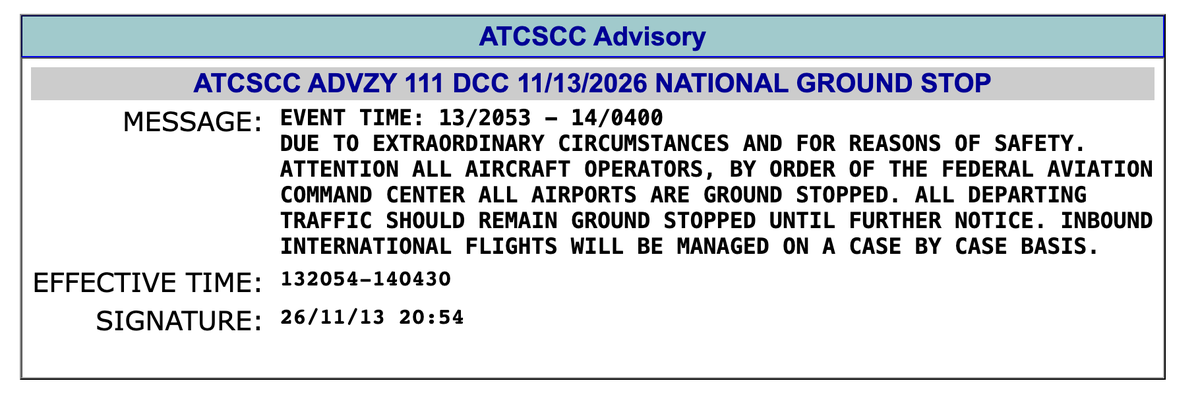
BREAKING: DHS Secretary Markwayne Mullin says "we can't rule out" AI and a cyberattack as the cause of the FAA disruption that grounded all flights nationwide.
On November 13, 2026, both the Federal Aviation Administration (FAA) and the Department of Homeland Security (DHS) publicly addressed a major telecommunications outage that forced a temporary nationwide ground stop across the United States #Airlines
An estimated 12.5 million Americans are expected to take a day off work or school for the release of GTA 6, potentially costing the U.S. economy billions in lost productivity.
Uber is notifying users that their personal information was exposed in a breach involving one of the company’s service providers. https://t.co/HH76IcZw2H
Issued by the FAA just moments ago, ALL US airports are currently ground stopped. This means NO flights may depart for US airports. Flights already in the air will be allowed to land. This is related to an FAA equipment outage.
BREAKING: Nvidia, $NVDA, has appointed Colette Kress, the company’s current CFO, as Interim CEO.
Jensen Huang’s 33-year career at Nvidia has officially come to an end.
Taiwanese semiconductor analyst Andrew Lu’s take on the recent scandal involving Jensen Huang:
Why the US Seized on the Scandal to Draw Its Sword: Three Strategic Objectives
The purpose of this scandal is by no means to expose an affair. It is to force through three critical objectives that had made no headway in the tech war between the US and China because Jensen Huang opposed them.
The first cut: Completely destroy the legitimacy of Jensen Huang's lobbying against sanctions in Washington
Over the past two years, the loudest and most influential business leader in Silicon Valley opposing a total ban on chip exports to China has been Jensen Huang. He has told the White House the same thing all along: "Cede the Chinese market to Huawei, and the only one that ends up dead is the American tech industry."
But the moment US intelligence labels the woman named as Huang's affair partner "a spy working for China's Ministry of State Security who sought to steer the US toward easing its chip controls," every bit of lobbying he has done for looser controls takes on an entirely different political meaning. It becomes a national security matter, raising the possibility that a foreign spy used a secret relationship to exert influence.
Huang can no longer say a single word in defense of the Chinese market before Congress or the White House. If he does, he will be branded as someone who "fell for an intelligence operation and still hasn't come to his senses."
The second cut: Reverse the H200 export approvals for China and sever the link between Chinese shell companies and Southeast Asian smuggling networks
Look at the timing of the two reports.
On November 8, the very day the Jensen Huang scandal broke, The New York Times published an investigation for which its reporters went in person to dozens of Chinese companies that the US Commerce Department had approved to handle Nvidia's H200 chips. New Matrix in Beijing was one of them. According to the report, the registered addresses of companies approved to buy the chips turned out to be empty "ghost offices," and some of the companies had close ties to entities on US sanctions lists and to firms under contract with the Chinese military.
One exposé says Nvidia's CEO was having an affair with a female spy from Megaspeed, the Singapore company that handled the chip smuggling. The other says the Chinese companies Commerce approved to buy H200s are nothing but shell companies trading on behalf of the Chinese military. The aim of these two reports is clear. They are meant to pressure the Trump administration and the Commerce Department into fully revoking or freezing H200 export approvals for China and, going further, to force a sweeping overhaul of the loophole that let chips be diverted through data centers run by third parties in Singapore and elsewhere in Southeast Asia.
The third cut: Put Nvidia on a national security leash through congressional oversight and an independent investigation
As the world's largest company by market cap and the dominant force in AI, Nvidia has until now enjoyed broad autonomy in how it runs its business. But in the wake of this incident, the three congressional committees responsible for China, foreign affairs, and intelligence have begun examining Nvidia's internal security measures directly. They have even pressured Nvidia's board into forming an independent investigation committee to look into the company's own founder and CEO.
In effect, Washington's national security establishment has planted a watchdog right inside Nvidia's board. From now on, the goal is to make sure that everything, down to where each and every one of Nvidia's high performance chips ends up, conforms strictly to US national security strategy. It also means there is no more room for skirting the edge of the rules or releasing chips with specs specially tailored to regulatory thresholds.
Conclusion
"The scandal was a detonator set off right on cue. The real goal was to plug the holes chips were leaking through."
Jensen Huang made the fatal mistake of letting his guard down in his private life and personal relationships. In the end, he fell into a honey trap, the textbook tactic of intelligence warfare, and was compromised. America's national security and intelligence agencies ruthlessly exploited the weakness his private life had exposed. As a result, they solved three thorny problems in a single stroke: Nvidia's lobbying at the White House to ease restrictions on China, the flow of H200 chips into Chinese shell companies, and smuggling routed through Singapore.
The closed congressional hearing set for November 18 will be the decisive turning point at which the US moves in earnest to tighten its sanctions on China's AI compute even further.
The AI trade got a political stress test and failed it in one session. The long-term thesis is intact, but the path just got rockier and more expensive