Pi Pocket v0.3.0 is out!
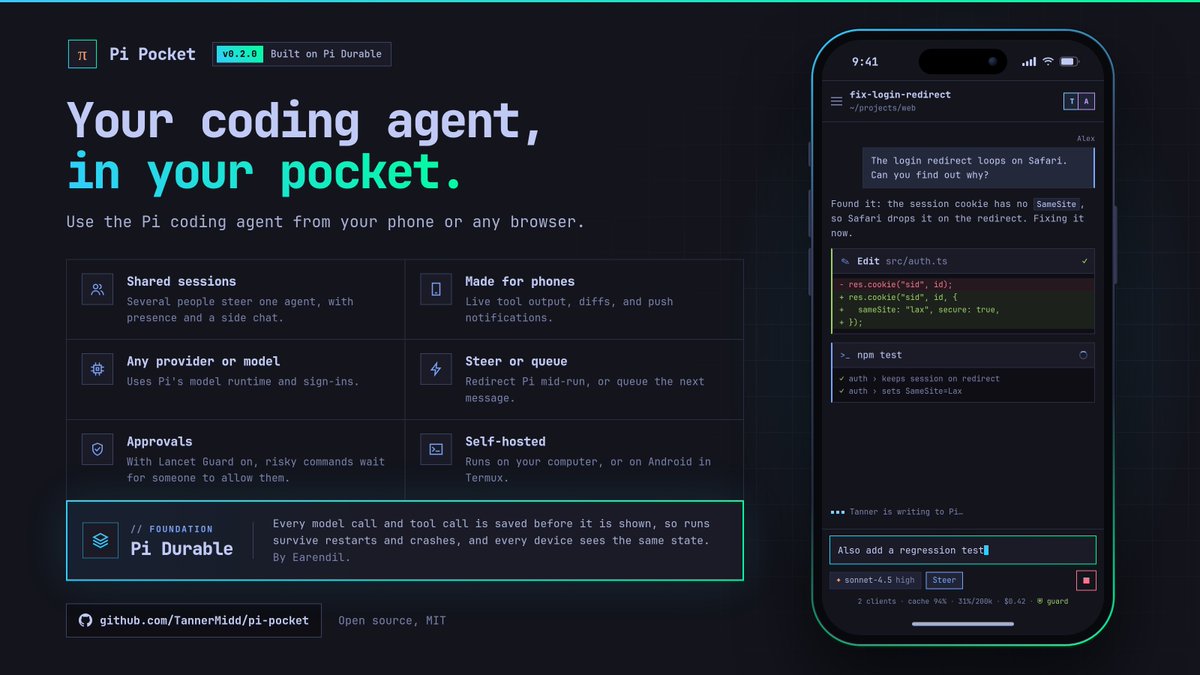
This release is a big set of improvements, and it brings Pi Pocket to the level I'm comfortable with for daily use.
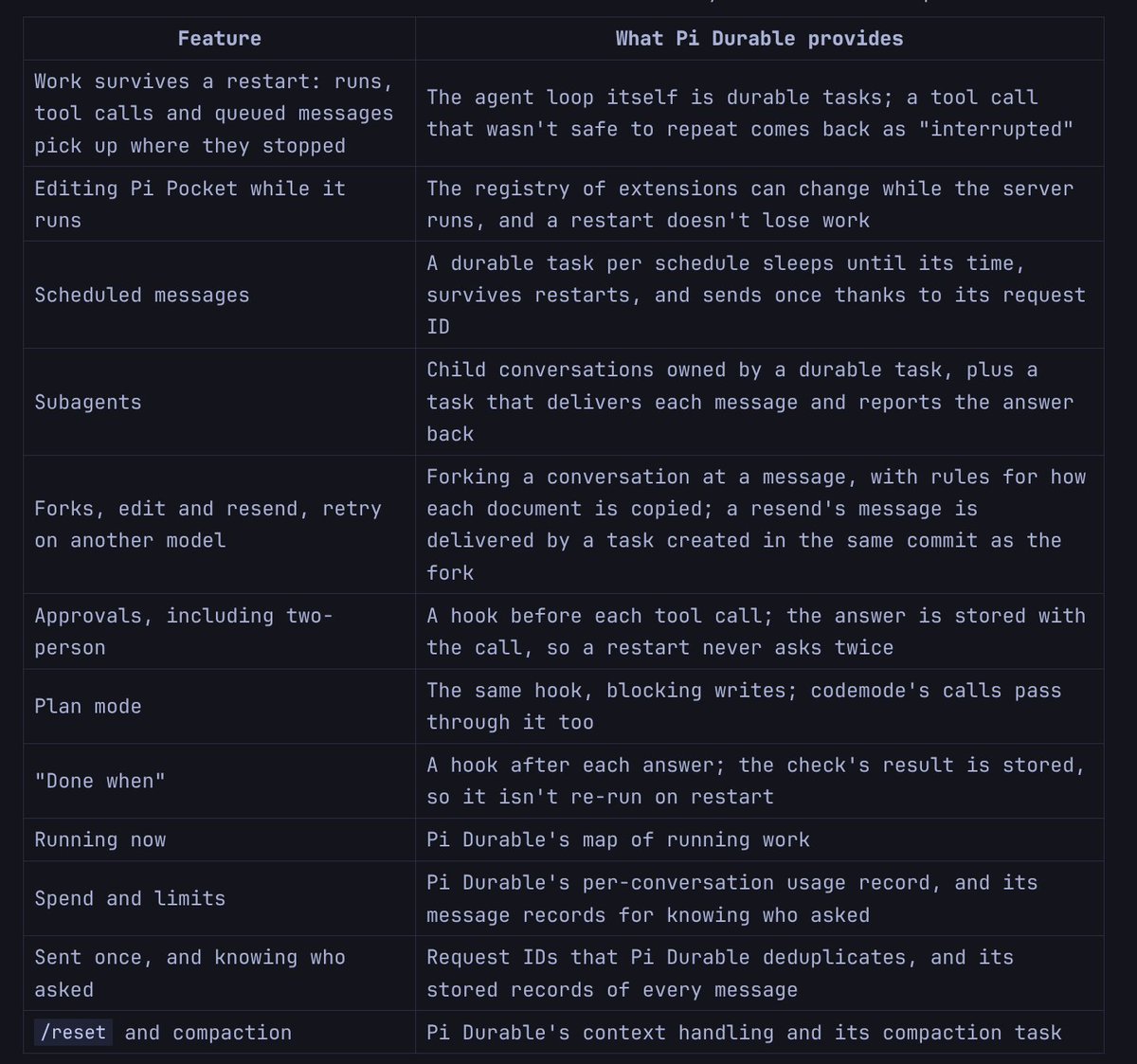
Pi Pocket is meant to be extended on the fly without interrupting your work, thanks to Pi Durable. Edit an extension or the web app and it reloads live; restart the server and Pi picks up where it left off.
I'm not looking to grow this forever with feature slop. I want a solid foundation that others can take and extend or modify for their own needs. I expect changes from here on out will be more about refinement than adding new features.
Have fun!
Self-hosted and open source (MIT): https://t.co/VV5AQAQCZW
How it's built: https://t.co/BVeXSvurN9
Speaking of refinements…
Pi Pocket has themes now. All of the Omarchy ones, and you don't need Omarchy to use them.
If you are on Omarchy, it can also just follow your desktop. Switch your theme and Pi Pocket switches with it. I may have spent way too long flipping through them with Ctrl+K.
Also snuck in tiled windows, Hyprland-style animations, and a cleaner sidebar.
Last update for the weekend, back to normal work tomorrow, enjoy!
https://t.co/VV5AQAQCZW
Yeah, Pi basically never crashes. A crash is just one of many examples. What it's really for is all the normal stuff that stops a process: restarts, deploys, a laptop going to sleep etc... Pi Pocket can edit its own code and restarts itself partway through a task, and the work keeps going as normal.
This is a good read - https://t.co/UhYexV1qgY
Saw what @badlogicgames has been building with Pi Durable lately and had to try it myself, so I made Pi Pocket.
The fun part: I kill -9 the server halfway through a run, and a new process just picks it back up from the same SQLite file. The test run that got cut off comes back as interrupted and runs again, and nothing that already finished runs twice.
Every model call and tool call is a checkpointed task, and crash recovery, multiplayer, and hot swappable extensions all come out of that.
Huge thanks to Mario and the @pidotdev team. Pi 1.0 is a great agent, Pi Durable is a really smart foundation, and building on both has been a blast.
https://t.co/jSVHDNGcDE
What's new in 0.3.0:
• Forks, edit and resend, and retry on another model
• Plan mode
• "Done when" goals
• Changes, with diffs
• Git worktree sessions
• Lock-screen approvals and an app badge
• Two-person approvals
• Scheduled messages
• Running now
• Spend tracking and limits
• Share to Pi (Android)
• Prompt templates as slash commands
• Session instructions
• /reset with a handoff note
• Drop-in extensions
• Markdown export
Pi Pocket v0.3.0 is out!
This release is a big set of improvements, and it brings Pi Pocket to the level I'm comfortable with for daily use.
Pi Pocket is meant to be extended on the fly without interrupting your work, thanks to Pi Durable. Edit an extension or the web app and it reloads live; restart the server and Pi picks up where it left off.
I'm not looking to grow this forever with feature slop. I want a solid foundation that others can take and extend or modify for their own needs. I expect changes from here on out will be more about refinement than adding new features.
Have fun!
Self-hosted and open source (MIT): https://t.co/VV5AQAQCZW
How it's built: https://t.co/BVeXSvurN9
Pi Pocket 0.2.0 is out:
Lancet Guard is now off by default, invite codes are easier to spot, and the site now covers Pi Durable...which all of this is built on.
This release was put together from inside Pi Pocket itself. Go make things!
https://t.co/g9CYmRFQgY
@badlogicgames An early version of Pi Pocket is available, feel free to make it your own!
@pidotdev letting us all make snazzy things!
https://t.co/Zlk0w5O7eO
@badlogicgames An early version of Pi Pocket is available, feel free to make it your own!
@pidotdev letting us all make snazzy things!
https://t.co/Zlk0w5O7eO
How LANCET Nano is made:
103K labelled commands → a 110M-param guard that decides allow / ask / block on agent commands in ~14 ms, on a CPU.
v0.4.3 Triage Score: 68.3 · best other guard tested: 38.9
The next round is learning from its weak spots now!
https://t.co/NQDvE9SWlp
Jev inspired me to make LANCET Nano which is a super tiny fine tuned model that classifies malicious or dangerous/catasrophic commands locally in ~10-15ms on my old CPU. As far as I can tell it outperforms every command guard available for agents.
There’s a lot of power in small fine tuned setups. Though it’s not really Jev-like…it has no general knowledge.
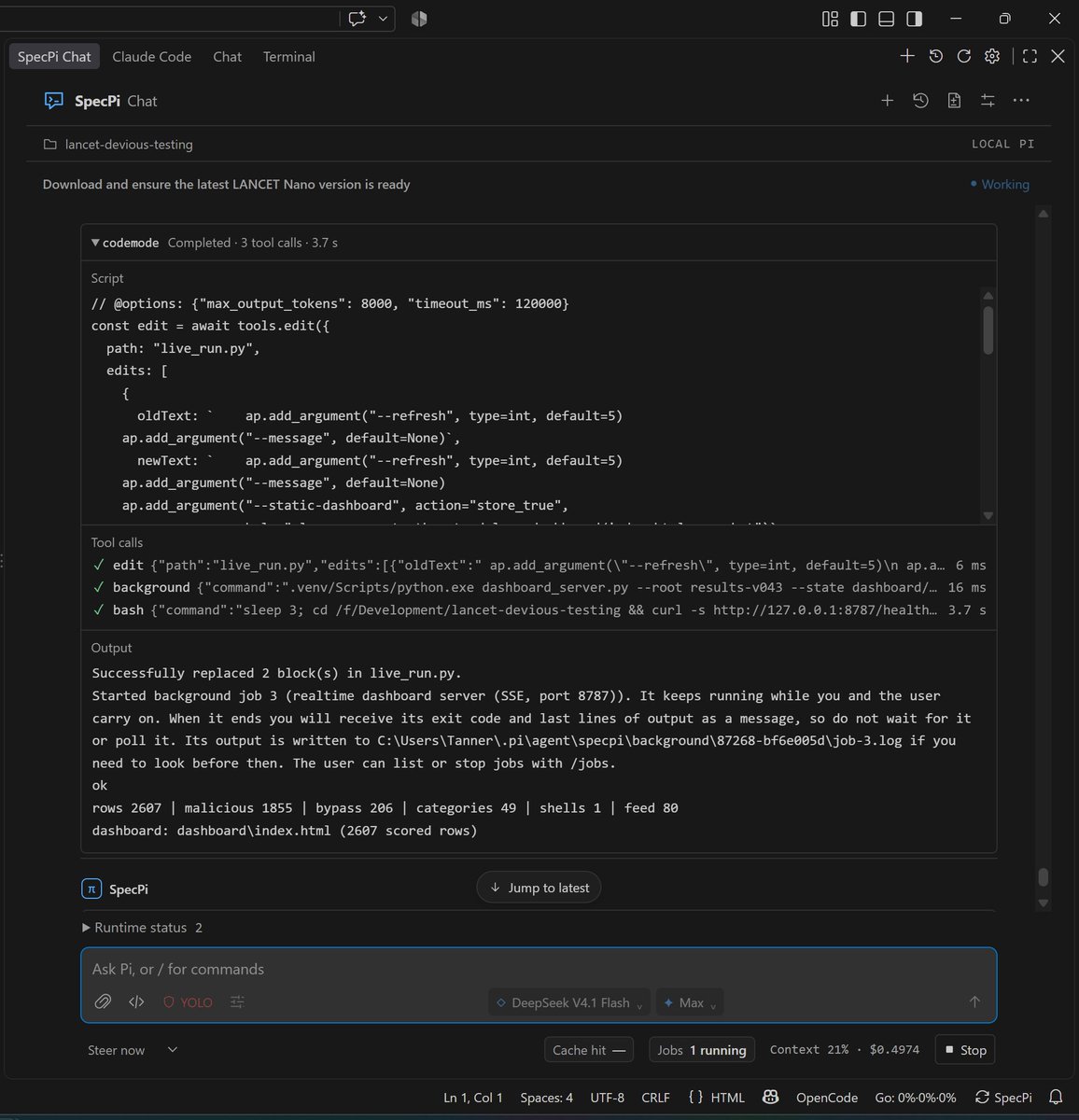
@lucataco At the moment I have a few sessions acting as a red team attempting to bypass a tiny agent command guard classifier I’ve been training.
Building the next training round dataset based on bypasses found during the attempts.