▫️Web3 Lawyer & Int. Mediator with a difference ⚖️ ▫️Anime lover 👘🍜▫️ Learning Japanese on Duolingo🍶||
Let's connect 🤝🏻:) Thoughts and opinions are mine.
Mada, mada... Not yet, not yet.
Tell that challenge you're not done yet. Reach for your goals, you can definitely get there!
A blessed morning to you 💝
#motivation#NFTCommunity#notyet
If you are a lawyer, run a law firm, work in one, or care about the future of law in Nigeria, we want to speak with you.
This June, our team at @UseCaseRadar is dedicating time to conversations with the people shaping the legal industry.
We want to hear what is working, what is broken, and what the future should look like.
Book a meeting with our team now: https://t.co/Cr5DlXsNBK
Help us repost this so our target audience can see this.
Thank you.
If one man can send 800+ applications in a foreign country, face near-total rejection, and still land one yes…
Then maybe the real question isn’t whether there are opportunities.
Maybe the question is: how long are you willing to stay in the game while everyone else is quitting early?
Nigeria is hard, yes.
But quitting early is harder in the long run.
You will pick your hard:
The hard of consistency, skill-building, rejections, and repeated effort…
Or the hard of staying stuck while calling it “no jobs.”
Either way, it’s hard.
The difference is whether your hard eventually pays you back.
After participating in about 15 hackathons, winning 12 across both national and international stages, judging hackathons, and mentoring a full team that went on to win, I’ve learned a lot from both wins and losses.
Some of the hackathons I’ve won include Microsoft-organized hackathons, Càvistà, Squad, HelpMum, Fusion Fest Tech, Cardano, AI for Social Impact, Sui, Remostart, and the Cyber AI Hackathon organized by the American Society of Engineers.
I put together something practical from all of this experience. Real lessons that actually matter in hackathons, from how to approach a problem, build the right team, pitch properly, handle demos, and position your solution in a way judges actually understand.
If you’re participating in hackathons, this will really help you think differently and strategize better.
Good luck in your future hackathons 🚀
https://t.co/xmRjnTiQsf
Vazi Legal’s Annual Summer Internship Program is officially open!
We are opening our doors to law students and recent graduates passionate about tech and innovation.
Apply here – https://t.co/NpLSh1lJgw
I decided to draft a legal application two weeks ago. I've spent nearly all that time just trying to find the actual law my clients were charged under.
Let that absurdity sink in. As a lawyer, with legal research skills and professional networks, I struggled for two weeks to locate the legislation I needed to work with. I finally obtained it yesterday and immediately distributed it to other lawyers I'd encountered during my search, because they were facing the same struggle.
I need to file this application on Monday when the matter is coming up, so I don't appear negligent before the Court. The timeline I am working with does not care that the law was nearly impossible to access.
The fundamental problem is that we're told "ignorance of the law is no excuse," yet the law itself is often hidden behind paywalls, buried in inaccessible databases, or simply unavailable to the average citizen.
How can we expect compliance when access to law is a privilege, not a right?
Laws must be freely accessible to all. Period. f we're bound by them, we deserve to read them without barriers.
Have you ever struggled to access a legislation you needed?
This shouldn't be the norm in a functioning legal system.
#LegalTech #AccessToJustice #RuleOfLaw #LegalReform
About 4-5 years ago, we started putting together one of the most immersive internship programs for young lawyers looking to build a career in tech. It is probably my favorite thing that we do at the firm.
Applications close this Friday
https://t.co/wzOMhFq0op
I came across a book that said:
Health: 80% eating,
20% exercising
Wealth: 80% habits,
20% math
Happiness: 80% purpose,
20% fun
Achieving: 80% listening,
20% speaking
Talking: 80% listening,
20% speaking
Improving: 80% persistence,
20% ideas
Learning: 80% understanding,
20% reading
Relationships: 80% giving,
20% receiving
Prioritize the 80%, and the rest will fall into place.
There are final year students in the university today who don’t know or have even heard anything about ‘Graduate Trainee’. There are corp members today who totally have no idea about company recruitments in Nigeria and they somehow hope they will end up working in a big company. Nothing beats access to information >>>>
@mehreeee Don’t underestimate the power of your network, meet new people in your field everyday, go to events , connect with people and be interested in them.
Give more than you receive
Takeaway from the session:
OrbitX enables you to change your Naira to dollars in mere seconds and some of its target audience are freelancers and importers.
Conversion is made easier with OrbitX .
@OrbitX_Pay@womenindefi_org
I want to share a takeaway from the #wid summit panel session that spoke to me:
Don't benchmark yourself on others and don't limit yourself based on others. That someone has gone to Singapore and you've not gone doesn't limit you. Build where you are. #WIDsummit2026
Amazing panel session from @SarahWahinya@OjiakuJennifer@onlyfayze@Queenxrypt on stablecoins & financial innovation for African women.
And this is just one of many powerful conversations happening here.
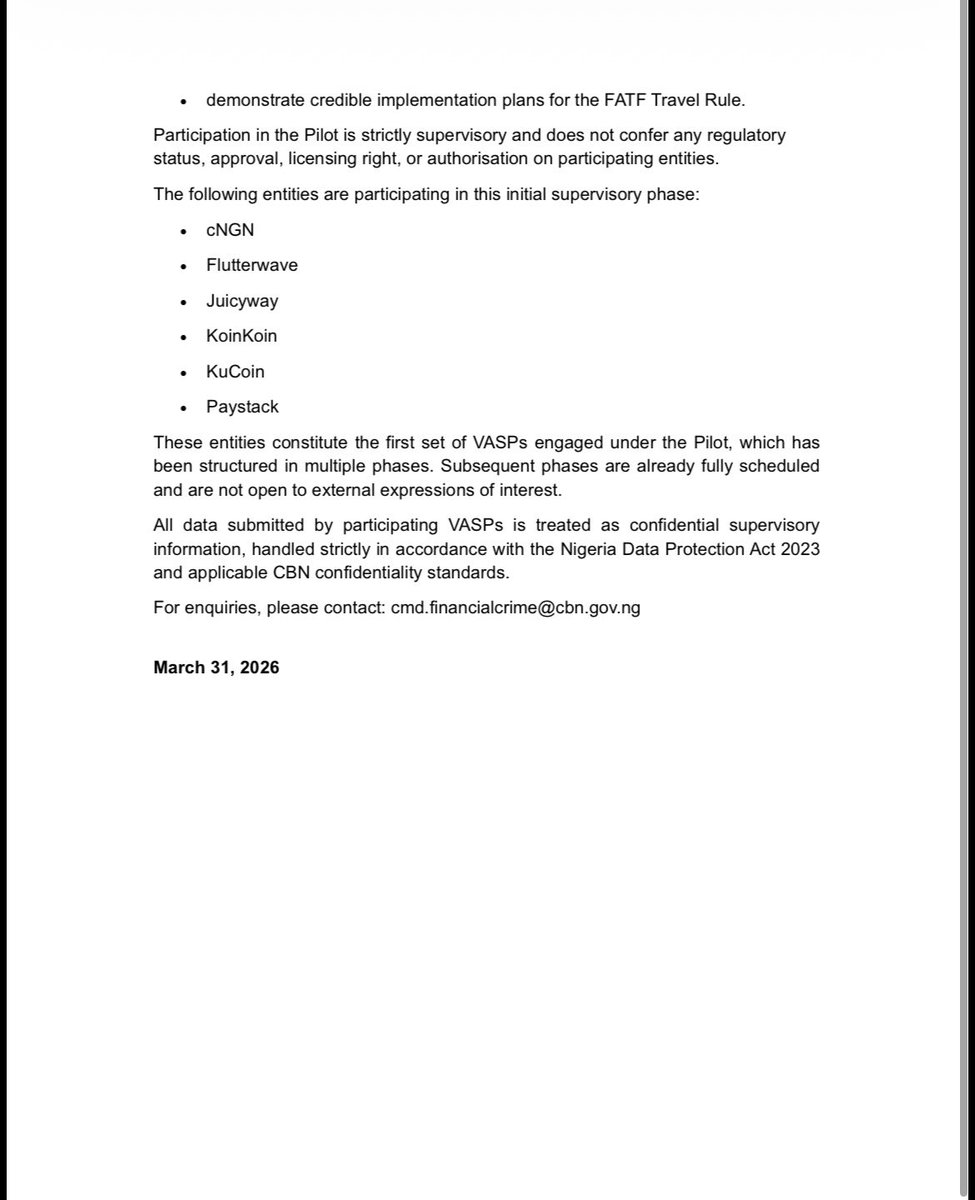
While men slept, yesterday night😅, the CBN confirmed the commencement of an AML/CFT/CPF Supervision Pilot for a select group of Virtual Asset Service Providers.
The selected companies are @paystack, @theflutterwave, @kucoincom, @cngn_co, @koinkoinapp and @juicywayhq 🎉
And before you get too excited o, the framing was careful that participation confers no licensing status, no regulatory approval, and does not supersede the existing framework📌
That much is clear.
But clarity of framing does not diminish significance of intent.
Nigeria’s virtual asset regulatory story has been long and turbulent.
We went from a blanket banking sector prohibition in 2021, through gradual re-engagement, to the ongoing question of which regulator owns what.
The CBN’s move here does not resolve that question but it signals that the apex bank is no longer watching from a distance. For the first time in a while, it feels like we have actually left the runway.
This structured supervisory engagement would involve a risk-based programme covering governance, customer onboarding, sanctions screening, transaction monitoring, and FATF Travel Rule preparedness.
The focus on Recommendations 15 and 16 is deliberate. This is the CBN signalling to FATF evaluators that Nigeria is actively supervising this space.
So now I’m thinking🤔, will this remain a compliance exercise, or is it the first step toward a functional, dual-supervised virtual asset ecosystem where the CBN and SEC each hold a defined lane?
I’m curious to hear your thoughts about this…