Cleanroom v0.10.0 is out.
Shared Cleanroom servers are a lot more usable now: OIDC auth, owner-scoped access, DeepSec hardening, and suspend/resume with automatic wake-on-use.
https://t.co/UDiqXgMTtX
Thrilled to welcome @jmwind to the Spellbook team. JML is one of the top technical executives in the world, having worked with Shopify as CTO and Atlassian as VP Engineering, bringing them both to IPO back-to-back.
Over the past year, I’ve been lucky to have him as a mentor and advisor. He is one of the most impressively “30,000 foot view” + “in the weeds” people I’ve ever met. In the same hour he can code a prototype and deliver deep insight about how to scale our culture & process.
This makes him uniquely suited for the role he is pioneering: Executive IC. AI enables people like JML to scale themselves 100x without getting bogged down in layers of management. We aim to write the playbooks for tomorrow, rather than to execute the playbooks of yesterday. We think that org charts will change radically in the next decade, and we want to get far ahead of it.
JML will pioneer the systems that scale our AI-native org, will deliver product and technical insight from decades of experience and help grow myself and our executive team.
I recommend following him if you are curious how AI-native orgs will operate–he is writing a playbook for the decade to come: @jmwind
https://t.co/39bEVPqctO
@yacineMTB Developers demand a stream of new tech to learn so that they can avoid the hard ambiguous challenge of actually making useful products
https://t.co/1YmXRFl8lz
Cleanroom v0.9 is out!
Private GitHub repos are easier to use in sandboxes: configure a GitHub App once, then Cleanroom handles short-lived tokens for repo fetches.
Also: daemon logs, faster darwin-vz startup, more reliable repo checkouts, and better image cache recovery.
https://t.co/0Uq2LUBnx6
Paperwork is better when you can just talk through it.
With Images in ChatGPT and voice mode, you can upload a form, say what to fill in, and get back a completed version.
It is becoming less taboo for VCs to back direct competitors
I propose a defensive pact amongst founders:
"If a Major Investor hedges by investing in my direct competitor, I will hedge by starting a second company"
Comment/retweet to cosign :)
Amp Labs: small teams of the best software builders, working inside the most frontier-oriented company per industry and region.
https://t.co/IAI3YBqBWf
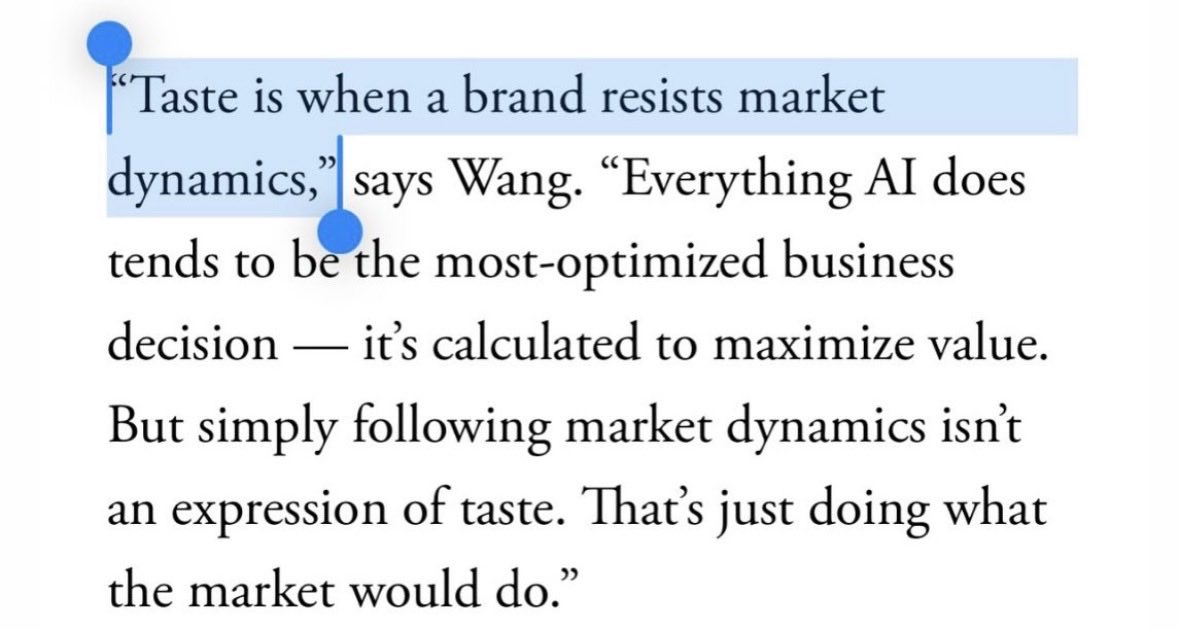
Shopify CEO Tobi Lutke explains Goodhart’s law and why he doesn’t like KPIs or OKRs
“Goodhart’s law is real. The moment a metric becomes a goal, it’s no longer a useful metric… No metric by itself is a complete heuristic for a complex business. There’s a million different tensions in a company, and you can’t keep all of them in harmony by optimizing for one thing.”
For this reason, Shopify doesn’t use KPIs or OKRs. But as Tobi explains, this doesn’t mean they don’t value data and metrics.
“We are extremely data informed. We have invested enormous amounts of money and time into systems that give us basically everything at our fingertips… But what Shopify attempts to do is just not over-fit for what’s quantifiable.”
People love optimizing for highly-quantifiable things because there’s immediate gratification that comes from seeing a number go up. But Tobi thinks that the most important aspects of a product are rarely quantifiable:
“The overlap of the most valuable things you can do with a product and the things that happen to be fully quantifiable are like maybe 20%. Which leaves 80% of a value space unaddressable by the people who only look at quantifiable things.”
He continues:
“Shopify is comfortable with unquantifiable things like taste, quality, passion, love, hate… The sort of deep satisfaction that a craftsperson feels when they’ve done a job well is actually a better proxy if you allow it to be.”
They then have robust analytics systems that tell the company if something’s wrong or a new rollout breaks something.
“We think about it as a cockpit for a pilot. The decisions are still made by pilots, and we think this leads to better results… I think there needs to be more acceptance in business of unquantifiable things… And then metrics take a support function.”
Source: @lennysan (Feb 2025)
Don’t share your kernels.
Or wait until the next copyfail demonstrates (again) you shouldn��t.
The rate of escapes will only increase with agent-based research.
Be wary of platforms that don’t rely on strong isolation just to look good on benchmarks.
@confusedqubit@modal > Your VM infrastructure needs to be able to start instantly, and scale infinitely, and just stay running even if all of AWS goes down - and it needs to do this cheaper than running an EC2 instance.
Sounds like you could basically replace all of AWS with this!
I think that is because we all tried to make it work with VM's a lot of years ago (search VMFork) and basically came to the conclusion that it's really, really hard to make work with most software stacks.
See https://t.co/HIESaoCacV
How are you thinking about working around those issues?
Memory snapshotting on firecracker is a legit speed hack for some applications
But it's terrible for most workloads because now you have all this state from timers, sockets, cryptography, + more to account for after you resume.
I recall a some team had a multiple day SEV2 because they needed to inject entropy for their crytopgrahic algorithms to work. (Used for auth, secure keys, etc)
filesystem artifacts/"snapshotting" are way cleaner and gets you close to 90% of the speed up for way less ops overhead.
this is why .smolmachines format doesn't bother with memory snapshotting by design
I strongly believe there are entire companies right now under heavy AI psychosis and its impossible to have rational conversations about it with them. I can't name any specific people because they include personal friends I deeply respect, but I worry about how this plays out.
I lived through the great MTBF vs MTTR (mean-time-between-failure vs. mean-time-to-recovery) reckoning of infrastructure during the transition to cloud and cloud automation. All those arguments are rearing their ugly heads again but now its... the whole software development industry (maybe the whole world, really).
It's frightening, because the psychosis folks operate under an almost absolute "MTTR is all you need" mentality: "its fine to ship bugs because the agents will fix them so quickly and at a scale humans can't do!" We learned in infrastructure that MTTR is great but you can't yeet resilient systems entirely.
The main issue is I don't even know how to bring this up to people I know personally, because bringing this topic up leads to immediately dismissals like "no no, it has full test coverage" or "bug reports are going down" or something, which just don't paint the whole picture.
We already learned this lesson once in infrastructure: you can automate yourself into a very resilient catastrophe machine. Systems can appear healthy by local metrics while globally becoming incomprehensible. Bug reports can go down while latent risk explodes. Test coverage can rise while semantic understanding falls. Changes happens so fast that nobody notices the underlying architecture decaying.
I worry.
It isn't unexpected that the focus of the Bun Rust rewrite is on the anti-Zig side more than anything, since the internet loves to hate. What is unexpected and unfortunate is that leadership within Bun hasn't tried to steer the conversation away from that at all.
There are so many positive and interesting takeaways from this and I'm not really seeing any of them pushed as the primary message.
A positive thing that hasn't been talked about at all is how far Bun came thanks to Zig. And even if you dump it now, its meaningful for how good Zig was to even build a product to this point and impact by any metric. I would've loved to see anyone in leadership say this.
On the interesting side is how fungible programming languages are nowadays. Programming languages used to be LOCK IN, and they're increasingly not so. You think the Bun rewrite in Rust is good for Rust? Bun has shown they can be in probably any language they want in roughly a week or two. Rust is expendable. Its useful until its not then it can be thrown out. That's interesting!
There's been a lot of talk about memory safety and no doubt Rust provides more guarantees than Zig. But I'd love to see a better analysis of why Bun in particular suffered so much rather than take the language-blame path. How could engineering as a practice been more rigorous to prevent this? What were the largest sources of crashes other programs should watch out for? How does Rust prevent them? How could Zig theoretically prevent them? That's interesting.
I know the official blog post hasn't come out yet from Bun. But they're smart enough to know that that PR would stir up controversy the moment it opened, or they should've been. And plenty in the company have been tweeting and writing about it. Its somewhat telling to me in various dimensions what they chose to talk about first.
I tend to think I'm pretty good at corporate PR/comms (especially when it comes to developer audiences) and I think appealing to the negative is never the right long term strategy; it does work to get short term eyes though.