59% of Spirit Airlines' revenue had nothing to do with flying people anywhere.
That is the real reason it just shut down.
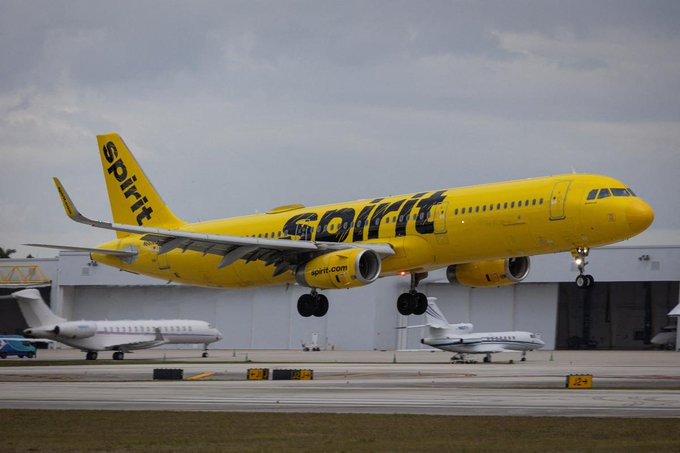
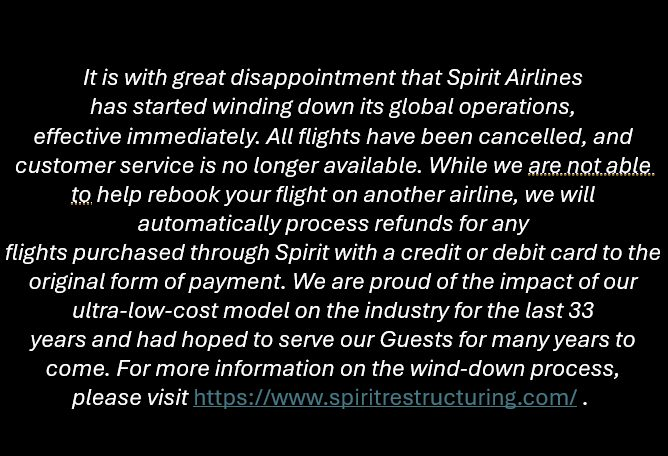
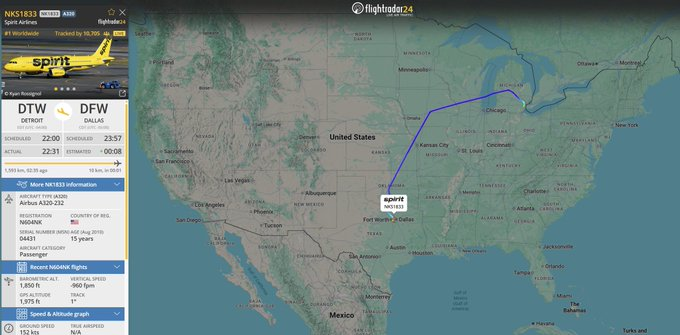
Spirit Airlines cancelled every flight this morning. 34 years of operations. 205 aircraft. 93 destinations across 15 countries. More than 40 million passengers a year. The seventh largest passenger carrier in North America, carrying more passengers annually than JetBlue. Gone.
Everyone is blaming the Iran war and fuel prices. That is the surface-level story. Here is what actually killed Spirit Airlines:
Spirit had the most controversial business model in commercial aviation. It stripped everything out of the ticket price. Carry-on bag: extra. Seat selection: extra. Water: extra. Printing a boarding pass at the counter: extra. The base fare was the lowest in the industry, sometimes as low as $26. But 59% of Spirit's total revenue came from those add-on fees, not from actually flying people. The airplane was the loss leader. The bag fees were the business.
The industry called it the Spirit Effect. When Spirit entered a route, competitors dropped their fares by 7 to 11% on average. On some routes, the lowest available fares dropped by 50%. The DOJ cited this specifically when it blocked the $3.8 billion JetBlue merger in January 2024: eliminating Spirit would eliminate the downward pressure it put on prices across the entire industry.
It was a real competitive force. And it was built entirely on being cheap.
Spirit had not turned a profit since 2019. In 2023, Pratt and Whitney recalled engines across the Airbus A320neo fleet for a defect in the powdered metal of their turbine parts. Spirit had 38 planes grounded. Nearly 80 engines needed to come off-wing for inspection. That pulled aircraft out of rotation for months. Then it lost $447 million in 2023 and $1.2 billion in 2024.
In November 2024, it filed for Chapter 11 bankruptcy. It emerged 87 days later in March 2025, but the restructuring was a balance sheet maneuver, not an operational fix. It swapped debt for equity and called it a turnaround. It lost another $257 million in the three months after emerging. By August 2025, it filed for Chapter 11 again. Two bankruptcies in less than a year.
Then the Iran war started and jet fuel doubled.
Spirit's restructuring plan assumed fuel at $2.24 a gallon. By the end of April 2026, it was $4.51. For an airline whose entire model depends on razor-thin margins and maximum utilization, that is not a headwind. That is an extinction event.
The administration offered a $500 million bailout. Spirit's creditors could not agree on terms. Two of three bondholder groups signed on. The third did not. The deal collapsed. On May 2, Spirit cancelled every flight, shut down customer service, told passengers not to come to the airport, and put 17,000 people out of work.
It was the first significant US airline to go out of business due to financial problems since Midway Airlines shut down the day after September 11, 2001.
Since deregulation in 1978, the US went from 30 major carriers to 105 by 1985, and then back down to 12 today. More than 100 airlines have gone bankrupt or been liquidated in that span. Eastern. Pan Am. TWA. Braniff. And now Spirit.
Every single one of them had customers. Most of them had brand recognition. Several of them were iconic. None of that saved them when the underlying business model stopped working.
Spirit's model stopped working because being the cheapest is not a moat. It is a position that only holds as long as your costs stay lower than everyone else's. The second that changes, you have nothing to fall back on. No loyalty. No premium positioning. No reason for a customer to choose you when someone else can match your price.
And that is exactly what happened. Legacy carriers started offering basic economy fares that undercut Spirit on routes where Spirit used to be the obvious budget choice. Delta, American, and United figured out how to be almost as cheap on select routes while offering everything Spirit could not: reliability, connecting networks, loyalty programs, customer service. Spirit lost its only advantage and had nothing else to offer.
This is exactly what is happening to most businesses and their marketing visibility right now.
(If you want to see where your site stands across Google and AI search, start here:
https://t.co/Pn764BHwyL)
Most businesses are competing on the cheapest available channel. They are buying the cheapest clicks. Running ads on whatever platform has the lowest CPM this quarter. Posting on social media because it is free. Sending email blasts because the marginal cost is near zero. Choosing marketing channels the same way Spirit's customers chose Spirit: purely on price.
And just like Spirit, the moment the cost structure shifts, everything falls apart.
Google raises ad prices and your cost per acquisition doubles overnight. Meta throttles organic reach because they want you to pay for what used to be free. A platform you built your entire pipeline on changes its algorithm and your traffic drops 40% in a week. An AI model starts answering the questions your paid search ads used to capture, and suddenly nobody is clicking through at all.
(If you want to see where your site stands across Google and AI search, start here:
https://t.co/Pn764BHwyL)
The businesses that survive that shift are not the ones that were spending the least. They are the ones that built something underneath the spending. Owned content that ranks. Backlinks from authoritative sources that compound over time. Structured entity presence that AI systems can evaluate and cite. A brand with enough depth in the places that matter that when one channel gets expensive or disappears entirely, the business keeps showing up.
ChatGPT, Perplexity, Google AI, and every AI platform that is increasingly driving purchasing decisions recommend the businesses with the strongest owned signals. Not the cheapest ads. Not the highest volume of social posts. The deepest authority.
When ChatGPT cites a source, it cites the most authoritative, most structured, most useful content it can find. No budget influences that. No social following affects it. The channel itself selects for the best answer.
That is the gap SEO Stuff was built to close.
https://t.co/eh1auroJF7
Spirit Airlines had 34 years, 205 planes, and more than 40 million passengers a year. It had the lowest fares in the industry and a competitive effect so powerful that the Department of Justice blocked a merger specifically to preserve it. And it is gone today because cheap was the only thing it had.
The question is whether your business is building something underneath the visibility or just competing on whichever channel is cheapest this quarter.
Spirit already answered that question for you.
@pearls125992@AnfieldPapers A struggling Birmingham side ? They were 5th or 6th and he took them to 20th before being sacked and was the reason they got relegated.
@yeflyka@BFISH804 @missed_3pointer @IAMSHO_NUFF He did an interview with A-Rod cause he was broke. Living paycheck to paycheck & owed $157k
. At the time, their (wife and him)
combined income was $26k annually, and their house was worth $133k.
Virat Kohli said, "my mother asks me why do I look weak and everyday calls me to ensure I've taken my food. She thinks I'm unwell for the last 8-9 years, I told her it's my fitness. This is all a blessing for me". (Wrogn).
On September 25, 2000, 19-year-old Kevin Hines attempted to end his own life by jumping off the Golden Gate Bridge. Plunging over 220 feet at a speed of 75 miles per hour, he hit the water below, shattering three of his vertebrae and narrowly missing severing his spine by two millimeters. Despite the odds, he miraculously survived the impact.
Upon realizing he was still alive, an intense will to live surged within him. Yet, the weight of his clothes continuously pulled him beneath the surface of San Francisco Bay. For what seemed like an eternity, he struggled to resurface briefly, gasping for air, just enough to hold on to life.
Suddenly, he felt an unusual force from below lifting him above the water's surface, where he remained until the Coast Guard arrived. It was only later that he discovered the mysterious presence keeping him afloat: a sea lion had been supporting his body until the rescue boat arrived, as eyewitnesses had observed.
His story gained major media coverage and he has since become a motivational speaker and advocate for suicide prevention.