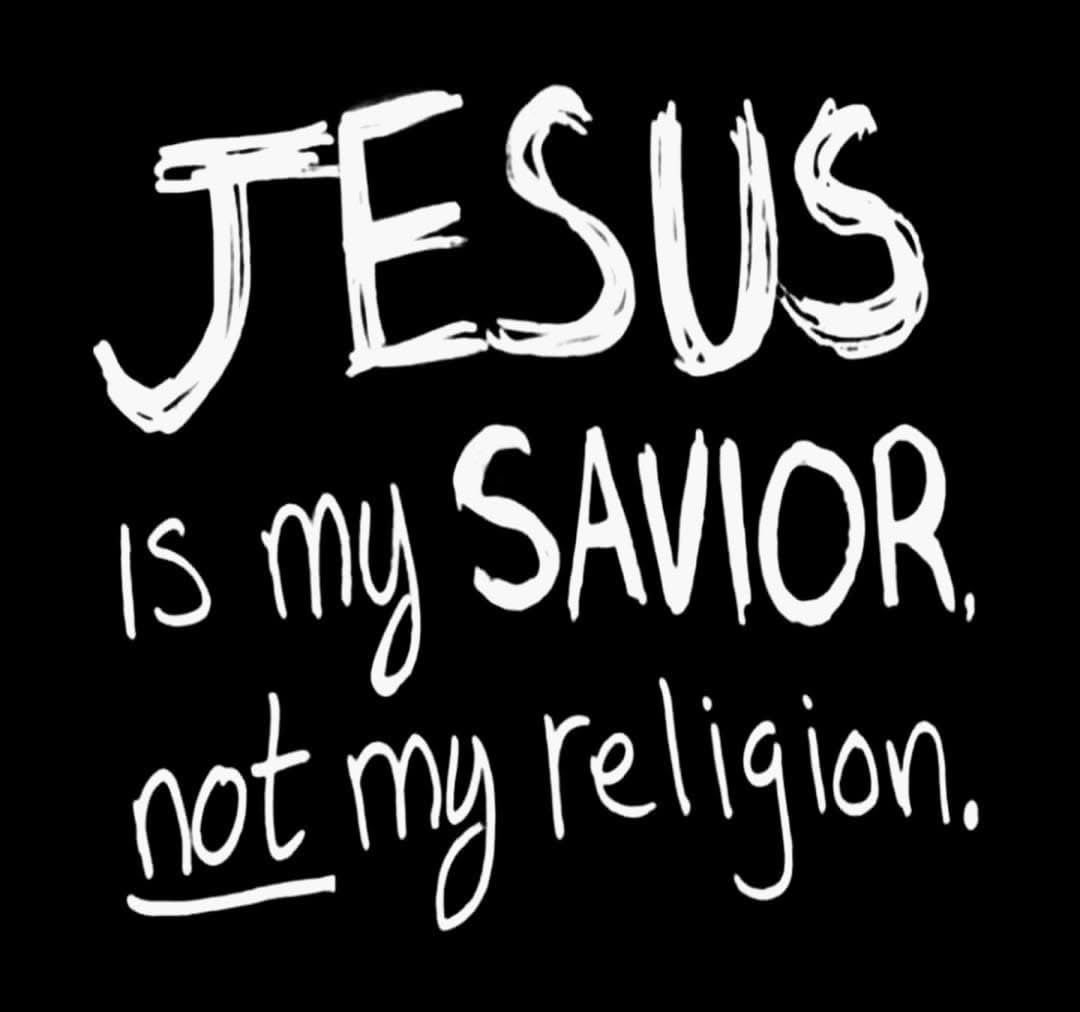
We are not saved because of how good we are, how much we give, how often we pray or how many good things we do.
We are saved by God’s grace through faith in Jesus Christ. It is a gift, not something we can earn.
Our good works don’t save us. They are the fruit of the new life we have received in Christ.
There is no room for boasting. All the glory belongs to God.
If Jesus wasn’t real, the world wouldn’t fight so hard to erase His name from everything.
They can take Him out of schools, government buildings, and public conversations, but they will NEVER erase Him from the hearts of those who believe.
The truth is, they know exactly who He is.
Jesus Christ is King. Yesterday, today, and forever.
The Gospel is offensive because it tells "good" people they're sinners, religious people their works can't save them, and proud people they have absolutely nothing to boast about before God.
And every word of it is true.
The Holy Spirit works powerfully through a life that is fully surrendered to God, where self-will has been laid down and the flesh no longer takes control.
The Miracle Prayer
Lord, Jesus, I come before You, just as I am.
I am sorry for my sins,
I repent of my sins,
please forgive me.
In Your name,
I forgive all others for what they have done against me.
I renounce Satan,
the evil spirits and all their works.
I give You my entire self.
Lord Jesus, now and forever,
I invite You into my life Jesus.
I accept You as my Lord and Saviour.
Heal me, change me,
strengthen me in body, soul, and spirit.
Come Lord Jesus,
cover me with Your precious blood,
and fill me with Your Holy Spirit,
I love You, Jesus.
I praise You, Jesus.
I thank You, Jesus.
I shall follow You every day of my life.
Amen.
El mundo creyó que estaba asistiendo a la ejecución de un hombre. En realidad, estaba presenciando la entronización de un Rey.
Cuando Jesús fue llevado a juicio, sabía que sus enemigos acabarían con su vida.
Y, sin embargo, no huyó de la cruz. Su aparente derrota era el comienzo de una victoria que el mundo todavía no había comprendido.
Hay una paradoja extraordinaria en el cristianismo. Cristo venció precisamente allí donde parecía haber sido derrotado.
No conquistó mediante la fuerza, la violencia o el poder terrenal. Venció entregándose, amando hasta el extremo y perdonando incluso a quienes lo crucificaban.
Sus enemigos pudieron clavar sus manos en la cruz, pero no pudieron vencer aquello que representaba; un amor más fuerte que el odio y una vida más fuerte que la muerte.
La resurrección confirmó lo que la cruz ya había anunciado; el Reino de Cristo no se construye destruyendo a sus enemigos, sino venciendo al pecado y a la muerte.
Y esa es también nuestra llamada como cristianos; no responder al odio con odio, no avergonzarnos de nuestra fe y comprender que la verdadera fortaleza está en vivir y amar como Cristo.
El mundo sigue confundiendo la entrega con la debilidad. La cruz nos recuerda que no siempre vence quien tiene más poder, sino quien permanece fiel a la verdad.
🙏🏻✝️
This was inspired by a beautiful illustration Charles Spurgeon once used about a poor woman who had little more than bread and water before her, yet looked at that small meal with astonished gratitude because she also had Christ.
There is something deeply convicting in that kind of contentment. Most of us have received far more than bread and water, yet we can still find ten things to complain about before thanking God for one. We become so accustomed to mercy that ordinary blessings begin to feel like things God owes us.
Paul wrote, “If we have food and covering, with these we shall be content” (1 Timothy 6:8). He was not praising poverty or pretending hunger and suffering do not hurt. He was showing us that godliness has changed the way a Christian measures wealth. The world counts what is in the hand. Faith begins with Who has taken hold of us.
This is why Paul could say that he had learned contentment in abundance and in need, in hunger and in plenty (Philippians 4:11–13). Philippians 4:13 is often ripped from that context and turned into a promise that we can accomplish whatever we dream. Paul was saying something harder. Christ gave him strength to remain faithful when there was plenty on the table and when there was almost nothing there.
The greatest gift God has given the Christian is not health, money, a comfortable home, a successful ministry, or another easy year. He has given us His Son. “He who did not spare His own Son, but delivered Him over for us all” has already given us the gift against which every other mercy must be measured (Romans 8:32).
That changes gratitude. We can thank God for a full table without worshipping prosperity, and we can still bless His name when the table becomes painfully small. Habakkuk could look at fields without food and stalls without cattle and still say, “Yet I will exult in the LORD, I will rejoice in the God of my salvation” (Habakkuk 3:17–18). His joy had gone deeper than his circumstances.
Perhaps one of the clearest signs that we have understood grace is that we begin to look at ordinary mercies with surprise instead of entitlement. Another meal. Another morning. Another page of Scripture. Another prayer heard by the Father. Another day belonging to Christ.
And then above all of it stands Christ Himself. Forgiven in Him. Accepted in Him. Kept by Him. An inheritance waiting that cannot perish. When that becomes real to the soul, even the smallest earthly mercy begins to look larger.
We have received far more than we deserve, and for the Christian the greatest wonder is still this: after everything else God has placed in our hands, He has given us Christ too.
Deuteronomy 6:5-6
“You shall love the LORD your God with all your heart, with all your soul, and with all your strength. And these words which I command you today shall be in your heart.”
John 4:14 But whosoever drinketh of the water that I shall give him shall never thirst; but the water that I shall give him shall be in him a well of water springing up into everlasting life.
Do not let an entire day pass while feeding your body, checking your phone, listening to everyone else, carrying your worries, and never opening the Word of God long enough for your soul to hear from Him.
Jesus said, “Man shall not live on bread alone, but on every word that proceeds out of the mouth of God” (Matthew 4:4). We understand quickly when the body has gone too long without food. Strangely, we can let the soul starve for days and still wonder why fear, bitterness, temptation, confusion, and discouragement have become so loud.
Scripture was never given merely to increase our information. Paul says that through “the perseverance and the encouragement of the Scriptures we might have hope” (Romans 15:4). God has put truth into words because He knows exactly what weak, frightened, grieving, wandering people need to hear.
And His comfort is not always soft. Sometimes the Word exposes the sin we have been protecting. Sometimes it tears away a lie we desperately wanted to believe. Sometimes it tells us that the road we are walking is wrong. That too is mercy. A Father who loves His children does not comfort them by leaving them undisturbed on a road that will destroy them.
Then there are days when one sentence of Scripture seems to carry the whole weight of us. The psalmist said, “This is my comfort in my affliction, that Your word has revived me” (Psalm 119:50). The affliction had not necessarily disappeared. What changed was that God had spoken into it.
That is why we should come to Scripture expecting more than religious duty. We come because God has revealed Himself there. We come because our thoughts are unreliable, our emotions move, circumstances change, people disappoint us, and suffering can make even familiar truths difficult to remember.
Some days you may read several chapters. Other days grief or exhaustion may leave you able to hold onto only a few verses. Read them slowly. Pray them. Carry them with you. Let the truth stay in your mind longer than the noise around you.
Before the day closes, hear something from God’s Word that reminds you who He is, what Christ has done, what He has promised, what He commands, and where your hope actually rests. The soul was never meant to survive on yesterday’s remembrance of God while today it listens to every other voice.
One reason people treat sin so lightly is that we have lost any serious sense of eternity. We think mainly in terms of what sin does to our health, relationships, reputation, finances, or peace of mind. Scripture goes much deeper than that.
Sin is first of all against God. David understood this when he prayed, “Against You, You only, I have sinned” (Psalm 51:4). Every sin may affect other people, but its deepest evil is that it is rebellion against the One who made us, owns us, sustains us, and has every right to command us.
That is why the consequences of sin cannot be measured only by what happens in this life. “The wages of sin is death” (Romans 6:23). Hebrews says, “It is appointed for men to die once and after this comes judgment” (Hebrews 9:27). Death does not close the account. It brings us before the Judge.
Jesus Himself spoke plainly about this. He warned that we should fear the One who is able to destroy both soul and body in hell (Matthew 10:28). He did not speak that way to frighten people for effect. He spoke that way because eternal judgment is real, and because sin is far more serious than our culture wants to admit.
The frightening thing is how normal sin has become. Pride is called confidence. Lust is called freedom. Greed is called ambition. Bitterness is called self protection. Rebellion against God is treated as personal choice. We rename sin until the conscience becomes quiet, but changing the label does not change the verdict.
And this is exactly why the gospel is such good news. Christ did not come merely to make life easier or help us become better versions of ourselves. He came to save sinners from the wrath we deserved. “Christ also died for sins once for all, the just for the unjust, so that He might bring us to God” (1 Peter 3:18).
The cross only makes sense when we understand what sin deserves. If sin is small, Calvary becomes unnecessary. But if sin brings real guilt before a holy God and eternal judgment, then the death of Christ becomes the only hope big enough for our condition.
We should stop asking only what sin will cost us today. The more serious question is what it means to stand before God with unforgiven sin. Eternity is too long, judgment is too real, and Christ is too precious for us to keep treating sin as though it were a small thing.